
A single shipping failure in the aerospace industry can cost far more than just the price of a replacement part; it can lead to grounded fleets and critical audit non-conformities. You likely recognize that your packaging isn’t just a box, but a technical component that must meet the same rigorous standards as the flight hardware itself. Finding a packaging supplier who understands aerospace quality management systems is essential for maintaining the integrity of your supply chain and ensuring that high-value components arrive in zero-defect condition.
We understand the pressure of managing material traceability while facing tight production deadlines and complex compliance requirements. In this guide, you’ll learn how to evaluate packaging partners based on AS9100D and the upcoming IA9100 standards to protect your bottom line. We’ll examine how custom-engineered foam and transparent QMS documentation can reduce shipping damage, eliminate audit stress, and streamline your operations from the warehouse to the hangar.
Key Takeaways
- Identify the critical differences between ISO 9001 and AS9100 standards to ensure your packaging partner maintains the same level of traceability as your own production line.
- Selecting a packaging supplier who understands aerospace quality management systems is the most effective way to eliminate audit failures and reduce damage to high-value flight hardware.
- Learn how to specify custom foam inserts, including PE, PU, and anti-static ESD options, to provide engineered protection for sensitive avionics and precision-machined parts.
- Evaluate how Vendor Managed Inventory (VMI) programs and local Southern California delivery can reduce lead times and improve overall supply chain reliability.
- Discover the cost benefits of consolidating your heavy-duty corrugated boxes, custom crates, and protective cushioning through a single QMS-compliant industrial supplier.
Why Aerospace QMS Matters in Packaging Procurement
In the aerospace sector, quality management isn’t a suggestion; it’s a mandate. An aerospace QMS in a packaging context ensures that every material, from heavy-duty corrugated boxes to precision-cut foam, meets strict safety and reliability requirements. Working with a packaging supplier who understands aerospace quality management systems means your provider views packaging as a technical extension of the flight hardware itself. They don’t just supply containers; they provide a documented system of protection that mitigates risk throughout the global supply chain.
Foreign Object Debris (FOD) and contamination are constant threats to aerospace components. A supplier with a robust QMS maintains controlled environments and strict material handling protocols. This prevents loose staples, dust, or chemical residues from compromising sensitive parts before they ever reach the assembly line. When your supplier adheres to these standards, they eliminate the variables that lead to part rejection or catastrophic failure during transit.
The True Cost of Quality (CoQ) in Shipping
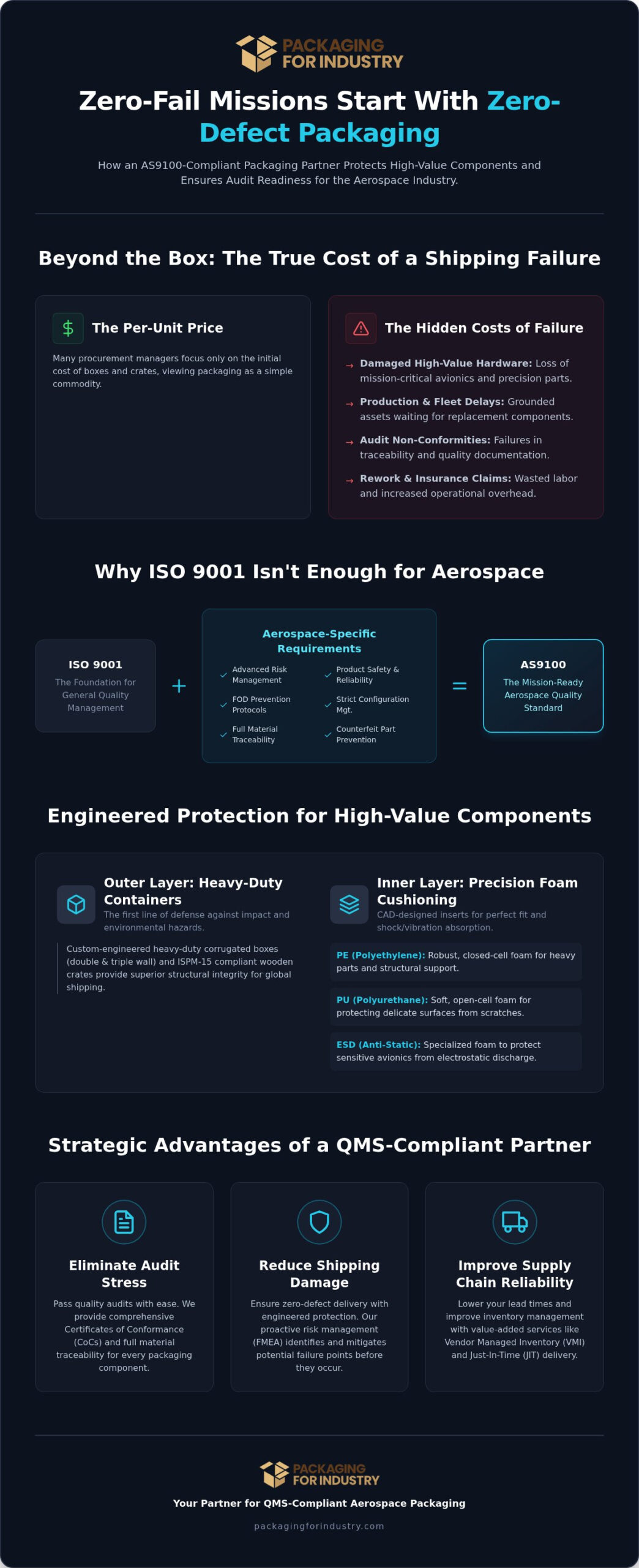
Many procurement managers focus on the per-unit cost of a crate or pallet. This is a narrow view of fiscal responsibility. The true Cost of Quality includes the financial fallout of damaged hardware, insurance deductibles, and the labor required for re-work. If a high-value avionics unit is damaged due to inadequate protective foam packaging, the initial savings from a cheaper supplier vanish. You can lower total packaging costs by investing in engineered solutions that ensure zero-defect delivery. This proactive approach reduces insurance claims and protects your standing with prime contractors.
Audit Readiness and Supplier Documentation
Traceability is the backbone of aerospace manufacturing. Every component in your warehouse must have a clear, verifiable chain of custody. A compliant supplier provides comprehensive Certificates of Conformance (CoCs) for all materials used in your project. This alignment with the AS9100 standard simplifies both internal and external quality audits. Instead of scrambling for missing documentation, you have transparent access to material certs and quality logs. Partnering with a specialized aerospace packaging provider ensures your documentation is always audit-ready. This prevents the administrative bottlenecks that often delay production schedules and lead to costly compliance failures.
AS9100 vs. ISO 9001: Choosing the Right Standard
ISO 9001 provides a solid general framework for quality, but it doesn’t account for the unique safety and regulatory demands of flight hardware. AS9100D builds upon that foundation by adding specific requirements for configuration management, product safety, and risk assessment. When you partner with a packaging supplier who understands aerospace quality management systems, you’re working with a team that treats every custom design packaging project with the same scrutiny as a machined engine component. This alignment ensures that your packaging meets the same rigorous standards as the parts it protects.
Aerospace manufacturers require these specific standards because the risk of a non-conforming part extends far beyond a simple refund. A failure in packaging can compromise the structural integrity of a component, leading to safety risks or mission failure. By following these protocols, a supplier ensures that every material used is verified and every process is repeatable. This level of oversight is necessary to maintain the integrity of the global aerospace supply chain, especially as the industry prepares for the transition to the IA9100 standard in 2026.
Risk Management in Packaging Design
Risk management in packaging starts with identifying potential failure points long before the first crate is built. We evaluate variables like G-force impact, vibration resonance, and environmental exposure during the design phase. For sensitive avionics, we utilize CAD/CAM support to ensure precision tolerances that match the exact geometry of your hardware. In this context, Failure Mode and Effects Analysis (FMEA) is a systematic method used to identify how packaging might fail during transport and determine the impact of those failures on the internal component. This proactive approach prevents damage before it happens, allowing you to request a packaging quote with confidence in the engineering behind it.
The Role of First Article Inspection (FAI)
In the aerospace world, a “close enough” fit is a liability. Every custom foam insert or heavy-duty crate requires a validated prototype to confirm it meets the engineering specifications. This process is known as First Article Inspection (FAI). It ensures that the production process can consistently produce parts that meet all requirements. At PFI, our free prototyping service directly supports your internal FAI needs. We provide a physical sample for your team to test and approve before we move into high-volume production. This step is crucial for ensuring consistency across high-volume production runs. Whether you need custom PE foam for vibration dampening or ESD-safe inserts for electronics, the FAI process guarantees that the final product mirrors the approved design exactly.
Engineering Protection for High-Value Aerospace Components
Protecting flight hardware requires more than just a sturdy container. It requires a deep understanding of material dynamics and environmental stressors. A packaging supplier who understands aerospace quality management systems selects materials based on the specific fragility and weight of the component. For example, Polyethylene (PE) foam provides the rigid, closed-cell support needed for heavy machined parts. In contrast, Polyurethane (PU) offers the soft, open-cell cushioning necessary for delicate sensors and vibration-sensitive avionics. When these materials are integrated with heavy-duty corrugated boxes, you create a comprehensive system capable of withstanding the rigors of global logistics.
Electronic components demand an additional layer of safety. We utilize ESD (Electrostatic Discharge) and anti-static packaging to prevent invisible damage to sensitive circuitry. For oversized or extremely heavy hardware, triple-wall corrugated provides a lightweight yet incredibly strong alternative to traditional wood. However, when the mission requires international transit, we design specialized crates that comply with ISPM-15 heat-treatment standards. This ensures your shipment clears customs without delays or quarantine issues. By focusing on these technical details, we help you reduce shipping damage and maintain the high standards required by your QMS.
Precision Custom Foam Inserts
Engineering custom foam packaging for irregular aerospace parts is a matter of precision. While die-cutting is efficient for high-volume runs, CNC routing offers the tight tolerances required for complex flight gear. This process allows us to create multi-layered inserts that cradle parts with zero movement. We often integrate these custom inserts into double-wall or triple-wall corrugated boxes to provide a complete, lightweight protection system. This approach not only secures the part but also optimizes the package footprint to lower your freight costs.
Specialized Crating and Wood Packaging
Oversized components like landing gear or engine housings require custom shipping crates designed for maximum shock absorption. These crates are often foam-lined to isolate the hardware from the vibrations of air and sea freight. We prioritize durability for multi-leg international shipping routes, ensuring the crate can be opened for inspection and resealed without compromising structural integrity. Whether you are shipping across Southern California or across the globe, our engineered wood solutions provide the heavy-duty protection your high-value assets deserve.
VMI and Stocking: Maintaining Quality at Scale
Supply chain reliability is the backbone of aerospace manufacturing. When production lines ramp up, the risk of human error in packaging procurement increases. A Vendor Managed Inventory (VMI) program solves this by shifting the burden of replenishment to the supplier. This prevents production stops caused by missing boxes or foam inserts. A packaging supplier who understands aerospace quality management systems ensures that even during rapid replenishment cycles, every batch of materials is accompanied by the necessary certifications. This keeps your inventory lean while maintaining total compliance. We track your usage rates and adjust stocking levels automatically, which eliminates the stress of manual ordering.
Just-In-Time Packaging for Aerospace Hubs
Aerospace facilities in Southern California clusters like Orange County and Los Angeles often face extreme space constraints. Storing bulk quantities of custom crates or heavy-duty corrugated boxes on-site is inefficient. We support these hubs with just-in-time delivery, often providing next-day service from our Anaheim-based operations. By managing long lead-time items through our dedicated stocking programs, we help you improve cash flow and reduce on-hand inventory. You only pay for what you use, when you need it. This model allows you to repurpose warehouse space for production equipment rather than stacks of unused pallets and boxes.
Kitting and Assembly Services
High-volume production lines can be slowed down by the manual assembly of complex packaging. Our packaging kitting services streamline this process by delivering pre-assembled components directly to your station. Your team spends less time folding boxes or inserting foam and more time on high-value assembly tasks. This reduces labor costs and ensures that every kit meets the same QMS-controlled quality standards established during the design phase. Working with a packaging supplier who understands aerospace quality management systems means these kits arrive with pre-verified traceability, simplifying your internal hand-offs. It’s a pragmatic way to scale your operations without adding administrative or operational overhead.
Partnering with PFI for Aerospace Packaging Excellence
PFI acts as a critical extension of your manufacturing floor. We recognize that aerospace logistics involve high stakes and zero room for error. Selecting a packaging supplier who understands aerospace quality management systems ensures your hardware remains protected from the design phase through final delivery. As a high-capacity bulk packaging supplier, we don’t offer generic templates; we provide engineered solutions that align with your specific internal quality protocols. If you’ve been searching for a reliable industrial packaging supplier near me, our team treats every project with a “fixer” mindset, focusing on tangible outcomes like reduced damage rates and simplified audit compliance.
Our approach focuses on the intersection of engineering and economics. By optimizing material selection and package dimensions, we help you reduce shipping damage while maintaining fiscal responsibility. We understand that over-packaging is a waste of capital, while under-packaging is a risk to your reputation. Whether you’re shipping precision avionics or oversized airframe components, we have the resources to scale production without compromising on the documentation or traceability required for your audits. We combine this technical rigor with a direct, solution-oriented communication style that keeps your projects on schedule and within budget.
Our Southern California Service Advantage
Being an Anaheim packaging supplier allows us to offer unmatched support to the aerospace hubs throughout Southern California. We provide local delivery to Orange County, Los Angeles, San Diego, and the Inland Empire, often with next-day availability for stocked items. If you need custom boxes in Orange County or specialized foam inserts in Riverside, our team can perform on-site packaging reviews to identify cost savings and operational bottlenecks. These face-to-face consultations allow us to respond quickly to urgent custom requirements or design changes, ensuring your production line never stalls due to a packaging shortage. While we have nationwide shipping capabilities, our local presence makes us a steady partner for regional manufacturers who value proximity and fast response times.
Get Started with a Custom Packaging Quote
We’ve simplified the procurement process to respect your time and operational needs. To begin, you can submit your technical specifications or part drawings for a comprehensive technical review. Our engineering team will evaluate your requirements and provide a free prototype to ensure a perfect fit before high-volume production begins. This allows you to compare packaging pricing and quality without upfront risk. If you’re ready to improve your supply chain reliability and protect your high-value flight hardware, it’s time to partner with a packaging supplier who understands aerospace quality management systems.
Let’s work together to secure your components and streamline your audit process for long-term success.
Frequently Asked Questions
Does PFI provide material certifications and Certificates of Conformance (CoC)?
Yes, we provide full Certificates of Conformance (CoC) and material certifications for every aerospace project. We recognize that your quality management system requires a verifiable chain of custody for all packaging components. Our documentation supports your internal and external audits by confirming that all materials meet the exact technical specifications required for flight hardware protection.
Can you design custom foam inserts for highly sensitive avionics?
We specialize in engineering custom foam inserts specifically for sensitive avionics and electronic components. Our team evaluates the fragility of your hardware to select between Polyethylene (PE) for rigid support or Polyurethane (PU) for superior vibration dampening. By utilizing CNC routing and precision die-cutting, we ensure a zero-movement fit that protects against G-force impacts during transit.
What is the typical lead time for custom aerospace crates in Southern California?
Lead times for custom aerospace crates vary based on design complexity, but our Anaheim location allows for rapid response times throughout Southern California. We often provide next-day delivery for recurring orders through our stocking programs. For new custom designs, our free prototyping service accelerates the approval process, helping you move from engineering to final production without unnecessary delays.
Do you support First Article Inspection (FAI) for new packaging designs?
Yes, we fully support the First Article Inspection (FAI) process by providing physical prototypes for your team to validate. This step is critical for a packaging supplier who understands aerospace quality management systems, as it ensures the production process consistently meets your engineering tolerances. We don’t move to high-volume manufacturing until you’ve tested and approved the initial physical sample.
Are your wood crates compliant with ISPM-15 for international export?
Every wood crate we manufacture for international shipping is fully compliant with ISPM-15 heat-treatment standards. This ensures your high-value aerospace components clear customs without being quarantined or delayed. We provide the necessary stamps and documentation to prove compliance, which is essential for maintaining the integrity of your global supply chain and avoiding costly logistical bottlenecks.
How does your VMI program help aerospace manufacturers reduce costs?
Our Vendor Managed Inventory (VMI) program reduces costs by eliminating the need for you to store bulk packaging inventory on-site. We monitor your usage and replenish stock automatically, which improves your cash flow and frees up valuable warehouse space for production. This proactive approach prevents production stops and ensures you always have the right crates and inserts ready for ship-out.
Do you offer ESD-safe packaging for electronic components?
We provide a comprehensive range of ESD-safe packaging solutions, including anti-static foam inserts and specialized corrugated materials. These solutions are essential for protecting sensitive electronic components from electrostatic discharge during handling and shipping. We work with you to select the correct dissipative or conductive materials required to meet your specific ESD control plan and safety standards.
Can PFI help reduce shipping damage for heavy flight hardware?
We reduce shipping damage for heavy flight hardware by using engineered materials like triple-wall corrugated and custom-lined wood crates. Our designs account for the center of gravity and weight distribution of heavy components to prevent shifting during transit. By combining high-density PE foam with reinforced containers, we ensure that even the most massive aerospace parts arrive in zero-defect condition.