
With California’s minimum wage reaching $16.90 per hour in 2026 and scheduled to climb to $17.40 in 2027, every extra second your team spends folding a box or taping a crate is a direct hit to your bottom line. You’ve likely seen the bottlenecks at the end of the line or felt the sting of high turnover in manual packing roles. We know that reducing packaging labor costs on a production line isn’t just about pushing staff to work faster. It’s about engineering the friction out of the process so your team can move more product with less effort.
You’ll discover how to slash man-hours and boost throughput by optimizing your materials for speed and implementing smarter inventory workflows. We’ll show you how “drop-in” custom foam solutions and simplified assembly techniques can lower your cost per unit shipped without requiring more headcount. This guide outlines a more efficient way to manage your warehouse floor in Southern California through engineered precision and proactive logistical flow.
Key Takeaways
- Learn to identify “hidden” labor leaks by calculating the fully burdened cost of your packing stations rather than focusing solely on hourly rates.
- Discover how custom-engineered materials, such as integrated foam inserts and custom corrugated boxes, are essential for reducing packaging labor costs on a production line.
- See how packaging kitting and Vendor Managed Inventory (VMI) streamline throughput by delivering pre-assembled sets directly to your assembly team.
- Gain actionable strategies for organizing packing stations to minimize physical movement and standardize worker decision-making for faster assembly.
- Understand the long-term value of a professional packaging review to find and fix specific operational bottlenecks in your Southern California facility.
Analyzing the True Cost of Packaging Labor
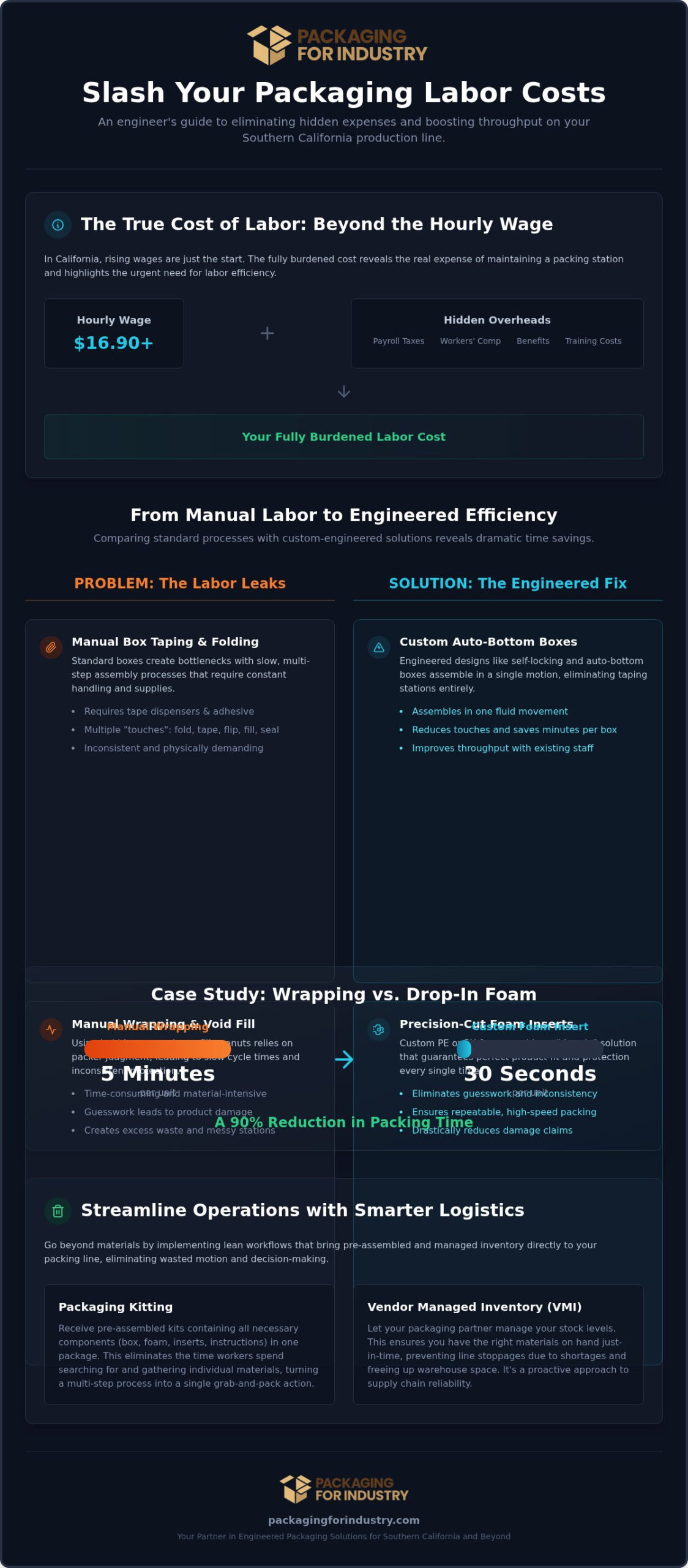
Many operations managers look at the hourly wage and assume they understand their labor spend. In California, where the minimum wage is $16.90 per hour as of August 2026, that’s only the starting point. To find the real number, you have to calculate the fully burdened cost, which includes payroll taxes, workers’ compensation insurance, and benefits. When you look at the total expense of maintaining a packing station, it becomes clear that reducing packaging labor costs on a production line is the fastest way to protect your margins.
The most expensive part of your packaging isn’t the material; it’s the “hidden” labor required to use it. If your team spends several minutes searching for the right foam insert, folding complex boxes, or wrestling with a manual tape dispenser, you’re paying for wasted motion. High turnover in these manual roles makes the problem worse. Every time a seasoned packer leaves, you lose speed and gain a training bill. New hires work slower and make more errors, which directly impacts your ability to hit shipping deadlines and maintain quality standards.
Measuring Touches and Transit Time
A “touch audit” is a pragmatic tool for identifying waste. You simply count every time a worker handles a product before it’s ready for the pallet. If a product is picked, set down, wrapped, picked up again, and then boxed, you have too many touches. Time spent on material prep, such as pre-folding corrugated boxes or hand-cutting cushioning, is another red flag. These are manufacturing tasks that shouldn’t be happening at the shipping dock. Additionally, warehouse travel time is a silent killer of productivity. If a worker has to walk across the floor for a fresh roll of stretch film or a new pallet, they aren’t adding value. Implementing a Lean Packaging Workflow focuses on bringing the materials to the worker in a way that minimizes every unnecessary step.
The Ripple Effect of Slow Packaging
When packaging becomes a bottleneck, the costs ripple through your entire facility. Slow packing lines often lead to expensive overtime during peak production cycles because the team can’t keep up with the output of the assembly line. This means you’re paying 1.5 times the labor rate for the least efficient part of your process. Rushed packing also leads to shipping errors and increased damage claims, which are far more costly than the packaging itself. By focusing on labor efficiency, you can achieve significant packaging cost savings while improving the overall reliability of your supply chain. It’s about engineering the process so your current headcount can handle higher volumes without the stress of a constant backlog.
Engineering Custom Materials for Faster Assembly
Pragmatic engineering is the most effective tool for reducing packaging labor costs on a production line. While many facilities focus strictly on material prices, the real savings are found in how quickly a worker can move a product from the assembly line into a finished box. Standard containers often require multiple steps, such as taping the bottom, adding loose-fill, and sealing the top, that consume valuable minutes. By switching to custom corrugated boxes, you can implement self-locking designs and auto-bottom structures that assemble in a single motion. These integrated solutions remove the need for industrial adhesive tapes and secondary assembly stations.
This engineering-first approach aligns with the goals of the NIST Manufacturing Extension Partnership, which focuses on enhancing industrial productivity through technical and process improvements. When your materials are designed for speed, you don’t just save on the cost of tape; you regain the lost capacity of your workforce. It’s about making the packaging process so simple that it no longer dictates the speed of your entire operation.
Custom Foam Inserts vs. Manual Wrapping
Manual wrapping with bubble wrap or loose-fill peanuts is a significant labor leak. It requires a level of “skilled” judgment from the packer to ensure enough protection is used, which leads to inconsistent results and slow cycle times. Precision-cut foam packaging replaces this guesswork with a “drop-in” solution. Using die-cut polyethylene (PE) or polyurethane (PU) foam inserts ensures that every product fits perfectly every time. We have seen operations reduce a five-minute manual wrapping process down to a 30-second box insert simply by switching to a custom foam profile. This speed allows you to maintain high throughput without adding headcount, even during seasonal spikes.
Optimizing Box Design for the Line
High-volume production lines benefit significantly from auto-bottom box designs. These containers pop into shape with a single motion, removing the need for a dedicated box-forming station. Additionally, using heavy-duty double-wall or triple-wall corrugated materials can eliminate the need for secondary outer layers or corner protection, further reducing the number of components a worker must handle. Designing for “kitting” is another powerful strategy. By engineering a single box to house all product components in dedicated compartments, you remove the “searching for parts” phase of the packing process. If you are ready to see how engineered materials can streamline your floor, you can request a packaging quote for a custom design review.
Streamlining Operations with Kitting and VMI
Labor expenses don’t stop at the packing station; they extend into your procurement and receiving departments. Managing a complex inventory of boxes, foam, tape, and labels requires significant administrative time that often goes uncalculated. A strategic approach to reducing packaging labor costs on a production line involves offloading these logistical burdens to a specialized partner. By utilizing Vendor Managed Inventory (VMI) and kitting services, you can transform your packaging from a series of disjointed tasks into a unified, high-speed workflow.
The VMI Labor Advantage
Traditional inventory management relies on manual stock counts and the constant monitoring of lead times. This process is prone to human error and often results in emergency re-orders that disrupt your production schedule. VMI removes these friction points by putting the responsibility for stock levels on the supplier. Your staff no longer needs to spend hours each week counting pallets or verifying shipments. Instead, materials arrive exactly when needed, reducing the labor required for receiving and inspecting bulk loads. This shift allows your procurement team to move away from mundane “box counting” and focus on high-level supply chain strategy. An OECD report on the MEP programme highlights that such process optimizations are critical for maintaining industrial competitiveness in high-cost environments like Southern California.
Kitting as a Production Accelerator
For manufacturers in the aerospace or medical sectors, packaging often involves multiple components like custom foam, anti-static bags, and heavy-duty corrugated outers. Packaging kitting simplifies this by delivering a pre-assembled set under a single SKU. Instead of a worker spending time “shopping” for five different components across the warehouse, they receive a unified kit ready for immediate use. This “one SKU” benefit drastically reduces the “searching for parts” phase that often causes bottlenecks at the end of the line. Providing a visual, structured packing kit also reduces assembly errors. When every piece has a designated spot in the kit, it’s immediately obvious if a component is missing. This ensures quality control without adding extra inspection steps. This just-in-time delivery model also clears valuable floor space, allowing your team to move more freely and safely throughout the facility.
Implementing a Lean Packaging Workflow
Reducing packaging labor costs on a production line requires a disciplined look at the physical workspace. While previous sections focused on material engineering and logistical kitting, the final gains are often found in the ergonomic organization of the packing station. When a worker has to reach above their shoulder or walk across the floor for a fresh roll of tape, you’re paying for movement that adds zero value to the finished product. A lean workflow ensures that every tool and material is positioned for minimal movement and maximum speed.
Decision fatigue is another silent killer of productivity. If your warehouse staff has to choose between twenty different box sizes for every order, they’ll inevitably hesitate or choose incorrectly. By standardizing your box sizes to a few versatile options, you reduce the decision-making burden on your workers. We also recommend implementing visual cues, such as shadow boards for tape guns and cutters, and clear work instructions. This level of organization ensures that output remains consistent regardless of staff turnover or seasonal labor spikes in your Anaheim or Riverside facility.
Step-by-Step Production Line Audit
To identify where your labor is being wasted, we recommend a formal audit of your current station layout. This process moves beyond a simple “touch audit” and looks at the entire environment:
- Step 1: Map the current packing process from the moment a product leaves production until it’s palletized.
- Step 2: Identify every non-value-added movement, including walking to retrieve pallets, reaching for cushioning, or manual taping.
- Step 3: Test custom prototypes on the floor to measure actual time savings before committing to a full-scale rollout.
Tooling and Station Optimization
Investment in semi-automation is often the most pragmatic way to scale without adding headcount. For high-volume operations, switching from hand-wrapping to machine stretch film dispensers can save hours of manual labor per shift. These machines provide consistent tension and stability that manual wrapping simply can’t match. Additionally, using corner and edge protection allows workers to stabilize pallets faster with fewer layers of film. Our CAD/CAM prototyping services allow you to test these line-ready packaging designs in a virtual environment before they hit your production floor. This ensures that the final solution integrates perfectly with your existing equipment and staff capabilities.
Partnering with a Southern California Packaging Expert
If you are searching for an industrial packaging supplier near me, local accountability is a critical factor in reducing packaging labor costs on a production line. Packaging For Industry (PFI) operates as a dedicated Anaheim packaging supplier, offering on-site consultations to identify the specific labor leaks that generic vendors often overlook. As a bulk packaging supplier of wholesale packaging supplies, we don’t just provide materials; we engineer solutions that prioritize speed and fiscal responsibility for manufacturers across Orange County, Los Angeles, and the Inland Empire.
Why Choose PFI
We serve as a proactive partner for your logistical challenges, combining engineering expertise with economic precision. Our team specializes in the aerospace and medical sectors, where reliability and damage prevention are paramount. By integrating custom design, kitting, and VMI into a single strategy, we help you achieve higher throughput without increasing your headcount. Our local presence ensures next-day delivery and rapid prototyping, giving you the peace of mind that your supply chain remains stable and efficient.
From Prototype to Production
Our engineering team works with your operations leads to optimize the line before mass production begins. We utilize custom CAD/CAM support to ensure every “drop-in” foam insert fits perfectly, reducing the risk of shipping damage while lowering labor requirements. This process allows you to test line-ready designs on your actual production floor. By refining the packaging at the prototype stage, we ensure the final solution integrates seamlessly with your existing staff and equipment capabilities.
Next Steps for Operations Managers
Addressing labor waste starts with a professional review of your current packing stations. You can request a custom packaging quote to begin a labor-saving audit of your facility. To prepare for a successful VMI implementation, we recommend gathering your monthly usage data for your highest-volume SKUs. This information allows us to build a custom plan that guarantees reliable supply and cleaner inventory control, letting your team focus on production rather than managing box counts.
Optimize Your Production Line for Long-Term Efficiency
Realizing sustainable gains in your facility requires moving beyond simple material costs to address the physical labor of assembly. By integrating custom-engineered corrugated boxes, precision foam inserts, and VMI programs, you can effectively reach your goal of reducing packaging labor costs on a production line. These strategies eliminate unnecessary touches and decision fatigue, allowing your current team to handle higher volumes with greater accuracy. It’s about engineering the friction out of your process so that throughput is no longer limited by manual packing speeds.
As a local Southern California partner, PFI brings specialized expertise in aerospace and industrial manufacturing to every project. We offer free prototyping for custom designs to ensure your new workflow is line-ready before you commit to production. Our local next-day delivery ensures your warehouse remains lean and responsive to changing demands. We are ready to help you eliminate operational stress and secure your bottom line through smarter packaging engineering.
Take the first step toward a more profitable and reliable production environment by choosing a partner focused on your total operational success.
Frequently Asked Questions
What is the fastest way to reduce packaging labor without buying expensive machines?
The fastest method is replacing standard RSC containers with auto-bottom or self-locking designs that assemble in a single motion. These “drop-in” materials are essential for reducing packaging labor costs on a production line because they remove the need for manual taping and complex folding. By simplifying the physical task, your team can maintain higher throughput without the need for additional headcount or expensive automation.
How do custom boxes save money on labor costs?
Custom boxes save money by reducing “touches,” which is the number of times a worker handles a product before shipping. Standard boxes often require multiple steps like taping the bottom, adding loose-fill, and sealing the top. A custom-engineered design can integrate these features, allowing for one-motion assembly. This efficiency directly lowers your cost per unit by cutting the time spent at the packing station.
Can kitting really improve my production line speed?
Kitting improves speed by delivering all necessary packaging components as a single, unified set. Instead of a worker spending time walking across the warehouse to find foam, boxes, and tape, they receive everything they need in one SKU. This eliminates the “searching for parts” phase that often causes bottlenecks. It ensures that the assembly team stays focused on packing rather than gathering materials.
Does VMI save labor for my warehouse team or just the purchasing department?
VMI saves labor for both by offloading the management of stock levels and delivery timing to the supplier. Your warehouse team no longer needs to perform manual stock counts or manage fragmented receiving tasks. Simultaneously, your purchasing department is freed from the burden of tracking lead times and placing emergency re-orders. This unified approach allows your entire staff to focus on production strategy rather than packaging logistics.
What industries benefit most from labor-reducing packaging design?
Aerospace, medical, and electronics sectors benefit the most because their products often require complex, multi-component protection. These industries typically rely on skilled labor that is too valuable to spend on manual wrapping or taping. By using precision-cut foam and custom corrugated outers, these manufacturers can significantly increase their shipping speed. Any high-volume operation facing rising California labor rates will see a pragmatic return on investment from these designs.
Is custom foam packaging more expensive than manual wrapping in the long run?
Custom foam is significantly more cost-effective when you calculate the fully burdened labor rate of your packing stations. Manual wrapping with bubble wrap or loose-fill is slow and leads to inconsistent protection. A custom foam insert ensures a perfect fit every time and can reduce a five-minute packing process to thirty seconds. The savings in man-hours and reduced shipping damage far outweigh the material costs.
How do I know if my production line is ready for a packaging audit?
Your line is ready for an audit if you are experiencing bottlenecks at the shipping dock or high overtime costs during peak cycles. Other indicators include frequent shipping damage or a high volume of packaging waste on the floor. If your current headcount is struggling to keep up with production output, it’s a sign that your packaging process is inefficient. A professional audit can identify specific “labor leaks” that custom engineering can resolve.
What Southern California cities does Packaging For Industry serve with local delivery?
We provide local next-day delivery to Anaheim, Los Angeles, San Diego, Riverside, and the Inland Empire. For manufacturers searching for an industrial packaging supplier near me with local engineering support, PFI is the pragmatic choice. You can request a custom packaging quote to evaluate our local delivery speeds and see how our proximity reduces your administrative and logistical labor overhead.