
Is your shipping department treating high-value aerospace components or precision rods like common retail posters? Relying on standard, thin-walled packaging for industrial assets often leads to crushed ends, bent contents, and the logistical headache of transit damage claims. It’s a frustrating reality for many procurement managers in Southern California who find that off-the-shelf options from national catalog suppliers don’t offer the structural integrity required for heavy-duty manufacturing applications.
We understand that protective packaging is a critical component of your operational efficiency. This guide will teach you exactly how to specify and source custom mailing tubes engineered for maximum durability, from selecting the ideal wall thickness to optimizing the inside diameter for your specific parts. We will preview the benefits of local sourcing in Los Angeles and Orange County, showing you how tailored dimensions can eliminate wasted space, lower your freight costs, and provide the peace of mind that comes with superior industrial protection.
Key Takeaways
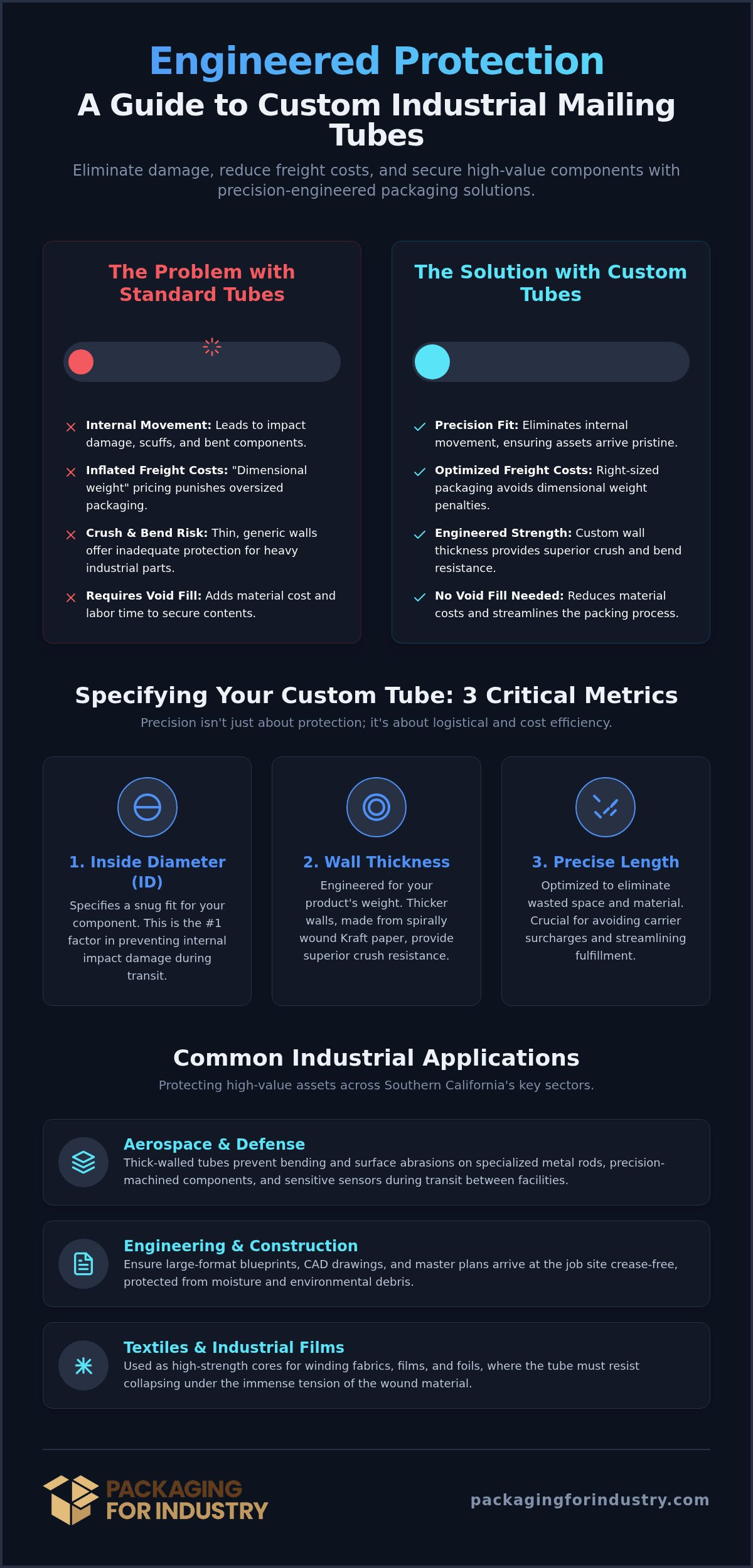
- Learn how to specify the exact inside diameter and wall thickness for custom mailing tubes to eliminate internal movement and prevent crush damage during transit.
- Discover how right-sizing your packaging avoids the “dimensional weight” trap that leads to inflated freight costs when using oversized stock options.
- Identify the specialized protective requirements for high-value industrial assets, including aerospace components, precision rods, and engineering blueprints.
- Understand the operational advantages of partnering with a local Southern California supplier for free prototyping and next-day delivery to Los Angeles and Orange County.
What Are Custom Mailing Tubes and Why Does Industry Need Them?
A shipping tube is a specialized packaging solution constructed from spirally wound layers of high-strength Kraft paper. While many associate these products with retail poster shipments, industrial applications are far more demanding. In sectors like manufacturing and aerospace, these tubes serve as engineered protective vessels for precision-machined rods, sensitive sensors, and critical schematics. Unlike standard off-the-shelf options, custom mailing tubes allow businesses to specify dimensions that match their products exactly, ensuring that high-value assets remain stationary and secure during the entire logistical journey.
The primary reason industry requires custom solutions over stock sizes is the elimination of internal movement. When a heavy metal rod or a delicate aerospace component is placed in a tube that’s even slightly too large, it shifts during transit. This movement creates internal impact, which can damage the product’s finish or force the end caps to fail. By utilizing a custom-tailored ID (inside diameter), procurement managers can secure their items without relying on expensive and time-consuming void fill materials. For companies operating out of Orange County or the Inland Empire, switching to custom-engineered tubes often results in a measurable decrease in shipping damage claims.
The Anatomy of an Industrial Shipping Tube
Industrial tubes are built for structural integrity rather than just aesthetics. The manufacturing process involves winding multiple layers of paper around a mandrel, using high-performance adhesives to create a rigid, crush-resistant wall. The specific recipe of paper grades and adhesive determines the tube’s final strength. Closures are equally important; options include standard plastic end caps for lightweight items, heavy-duty metal ends for high-density parts, and crimped “snap-loc” ends for high-volume, cost-sensitive runs. Choosing custom mailing tubes means you aren’t just choosing a length; you’re engineering the wall thickness and closure type to meet your specific durability requirements.
Common Industrial Use Cases
Reliable protection is non-negotiable across several key sectors in Southern California. The following industries frequently utilize custom-sized tubes and cores to maintain supply chain reliability:
- Engineering and Construction: Large-format blueprints and master plans must arrive at the job site crease-free and protected from moisture or environmental debris.
- Aerospace and Defense: Specialized metal rods and precision-machined components require thick-walled tubes to prevent bending or surface abrasions during transit between facilities.
- Textiles and Industrial Films: Manufacturers use these tubes as high-strength cores for winding fabrics, films, and foils, where the tube must resist collapsing under the tension of the wound material.
Specifying Custom Industrial Tubes: Diameters, Wall Thickness, and Lengths
Specifying the correct dimensions for custom mailing tubes is an engineering task that directly impacts your bottom line. While retail buyers might settle for “close enough,” industrial procurement requires exactness to ensure that high-value components don’t shift during high-vibration transit. Adhering to USPS mailing tube standards for strength and closure is a baseline, but industrial applications often require exceeding these specs to handle heavy loads or automated sorting systems. Precision isn’t just about protection; it’s about logistical efficiency.
The Inside Diameter (ID) should provide a snug fit to eliminate “slack,” which is the primary cause of internal impact damage. If the ID is too large, the product acts like a slide hammer against the end caps. Likewise, the overall length must be optimized. Even an extra two inches of tube can trigger significant surcharges from carriers like UPS or FedEx due to dimensional weight pricing. Precision tolerances are especially critical if you use automated fulfillment lines, where a variation of just 1/16th of an inch can cause equipment jams or labeling errors.
Understanding Wall Thickness for Heavy Loads
When ordering custom mailing tubes for heavy-duty applications, the wall thickness becomes the most critical engineering variable. Wall thickness is the distance between the inside and outside diameters and serves as the primary indicator of a tube’s crush test rating and stacking strength. For lightweight documents, a .060 wall may suffice, but industrial parts like steel rods or aerospace sensors often require heavy-duty .125 or .250 wall specs. To calculate the required thickness, consider the total weight of the item and whether the tubes will be palletized and stacked. If you’re unsure about the right specs, you can request a custom packaging quote to have an expert evaluate your specific load requirements.
Closure Options and Security
Closures are the final line of defense for your product. Plastic end caps are the most common choice for items that require easy access or reuse, as they friction-fit into the tube ends. For long-haul freight or high-density metal parts, metal end stops offer superior security and prevent the heavy contents from “punching through” the cap during sudden stops. Crimped or “snap-loc” ends provide a tamper-evident, cost-effective solution for document shipping where secondary fasteners aren’t desired. Each closure type affects the usable internal length, so always account for the cap depth when specifying your final tube dimensions.
Stock vs. Custom Mailing Tubes: Evaluating Cost and Protection
Procurement managers often prioritize the low per-unit price of stock supplies, but this approach frequently masks the true cost of industrial shipping. While stock tubes are readily available from national catalog suppliers, they rarely offer the precise fit required for specialized manufacturing components. The gap between “close enough” and a perfect fit is where shipping damage and inflated freight costs reside. Choosing custom mailing tubes is an investment in logistical efficiency that addresses the total cost of ownership rather than just the initial purchase price.
The “Dimensional Weight” trap is a primary driver of hidden costs in warehouse operations. Carriers like UPS and FedEx calculate shipping rates based on the volume of the package. If you use a stock tube that’s three inches longer or one inch wider than your product requires, you’re paying to ship air. Over hundreds of shipments, these surcharges far exceed the marginal cost of a custom run. Furthermore, relying on extra void fill to stabilize a part in an oversized stock tube is a high-risk strategy. In industrial applications, bubble wrap or paper often compresses under the weight of metal rods or precision parts, leading to internal impact damage that a custom-sized tube would have prevented.
Stock tubes do have a place in general warehouse needs, such as storing internal documents or shipping non-critical, lightweight items. However, when the value of the asset or the cost of a replacement is high, the cost-benefit analysis shifts toward customization. A single damaged aerospace component or a rejected blueprint can cost more in labor and replacement than the entire savings gained from using stock packaging.
The Hidden Costs of ‘One-Size-Fits-All’
Using improper tube sizes creates a ripple effect of operational inefficiencies. Packing oversized stock tubes requires more labor time as warehouse staff must measure, cut, or add protective cushioning to secure the load. Beyond labor, you face aggressive freight surcharges for tubes that exceed standard carrier dimensions. The most significant cost, however, is the intangible damage to your brand reputation when a client receives a damaged product. Customer dissatisfaction and the logistical nightmare of processing returns often outweigh any upfront savings on packaging materials.
Bulk Purchasing Strategies for Manufacturers
Manufacturers can significantly lower their per-unit costs by optimizing order quantities for custom runs. By predicting your annual usage and leveraging custom packaging quotes for recurring production needs, you can secure volume pricing that rivals stock options. Custom tubes also simplify inventory management in the warehouse. Instead of stocking multiple sizes of bubble wrap and various stock tubes, your team has a single, engineered solution that’s ready to pack immediately. This streamlined approach reduces warehouse clutter and improves the speed of your fulfillment lines.
Industrial Applications: Protecting Blueprints, Rods, and Specialized Components
Industrial sectors across Southern California, from the aerospace hubs in Los Angeles to the manufacturing centers of the Inland Empire, require more than just a paper container. They need engineered protection. Custom mailing tubes provide a rigid, structural barrier for items that are too long for standard corrugated boxes and too delicate for simple stretch wrapping. This specialization is critical when shipping precision-machined shafts, architectural master plans, or sensitive defense components that cannot tolerate even minor surface abrasions.
Aerospace Packaging Compliance
Aerospace components often involve incredibly tight tolerances and sensitive finishes where a single scratch can lead to a rejected part. By integrating Aerospace & Aviation Packaging Solutions, companies ensure their high-value assets meet strict physical and environmental compliance standards. For the most sensitive parts, we recommend using custom mailing tubes paired with custom-cut foam inserts. These inserts suspend the component within the tube, providing a 360-degree cushion that eliminates any possibility of surface contact or vibration damage during long-haul transit.
In the broader manufacturing sector, shipping precision-machined rods and shafts requires a focus on surface integrity. Standard tubes often allow for “micro-shifting,” which causes “polishing” or scratching on finished metal surfaces. Custom-engineered IDs eliminate this movement. This same logic applies to high-volume e-commerce businesses shipping oversized goods like home decor, industrial lighting, or sporting equipment. These items are frequently handled manually during the “last mile” of delivery, making the crush resistance of a heavy-duty tube far superior to a standard rectangular box.
Blueprint and Document Security
Engineering and construction firms in Anaheim and Orange County rely on large-format prints that must arrive at the job site without edge curling, creases, or moisture damage. High-grade Kraft paper construction is essential for these applications, particularly when plans are stored in non-climate-controlled environments or delivered to active construction sites. While plastic end caps are sufficient for frequent access, we suggest metal closures for long-term archiving. Metal ends provide a more robust seal against moisture and pests, ensuring that master plans remain legible and pristine for years.
Custom Mailing Tube Solutions in Southern California: The PFI Advantage
Choosing a partner for custom mailing tubes shouldn’t mean waiting weeks for a national catalog supplier to process a non-standard order. PFI positions itself as a pragmatic fixer for Southern California manufacturers who need both precision and speed. While mass-market vendors offer vast stock inventories, they can’t provide the engineered wall thicknesses or tailored IDs required for specialized aerospace or heavy industrial parts. We act as your local industrial packaging supplier, offering a level of accountability and technical support that distant corporations simply can’t match.
Local Support for SoCal Manufacturers
Proximity matters when your production line is waiting on packaging. We provide next-day delivery to Anaheim, Los Angeles, and Orange County, ensuring your operations never stall due to supply chain gaps. For firms in Irvine, Huntington Beach, or Riverside, working with a local Anaheim packaging supplier allows for on-site assessments where we can physically measure your parts and identify the exact specs needed to reduce shipping damage. We also maintain nationwide shipping capabilities to support your secondary facilities across the country, providing a consistent standard of protection regardless of the destination.
Before you commit to a full production run, we offer free prototyping for your custom designs. This proactive step allows your engineering team to verify the fit and durability of the custom mailing tubes using your actual products. By testing the wall thickness and closure security upfront, you eliminate the risk of purchasing bulk quantities that don’t meet your protective requirements. It’s a steady, logical approach to procurement that prioritizes long-term reliability over quick, off-the-shelf guesses.
Streamlining Your Supply Chain
Managing tube stock is often an overlooked warehouse burden until the floor is empty. We solve this through our Vendor Managed Inventory (VMI) program. By letting PFI track and replenish your tube inventory, your procurement team can focus on higher-level operations while maintaining a seamless just-in-time flow. This system prevents stockouts and reduces the amount of warehouse space dedicated to bulky packaging supplies.
Many of our clients find additional value by combining these tubes with custom foam packaging inserts to create a comprehensive, ready-to-ship protective system. This holistic approach ensures that even the most delicate aerospace components remain stationary and cushioned. To begin an efficiency review of your current packaging and compare packaging pricing, request a custom packaging quote and see how a local partnership improves your bottom line.
Secure Your Supply Chain with Engineered Protection
Engineering your packaging to match the specific dimensions of your industrial parts is a strategic move that pays for itself through reduced damage claims and lower freight surcharges. By specifying the exact wall thickness and inside diameter for your custom mailing tubes, you eliminate the internal movement that often compromises the integrity of sensitive aerospace and manufacturing components. PFI provides the structural reliability of industrial-grade Kraft construction alongside the logistical speed of local next-day delivery in Southern California.
Our process prioritizes precision and fiscal responsibility. We offer free prototyping for custom designs so your team can verify the fit and performance of our tubes before committing to a full production run. This consultative approach helps you move away from the “one-size-fits-all” trap of national catalog suppliers while streamlining your warehouse operations through specialized programs like Vendor Managed Inventory.
We’re ready to help you optimize your protective packaging and improve your supply chain reliability with a solution tailored to your exact operational needs.
Frequently Asked Questions
How do I measure for a custom mailing tube?
Measure the widest point of your product to determine the required Inside Diameter (ID) and add the total length of the item plus the depth of the end caps. It’s essential that the ID provides a snug fit to prevent internal shifting. For blueprints, ensure the ID allows for easy removal without causing edge curling. We recommend providing the exact dimensions of your part so we can engineer the tube to eliminate unnecessary slack.
What is the minimum order quantity (MOQ) for custom mailing tubes?
We specialize in bulk quantities and recurring production runs to provide the most competitive per-unit pricing for our industrial clients. Minimum order quantities vary based on the specific dimensions and wall thickness required for your custom mailing tubes. Larger runs allow us to optimize machine setup times and pass those savings on to you. Contact us for a specific quote based on your annual or project-based volume needs.
Can custom mailing tubes be reused for multiple shipments?
Yes, our industrial-grade mailing tubes are engineered for durability and can often be reused for internal transfers or multiple shipments. The high-strength Kraft paper construction maintains its structural integrity even under significant physical stress. If your operations involve recurring shipments between facilities, choosing a heavier wall thickness will extend the lifespan of the tubes. This durability reduces your long-term packaging spend and minimizes waste in your distribution cycle.
What wall thickness do I need for heavy industrial parts?
Heavy industrial parts like steel rods or aerospace sensors typically require a wall thickness of .125 or .250 inches for adequate crush resistance. The ideal thickness depends on the total weight of the item and whether the custom mailing tubes will be palletized and stacked during transit. Thicker walls prevent the tube from collapsing under pressure. We can provide prototyping to test different thicknesses against your specific load requirements before you place a full order.
Do you offer local delivery for custom tubes in Orange County?
We provide local next-day delivery for businesses throughout Orange County, Los Angeles, and the Inland Empire. Being a Southern California supplier allows us to bypass the long lead times associated with national catalog companies. Our fleet services major industrial hubs in Anaheim, Irvine, and Huntington Beach. This local proximity also enables our team to conduct on-site assessments to ensure your packaging specs are perfectly aligned with your operational needs.
Can I get custom printed mailing tubes for my brand?
We offer custom printing and labeling options to help industrial firms maintain brand consistency and include critical handling instructions. While our primary focus is on the structural integrity of the tube, adding your logo or part numbers can streamline warehouse identification and improve professional presentation. This is particularly useful for e-commerce companies shipping oversized goods or manufacturers who need clear part identification for their customers during the unboxing process.
What closure type is best for heavy metal components?
Metal end stops are the most reliable closure type for heavy metal components and high-density industrial parts. These closures provide a secure friction fit that prevents heavy items from punching through the ends during the high-vibration environment of long-haul freight. For lighter parts, plastic end caps are often sufficient and allow for easy reuse. If your application requires a tamper-evident seal, we can also provide crimped “snap-loc” configurations for document security.
How do custom tubes help reduce UPS or FedEx shipping surcharges?
Custom tubes reduce shipping surcharges by right-sizing the package to eliminate the “air” that triggers dimensional weight pricing from UPS and FedEx. Carriers charge based on the volume of the container, so even an extra two inches of length can move your shipment into a higher cost bracket. By engineering the tube to the exact dimensions of your product, you avoid these aggressive surcharges and lower your total freight expenses over time.