
Is your product’s footprint dictated by a standard 48×40 pallet, or is it actually protected by one? You likely already know that forcing a specialized piece of equipment or sensitive electronics onto a generic platform is a primary cause of product overhang and expensive transit damage. When you invest in custom size wood pallets for unique products Orange County distributors and manufacturers rely on, you’re not just buying a platform; you’re securing an engineered solution that eliminates shipping waste. This guide provides the technical insights you need to specify and procure pallets tailored to your specific dimensions to reduce freight costs and improve supply chain reliability in Southern California.
We’ll examine how to navigate the 2026 ISPM-15 hyphen requirements for international export and why local, just-in-time delivery from an Anaheim facility is critical for lean operations. You’ll learn how to optimize your pallet footprint to avoid carrier surcharges while ensuring your cargo remains stable from the warehouse floor to its final destination. We also cover how PFI’s vendor-managed inventory and prototyping services provide the consistency that recycled vendors often lack, giving you total accountability over your logistics flow.
Key Takeaways
- Identify why standard GMA pallets often lead to product overhang and transit damage, requiring a shift toward engineered wood solutions.
- Learn to calculate static and dynamic load capacities to ensure your pallets safely support heavy industrial machinery.
- Specify custom size wood pallets for unique products Orange County businesses ship to reduce freight costs and eliminate carrier surcharges.
- Ensure 2026 export compliance by mastering ISPM-15 heat treatment standards and the mandatory hyphen marking requirements.
- Streamline your operations with PFI’s Anaheim based prototyping and next-day delivery for integrated wood, foam, and corrugated packaging.
The Limitations of Standard Pallets for Unique Industrial Goods
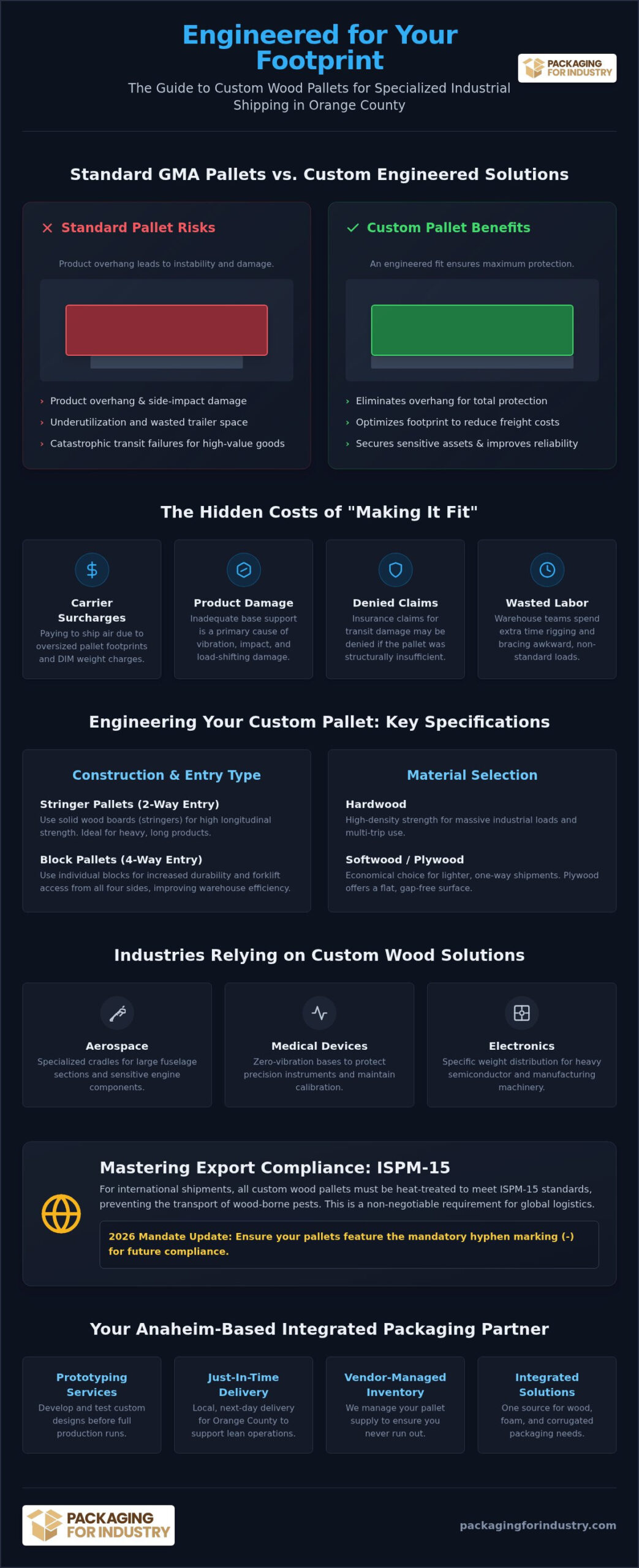
The 48″ x 40″ GMA pallet is the standard of the North American supply chain. It works for uniform boxes, but it frequently fails specialized industrial equipment. When a product doesn’t align with these fixed dimensions, you face two primary risks: overhang and underutilization. Overhang occurs when the product extends beyond the pallet edge, leaving it vulnerable to side-impact damage from forklifts or adjacent freight. Conversely, using a pallet that is too large creates “dead space,” which increases your shipping footprint without adding protection. For companies shipping high-value components, The Limitations of Standard Pallets become clear when transit damage starts impacting the bottom line.
Hidden Costs of “Making It Fit”
Attempting to force a unique product onto a standard pallet creates financial leaks. Carriers like FedEx and UPS apply dimensional weight (DIM) surcharges based on the total volume of the shipment. If your pallet footprint is larger than necessary, you’re paying to ship air. Beyond freight rates, inadequate base support often leads to higher insurance premiums. If an adjuster determines the pallet was structurally insufficient for the load, claims for transit damage may be denied. There’s also a labor cost; warehouse teams spend extra time rigging or bracing awkward loads that don’t sit flush. Switching to custom size wood pallets for unique products Orange County facilities produce can lower packaging costs by optimizing every square inch of trailer space.
Industries Requiring Custom Wood Solutions
Certain sectors cannot rely on off-the-shelf solutions. In aerospace manufacturing, large fuselage sections or engine components require specialized cradles built into the pallet base. Medical device companies often ship precision instruments that need zero-vibration bases to maintain calibration. Similarly, the electronics industry relies on heavy semiconductor machinery with sensitive footprints that require specific weight distribution. Our Anaheim facility specializes in engineering these bases to ensure that high-value equipment remains stable. By matching the pallet to the product’s “true footprint,” we help manufacturers eliminate the structural instability that leads to catastrophic transit failures. Implementing custom size wood pallets for unique products Orange County businesses ship is the most direct way to secure these sensitive assets.
Engineering Custom Wood Pallets: Dimensions, Entry Types, and Load Capacity
Engineering a pallet for a specialized product requires more than just getting the length and width right. You must consider the structural integrity of the base relative to the cargo’s weight distribution. Stringer pallets use solid wood boards to support the deck, offering excellent longitudinal strength for heavy machinery. Block pallets use individual wood blocks, providing more entry points and increased durability for multi-trip use. Material selection is equally important; hardwood offers the high-density strength needed for massive industrial loads, while softwood is an economical choice for lighter, one-way shipments. Plywood decks are often utilized for products requiring a completely flat surface without gaps between deck boards. Proper deck board spacing also ensures adequate airflow to prevent moisture buildup and provides secure points for heavy-duty strapping. When designing custom size wood pallets for unique products Orange County manufacturers use, these technical details determine whether a shipment arrives intact. Navigating Export Compliance also remains a top priority, as all wood must be heat-treated to meet ISPM-15 standards for international transit.
2-Way vs. 4-Way Entry: Which Does Your Warehouse Need?
A 2-way entry pallet allows forklift access from only two ends. These are typically stringer pallets and offer high longitudinal strength, making them ideal for heavy, long products that require rigid support. Conversely, 4-way entry pallets allow access from all four sides. This is often necessary in tight Orange County warehouse environments where maneuverability is limited. For businesses utilizing custom size wood pallets for unique products Orange County warehouses often require 4-way entry to maximize storage density and racking efficiency. Your choice depends entirely on your material handling equipment and the specific layout of your loading docks.
Load Distribution and Weight Ratings
Understanding weight ratings is vital to prevent wood failure and workplace accidents. Static load capacity refers to the maximum weight a pallet supports while resting on a flat, level floor. This is your primary concern for long-term warehouse storage. Dynamic load capacity measures the weight the pallet can handle while in motion, such as being lifted by a forklift or subjected to the vibrations of LTL transit. Dynamic ratings are typically much lower than static ones. We also factor in “racking load,” which is the capacity when the pallet is only supported by two edges in a rack. To ensure safety, we apply standard safety factors that account for the sudden shocks of ocean transit or rough handling. If you’re unsure about the weight requirements for your machinery, you can request a packaging quote to have our engineering team calculate the ideal specifications for your specific application.
Navigating Export Compliance and Material Selection in Orange County
Manufacturers in Southern California face rigorous oversight when moving goods through the Ports of Long Beach or Los Angeles. For international trade, the primary hurdle is ensuring all wood packaging meets ISPM 15 export compliance standards. This regulation dictates that all non-manufactured wood must be heat-treated to eliminate invasive pests that could disrupt foreign ecosystems. While plastic or presswood pallets are sometimes used to bypass these rules, they often lack the structural rigidity required for heavy industrial machinery. Utilizing custom size wood pallets for unique products Orange County exporters ship ensures you maintain the strength of wood while remaining fully compliant with global biosecurity protocols.
The ISPM-15 Certification Process
The heat treatment (HT) process involves placing the wood in a specialized kiln until it reaches a core temperature of 56°C for a minimum of 30 continuous minutes. Once treated, the pallet receives a permanent “Wheat” stamp, which serves as its passport. As of January 1, 2026, customs enforcement has tightened regarding the ISPM 15 hyphen requirement. The stamp must now clearly include a hyphen separating the country code and the facility code; otherwise, the wood packaging is considered non-compliant. Failure to meet these specific marking standards can lead to your entire load being quarantined or rejected at the destination port. The resulting return freight costs and supply chain delays often far exceed the initial investment in certified custom size wood pallets for unique products Orange County facilities require.
Local Sourcing for Orange County Manufacturers
Partnering with an Anaheim-based supplier provides a distinct logistical advantage for local manufacturers. Working with a regional partner allows for rapid replenishment of HT-certified pallets, which is essential for maintaining high-volume production lines. This proximity supports Just-In-Time (JIT) delivery models, reducing the need for you to store bulky pallet inventory on-site. Choosing a local source also helps lower the carbon footprint of your operations by minimizing the transport distance of raw materials. When you compare packaging pricing, consider the total cost of ownership, including the peace of mind that comes from a reliable, local supply chain that can provide custom sizes available on short lead times. This regional integration ensures that your export operations remain efficient and your compliance documentation is always in order.
How to Specify Custom Pallets for Odd-Shaped or High-Value Equipment
Specifying a pallet for a non-standard item requires a methodical approach to ensure both safety and cost-efficiency. When you order custom size wood pallets for unique products Orange County logistics experts recommend a four-step framework to capture every technical requirement. First, measure the “True Footprint.” This includes the widest points of the product, such as protruding hardware, external cables, or control panels that might otherwise hang over the edge. Second, identify the center of gravity. For heavy machinery, an offset center of gravity can cause the pallet to tip during forklift maneuvers if the base isn’t engineered to compensate. Third, determine critical pressure points. Sensitive equipment may require support at specific load-bearing frames while avoiding contact with delicate exterior housings. Finally, select your fastening method. Heavy equipment often requires through-bolting directly to the stringers, while lighter items may rely on custom blocking and high-tension strapping to prevent shifting.
Beyond the Wood: Integrated Protective Features
A pallet is often just one component of a larger protective system. For high-value electronics or medical instruments, we frequently integrate custom foam inserts directly onto the wood deck to provide essential vibration dampening. If your product requires full enclosure, we can combine heavy-duty corrugated boxes with the pallet base to create a secure, palletized container. This approach provides a “kitted” solution that simplifies your warehouse workflow. To add another layer of accountability, consider incorporating shock indicators or tilt sensors. These tools provide immediate visual evidence of mishandling during transit, which is vital for filing insurance claims on sensitive cargo.
Requesting a Custom Pallet Quote
To provide an accurate quote, your supplier needs specific data: total weight, exact dimensions, the type of handling equipment used in your facility, and the final destination. One of the most significant advantages of partnering with PFI is our free prototyping service. We build a physical sample to verify the fit before you commit to a full production run. This prevents costly errors and ensures the design meets your performance standards. When you compare pricing, look beyond the unit cost. The true ROI comes from lower packaging costs through reduced damage claims and optimized freight footprints. Investing in custom size wood pallets for unique products Orange County manufacturers produce is a strategic move to protect your bottom line.
Partnering with PFI for Integrated Custom Wood Solutions in Anaheim
PFI differentiates itself by moving beyond the role of a simple wood vendor. We view the pallet as a foundational element of a holistic protective system. For manufacturers handling sensitive instruments or heavy machinery, we engineer custom size wood pallets for unique products Orange County businesses ship by integrating wood bases with precision-cut foam and heavy-duty corrugated walls. This unified approach ensures that every component works together to dissipate shock and prevent movement. While a standard pallet might suffice for bulk commodities, high-value equipment often requires the full enclosure of a custom wood crate. We help you determine when the added protection of a crate is necessary to mitigate the risk of catastrophic transit loss.
The PFI Advantage: Engineering Meets Economics
Our Anaheim facility utilizes advanced CAD/CAM support to eliminate the guesswork often found in traditional pallet building. This precision allows us to reduce material waste and optimize the weight of each unit, which directly impacts your freight costs. For an aerospace supplier, this might mean a pallet base with integrated foam-lined cradles designed to support a specific engine component. By utilizing just-in-time delivery, you can free up valuable warehouse floor space that would otherwise be occupied by empty pallet stacks. Our Vendor Managed Inventory (VMI) programs allow us to monitor your usage levels and replenish your stock automatically. This ensures you never face a production bottleneck due to a pallet shortage.
Next Steps for Your Operations Team
Optimizing your logistics starts with a comprehensive packaging review. Our team can visit your facility to identify where standard pallets are causing damage or where oversized footprints are driving up carrier surcharges. Consolidating your shipping supplies under a single local partner simplifies your accounting and improves supply reliability. PFI offers next-day delivery across Orange County and Los Angeles, providing the rapid response time required for modern manufacturing schedules. If you’re ready to secure your assets and lower packaging costs, the first step is to establish a technical baseline for your requirements. Request a custom wood pallet quote today to begin the prototyping process and see how an engineered approach transforms your shipping outcomes.
Secure Your Supply Chain with Engineered Wood Solutions
Optimizing your logistics requires moving past the limitations of one-size-fits-all platforms. By specifying custom size wood pallets for unique products Orange County manufacturers can eliminate product overhang, reduce transit damage, and avoid expensive carrier surcharges. Whether you’re shipping sensitive aerospace components or heavy industrial machinery, an engineered base provides the structural integrity necessary for both domestic and international transit.
PFI serves as your local expert in Anaheim, offering the technical CAD support and free prototyping required to get your specifications right the first time. Our team ensures full ISPM-15 export compliance, protecting your shipments from port delays and non-compliance fines. Transitioning to a local, integrated supplier allows you to consolidate your shipping supplies while benefiting from just-in-time delivery and vendor-managed inventory.
Protect your high-value assets and streamline your warehouse operations with a partner that understands the intersection of engineering and economics. We’re ready to help you build a more resilient and cost-effective shipping strategy.
Frequently Asked Questions
What is the standard lead time for custom size wood pallets in Orange County?
Standard lead times for custom wood pallets typically range from 3 to 5 business days depending on the complexity of the design. For manufacturers requiring rapid prototyping, our Anaheim facility can often provide a physical sample within 48 hours. We maintain a local supply of diverse lumber grades to ensure that we can meet tight production schedules without compromising on structural integrity or quality.
Do I need heat-treated pallets if I am only shipping within California?
No, you don’t need heat-treated pallets for shipments that remain within California or the United States. ISPM-15 compliance is only mandatory for international exports to prevent the spread of invasive pests. However, some medical or electronics manufacturers choose heat-treated wood for domestic use to reduce moisture content and mold risks. This extra step helps maintain a cleaner warehouse environment for sensitive components.
What information do I need to provide for a custom pallet quote?
You should provide the product’s footprint dimensions, total weight, and the type of handling equipment used in your facility. It’s also helpful to specify the destination to determine if ISPM-15 export stamps are required. Providing a CAD drawing or a physical prototype allows our engineering team to calculate the ideal load distribution. This data ensures we build a pallet that fits your specific machinery perfectly.
Can custom pallets be designed for reuse in a closed-loop supply chain?
Yes, custom pallets can be engineered for high durability to support multiple transit cycles in a closed-loop system. We utilize higher-grade hardwoods and reinforced fastening methods to ensure the pallet withstands repeated handling by forklifts and pallet jacks. This strategy is an effective way to lower packaging costs over time by reducing the need for constant pallet replacement between regional distribution centers.
How much weight can a custom heavy-duty wood skid actually hold?
A custom heavy-duty wood skid can support upwards of 10,000 pounds when engineered with the correct stringer thickness and deck board density. The actual weight capacity depends entirely on the wood species selected and how the load is distributed across the surface. We calculate both static and dynamic load ratings to ensure the base remains stable during warehouse storage and the rigors of LTL transit.
Is it cheaper to buy recycled pallets and modify them myself?
It’s rarely more cost-effective to modify recycled pallets yourself when you consider labor costs and the risk of structural failure. Recycled wood often has inconsistent strength and hidden defects that can lead to catastrophic damage. Procuring custom size wood pallets for unique products Orange County businesses ship ensures your assets are secured on a base engineered for their specific dimensions. This approach protects your bottom line from expensive damage claims.
What is the difference between a pallet and a skid for industrial equipment?
A pallet features both top and bottom deck boards, while a skid consists only of a top deck supported by runners. Skids are often preferred for heavy industrial machinery because they have a lower profile and are easier to move with rollers or drag across a floor. Pallets provide better stability for stacking and are the standard choice for most warehouse racking systems and standard forklift operations.
Does Packaging For Industry provide delivery to Irvine and Huntington Beach?
Yes, PFI provides local delivery to Irvine, Huntington Beach, and throughout the Southern California region. Our Anaheim facility is strategically located to offer next-day delivery for many stock items and just-in-time replenishment for custom orders. We manage our own fleet to ensure that the custom size wood pallets for unique products Orange County operations depend on arrive exactly when your production line requires them.