
The softest foam in your warehouse might actually be the primary cause of your rising transit damage claims. While it feels protective to the touch, insufficient density often leads to bottoming out during the high-velocity impacts common in modern logistics. If you aren’t sure what is the best foam for shock absorption during shipping, you’re likely over-paying for generic materials that don’t fit your specific G-force requirements. You know that every returned unit represents more than just a lost sale; it’s a direct hit to your margins and a strain on your warehouse operations.
This 2026 guide provides a technical comparison of industrial materials to help you select the right protection for your specific application. We’ll examine how to balance impact attenuation with fiscal responsibility, especially as polyurethane resin prices remain volatile through the end of the year. You’ll learn how to optimize box sizes to avoid freight surcharges and maintain compliance with the latest ISTA 3E standards and California SB 54 plastic reduction mandates. Whether you’re managing complex military-spec requirements or protecting sensitive medical electronics, we’ll analyze the performance of polyethylene, polyurethane, and ESD-safe foams to ensure your high-value components arrive in perfect condition while securing your bottom line.
Key Takeaways
- Understand the relationship between foam density and G-force attenuation to prevent high-value goods from bottoming out during high-impact transit events.
- Determine what is the best foam for shock absorption during shipping by comparing the high load-bearing capacity of polyethylene with the soft, flexible cushioning of polyurethane.
- Identify specialized requirements for sensitive electronics, including the use of anti-static (ESD) foams and compliance with current mil-spec packaging standards.
- Evaluate the total cost of ownership by switching from generic void fill to custom die-cut inserts that reduce labor time and eliminate freight surcharges through optimized box sizes.
- Leverage local Southern California logistics and vendor-managed inventory (VMI) to maintain a reliable supply of protective materials while avoiding the hidden costs of large catalog distributors.
The Science of Shock Absorption: How Packaging Foam Protects High-Value Goods
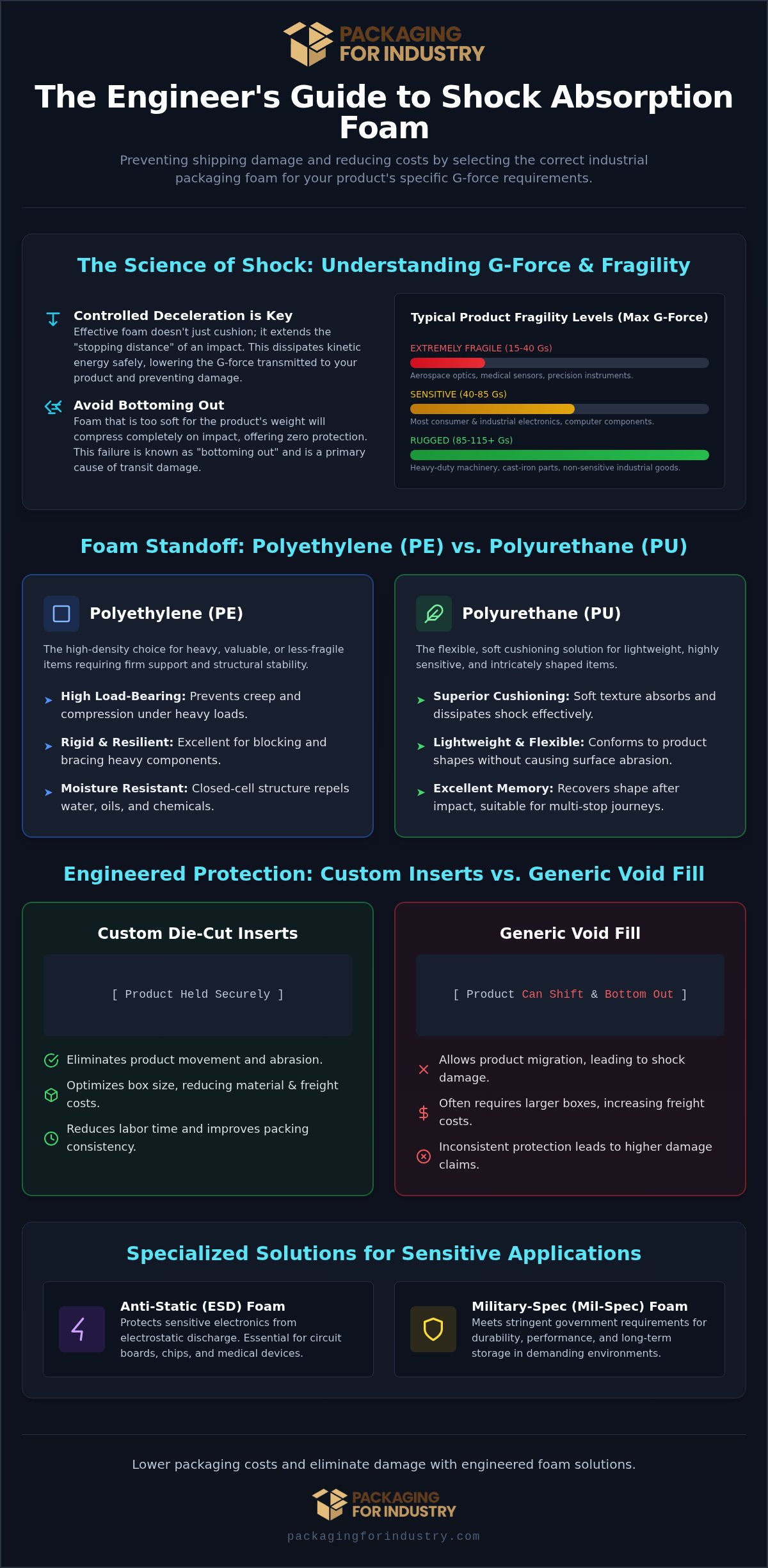
Shock absorption in logistics is the deliberate management of kinetic energy during collisions, drops, or sudden shifts in transit. When a package falls, the product inside possesses energy that must be dissipated safely to prevent structural or functional failure. Effective Package cushioning works by extending the time it takes for an item to come to a complete stop. This concept, known as “stopping distance,” is directly controlled by the thickness and density of the material. If you’re trying to determine what is the best foam for shock absorption during shipping, you must first understand that the goal isn’t just softness; it’s controlled deceleration.
Engineers use a technical chart called a Cushion Curve to identify the performance of specific materials. These curves plot the peak G-force transmitted to a product against the static load it applies to the foam. By analyzing these charts, you can find the “sweet spot” where a specific foam thickness provides maximum protection for your product’s weight. Using the wrong density leads to two common failure points. A foam that’s too soft will “bottom out,” allowing the item to strike the outer corrugated wall. Conversely, a foam that’s too rigid acts like a brick, transmitting the full force of the impact directly to the product’s internal components.
Over-packaging is a frequent and costly mistake in warehouse operations. Adding excessive foam without engineering data can actually increase damage through vibration. Every material has a natural resonance frequency. If your packaging creates a resonance that matches the vibration of a delivery truck or aircraft, it can amplify the shaking. This leads to “scuffing” or internal fatigue in sensitive electronics, even if the box never experiences a drop.
G-Force and Fragility Levels
Industrial components vary significantly in their sensitivity to impact. A heavy-duty cast iron pump might withstand 100 Gs without damage, while specialized medical sensors or aerospace optics are far more vulnerable. Fragility ratings for high-precision electronics typically fall between 15 and 40 Gs, representing the maximum deceleration the internal circuitry can withstand before failing. To protect these items, you must calculate drop height requirements based on your shipping lane. Parcel carriers often require protection for 30-inch drops, whereas palletized loads in a dedicated truck might only face 12-inch impact risks. Matching the foam to these specific G-unit limits is the only way to guarantee zero-damage transit.
Energy Dissipation vs. Energy Return
Not all materials handle energy the same way. Some foams act like a spring, storing energy and then “bouncing” it back into the product. High-quality foam packaging focuses on energy dissipation, converting kinetic energy into a small amount of heat through the physical deformation of the foam cells. You must also account for “creep,” which is the gradual loss of foam thickness when a heavy item sits on it for an extended period. If a material has a poor compression set, it won’t recover its shape after the first impact. This makes material memory a critical factor for multi-stop shipping cycles where a package might face several smaller impacts before reaching the final destination.
Polyethylene vs. Polyurethane: Comparing the Industry Standard Shipping Foams
Selecting the correct material is a balance of engineering and economics. While the science of shock absorption dictates how much foam you need, the physical properties of the foam itself determine how it survives the rigors of your specific shipping lane. In the industrial sector, two materials dominate the market: Polyethylene (PE) and Polyurethane (PU). Choosing between them requires an understanding of cell structure and load-bearing capacity. For those asking what is the best foam for shock absorption during shipping, the answer depends entirely on your product’s weight and its sensitivity to moisture or chemicals.
Polyethylene (PE) Foam: The Heavy-Duty Choice
Polyethylene is a closed-cell foam known for its rigidity and durability. Because the cells are sealed off from one another, the material is naturally moisture-resistant and impervious to most industrial chemicals. This makes it the preferred choice for aerospace components, automotive parts, and heavy machinery. PE foam is available in a wide range of densities, typically from 1.2lb to 9lb. A 2.0lb density is the standard for most industrial kitting, providing a firm surface that supports heavy items without bottoming out. According to this Foam Selection Guide, the closed-cell nature of PE allows it to maintain its structural integrity even after multiple impacts, which is critical for long-distance freight or multi-stop distribution cycles.
Polyurethane (PU) Foam: The Lightweight Specialist
Polyurethane is an open-cell material that offers a much softer, more flexible feel. Because air can flow through the cells, PU acts as a highly effective damper for very light items like glassware, medical instruments, and consumer electronics. It is most recognizable in its “convoluted” or egg-crate form, which provides a gentle grip that prevents small parts from shifting. However, PU has limitations. Its open-cell structure makes it susceptible to moisture absorption, and it can suffer from “creep” or permanent compression if used to support heavy industrial parts. It is designed for items with low static loads where surface protection and gentle deceleration are the primary goals.
In many complex shipping scenarios, a hybrid solution provides the most effective protection. We often design custom inserts using a rigid PE base to support the weight of a component, paired with a soft PU topper to eliminate surface scuffing. This engineered approach ensures that you don’t over-pay for material while still achieving zero-damage transit. If you are looking to optimize your packaging spend, you can request a packaging quote to see how a custom-engineered foam solution compares to your current stock inserts. Balancing these materials correctly is the most reliable way to lower packaging costs while maintaining high protection standards for Southern California’s aerospace and electronics sectors.
Specialized Protection: ESD and Mil-Spec Foams for Sensitive Electronics
While physical cushioning is vital for heavy machinery, high-value electronics require protection against invisible threats. Electrostatic discharge (ESD) is a silent killer that can destroy internal circuitry before a product is even unboxed. When you are determining what is the best foam for shock absorption during shipping for microchips, semiconductors, or medical sensors, anti-static properties are just as critical as density. Using standard foam for these components is a risk that often leads to high RA rates and damaged reputations with Tier 1 aerospace and medical clients.
ESD Foam for Electronics and Semiconductors
Electrostatic discharge occurs when two surfaces rub together, creating a charge that can fry sensitive semiconductors. Standard foams are insulators that allow significant surface charges to build up during the vibrations of transit. Anti-static or dissipative foam is treated with chemical additives to prevent this buildup. You can easily identify this material by its industry-standard pink tint. For components requiring the highest levels of protection, conductive foam provides a path for static to drain away safely. These materials are essential for ESD and Cleanroom Packaging Solutions, ensuring that circuit boards and microprocessors remain functional throughout the logistical chain.
Compliance and Mil-Spec Standards
Defense and aerospace contractors in Southern California face stringent regulatory requirements that go beyond standard commercial shipping needs. When bidding on government contracts, you must ensure your materials meet specific military packaging standards such as PPP-C-1752D. This specification covers various grades of chemically blown polyethylene foam used for cushioning and vibration dampening. PFI supports Military Packaging compliance by providing certified materials that meet these rigorous G-force attenuation and durability benchmarks. We help you navigate the complexities of MIL-STD-2073-1E and MIL-DTL-28786 to ensure your shipments are never rejected for non-compliance.
In the aerospace sector, Foreign Object Debris (FOD) prevention is a primary safety concern. Low-quality foams can “shed” small particles or dust during transit, which can contaminate jet engine components or optical sensors. High-grade closed-cell polyethylene is the industry standard because it provides superior shock absorption without the risk of material degradation. For manufacturers in Los Angeles, Orange County, and San Diego, using certified, non-shedding foam is a prerequisite for maintaining supplier status with major aerospace firms. We provide the technical documentation and high-purity materials needed to satisfy these rigorous quality control audits.
Custom Die-Cut Inserts vs. Void Fill: Engineering the Perfect Fit
Generic void fill like packing peanuts or bubble wrap often fails to secure high-value industrial components. These materials shift during transit, creating “dead spots” where the product can strike the box wall. When you’re determining what is the best foam for shock absorption during shipping, you must consider the physical geometry of your part. Custom die-cut foam inserts provide a precision-fit “nest” that immobilizes the item. This ensures the foam’s shock-absorbing properties are utilized at every contact point, providing total accountability for the product’s safety.
Beyond protection, custom inserts reduce labor costs on the packing line. A packer simply drops the item into a pre-designed slot rather than manually wrapping and taping multiple layers of bubble wrap. This speed increases throughput in high-volume warehouses. CAD/CAM design allows us to minimize the footprint of the packaging by analyzing the exact dimensions of your component. By engineering a tighter fit, we can often move products into smaller corrugated boxes. This shift significantly lowers dimensional weight (DIM) fees and freight surcharges, which can represent a 25% reduction in total shipping costs depending on the carrier and lane.
The Value of Prototyping
A digital design is only the first step in the engineering process. A physical prototype is essential to verify the fit and ease of use in a real-world warehouse environment. PFI provides free prototyping to eliminate the trial and error often associated with new product launches. We test the friction, the “pop-out” force required to remove the part, and how the material responds to what is the best foam for shock absorption during shipping for your specific G-force requirements. This consultative approach ensures your production run is optimized for both speed and safety before you commit to bulk quantities.
Integrating Foam with Corrugated and Crates
Foam doesn’t work in isolation; it’s one part of an integrated system. For small-parcel e-commerce, we engineer foam-lined RSC or folder-style boxes. For heavier machinery, we utilize foam planks and end caps as internal dampening for custom wood crates. We also offer kitting services where foam inserts arrive pre-assembled inside their boxes. This just-in-time delivery model prevents stockouts and reduces the warehouse footprint required for bulky packaging materials in your Southern California facility. By leveraging our local delivery capabilities in Orange County and Los Angeles, you can maintain a leaner inventory while ensuring your packing lines never stop.
Selecting Your Foam Supplier: Balancing Protection, Cost, and Logistics
Choosing a material based on technical data is essential, but the logistical reality of procurement often dictates your final margins. Shipping air is expensive. Because foam is essentially structured air, transporting it over long distances is inherently inefficient; you’re paying to move volume rather than weight. For manufacturers in the Inland Empire or Los Angeles, a local partner provides a decisive advantage. Determining what is the best foam for shock absorption during shipping is only the first step. You must also ensure that your supplier can maintain a consistent flow of materials without forcing you to dedicate half your warehouse to bulky inventory.
We prioritize a consultative approach that focuses on the total cost of ownership. This calculation includes the initial material price, the labor required for assembly, and the long-term reduction in RAs and damage claims. By shifting from a simple vendor relationship to a strategic partnership, you can leverage services like Vendor Managed Inventory (VMI). We monitor your stock levels and replenish your supply automatically, which eliminates the risk of production shutdowns due to foam stockouts. This proactive management is especially critical as polyurethane resin prices remain subject to market volatility through the end of 2026.
Optimizing Your Packaging Spend
Many procurement officers default to large national catalog distributors for convenience, but this often leads to higher packaging costs over time. Catalog items are designed for generic scenarios, which results in over-packaging and excessive dimensional weight fees. Custom-engineered foam allows you to use the exact amount of material needed for G-force attenuation. When you compare packaging pricing, look beyond the unit cost and evaluate the ROI of professional-grade shock absorption. Reducing your damage rate by even a small percentage often pays for the entire cost of a custom die-cut insert program. It’s a pragmatic way to protect your brand reputation while identifying what is the best foam for shock absorption during shipping for your specific bottom line.
Southern California Logistics and Support
Our proximity to major industrial hubs allows us to offer local next-day delivery to businesses in Anaheim, Irvine, and throughout Los Angeles County. This speed is a critical component of a Just-In-Time (JIT) delivery strategy. It allows you to free up valuable floor space for manufacturing rather than storage. While we specialize in Southern California support, we also maintain nationwide shipping capabilities for multi-location distributors who require a reliable, recurring supply of protective inserts. Packaging For Industry (PFI) provides the stability your supply chain needs to scale without the stress of logistical bottlenecks.
Securing Your Supply Chain for 2026 and Beyond
Choosing the right protective material is a pragmatic business decision that directly impacts your bottom line. We’ve explored how matching material density to G-force requirements prevents bottoming out and eliminates the hidden costs of transit damage. Whether your operations require specialized ESD protection for semiconductors or Mil-Spec compliance for defense contracts, the right engineering ensures zero-damage transit. Determining what is the best foam for shock absorption during shipping shouldn’t be a matter of guesswork; it requires a data-driven approach to material memory and energy dissipation.
By shifting from generic void fill to custom die-cut inserts, you can optimize box sizes and reduce dimensional weight surcharges. Our team supports this transition with free CAD/CAM prototyping and local next-day delivery across Southern California. We’re ready to help you streamline your warehouse logistics and improve supply reliability through vendor-managed inventory and precision-engineered cushioning.
We look forward to partnering with you to eliminate professional stress and bring peace of mind to your industrial shipping operations.
Frequently Asked Questions
What is the difference between open-cell and closed-cell foam for shipping?
Closed-cell foams like polyethylene feature sealed cells that provide high load-bearing capacity and moisture resistance. In contrast, open-cell polyurethane is soft and flexible because air flows between the cells. When determining what is the best foam for shock absorption during shipping, you must evaluate if your product requires the rigid support of a closed-cell structure or the gentle damping of an open-cell material. Most industrial applications favor closed-cell options for their durability.
How do I know what density of polyethylene foam I need for my product?
Density selection depends on your item’s static load and fragility rating. A 1.2lb or 1.7lb polyethylene is typically used for lighter components, while 2.2lb density is the industry standard for most industrial kitting. Heavier items like aerospace pumps may require 4lb or 9lb planks to prevent bottoming out. We analyze your product’s weight and the likely drop heights in your shipping lane to recommend the exact density that ensures maximum G-force attenuation.
Is custom-cut foam significantly more expensive than standard bubble wrap?
Custom-cut inserts often provide a higher return on investment than bubble wrap for high-value goods. While the material price per unit might be higher, you’ll lower packaging costs by reducing packing labor time and eliminating transit damage. Precision inserts also allow you to use smaller corrugated boxes, which significantly cuts dimensional weight fees. When you determine what is the best foam for shock absorption during shipping, the reduction in damage claims usually outweighs the initial engineering costs.
Can I get anti-static foam for shipping sensitive electronic components?
Yes, we provide specialized anti-static (ESD) foam designed specifically for semiconductors and circuit boards. This material is treated with chemical additives to prevent the buildup of electrostatic charges during the vibrations of transit. It’s easily identified by its pink color. Using ESD-safe foam is a critical requirement for medical and electronics manufacturers who need to ensure sensitive components arrive fully functional without the risk of invisible discharge damage during the unboxing process.
Does PFI provide prototypes for custom foam inserts before I place a bulk order?
PFI offers free CAD/CAM prototyping to ensure your custom foam inserts fit perfectly before you commit to a bulk production run. This process allows you to verify the nesting of your product and test the ease of assembly on your packing line. By creating a physical sample first, we eliminate the risk of trial and error, ensuring your final order meets all technical specifications for impact protection and operational efficiency in your warehouse.
What are the benefits of using foam end caps instead of full foam lining?
Foam end caps provide targeted protection at the most vulnerable points of a product while using significantly less material than a full lining. This design suspends the item in the center of the box, creating a protective air cushion on all sides. It’s an efficient way to lower packaging costs and reduce the overall weight of the shipment. End caps are particularly effective for rectangular or cylindrical industrial components that require high-impact protection on their corners.
How does custom foam help reduce UPS and FedEx shipping surcharges?
Custom foam helps you avoid Dimensional Weight (DIM) surcharges by allowing you to ship in the smallest box possible. Standard void fill often requires oversized boxes to accommodate layers of bubble wrap or peanuts. In contrast, an engineered foam insert provides superior shock absorption in a compact footprint. By optimizing your box size to match the precision fit of the foam, you can significantly reduce the volumetric weight that parcel carriers use to calculate freight costs.
Is there a specific foam required for military or aerospace shipping standards?
Military and aerospace contracts often require compliance with specific standards like PPP-C-1752D for cushioning materials. These specifications ensure the foam meets rigorous benchmarks for density, compression set, and durability. In aerospace, we often provide high-purity, non-shedding polyethylene to prevent Foreign Object Debris (FOD) contamination. If you’re bidding on defense contracts, using certified Mil-Spec packaging is a prerequisite to ensure your shipments aren’t rejected during the quality control audit process.