
For Santa Ana manufacturers, a damaged shipment isn’t just a logistical hiccup; it’s a direct hit to your profit margins and brand reputation. You’ve likely felt the frustration of high product return rates caused by impact damage or realized you’re overpaying for bulky catalog foam that leaves too much empty space in your boxes. Managing inventory for massive foam rolls often eats up valuable floor space that should be used for production. Finding the right shock absorbent foam for shipping Santa Ana products requires more than just picking a generic material from a national catalog. It demands an engineering mindset that balances material density with fiscal responsibility.
We understand that your goal is to eliminate professional stress by ensuring every item arrives in perfect condition. This guide will show you how to select the right industrial foam densities and custom-engineered inserts to eliminate transit damage for your Santa Ana based operation. You’ll learn how to optimize box sizes to lower freight costs and leverage local just-in-time delivery to keep your warehouse lean. We’ll examine the technical differences between polyethylene and polyurethane foams, the impact of recent material price shifts, and why custom-tailored protection is often the most cost-effective path to a streamlined supply chain.
Key Takeaways
- Match material properties to product specs by choosing between durable closed-cell polyethylene for heavy items and soft open-cell polyurethane for delicate vibration dampening.
- Discover how custom-engineered shock absorbent foam for shipping Santa Ana products reduces freight costs by optimizing box dimensions and eliminating expensive dimensional weight surcharges.
- Conduct a systematic damage audit to identify specific vulnerabilities in your current logistical flow and define precise engineering requirements for your packaging.
- Evaluate the long-term ROI of custom die-cut inserts against stock foam rolls, focusing on labor efficiency and the significant reduction in kitting time.
- Leverage local Southern California expertise for free prototyping and just-in-time delivery to recover valuable warehouse floor space through a managed inventory program.
The Critical Role of Shock Absorbent Foam for Santa Ana Manufacturers
Shock absorbent foam is a specialized material engineered to dissipate kinetic energy during transit, acting as a critical decelerator that prevents impact energy from reaching the product. For Santa Ana industries, particularly those in aerospace, medical devices, and high-end electronics, standard bubble wrap or loose fill rarely provides sufficient protection. These sectors require high-performance Package cushioning materials that can withstand the rigors of complex supply chains. Precise engineering ensures that the kinetic energy from a drop or jolt is absorbed by the foam’s cellular structure rather than the sensitive internal components of the shipment.
A significant challenge for local manufacturers is “hidden damage.” This refers to internal component failure caused by vibration or micro-impacts that don’t leave visible marks on the outer corrugated box. When you select the correct shock absorbent foam for shipping Santa Ana products, you’re not just buying a material; you’re investing in a strategy to reduce Return Material Authorizations (RMAs). Each avoided return saves on freight costs, inspection labor, and replacement parts. Lowering your return rate directly stabilizes your bottom line and preserves customer trust in a competitive market.
Understanding G-Force and Fragility Factors
Selecting the right foam starts with determining your product’s fragility rating, which measures the maximum acceleration the item can withstand before breaking. Most industrial products fall between 15 Gs, which is extremely fragile, and 100 Gs for more rugged equipment. Engineering the right solution requires matching this rating to expected drop heights, typically ranging from 30 to 48 inches depending on the carrier and package weight. The G-factor is defined as the maximum deceleration an object can experience without sustaining functional or structural damage during a shock event.
Local Logistics Challenges in Southern California
Shipping within the Inland Empire and Orange County presents unique environmental stressors. Short-haul freight often involves frequent stops and starts. This increases the cumulative vibration load on sensitive components compared to steady long-haul transit. Additionally, the high temperatures common in Southern California warehouse environments can affect the structural integrity of certain low-grade foams, causing them to lose their compressive strength over time. Working with a local Santa Ana packaging partner ensures that your materials are specifically selected to withstand regional climate conditions and the specific logistical patterns of local distribution routes.
Technical Material Selection: Polyethylene vs. Polyurethane vs. ESD Foam
Selecting the right shock absorbent foam for shipping Santa Ana manufactured goods is a balance of engineering and budget. Material choice determines how effectively a package handles compressive loads and environmental stressors. Meeting federal requirements for packaging requires a technical distinction between foam types to ensure safety during standard transport. Using the wrong density can lead to “bottoming out,” where the foam fully compresses and transfers the entire impact force to your product.
Beyond physical protection, consider chemical stability for sensitive components. Certain materials can “outgas,” releasing volatile organic compounds that might fog high-precision optics or corrode delicate metal contacts during long-term storage. Distinguishing between one-way shipping needs and long-term protective storage is essential for optimizing your material spend.
Polyethylene (PE) Foam: The Industrial Workhorse
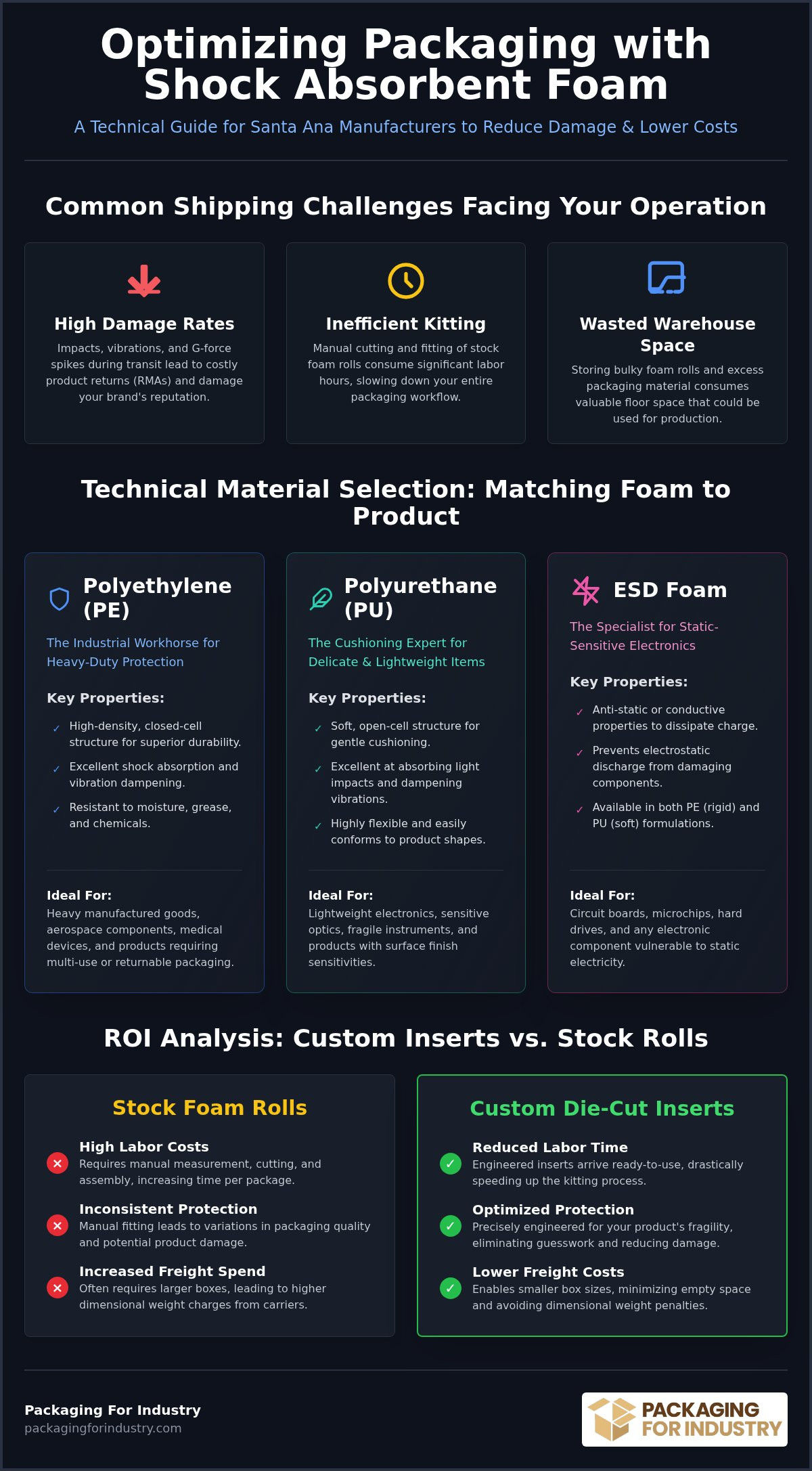
PE is a closed-cell foam known for its high-density protection and durability. It’s the standard for Santa Ana’s aerospace and heavy manufacturing sectors because it supports significant weight without collapsing. Its closed-cell structure makes it naturally resistant to moisture, grease, and industrial chemicals. These PE planks are ideal for custom foam packaging because they maintain structural integrity under the weight of heavy machinery parts or aircraft components. Unlike softer options, PE provides excellent vibration dampening for high-mass items during transit.
Polyurethane (PU) Foam for Fragile Components
Delicate medical instruments and high-end electronics often require the gentle support of Polyurethane. This open-cell material is breathable, highly flexible, and significantly softer than PE. Convoluted or “egg-crate” PU foam is particularly effective for securing irregularly shaped products without requiring a custom-molded cavity. It excels at absorbing low-energy impacts that could still shatter fragile glass or ceramic parts. If you’re unsure which density fits your specific product weight, you can request a technical evaluation to find the optimal balance for your application.
Anti-Static and ESD Foam for Electronics
Electronic components like PCBs and semiconductors face a dual threat: physical impact and electrostatic discharge (ESD). Pink anti-static foam is treated with a topical agent to prevent static buildup on the foam’s surface. For more sensitive applications, black conductive or dissipative foams provide a permanent path for static to ground. Using these specialized materials is often mandatory for meeting mil-spec requirements in defense-related shipping or protecting high-value semiconductor shipments in the Santa Ana tech corridor.
Custom Die-Cut Inserts vs. Stock Foam Rolls: An ROI Analysis
Many businesses in Southern California rely on stock foam rolls because the initial price per square foot appears lower. However, a pragmatic analysis of the total cost of ownership often reveals that custom-engineered inserts provide a superior return on investment. When you utilize shock absorbent foam for shipping Santa Ana manufactured parts, the goal is to minimize total logistical spend, not just the material cost. Stock rolls require manual cutting, wrapping, and taping. This increases labor hours and introduces human error into the protective process.
Switching to custom die-cut inserts streamlines the kitting process. An operator can secure a product in seconds rather than minutes. This speed directly lowers the labor cost per unit shipped. Additionally, precision-engineered foam allows for the smallest possible exterior corrugated box, which is essential for avoiding expensive UPS and FedEx dimensional weight surcharges. PFI’s custom design packaging services eliminate the guesswork by creating a solution tailored to your product’s specific dimensions and fragility. For high-value industrial clients, the professional unboxing experience of a custom insert also reinforces your brand’s commitment to quality and precision.
The Engineering Process: Prototyping and CAD/CAM
Our approach treats packaging as a component of the product itself. We use CAD/CAM support to translate technical drawings into precision-fit foam cavities. This level of detail is vital for complex aerospace parts or multi-component medical kits where every piece must remain stationary. We offer free prototyping for product fit to ensure the shock absorption meets your requirements before bulk production begins. This proactive step prevents the costly mistake of ordering thousands of units that don’t perform as expected during real-world transit.
Total Cost of Ownership (TCO) in Packaging
True fiscal responsibility in logistics means looking beyond the invoice for foam rolls. Consider these factors when evaluating your packaging strategy:
- Labor Efficiency: Pre-cut inserts can reduce assembly time by up to 50% in high-volume kitting operations.
- Freight Optimization: Reducing box volume by even a few cubic inches can lead to significant savings in annual freight spend by lowering dimensional weight.
- Inventory Space: Precision-cut foam planks take up less room than bulky rolls, freeing up floor space for manufacturing activities.
A reliable local supplier helps you manage these variables through just-in-time delivery. This ensures your warehouse remains lean and efficient without the need to store months of bulky inventory.
Procurement Strategies for Santa Ana Operations
Procuring the right shock absorbent foam for shipping Santa Ana manufactured goods requires a methodical approach that balances engineering requirements with budgetary constraints. A haphazard selection process often leads to over-packaging or, conversely, expensive transit damage. Following a structured procurement strategy ensures your logistics operation remains both protected and lean. This pragmatic process moves from internal assessment to external sourcing, focusing on tangible operational outcomes.
The first step is conducting a thorough damage audit of your current shipping methods. Analyze your return data to pinpoint exactly where failures occur and whether they’re due to impact or vibration. Next, define your product’s weight, dimensions, and fragility rating. These metrics are the foundation for any foam selection. You must then determine if stock sheets or custom die-cut inserts are required. While stock options have a lower unit price, custom inserts often provide a higher ROI through labor savings. Finally, evaluate local delivery and stocking options to minimize lead times and storage costs before you Request a packaging quote with your specific material requirements.
Avoiding Catalog Markups and Lead Time Surprises
National catalog giants often include significant markups on bulky foam products and charge high freight rates for shipping them to Southern California. Local suppliers outperform these national entities on both price and speed. By leveraging PFI’s manufacturing expertise, you gain direct access to industrial-grade materials without middleman fees. A “just-in-time” delivery model allows your Santa Ana facility to operate with minimal on-site inventory, freeing up valuable floor space for production rather than storage. This logistical efficiency is a key component of a stable and fiscally responsible supply chain.
Sustainability in Industrial Foam
Modern industrial operations must align protective requirements with corporate ESG goals. Polyethylene (PE) foam is a recyclable material that supports sustainable supply chain initiatives. Precision-engineered designs further enhance sustainability by reducing material waste. When a foam insert is CAD-designed for a specific product, it uses the minimum amount of material necessary for maximum protection. This reduction in waste lowers your environmental footprint and reduces your total material spend. Optimized packaging is the most direct route to meeting sustainability targets without compromising product safety.
Why PFI is the Preferred Foam Supplier in Santa Ana
PFI serves the Santa Ana industrial corridor with a focus on logistical flow and engineering precision. Unlike national catalogs that treat packaging as a commodity, we provide a localized partnership that prioritizes your operational efficiency. Our proximity allows for next-day delivery across Santa Ana, Irvine, and Orange County, ensuring your production schedule remains uninterrupted. When you source shock absorbent foam for shipping Santa Ana products from a local manufacturer, you eliminate the risk of long lead times and high freight surcharges. This direct relationship allows us to act as a seasoned industrial consultant for your team, providing the steady and dependable support required for high-stakes manufacturing.
We provide integrated solutions that go beyond the foam itself. By combining custom foam inserts with matching corrugated boxes and corner protection in a single quote, we ensure total component compatibility. This holistic approach eliminates the risk of mismatched packaging materials that can lead to transit damage. It also simplifies your procurement process, reducing the administrative burden of managing multiple vendors. We focus on the end-to-end experience, from the initial design phase to final delivery, creating a narrative of total accountability for your product’s safety.
Solving Warehouse Space Issues with VMI
Our vendor managed inventory (VMI) program is designed to keep your production lines moving without cluttering your floor. We take responsibility for monitoring your foam stock levels and replenishing them according to your specific usage patterns. This system eliminates stockouts of critical custom foam inserts and frees up valuable warehouse space for your core manufacturing operations. We work on weekly or monthly review cycles tailored to your facility’s specific logistical needs, providing the peace of mind that comes from knowing your packaging supply is secured. It’s a pragmatic solution for warehouses that need to maximize every square foot of floor space.
Ready to Secure Your Shipments?
Our commitment to reliability and cost-reduction is backed by direct access to seasoned packaging engineers. You won’t deal with simple order takers; you’ll partner with “fixers” who understand the intersection of material science and economics. We focus on tangible, real-world outcomes that protect your bottom line and eliminate the stress of shipping damage. Our goal is to provide a reliable system of protection that integrates seamlessly with your existing supply chain. We value long-term reliability over flashy innovation, ensuring your operations remain stable and predictable.
Securing Your Santa Ana Supply Chain with Engineered Protection
Selecting the correct density and material for your packaging is a strategic decision that directly influences your operational profitability. By moving away from generic catalog options and adopting custom-engineered inserts, you reduce labor costs, eliminate transit damage, and optimize freight spend. Whether your facility handles sensitive medical instruments or heavy aerospace components, the technical distinction between polyethylene and polyurethane foams ensures your specific fragility requirements are met with precision.
Securing high-performance shock absorbent foam for shipping Santa Ana goods is more efficient with a local partner that understands Southern California’s logistical challenges. Our team provides free prototyping and CAD/CAM support to ensure a precision fit before bulk production begins. We specialize in protecting high-value assets for the aerospace, medical, and electronics sectors. With local next-day delivery, we help you maintain lean inventory levels while ensuring every component arrives intact and ready for use.
Take the guesswork out of your packaging strategy. We’re ready to help you streamline your warehouse operations and achieve long-term fiscal stability through reliable, engineered protection that respects your bottom line.
Frequently Asked Questions
What is the best shock absorbent foam for heavy industrial parts in Santa Ana?
Polyethylene (PE) foam is the most effective choice for heavy industrial parts due to its high-density, closed-cell structure. It provides the necessary compressive strength to support significant weight without collapsing or “bottoming out” during transit. It’s the standard for aerospace and machinery components manufactured in Santa Ana. Unlike softer materials, PE remains resilient under repeated impacts, ensuring that heavy assets remain stationary and protected within their corrugated containers throughout the logistical cycle.
How do I choose between polyethylene and polyurethane foam for shipping?
Selection depends primarily on your product’s weight and fragility rating. Polyethylene is a rigid, closed-cell material designed for heavy items and repeated impacts. Conversely, Polyurethane is a soft, open-cell foam ideal for cushioning lightweight, delicate components and dampening high-frequency vibrations. If your item is fragile and light, like a medical instrument, choose polyurethane. For rugged, heavy parts that require structural support, polyethylene is the pragmatic choice for a stable shipping environment.
Does PFI offer custom die-cut foam inserts for small production runs?
Yes, we provide custom die-cut foam solutions tailored to various production scales, including smaller specialized runs. Our engineering-minded approach utilizes CAD/CAM technology to create precise cavities for complex parts regardless of the order volume. This flexibility allows Santa Ana manufacturers to access high-performance protection without the need for massive inventory commitments. By focusing on your specific operational needs, we ensure even limited production batches receive the same level of precision and durability as high-volume runs.
Can I get next-day delivery on foam packaging in Orange County?
We offer local next-day delivery for foam packaging across Santa Ana and the broader Orange County area. Our Southern California logistics network is designed to support just-in-time manufacturing environments where warehouse space is at a premium. This rapid response time eliminates the need for you to store bulky foam rolls or large quantities of inserts on-site. It’s a reliable way to help you maintain a lean supply chain and avoid the delays associated with national catalog suppliers.
Is there anti-static foam available for sensitive electronic components?
Specialized anti-static and ESD foams are available to protect sensitive electronic components from electrostatic discharge. We offer pink anti-static foam for general static prevention and black dissipative or conductive foams for more sensitive semiconductor and PCB applications. These materials are mandatory for meeting mil-spec requirements in defense-related shipping. Using the correct shock absorbent foam for shipping Santa Ana electronics ensures your products are protected from both physical impact and invisible electrical damage during transit.
How can custom foam inserts help reduce my overall shipping costs?
Custom foam inserts reduce total shipping costs by optimizing the exterior box size and lowering labor requirements. Precision-engineered inserts allow for the smallest possible corrugated dimensions, which helps you avoid expensive dimensional weight surcharges from carriers like UPS and FedEx. Additionally, pre-cut inserts streamline the kitting process, so your staff doesn’t have to wrap products manually with stock rolls. These efficiencies lead to tangible fiscal savings across your entire distribution operation.
Do you provide free prototypes for custom foam designs?
We provide free prototyping for product fit to verify that our custom foam designs meet your specific shock absorption requirements. Our engineers use CAD drawings to create accurate samples, allowing you to test the physical fit and protective performance before committing to a bulk production run. This proactive step eliminates the risk of ordering ineffective packaging and ensures your final solution is optimized for both safety and cost-effectiveness. It’s a key part of our consultative partnership.
What industries in Santa Ana typically use your custom foam solutions?
Aerospace, medical device, and high-tech electronics companies are the primary industries in Santa Ana that use our custom foam solutions. These sectors require high-performance shock absorbent foam for shipping Santa Ana products because their components are often high-value and sensitive to vibration or impact. We also support general manufacturing and e-commerce operations that need to reduce return rates. Our expertise in these specialized fields ensures your packaging meets the highest industrial standards.