
If your product arrives damaged, it doesn’t matter how fast the transit time was or how low the initial freight rate looked. For manufacturers in high-stakes sectors like aerospace or medical devices, using the right foam end caps for protecting products in transit is the difference between a successful delivery and a costly insurance claim. You’re likely tired of managing inconsistent lead times from suppliers and paying carrier surcharges for bulky packaging that still fails to protect your equipment.
We understand that effective protection isn’t about simply adding more material; it’s about engineered deceleration and structural clearance. This guide explains how to specify, select, and implement custom foam solutions to eliminate damage and optimize your industrial shipping costs. We’ll walk you through the technical differences between polyethylene and polyurethane, the impact of new 2026 ISTA standards, and how a local vendor-managed inventory program can stop stockouts in your warehouse.
Key Takeaways
- Learn how engineered foam end caps for protecting products in transit create a “floating” environment that absorbs G-force impacts and prevents structural damage.
- Discover how to select the correct material density, choosing between Polyethylene (PE) for heavy industrial components and Polyurethane (PU) for lightweight, fragile items.
- Understand how custom CAD/CAM engineering eliminates the hidden costs of over-packaging and reduces freight surcharges by minimizing total shipping volume.
- Master the specification process by identifying your product’s G-factor and critical impact points to ensure optimal protection without excess waste.
- Explore how integrated packaging solutions and Vendor Managed Inventory (VMI) programs can lower total procurement costs while ensuring supply chain reliability.
Understanding Foam End Caps for Industrial Product Protection
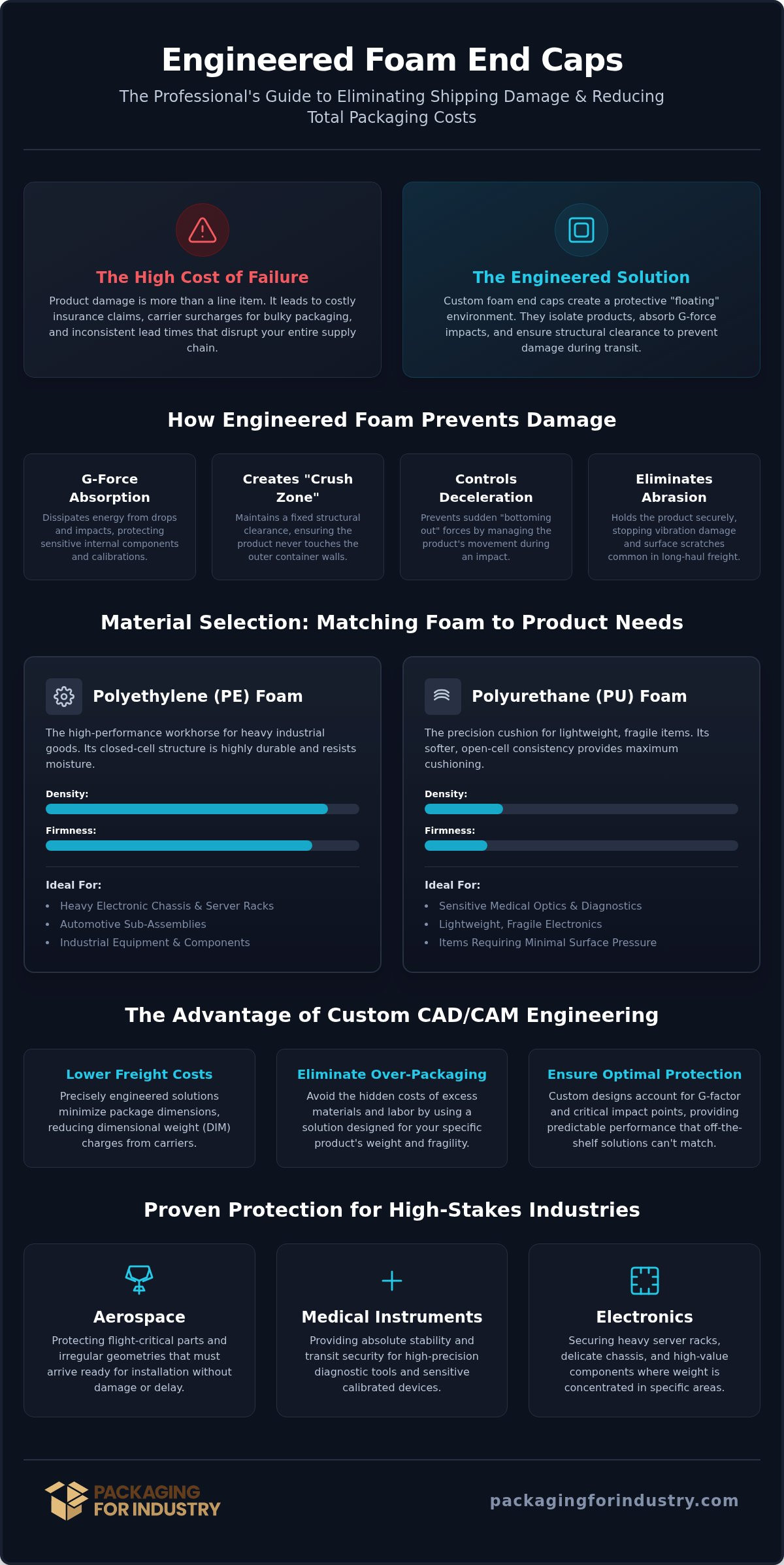
Standard packing peanuts and air pillows don’t cut it for heavy industrial equipment or delicate electronics. To ensure a damage-free shipping cycle, manufacturers utilize foam end caps to isolate their products from the rigors of the road. These components are engineered cushions that essentially “float” a product inside a shipping box, ensuring that the item never makes direct contact with the outer corrugated walls. By using foam end caps for protecting products in transit, you create a fixed structural clearance that remains consistent, unlike loose-fill materials that shift and settle during movement.
The mechanics of this protection are rooted in Package cushioning principles, which focus on energy dissipation. When a package is dropped or handled roughly by a carrier, the foam absorbs the resulting G-force impact. This is vital for high-stakes sectors like aerospace and medical device manufacturing. For these industries, protection isn’t just about preventing scratches; it’s about protecting sensitive internal calibrations that can be ruined by a single high-impact jolt. PFI designs these solutions to provide predictable performance, helping you lower packaging costs by eliminating the financial drain of product returns.
How End Caps Prevent Transit Damage
Effective protection requires a dedicated “crush zone” between the product and the exterior container. Foam end caps provide this by acting as a shock absorber that manages the energy of an impact through controlled compression. In the context of foam thickness, the deceleration distance is the specific amount of space the foam allows the product to move as it slows down during an impact. This controlled movement prevents the product from experiencing a sudden “bottoming out” force. Additionally, these caps eliminate surface abrasion by holding the product securely, which stops the vibration damage often seen in long-haul freight. It’s a level of precision that standard wrapping simply can’t match.
Common Applications in Manufacturing
Many Southern California facilities, from Anaheim to Irvine, rely on custom foam packaging to secure their most valuable assets. We regularly see these applications across several key manufacturing sectors:
- Electronics: Securing heavy server racks and chassis where weight is concentrated in specific areas.
- Medical Instruments: Providing secure transit for high-precision diagnostic tools that require absolute stability.
- Aerospace Components: Using custom-cut foam to accommodate irregular geometries and flight-critical parts that must arrive ready for installation.
Whether you’re shipping locally within Los Angeles or nationwide, using foam end caps for protecting products in transit ensures your goods arrive in the same condition they left the factory floor.
Material Selection: Choosing the Right Foam for Your Needs
Selecting the correct material is the most critical step in the engineering process. If the foam is too dense, it won’t compress enough to absorb shock; if it’s too soft, the product will “bottom out” against the outer container. Successful implementation of foam end caps for protecting products in transit depends on matching material properties to the weight and fragility of your specific components. At PFI, we focus on the intersection of material science and logistical economics to ensure you aren’t over-paying for over-engineered solutions.
Polyethylene (PE) foam serves as the high-performance workhorse for heavy industrial goods. As a closed-cell material, it’s highly durable and resists moisture, making it ideal for heavy electronic chassis or automotive sub-assemblies. Conversely, Polyurethane (PU) foam is an open-cell material with a softer consistency. It’s the preferred choice for lightweight, highly fragile items like sensitive medical optics that require maximum cushioning with minimal pressure.
For specialized applications, we utilize cross-linked polyethylene when high-end aesthetics and extreme durability are required. This material has a smooth, non-abrasive surface that’s perfect for luxury electronics or presentation-grade medical devices. Each of these materials can be specified in various densities to meet your exact protection requirements.
PE vs. PU Foam: A Comparison for Buyers
Density ratings, typically measured in pounds per cubic foot (pcf), correlate directly to the weight your packaging can support. PE foam is often the better choice for recurring shipments because its cell structure allows it to recover its shape after multiple impacts, providing a higher long-term ROI for closed-loop shipping cycles. PU foam is generally more cost-effective for single-trip applications but requires careful consideration of environmental factors. For instance, PU can absorb moisture or outgas in certain conditions, which may be a deal-breaker for sterile medical environments.
Specialized Foam for Sensitive Electronics
Shipping semiconductors or circuit boards requires more than just physical cushioning. It requires protection against electrostatic discharge. We provide custom foam packaging in both anti-static (pink) and conductive (black) varieties. Pink anti-static foam prevents the buildup of static charges, while black conductive foam actually draws charges away from the product. Identifying which level of ESD protection your components require is a vital part of the specification process. If you are unsure which material fits your current production run, you can request a packaging quote to have our team evaluate your product’s technical requirements.
Custom Engineering: Why Off-the-Shelf Solutions Often Fail
Relying on catalog giants for protective packaging often leads to a “good enough” mentality that drains your bottom line. Standard sizes rarely align with the precise geometries of industrial equipment, forcing warehouse teams to use oversized boxes filled with excess void-fill. When you specify custom foam end caps for protecting products in transit, you eliminate the risk of “over-packaging,” where you pay for material volume that doesn’t actually improve safety. Precision CAD/CAM design allows us to map the exact contours of your product, ensuring that every square inch of foam provides maximum deceleration during an impact. This engineering-led approach is essential for heavy machinery where irregular weight distribution can cause standard cushions to fail under pressure.
The PFI Prototyping Advantage
We provide free prototyping to remove the guesswork from your procurement cycle. Because our engineering team is located locally in Anaheim, we can turn around physical samples quickly to verify fit and function. We recently solved a recurring damage issue for an aerospace client whose flight-critical components were shifting during long-haul freight. By designing a custom-cut foam profile that locked the irregular shape into place, we achieved a zero-damage shipping cycle. This proactive custom design packaging service ensures that your production line never stops due to ill-fitting supplies or transit failures.
Optimizing for Dimensional Weight (DIM)
Strategic engineering directly lowers your freight spend by reducing the Dimensional Weight (DIM) of your shipments. Off-the-shelf solutions often require larger corrugated boxes to accommodate generic foam sizes. By using the right material density, we can minimize the thickness of the end caps while maintaining the necessary “crush zone” for safety. Higher density foam often allows for a shorter deceleration distance, which directly results in more compact exterior box dimensions and lower shipping surcharges. We offer custom sizes available for any production volume, helping you maximize pallet density and reduce the total number of truckloads required for distribution.
How to Specify Foam End Caps to Reduce Shipping Damage
Procuring the right protective packaging requires more than just a rough estimate of your product’s size. To design effective foam end caps for protecting products in transit, our engineering team needs specific data points to calculate the necessary cushioning. Without these specs, you risk over-spending on materials that don’t solve the core problem. A systematic approach ensures that your final solution provides maximum protection at the lowest possible cost. Follow these five steps to prepare your requirements:
- Step 1: Document exact weight and dimensions. Provide the length, width, and height to the nearest eighth of an inch. Even small discrepancies can lead to a loose fit that causes surface abrasion.
- Step 2: Identify fragility (G-factor). Determine the maximum acceleration your product can withstand. Pinpoint sensitive impact points, such as glass screens or protruding knobs, that require extra clearance.
- Step 3: Determine the shipping method. Small parcel environments like UPS or FedEx involve automated sorting and more frequent drops. Palletized LTL shipments generally face fewer impacts but more sustained vibration.
- Step 4: Select the outer box grade. Match your foam to the right container. Heavy items often require Double-wall corrugated boxes to prevent the foam caps from “punching through” the carton walls during a drop.
- Step 5: Request a prototype. Always validate the design with a physical sample before committing to a high-volume production run.
Checklist for a Custom Packaging Quote
When you are ready to request a packaging quote, having a complete technical profile prevents delays. Be prepared to discuss your expected order quantity and whether you need recurring deliveries through a VMI program. If your sector has specialized compliance needs, such as ESD protection for semiconductors, mil-spec standards for defense, or cleanroom-compatible materials for medical devices, these must be identified at the start of the design phase.
Testing Your Packaging Design
Validation is the final safeguard against shipping damage. While we design to ISTA drop-test standards, you can perform a basic “shake test” in your own facility. If you hear the product moving inside the box, the foam isn’t providing a secure enough “float.” This iterative design process allows us to adjust foam thickness or density based on real-world testing results. By refining the design before the full production run, you ensure a damage-free shipping cycle from day one.
Lowering Total Packaging Costs with Integrated Solutions
Most procurement managers treat foam and corrugated as separate line items. This fragmented approach often leads to hidden costs and assembly delays. When you utilize an integrated solution, the foam end caps for protecting products in transit are designed simultaneously with the outer shipping container. This ensures a perfect fit that maximizes protection while minimizing the overall box size. By sourcing both components from a single partner like PFI, you can lower packaging costs through bulk material purchasing and streamlined logistics. It’s about optimizing the entire system, not just the individual parts.
VMI and Stocking Programs for Manufacturers
Managing warehouse space is a constant challenge for Southern California manufacturers. Our VMI services allow logistics managers to offload the burden of inventory tracking to our team. We monitor your usage rates and maintain a safety stock of your custom end caps in our facility. This eliminates the risk of production line shutdowns due to stockouts. You’ll reduce purchasing overhead and avoid the expensive rush fees associated with last-minute orders. More importantly, it improves your cash flow by ensuring you only pay for the packaging you need, exactly when you need it.
Southern California Next-Day Delivery
Our local presence in Anaheim provides a distinct competitive advantage over national catalog giants. We serve the industrial hubs of Orange County, Los Angeles, and San Diego with our own fleet of trucks. For businesses in Irvine or Torrance, this means reliable next-day delivery on stocked items.
By implementing a Just-In-Time (JIT) delivery model, you can reclaim valuable floor space for production rather than storing bulky packaging materials. This proximity reduces lead times from weeks to days, allowing your supply chain to remain agile. Choosing a local partner also reduces the carbon footprint of your logistics while supporting “Made in USA” manufacturing. Whether you’re shipping aerospace components or medical devices, our integrated approach ensures your packaging is a driver of efficiency rather than a bottleneck.
Optimizing Your Industrial Shipping Cycle
Eliminating transit damage requires moving beyond generic packaging to engineered solutions. By selecting the right material density and utilizing custom CAD designs, you ensure that your equipment remains suspended and safe during the most rigorous freight cycles. Implementing integrated packaging systems and vendor-managed inventory programs further reduces operational overhead while freeing up critical warehouse floor space. It’s a pragmatic approach that prioritizes both physical protection and fiscal responsibility.
PFI brings specialized experience in the aerospace and medical sectors to every project we undertake. Our team provides free prototyping and precision CAD design to ensure your foam end caps for protecting products in transit fit perfectly before you commit to a full production run. With our local fleet supporting next-day delivery across Southern California, we provide the reliability your production line demands. We’re ready to help you stabilize your supply chain and protect your bottom line with high-performance cushioning.
Take the first step toward a damage-free shipping cycle today. Our team is standing by to help you compare packaging pricing and implement a solution that works for your specific logistics needs.
Frequently Asked Questions
What is the difference between polyethylene and polyurethane foam end caps?
Polyethylene (PE) is a closed-cell, dense material engineered for heavy industrial components that require rigid support. It resists moisture and provides excellent recovery after multiple impacts. Polyurethane (PU) is an open-cell, softer foam designed for lightweight, highly fragile items like medical optics. While PE is the workhorse for heavy machinery, PU offers the delicate cushioning needed for sensitive instruments that cannot withstand high pressure.
Can foam end caps be reused for multiple shipments?
Polyethylene foam end caps are highly reusable because their cell structure recovers its shape after impact. This makes them ideal for closed-loop shipping cycles between manufacturing plants and distributors. Polyurethane foam is typically intended for single-use applications as it loses its cushioning properties more quickly over time. Choosing PE foam for recurring transit can significantly lower your long-term packaging costs through material durability.
How do I determine the correct foam density for my product?
Density is determined by calculating your product’s weight relative to its fragility, often referred to as the G-factor. Heavier industrial goods require higher density PE foam, typically ranging from 1.7lb to 2.2lb, to prevent the item from bottoming out during a drop. Lightweight electronics may only require 1.2lb density. Our engineering team uses these specs to ensure foam end caps for protecting products in transit provide the exact deceleration distance required.
Do you offer anti-static foam end caps for electronics?
We provide both anti-static (pink) and conductive (black) foam options specifically for the semiconductor and electronics industries. Pink anti-static foam is treated to prevent the buildup of static charges during handling. Black conductive foam goes a step further by actively dissipating existing charges away from sensitive circuit boards. These materials are essential for any manufacturer shipping components that are vulnerable to electrostatic discharge damage.
What is the typical lead time for custom foam end cap prototypes?
Typical lead times for custom prototypes range from three to five business days. Because we handle CAD design and foam cutting locally in Anaheim, we can accelerate the development cycle compared to national catalog suppliers. This fast turnaround allows you to verify the fit and function of your foam end caps for protecting products in transit before committing to a full production run, ensuring zero margin for error.
Can you provide the outer corrugated boxes along with the foam end caps?
PFI provides integrated packaging solutions that combine custom foam inserts with the appropriate grade of corrugated boxes. Sourcing both components from a single partner ensures a precision fit and simplifies your procurement process. We can match heavy-duty double-wall boxes with dense PE foam for maximum protection or provide lightweight RSC boxes for smaller parcel shipments. This total system approach reduces assembly time in your warehouse.
How do foam end caps help reduce UPS or FedEx shipping surcharges?
Custom end caps reduce shipping surcharges by optimizing the exterior dimensions of your package to lower its Dimensional Weight (DIM). Off-the-shelf foam often requires oversized boxes that trigger expensive carrier surcharges. By engineering the foam thickness to the minimum required for safety, we can often move your shipment into a smaller box category. This precision engineering directly lowers your freight spend while maintaining superior product protection.
Do you offer local delivery for businesses in Orange County or Los Angeles?
We operate our own fleet of trucks to provide local next-day delivery throughout Orange County, Los Angeles, and the Inland Empire. This local support is a core component of our Vendor Managed Inventory (VMI) and Just-In-Time (JIT) programs. Businesses in cities like Irvine, Santa Fe Springs, and Torrance can rely on consistent delivery schedules that help reclaim warehouse floor space and eliminate the need for bulk on-site storage.