
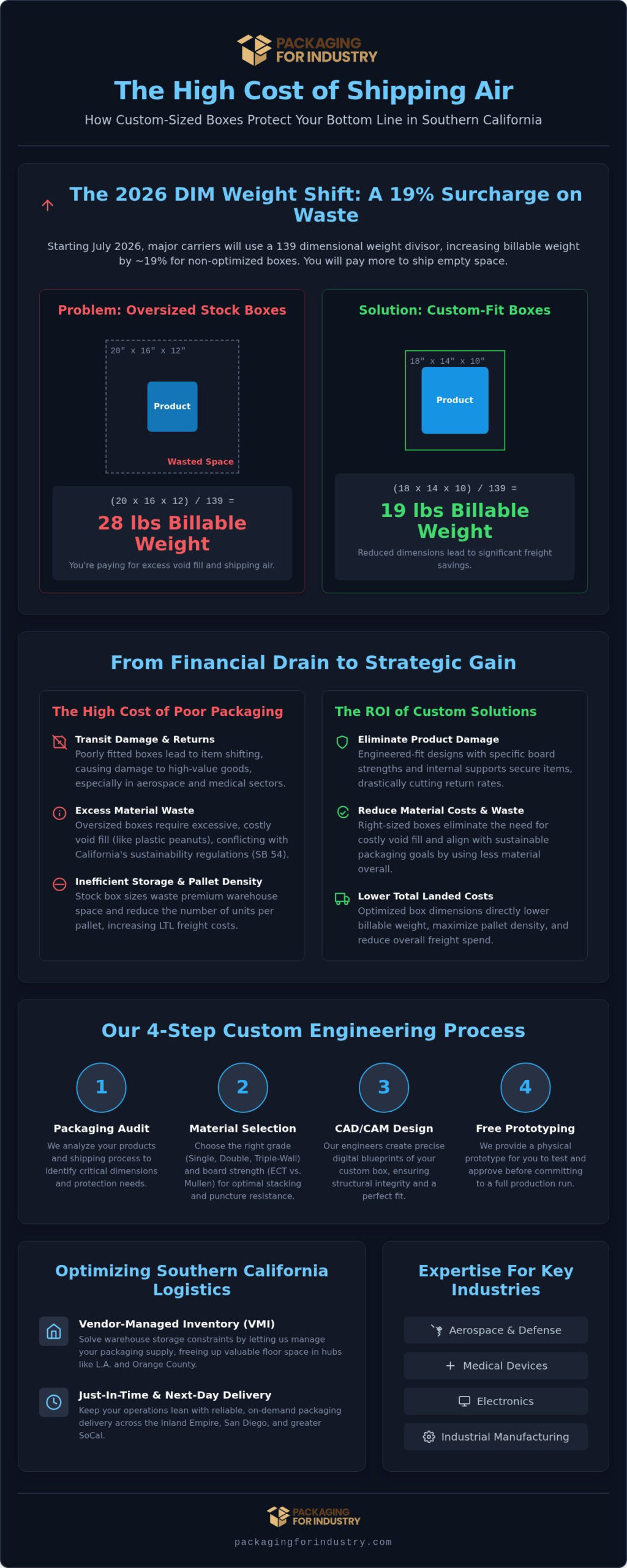
Did you know the July 2026 shift to a 139 dimensional weight divisor across all major carriers can increase your billable weight by approximately 19%? If you’re still relying on oversized stock containers, you’re essentially paying to ship air. Manufacturers and distributors throughout the region are facing unprecedented pressure to minimize package footprints to avoid aggressive volume-based surcharges. Finding reliable custom size shipping boxes Southern California isn’t just about branding; it’s a critical financial strategy to protect your bottom line.
We understand that warehouse space is at a premium and product damage during transit is an unacceptable drain on your resources. This article demonstrates how engineered corrugated solutions can optimize your supply chain, eliminate shipping damage, and drastically reduce freight costs. You’ll learn about our professional CAD-designed prototypes that ensure a perfect fit and how our local next-day delivery options keep your operations running lean. We’ll also explore how vendor-managed inventory can solve your storage challenges while keeping you compliant with evolving California packaging regulations.
Key Takeaways
- Learn how to lower total landed costs by eliminating the oversized stock containers that trigger expensive dimensional weight surcharges.
- Discover how custom size shipping boxes Southern California are engineered with specialized board strengths to eliminate product damage and reduce void fill waste.
- Determine the break-even point between stock box pricing and the long-term freight savings provided by custom-engineered corrugated solutions.
- Implement a strategic packaging audit to identify your most critical dimensions and ensure a professional CAD-designed fit for every shipment.
- Explore how Vendor Managed Inventory (VMI) programs solve warehouse storage constraints while maintaining a reliable local supply of packaging materials.
The Financial Case for Custom Size Shipping Boxes in Southern California
Southern California businesses operating out of industrial hubs like Los Angeles, Orange County, and the Inland Empire face some of the highest logistics and real estate costs in the nation. Using oversized stock boxes isn’t just a minor inefficiency. It’s a direct leak in your operational budget. When your packaging doesn’t fit your product, you pay twice: once for the excess void fill material and again for the “air” you’re shipping. Transitioning to custom size shipping boxes Southern California allows you to align your packaging spend with your actual product dimensions rather than carrier-friendly stock sizes.
Understanding Dimensional Weight Surcharges
Major carriers like UPS, FedEx, and USPS have standardized on a 139 dimensional (DIM) weight divisor for domestic shipments as of July 2026. This change, combined with the rule requiring all dimensions to be rounded up to the next whole inch, has increased billable weight for many shippers by approximately 19%. If your box is slightly too large, you’re paying for “air” at a premium rate. Reducing a box’s dimensions by just two inches can save several dollars per shipment by dropping the package into a lower billable weight bracket. These savings compound across thousands of shipments, making optimized sizing a primary tool to lower packaging costs. Precise dimensions also improve pallet density, allowing you to fit more units into every LTL shipment and maximize your freight spend.
Eliminating Transit Damage in High-Value Supply Chains
Poorly fitted boxes are the primary cause of transit damage in industrial supply chains. When items shift during handling, the risk of structural failure or cosmetic damage increases. For specialized sectors like aerospace and medical device manufacturing in Orange County and San Diego, even minor vibration damage can lead to a rejected shipment. When packaging engineers design custom corrugated solutions, they incorporate specific tolerances and internal protective elements like partitions or dividers. These exact-fit designs eliminate the need for excessive plastic void fill, helping you stay ahead of California SB 54 regulations while protecting your high-value assets. Reducing your “returns and replacements” line item is often the fastest way to see a return on investment for custom packaging. You can request a packaging quote to compare how much an optimized design can save your operation compared to stock alternatives.
Engineering Your Solution: Materials and Design Specifications
Designing the ideal container requires more than just measuring the product. It involves selecting a structural style that balances assembly speed with protection. While the Regular Slotted Container (RSC) is the industry standard for most industrial applications, die-cut designs offer precision for complex components that require integrated tabs or unique opening features. Choosing the right architecture for your custom size shipping boxes Southern California ensures that the box performs under the stresses of local transit and long-haul freight.
Selecting the Proper Corrugated Grade
Industrial equipment and heavy machinery require materials that exceed standard retail specifications. We offer single-wall, double-wall, and heavy-duty triple-wall options to match the specific density and fragility of your cargo. When evaluating board strength, it’s vital to distinguish between the Mullen Test, which measures puncture resistance, and the Edge Crush Test (ECT), which focuses on stacking strength. For manufacturers following sustainable materials management principles, selecting the exact ECT rating needed reduces material waste and lowers total landed costs. We also provide weather-resistant and mil-spec corrugated options for aerospace clients who must meet rigid environmental transit standards.
The Custom Prototyping Process
The transition from a conceptual design to mass production shouldn’t be a guessing game. Our engineering team utilizes CAD/CAM technology to create precise structural blueprints for custom size shipping boxes Southern California. We provide free physical prototyping to ensure the fit is perfect before you commit to a bulk order. This phase is especially critical when integrating custom foam packaging like polyethylene or ESD-safe inserts. A physical prototype allows your team to test the kitting process and verify that the internal cushioning aligns perfectly with the outer corrugated shell.
By verifying the design through a physical sample, you eliminate the risk of ordering thousands of units that don’t meet your protection requirements. This methodical approach ensures that every box serves as a functional tool in your logistics chain. If you’re ready to see how an engineered solution can improve your workflow, you can request a packaging quote to start the design process with our engineering team.
Custom vs. Stock Boxes: A Decision-Making Framework
Choosing between stock and custom packaging is a strategic decision that affects every stage of your logistics. While stock boxes appear cheaper on a per-unit basis, they often hide costs in freight and labor. Sourcing custom size shipping boxes Southern California allows you to bypass the limitations of generic catalog options and align your packaging with your actual operational needs. It’s about finding the break-even point where the savings in freight and protection outweigh the initial design investment.
Total Landed Cost Analysis
A “cheap” stock box often requires extra bubble wrap or paper void fill to secure the product. This increases material costs and packing time. When you use an exact-fit box, you eliminate the need for excessive dunnage. This speeds up the kitting process and reduces the risk of human error during packing. Custom designs also allow for higher pallet density. By fitting more units into a single shipment, you lower the total landed cost per item. For a deeper financial analysis, you can explore our resources on packaging cost savings to see how these small efficiencies scale across your entire operation.
Lead Times and Local Availability
Sourcing from a local Southern California manufacturer provides a significant logistical advantage over national catalog suppliers. While large catalog companies might offer wide selections, they often struggle with specialized industrial requirements and high shipping costs for bulk orders. PFI offers local next-day delivery options throughout Orange County, Los Angeles, and the Inland Empire. This ensures your production lines never stall due to a lack of supplies. Managing recurring orders through a local partner allows for a more consistent supply chain flow, which is essential for just-in-time manufacturing environments.
Custom boxes also serve as a professional touchpoint. High-quality printing on your corrugated containers reinforces your brand’s industrial authority, which is critical when shipping to high-tier aerospace or medical clients. Additionally, custom-sized boxes take up less warehouse floor space than oversized stock options. This allows you to store more inventory in the same square footage. If you’re ready to evaluate your current setup, you can compare packaging pricing for a custom solution tailored specifically to your facility’s needs.
Optimizing Your Procurement for Southern California Logistics
Procuring custom size shipping boxes Southern California requires a methodical approach to ensure your packaging spend aligns with your operational goals. It isn’t just about replacing one box with another; it’s about integrating a protective system into your existing supply chain. By following a structured procurement process, you can eliminate the trial-and-error phase and move directly to a cost-effective, scalable solution.
- Step 1: Conduct a Packaging Audit. Review your shipping data from the last six months to identify which stock dimensions are triggering the highest surcharges. This identifies the specific “problem sizes” where custom engineering offers the fastest ROI.
- Step 2: Define Protection Requirements. Consider the weight of your product, its fragility, and the primary shipping method. LTL freight requires different stacking strength than parcel shipping.
- Step 3: Request a Tiered Quote. Provide volume estimates for your annual usage. This allows for better tiered pricing, as manufacturing costs per unit drop significantly with higher volume runs.
- Step 4: Test Prototypes. Never skip the field test. Use a physical prototype in your actual shipping environment to verify that the box holds up under real-world transit stresses.
How to Request an Accurate Packaging Quote
To receive a precise estimate, your procurement team should provide three essential data points: inside dimensions (ID), the desired board grade, and the order quantity. It’s also vital to provide the exact weight of your product. This information allows our engineers to determine the necessary Edge Crush Test (ECT) rating to prevent box failure during stacking. Using our request a quote tool provides a streamlined way to submit these technical specifications for a fast industrial estimate.
Local Logistics Advantage
Our proximity to major industrial hubs like Anaheim, Irvine, and the Inland Empire provides a distinct logistical advantage. If you’re managing imports through the LA or Long Beach ports, having a local packaging partner means you can react quickly to incoming shipments without waiting for national freight deliveries. We provide dedicated support through our Orange County service area, ensuring that local manufacturers have a reliable, next-day resource for their most critical packaging needs. This local presence reduces your lead times and eliminates the high shipping costs associated with ordering bulk corrugated supplies from out-of-state vendors.
Solving the Storage Problem: VMI and Just-In-Time Delivery
One of the biggest obstacles to ordering custom size shipping boxes Southern California in bulk is the physical footprint they occupy. Industrial real estate in cities like Santa Fe Springs or Irvine is expensive. Tying up thousands of square feet with empty corrugated containers isn’t an efficient use of your facility. We solve this logistical bottleneck by acting as your off-site warehouse. Our inventory management solutions allow you to maintain the benefits of custom sizing without the burden of bulk storage. It’s about maximizing your operational square footage for revenue-generating activities.
The PFI Vendor Managed Inventory (VMI) Program
Our Vendor Managed Inventory services are designed to put your packaging on autopilot. We handle the monitoring. Instead of your team manually checking pallet counts, we establish customized review cycles based on your specific production volume. These reviews occur at weekly, bi-weekly, or monthly intervals depending on your needs. We stock your custom boxes at our facility and deliver them exactly when your levels hit a predetermined reorder point. Proactive replenishment prevents production shutdowns caused by unexpected packaging shortages. This approach also significantly improves your cash flow. You only pay for the packaging as it’s actually released to your warehouse, which keeps your working capital liquid. It eliminates the need for large upfront capital outlays on massive box orders that might sit for months.
Just-In-Time (JIT) Packaging for Manufacturers
For industries like aerospace and medical device manufacturing, production schedules are tight. Precision is mandatory. Just-In-Time (JIT) delivery synchronizes your packaging arrivals with your manufacturing output. When you use JIT, you reduce the risk of holding obsolete inventory. If a product design changes, you aren’t stuck with thousands of boxes that no longer fit. This agility is a standard requirement for high-tech sectors where engineering revisions are common. By sourcing your custom size shipping boxes Southern California through a JIT model, you ensure your floor space remains dedicated to production rather than packaging storage. Our local delivery fleet enables this responsiveness, providing a reliable link between our production line and yours. We act as a seamless extension of your warehouse, ensuring that your packaging is always a solution, never a storage problem.
Secure Your Southern California Supply Chain Strategy
Transitioning to an engineered packaging model is a necessary step for any manufacturer looking to offset rising carrier surcharges and eliminate transit waste. By focusing on the intersection of engineering and economics, your operation can replace generic stock containers with high-performance custom size shipping boxes Southern California. This shift does more than just lower packaging costs; it provides a professional, reliable system of protection that scales with your production volume.
Our team specializes in resolving complex industrial logistics challenges through local manufacturing and free custom prototyping. Whether you need heavy-duty triple-wall corrugated for machinery or specialized inserts for aerospace components, we provide the technical expertise to optimize every square inch of your shipment. Integrating a Vendor Managed Inventory (VMI) program further ensures you never face production delays while keeping your warehouse floor space clear for active manufacturing.
We’re ready to help you build a more efficient, cost-effective packaging operation. Let’s start designing a solution that protects your products and your bottom line.
Frequently Asked Questions
What is the minimum order quantity for custom size shipping boxes?
Minimum order quantities vary based on the box style and production complexity, but we specialize in bulk industrial orders for manufacturers and distributors. While we handle recurring production runs, we don’t focus on one-time residential purchases or small retail quantities. We recommend you request a packaging quote to discuss your specific volume needs and see how tiered pricing can lower your costs for high-volume requirements.
How much can I save on freight costs by using custom-sized boxes?
Using custom size shipping boxes Southern California can reduce billable weight by approximately 19% by avoiding the 139 DIM weight divisor penalty. Since carriers round dimensions up to the next whole inch, even a one-inch reduction in box size can drop your shipment into a lower weight bracket. These optimizations eliminate the cost of shipping air and significantly reduce total landed costs for high-volume shippers.
Do you provide custom printed shipping boxes for industrial branding?
Yes, we provide custom printing services for industrial corrugated boxes to help reinforce your brand’s professional image. From simple one-color logos to more complex informational printing, our team ensures your shipping containers meet both functional and aesthetic requirements. This is particularly valuable for aerospace and medical device manufacturers who need to maintain a high-tier professional presence during the transit of high-value components.
Can you design custom boxes for heavy machinery over 100 pounds?
We specialize in engineering heavy-duty solutions for industrial equipment and machinery weighing well over 100 pounds. Our team often recommends triple-wall corrugated or custom wood crates with heavy-duty skids for these applications. We also design integrated foam assemblies and cushioning materials to ensure that heavy, high-value assets remain secure and immobile throughout the entire shipping process, whether traveling by land or sea.
How long does it take to get a custom box prototype in Southern California?
Our local presence in Anaheim allows us to provide custom prototypes quickly, often within a few business days once the CAD design is finalized. Because we handle engineering and production in Southern California, we bypass the long lead times associated with out-of-state catalog suppliers. This speed ensures your team can test the fit and function of a box before committing to a full production rollout.
What information do I need to provide for a custom packaging quote?
To provide an accurate quote, we need the inside dimensions (length, width, and depth), the expected order quantity, and the weight of your product. Specifying your preferred board grade or the fragility of the item helps our engineers determine if you need single-wall, double-wall, or triple-wall protection. You can use our online tool to compare packaging pricing based on these specific industrial metrics and volume estimates.
Do you offer next-day delivery for custom box orders in Orange County?
We offer local next-day delivery for stock and recurring custom box orders throughout Orange County, including cities like Irvine, Anaheim, and Huntington Beach. This service is a core component of our Vendor Managed Inventory (VMI) programs, which aim to prevent production shutdowns. By keeping your custom size shipping boxes Southern California ready for immediate dispatch, we help you maintain a lean warehouse without risking supply shortages.
What is the difference between single-wall and double-wall corrugated boxes?
The primary difference lies in the number of fluted layers and linerboards, which directly impacts stacking strength and puncture resistance. Single-wall corrugated consists of one fluted medium glued between two liners, while double-wall adds an extra flute and liner for increased durability. We typically recommend double-wall or triple-wall for heavy industrial parts or high-value electronics that require superior protection during LTL freight transit and long-term storage.