
A collapsed pallet in the back of a trailer is more than just a mess; it’s a direct hit to your profit margins and warehouse safety. Many operations try to solve this by simply adding more layers of plastic, yet they still face rejected shipments and high return rates. If you want to know how to improve pallet load stability for shipping, you must look beyond the wrap and focus on the physics of the entire load. You’ve likely felt the stress of a major distributor flagging your shipment for instability, leading to wasted labor and unnecessary material costs.
We understand that your goal is a zero-damage shipping cycle that doesn’t sacrifice efficiency. This article outlines engineering-backed strategies designed to eliminate load shifting while reducing your overall packaging spend. We’ll walk through the essential components of a stable load, from selecting the right pallet grade to utilizing custom corner protection and high-performance stretch film. By the end, you’ll have a clear roadmap to improve worker productivity and ensure every product arrives in pristine condition.
Key Takeaways
- Identify the hidden costs of unstable loads, including carrier rejections and increased insurance premiums, to protect your operational bottom line.
- Master the fundamental stacking techniques and pallet selection criteria that dictate how to improve pallet load stability for shipping from the ground up.
- Integrate corner protection and custom foam inserts to reinforce vertical strength and stabilize high-value internal components during transit.
- Define and apply the correct containment force for your specific load type to ensure consistent security while minimizing stretch film waste.
- Utilize custom-engineered corrugated solutions and inventory management programs to maintain a steady supply of critical stabilization materials.
The Logistics of Load Stability: Why It Matters for Your Bottom Line
Maintaining a rigid load is a fundamental requirement for any high-volume shipping operation. While many managers view pallet wrapping as a final, minor step, the financial consequences of poor stability are immense. Understanding how to improve pallet load stability for shipping is the first step in protecting your company from carrier rejections and escalating insurance premiums. When a pallet arrives at a hub leaning or partially collapsed, carriers often refuse to move it further. This leads to costly delays and emergency repalletization fees. Beyond these immediate charges, frequent damage claims signal to insurers that your logistical processes are high-risk, which eventually drives up your annual premiums.
A Global Packaging Review serves as a diagnostic tool to identify exactly where stability fails. By analyzing the entire journey of a product, from the assembly line to the final mile, engineers can pinpoint whether the issue lies in the primary box strength, the friction between layers, or the containment force of the film. This systematic approach transforms stability from a guessing game into a predictable engineering outcome. It also helps businesses avoid dimensional weight surcharges by ensuring that loads don’t bulge or shift, which can cause them to exceed the footprint of the pallet and trigger higher freight rates.
Financial Impact of Transit Damage
The true cost of a returned pallet far exceeds the value of the damaged goods. You must account for the original freight cost, the return shipping, the labor required to inspect and restock items, and the loss of customer trust. Carriers like UPS and FedEx apply significant surcharges for non-conforming or unstable loads that require manual handling. These costs quickly erode the margins of even the most efficient manufacturing cycles. The Cost of Quality in industrial shipping represents the total expenditure incurred to prevent defects and the subsequent financial losses when those prevention measures fail. Investing in packaging cost savings strategies often begins with improving this stability to eliminate these avoidable expenses.
Regulatory and Safety Compliance
Stability is also a matter of legal and physical safety. For specialized industries like aerospace, medical device manufacturing, or military logistics, meeting strict compliance standards is non-negotiable. Shifting loads are a primary cause of warehouse accidents and forklift mishaps, which often lead to OSHA investigations and potential fines. On the road, an unstable pallet can compromise vehicle handling during sudden stops or turns, putting the driver and the public at risk. Ensuring every load is securely anchored to its base is a critical component of a responsible supply chain.
Building a Solid Foundation: Proper Palletizing and Stacking Techniques
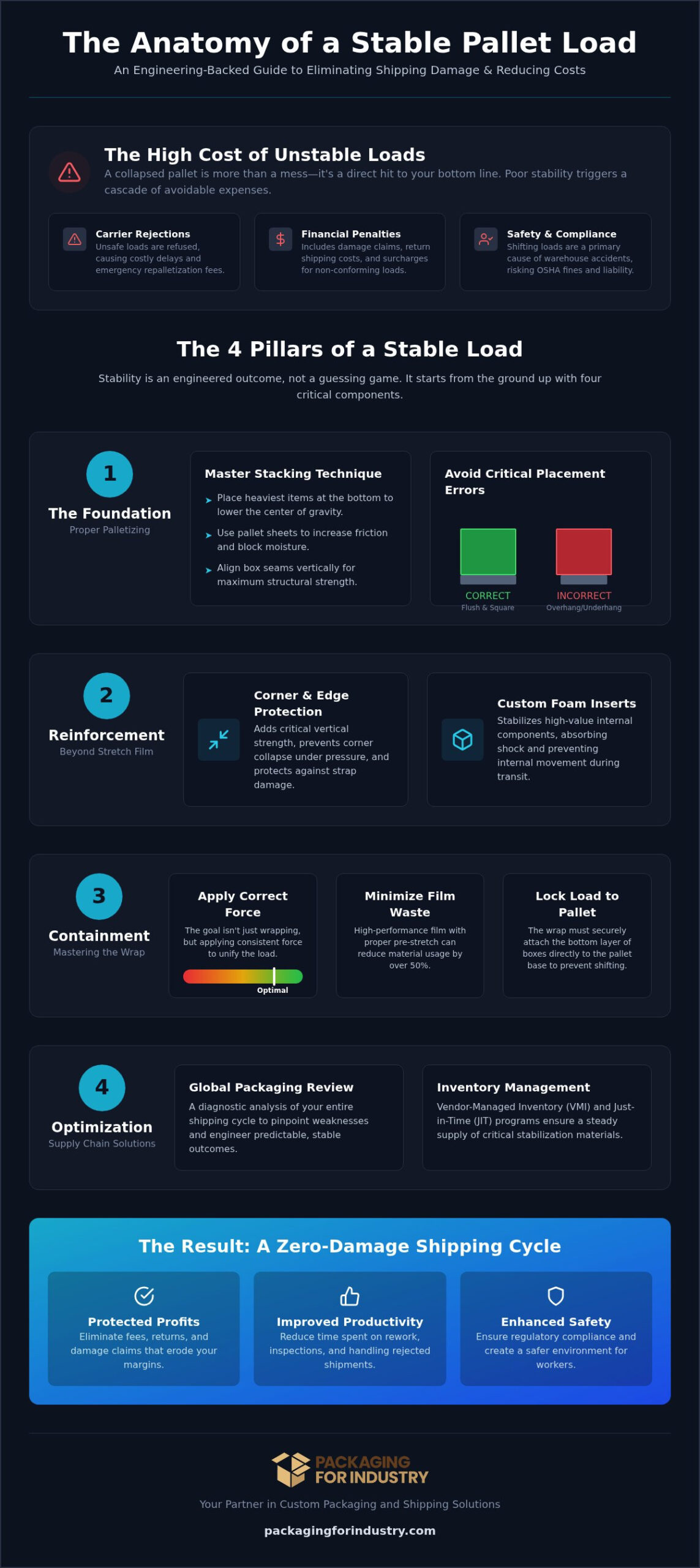
A stable load begins long before the first wrap of film is applied. Choosing the correct base is essential; while heat-treated wood pallets are necessary for international compliance, heavy-duty plastic skids offer the dimensional consistency required for automated conveyor systems. Once the base is selected, you must prioritize weight distribution. Placing the heaviest items at the bottom keeps the center of gravity low, which prevents the pallet from tipping during sharp turns in transit. This fundamental step is often overlooked, yet it’s the most effective way to prevent catastrophic load failure.
Avoiding overhang and underhang is a critical part of how to improve pallet load stability for shipping. When boxes hang over the edge, they lose the structural support of the pallet deck, often leading to corner collapse. Conversely, underhang creates gaps that allow the load to shift internally and can cause stretch film to puncture against sharp pallet edges. A square, flush load is the only way to ensure the packaging materials perform as engineered.
Mastering the Base Layer
The first layer of boxes dictates the integrity of the entire stack. We recommend using pallet sheets or corrugated pads to create a barrier against moisture and increase friction between the wood and the product. You should align the box seams vertically to maximize structural strength. Ensure every box is flush with the pallet edges to create a square, uniform footprint that the stretch film can grip effectively. If you’re dealing with irregular product footprints, requesting a quote for custom-sized pallets can eliminate these foundational gaps entirely.
Optimizing Stacking Patterns
While many warehouse teams default to interlocking or “brick” patterns, these actually reduce vertical compression strength. Column stacking, where boxes are placed directly on top of each other, utilizes the strength of the box corners to support the weight of the layers above. This is the most effective method for preventing box crush. However, if lateral shifting is a primary concern, you can use a pinwheel pattern for the top layer only to “lock” the load without compromising the entire stack’s strength. For mixed-SKU pallets, always place smaller, lighter items on top and use internal dividers to maintain a level surface for stacking. This strategic approach ensures your goods remain secure regardless of the transport method.
Beyond Stretch Film: Integrating Corner Protectors and Protective Foam
While stretch film is the most visible component of a secure load, it can’t solve foundational structural weaknesses on its own. Learning how to improve pallet load stability for shipping requires a multi-layered approach where different materials work in concert. If a load lacks vertical rigidity, excessive film tension can actually cause the boxes to buckle. Integrating secondary stabilization materials creates a unified structure that resists both vertical compression and lateral shifting. This material synergy is what separates a standard shipment from a zero-damage logistics cycle.
The Power of Corner and Edge Protection
Cardboard edge protectors act as the skeleton of your pallet load. They provide essential vertical stacking strength, allowing you to stack pallets higher in the warehouse without risking box failure. One of their primary advantages is preventing strap crush. When you apply poly or steel banding, the pressure often cuts into the corners of corrugated boxes, compromising their integrity. Edge boards distribute this force across a larger surface area. They also allow for higher stretch film tension; you can wrap the load tighter to increase containment force without damaging the product inside. Choosing between light-duty and heavy-duty corner guards depends on the weight of the load and the expected duration of the transit.
Internal Stabilization with Custom Foam
Stability isn’t just about the outside of the box. If the product moves inside its primary packaging, the entire pallet’s center of gravity shifts during transit. Utilizing custom foam inserts ensures that high-value or fragile components remain stationary. Polyethylene foam is a closed-cell material ideal for heavy-duty support and vibration dampening, while Polyurethane is an open-cell foam better suited for cushioning lighter, delicate items. For industries like aerospace and medical device manufacturing, foam end caps are vital. They suspend the product in the center of the box, ensuring that even if the pallet experiences a hard impact, the sensitive internal components remain untouched and the load remains balanced.
Friction and Pressure Distribution
Friction is a powerful tool for stability that many operations overlook. Anti-slip pallet sheets placed between layers significantly reduce horizontal shifting during truck acceleration and braking. This reduction in movement often allows you to use less stretch film while maintaining the same level of security. Additionally, using corrugated top caps or pads helps distribute the downward pressure from double-stacked pallets. This prevents the top layer of boxes from bearing the full weight of the upper pallet at four specific points, which often leads to peaking or chimney failures. By distributing this pressure across the entire surface area, you maintain the structural integrity of every box in the stack.
Mastering the Wrap: Tension, Containment Force, and Pallet Attachment
Wrapping is the final line of defense in your logistics cycle. It’s not just about covering the product in plastic; it’s about engineering a containment system that holds the load together under the stress of transit. If you want to know how to improve pallet load stability for shipping, you have to understand the difference between simple tension and containment force. Tension is how tight the film is pulled as it leaves the roll, but containment force is the combined pressure of all layers acting on the load. Achieving the right “magic number” for your specific product weight is the only way to ensure the stack doesn’t shift when the truck hits a bump or takes a sharp turn.
A critical failure point in many warehouses is the connection between the load and the pallet. Many crews wrap only the boxes, leaving the base vulnerable to lateral movement. The “Pallet Lock” technique involves wrapping the bottom layer of the load and extending the film at least three inches down onto the pallet itself. This anchors the boxes to the wood, preventing the entire stack from sliding off the pallet during sudden braking. Volume also dictates your equipment choice. Hand wrapping is suitable for low-volume operations, but it lacks the consistency required for high-stakes shipping. Machine stretch film dispensers provide repeatable containment force every time, which is vital for maintaining standards across a busy warehouse.
Achieving Proper Containment Force
You can’t manage what you don’t measure. Use a wrap gauge to test the containment force at the top, middle, and bottom of the load. Consistency is key. Heavy industrial loads require higher force, while light e-commerce shipments need carefully calibrated tension to prevent crushing the corrugated boxes. The relationship between film gauge and wrap revolutions is a balance of physics; thinner, high-performance films often provide better containment than thicker, low-grade alternatives when applied with the correct pre-stretch settings. This ensures the film is at its strongest point when it hits the load, reducing material waste and lowering your total packaging costs.
Selecting the Right Stretch Film
Choosing between blown and cast stretch film depends on your specific environment. Blown film offers superior puncture resistance for loads with sharp corners or irregular shapes, while cast film provides better clarity for scanning labels and runs quieter on machine wrappers. High-performance engineered films are designed to be stretched up to 300% before application. This pre-stretch technology allows you to get more stability with less material, offsetting the rising costs of raw materials seen throughout 2026. Over-wrapping a pallet with excessive layers is a clear sign that your film selection or machine settings are mismatched for the application.
Request a quote for a professional stretch film audit
Optimizing Your Supply Chain with PFI’s Custom Stability Solutions
Establishing a zero-damage shipping cycle is a continuous process of refinement. It requires high-quality materials and a deep understanding of load dynamics. At PFI, we function as an extension of your engineering team, providing the technical expertise needed to address specific failure points in your supply chain. When you evaluate how to improve pallet load stability for shipping, our focus remains on reducing your total cost of ownership through precision-matched materials and logistical efficiency. We don’t just sell supplies; we design systems that protect your brand’s reputation and your bottom line through expert packaging reviews.
Custom Engineering for Complex Loads
Designing custom corrugated boxes that fit your products perfectly is the first step toward a stable load. Off-the-shelf sizes often leave internal voids that allow products to shift, compromising the integrity of the entire pallet stack. We use advanced CAD/CAM prototyping to create hybrid designs that integrate protective foam and heavy-duty corrugated board. This approach is particularly effective for the aerospace and manufacturing sectors, where high-value equipment requires absolute immobility. By solving ‘unshippable’ product challenges through custom engineering, we eliminate the need for excessive secondary packaging and reduce your freight costs. Our prototyping process allows you to test stability before committing to a full production run, ensuring the final solution is both effective and economical.
Seamless Procurement and Local Reliability
Reliability in the supply chain depends on having the right materials exactly when you need them. Our Vendor Managed Inventory (VMI) programs prevent stabilization supply shortages by placing PFI in charge of your stock levels. This system frees up your warehouse space and capital, allowing your team to focus on production rather than procurement. For manufacturers in Anaheim, Orange County, and Los Angeles, our local presence ensures rapid response times and next-day delivery on critical supplies. We provide the stability of a steady partner who understands the local logistical landscape and the pressure of tight distribution windows. This proactive approach to inventory management eliminates the professional stress of stock-outs and ensures your shipping floor never stops moving.
Secure Your Logistics Cycle with Engineered Stabilization
Achieving a zero-damage shipping cycle depends on more than just the volume of stretch film used. It requires a methodical approach that combines proper column stacking, the integration of corner protection, and the calculation of actual containment force. Mastering how to improve pallet load stability for shipping involves shifting your focus from material quantity to material synergy. This transition protects your inventory while eliminating the financial drain of carrier rejections and high insurance premiums.
PFI provides the specialized resources necessary to implement these optimizations without disrupting your daily operations. Our team offers free prototyping for custom designs and expert VMI program management to ensure your facility remains stocked with critical stabilization supplies. For manufacturers and distributors in Southern California, our local next-day delivery provides the logistical speed required to maintain a high-performance supply chain.
We’re ready to help you transform your shipping floor into a center of efficiency, safety, and long-term reliability.
Frequently Asked Questions
What is the most effective way to secure a pallet for shipping?
The most effective method involves a combination of structural stacking and calibrated containment force. You should start with a column stack to maximize vertical strength and use anti-slip sheets between layers to prevent lateral movement. Once the load is square, apply high-performance stretch film that anchors the boxes directly to the pallet base. This integrated strategy is the best way to learn how to improve pallet load stability for shipping while reducing material waste.
How many layers of stretch wrap should be used on a pallet?
There is no universal number of layers because stability depends on the film’s containment force and pre-stretch ratio. Generally, heavy industrial loads require more revolutions at the base and top to ensure a secure anchor. Instead of counting layers, you should use a wrap gauge to measure the total pressure exerted on the load. This ensures you aren’t over-wrapping, which leads to unnecessary material costs without adding actual security or protecting the bottom line.
What is containment force and how do I measure it?
Containment force is the total amount of pressure that the stretch film applies to the load to keep it together. It’s the cumulative effect of the film’s thickness, tension, and the number of layers applied. You measure this using a digital or mechanical wrap gauge by inserting the tool under the film and pulling it away from the load. This provides a specific pound-force reading that helps you maintain consistency across all shipments and prevents load failure.
Are corner protectors necessary for every palletized load?
Corner protectors aren’t mandatory for every shipment, but they are essential for loads requiring high containment force or vertical stacking. These protectors provide the structural rigidity needed to prevent boxes from buckling under the pressure of tight stretch film. They also distribute the weight of double-stacked pallets across the entire footprint. If your products are prone to corner collapse, integrating edge boards is a pragmatic solution for long-distance transit and warehouse storage.
How do I prevent boxes from sliding off a pallet during transit?
You can prevent sliding by utilizing the “Pallet Lock” technique and increasing friction between layers. Ensure the stretch film extends at least three inches down onto the pallet deck to anchor the load to the wood base. Additionally, placing anti-slip pallet sheets between box layers stops the internal shifting that often leads to a leaning pallet. These combined steps ensure the entire unit moves as a single, stable block during truck acceleration and braking.
Can custom foam inserts improve the stability of my shipping pallets?
Custom foam inserts significantly improve stability by eliminating movement inside individual boxes. When internal components shift, the pallet’s center of gravity changes, which can lead to load failure or collapse. By using precision-cut Polyethylene or Polyurethane foam, you ensure that high-value items remain stationary. This internal security complements your external wrapping efforts, making it a critical part of how to improve pallet load stability for shipping for sensitive equipment like medical devices or aerospace components.
What is the difference between hand wrap and machine stretch film?
The primary difference lies in the film’s stretch capacity and application consistency. Hand wrap is designed for manual application and typically has a lower pre-stretch ratio, making it suitable for low-volume or irregular loads. Machine stretch film is engineered to be pulled up to 300% by automated equipment, which maximizes material efficiency and provides a repeatable containment force. High-volume operations should prioritize machine film to ensure every pallet meets the same safety and structural standards.
How does pallet overhang affect load stability and safety?
Pallet overhang occurs when boxes extend beyond the edge of the pallet deck, which removes the structural support from the corners. This often leads to box failure as the weight of the stack bears down on unsupported edges. Overhang also increases the risk of the load shifting or striking other pallets in a trailer. To maintain safety, you must ensure the load is flush with the pallet edges or use custom-sized pallets for larger products.