
The lowest unit price on your packaging invoice is often the most expensive mistake your procurement team can make. While a cheaper corrugated box looks like a win on paper, the true cost is hidden beneath the surface in the form of transit damage, wasted warehouse floor space, and rising fuel surcharges. You likely feel the pressure of tightening margins, especially with North American containerboard prices increasing by $100 per ton in the first half of 2026. Learning how to calculate total cost of ownership for packaging is the only way to stop these invisible drains from eroding your profitability.
This guide moves you past the unit price to implement a data-driven TCO framework that accounts for everything from labor costs to current landfill tipping fees. We’ll show you how to identify hidden surcharges and optimize your storage strategy to reduce overall logistics spend. You’ll gain a clear formula to justify smarter packaging investments that improve supply reliability and reduce shipping damage. By analyzing the intersection of engineering and economics, you can finally take control of your end-to-end operational costs and find the peace of mind that comes with a stabilized supply chain.
Key Takeaways
- Identify the “Iceberg Effect” where the unit price of materials represents only a small fraction of your true operational expenditure.
- Account for indirect labor costs by measuring the time and personnel required for assembly, packing, and sealing within your facility.
- Quantify the multiplier effect of transit damage to understand how a single failed shipment impacts your administrative overhead and reverse logistics spend.
- Learn how to calculate total cost of ownership for packaging by evaluating inventory carrying costs and the fiscal impact of warehouse floor space.
- Implement a structured five-step audit to review historical packaging data and identify immediate opportunities to lower your overall logistics spend.
Beyond the Invoice: Defining Total Cost of Ownership in Packaging
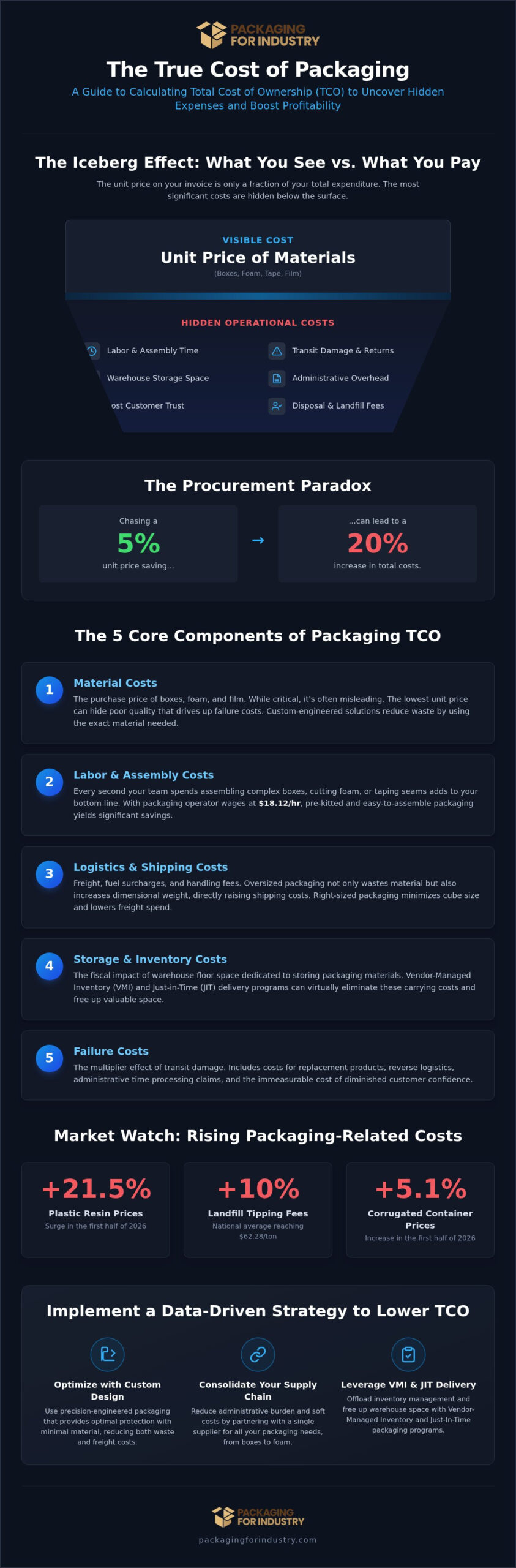
Procurement teams often fall into the trap of focusing solely on the unit price of a box or a roll of stretch film. While the invoice price is easy to track, it only represents the tip of the “Iceberg Effect.” The vast majority of expenses are submerged, hidden in operational inefficiencies, labor overhead, and transit failures. Understanding how to calculate total cost of ownership for packaging requires looking past the line item on your purchase order to see the entire lifecycle of the material.
In an industrial context, Total Cost of Ownership (TCO) is the comprehensive financial estimate of all direct and indirect expenses associated with a packaging material throughout its entire lifecycle, from procurement and assembly to transit and disposal. When you only focus on material price, you risk the TCO paradox: a five percent saving on corrugated material can easily lead to a twenty percent increase in total costs if those boxes are slower to assemble or fail during transit. To get an accurate picture, you must categorize costs into five key areas: material, labor, logistics, storage, and failure costs.
The Material Cost Trap
The lowest bid often results in the highest TCO. If you’re shipping high-value aerospace components or sensitive medical equipment, a standard stock box might seem economical. However, these generic solutions often lack the structural integrity required for heavy industrial use. Choosing a 275# double-wall corrugated box over a cheaper single-wall alternative might increase your material spend, but it drastically reduces the “failure costs” associated with crushed products. At Packaging For Industry (PFI), we emphasize custom design packaging because precision-engineered solutions use exactly the amount of material needed to protect your goods, eliminating the waste inherent in oversized stock sizes.
The Role of Procurement Efficiency
Procurement efficiency isn’t just about price negotiation; it’s about reducing soft costs. Managing a dozen different vendors for tape, foam, and corrugated boxes creates a massive administrative burden. Every purchase order, invoice reconciliation, and delivery coordination adds to your overhead. Consolidating your supply chain with a local Southern California partner reduces these hidden administrative expenses. By utilizing services like vendor-managed inventory (VMI), you can offload the management of stock levels and storage, ensuring you only pay for what you need while maintaining a streamlined operational flow.
Breaking Down Direct vs. Indirect Packaging Costs
Calculating the true expense of your shipping operations requires a granular look at both line-item material costs and the “soft” costs that never appear on a supplier’s invoice. Direct costs are the most visible, representing the purchase price of materials such as RSC boxes (Regular Slotted Containers), foam packaging, and stretch film. These prices are currently volatile; in the first half of 2026, corrugated shipping container prices rose 5.1%, while plastic resin prices surged by 21.5%. While these figures are critical, they only tell part of the story when you analyze how to calculate total cost of ownership for packaging.
Indirect costs often represent the largest portion of the TCO total. Labor is the primary driver here. With the average hourly wage for packaging operators reaching $18.12 in August 2026, every extra second spent folding a box or taping a seam adds to your bottom line. Beyond labor, you must account for disposal fees. National landfill tipping fees have increased by 10% recently, averaging $62.28 per ton. If your packaging is difficult to recycle or excessively bulky, your customers or your own facility are paying a premium just to throw it away.
Labor and Assembly Efficiency
Efficiency in the warehouse is measured in seconds of throughput. If your team is manually cutting foam or hunting for matching components, your production speed drops. High-volume operations benefit significantly from packaging kitting services and the use of pre-cut corner boards to stabilize loads faster. By receiving pre-assembled kits, you eliminate the time-motion waste of multi-step assembly. This proactive approach allows you to lower packaging costs by reducing the headcount or hours required to move a product from the shelf to the truck.
Freight and DIM Weight Optimization
Logistics costs are currently under heavy pressure from volatile energy prices. As of August 2026, UPS domestic ground fuel surcharges sit at 27.00%, while air surcharges have reached 29.25%. These fees are applied to the dimensional (DIM) weight of the package, not just the physical weight. If you use a box that’s three inches too large, you aren’t just paying for extra corrugated material; you’re paying to ship air at a premium rate. Having custom sizes available ensures you aren’t hit with oversized surcharges that can dwarf the material cost of the box itself.
The Cost of Failure: Evaluating Damage and Returns
Transit damage is the most volatile variable in any logistical budget. While you can negotiate a fixed price for corrugated materials, you cannot easily predict the financial impact of a pallet being mishandled in a cross-dock facility. This is why how to calculate total cost of ownership for packaging must prioritize failure rates. A damaged product triggers a chain reaction of expenses that often exceed the original value of the item itself. When a high-value component is destroyed in transit, the replacement process often doubles the initial investment when you factor in the wasted time of your customer service, engineering, and warehouse teams.
Beyond the physical loss of the product, you must account for the “Invisible Cost” of brand erosion. If a customer receives a compromised medical device or a sensitive electronic assembly, the professional stress and operational delays can lead to lost future contracts. These administrative overheads, including processing the claim, inspection labor, and the lost margin on the original sale, are the true drivers of high TCO. They represent a significant drain on resources that a simple unit-price comparison fails to capture.
Calculating the True Cost of a Return
To understand the financial impact of transit failures, use this formula: Replacement cost + Freight out + Freight back + Labor (inspection and repacking) + Lost margin. For manufacturers in specialized sectors, adhering to mil-spec packaging standards is not just about compliance; it is a critical component of damage prevention. Implementing custom design packaging acts as a preventative measure. It ensures that the protective solution is engineered for the specific weight and fragility of your product rather than relying on generic stock options that offer inadequate protection during the rigors of multi-modal transport.
Prototyping as an Insurance Policy
High-quality materials often carry a higher upfront price, but they pay for themselves by eliminating failure. Prototyping allows your team to test material density, such as choosing between polyethylene (PE) and polyurethane (PU) foam, to ensure specific G-force protection for your specific product geometry. At PFI, we provide prototyping to ensure a perfect product fit before a full rollout. Utilizing custom-engineered protective foam packaging ensures your goods survive the vibration and impact of long-haul shipping. This is a critical step in mastering how to calculate total cost of ownership for packaging and protecting your long-term bottom line from the high cost of replacement cycles.
Operational Flow: Storage, VMI, and Inventory Carrying Costs
Warehouse floor space is a finite financial asset. Every pallet of bulky corrugated boxes or rolls of stretch film sitting in your facility represents capital that isn’t working for your business. When you evaluate how to calculate total cost of ownership for packaging, you must include inventory carrying costs as a primary variable. This calculation includes the physical cost of the square footage and the cost of capital. With the prime interest rate at 6.75% as of August 2026, tying up cash in twelve months of stock just to secure a bulk discount is often a net loss. You also face the risk of obsolescence; if your product specifications change, that pre-purchased inventory becomes a total loss that must be disposed of at rising landfill rates.
The Financial Benefits of VMI
Implementing vendor managed inventory services shifts the storage burden back to the supplier. This model improves your cash flow by ensuring you only pay for packaging as you use it, rather than maintaining a massive, stagnant stockpile. It also reduces soft costs by minimizing the number of purchase orders your procurement team processes annually. Instead of managing dozens of individual transactions and tracking lead times, VMI provides a streamlined flow that eliminates stockouts. A production line stoppage due to a lack of custom foam or shipping boxes is a massive TCO failure that a proactive inventory program prevents.
Local vs. National Supply Chains
Proximity is a critical factor in your logistics TCO. National catalog suppliers often ship from distant hubs, which leads to high freight costs and unpredictable lead times. As established, UPS domestic ground fuel surcharges reached 27.00% in August 2026. A local partner provides a strategic advantage by offering next-day delivery across Orange County and Los Angeles. Our Anaheim location serves as a strategic hub that allows Southern California manufacturers to operate with minimal on-hand stock. This proximity reduces freight TCO and enables a Just-In-Time (JIT) delivery model. By receiving smaller, frequent shipments, you keep your warehouse floor clear for revenue-generating production and eliminate the hidden costs of long-distance logistics. This approach is essential for any business learning how to calculate total cost of ownership for packaging while maintaining a lean operational footprint.
5 Steps to Calculate Your Total Packaging Cost
Transforming your packaging from a reactive expense into a strategic asset requires a structured analytical approach. You cannot optimize what you do not measure. By following a methodical audit process, you can uncover the hidden leaks in your logistics budget and stabilize your operational flow. If you are ready to learn how to calculate total cost of ownership for packaging, implement these five actionable steps:
- Step 1: Audit your last 12 months of packaging invoices. Establish a baseline for your material spend across all categories, ensuring you include secondary supplies like tape, stretch film, and corner boards.
- Step 2: Track your damage rates and the full cost of returns. Quantify the financial impact of every transit failure, including the administrative hours spent processing claims and the lost margin on replacement units.
- Step 3: Measure packing labor and warehouse allocation. Use the labor benchmarks discussed earlier to calculate the time spent on assembly and assess the cost of floor space occupied by stagnant inventory.
- Step 4: Analyze freight bills for DIM weight surcharges. Identify where oversized RSC boxes are triggering expensive dimensional weight penalties, which often represent a significant portion of hidden logistics spend.
- Step 5: Partner with a consultant for a packaging cost-reduction analysis. Professional oversight can identify engineering opportunities, such as material density shifts, that internal teams often overlook.
Creating a TCO Scorecard
A TCO scorecard shifts your focus from the “Cost per Box” to the “Cost per Shipped Unit.” This distinction is critical because it accounts for every variable that touches the product before it reaches the end user. Your scorecard should track key performance indicators (KPIs) such as damage reduction percentages, inventory turn rates, and assembly throughput speeds. Implementing a TCO scorecard changes procurement strategy from a price-per-unit mentality to a system-wide optimization approach. This data allows you to lower packaging costs by justifying higher-quality protective materials that prevent expensive replacement cycles.
Next Steps: Requesting a Custom Quote
To move from calculation to implementation, you need a partner who understands the intersection of engineering and economics. Providing detailed data on your current failure rates and throughput challenges allows a supplier to provide a more accurate TCO estimate. We recommend an on-site packaging review to observe your warehouse flow and kitting process firsthand. This consultative approach ensures that any proposed solution is tailored to your specific industrial needs. Because we have custom sizes available for all corrugated and foam products, we can eliminate the excess void fill that leads to freight surcharges. We encourage you to request a packaging quote to begin your comprehensive TCO analysis and secure your supply chain against rising operational costs.
Secure Your Supply Chain with Data-Driven Packaging
Managing industrial logistics in Southern California requires a shift from focusing on the invoice price to mastering the total lifecycle of your materials. By identifying hidden drains like DIM weight surcharges and excessive warehouse carrying costs, you can stabilize your margins even as raw material prices fluctuate. Learning how to calculate total cost of ownership for packaging provides the roadmap needed to eliminate professional stress and ensure your products arrive intact.
PFI offers the specialized expertise in aerospace and industrial logistics required to optimize these complex variables. We provide free prototyping for custom designs to ensure a perfect fit before you commit to a full production run. With local next-day delivery across Orange County and Los Angeles, we are ready to help you lower your overall logistics spend and improve your supply reliability.
Take the first step toward a more efficient operation and gain the peace of mind that comes with a stabilized bottom line.
Frequently Asked Questions
What is the difference between price and total cost of ownership in packaging?
Price is simply the invoice amount paid for materials, while total cost of ownership includes every expense from procurement through disposal. Understanding how to calculate total cost of ownership for packaging involves looking at “submerged” expenses like assembly labor, storage overhead, and transit failures. A low unit price often hides high operational inefficiencies that drain your profitability. TCO provides a comprehensive financial view of your entire logistical flow.
How much does transit damage typically add to packaging TCO?
Transit damage acts as a cost multiplier that can triple the initial value of the lost item. Beyond the physical product cost, you must account for reverse logistics, inspection labor, and administrative processing. For high-value sectors like aerospace, a single failure can disrupt production timelines and damage long-term customer contracts. These hidden failure costs are often the largest variable in a manufacturer’s total logistical expenditure.
Can custom packaging actually lower my total costs?
Custom-engineered solutions reduce costs by eliminating the waste and surcharges associated with oversized stock boxes. Custom sizes ensure you use only the necessary amount of corrugated material and protective foam, which lowers the physical weight and optimizes pallet density. This precision engineering prevents transit damage and reduces the time your team spends on manual assembly, directly lowering your total cost of ownership for packaging through improved throughput.
How does dimensional weight (DIM) affect my packaging budget?
DIM weight pricing shifts your shipping costs from physical weight to the volume of space a package occupies. If you use a box that is larger than necessary, carriers will charge you for the extra air. With fuel surcharges currently exceeding 27%, shipping oversized boxes can double your freight bills. Optimizing box dimensions is a critical step in controlling your end-to-end logistical spend and maintaining predictable shipping margins.
What are the hidden costs of managing multiple packaging vendors?
Managing multiple vendors creates a heavy administrative burden that increases your “soft” costs. Every additional supplier requires a separate purchase order, invoice reconciliation, and delivery coordination. This fragmentation leads to inconsistent lead times and higher freight totals. Consolidating your supply chain with a single local partner reduces these overheads and allows for better volume pricing on essential items like stretch film, pallets, and corner boards.
How can a VMI program help reduce my packaging TCO?
A vendor-managed inventory (VMI) program reduces TCO by offloading the financial burden of storage and inventory management to the supplier. You only pay for materials as you consume them, which improves your cash flow and frees up valuable warehouse floor space. This model also eliminates the risk of stockouts that can halt your production line, ensuring that critical supplies are always available for just-in-time assembly and shipping.
Is it better to buy packaging in bulk or use a just-in-time model?
A just-in-time (JIT) model is generally more cost-effective for industrial manufacturers due to the current high cost of capital. Tying up cash in bulk stock increases your inventory carrying costs and the risk of material obsolescence. By receiving smaller, frequent deliveries from a local Southern California hub, you maintain a lean operational footprint. This approach minimizes storage fees and keeps your working capital available for other business-critical investments.
How do I justify a higher material cost to my CFO?
Justify higher material investments by presenting a TCO scorecard that highlights the reduction in failure and labor costs. Show how a more durable double-wall corrugated box or precision-cut foam insert prevents expensive transit damage and customer returns. Highlighting the intersection of engineering and economics demonstrates that spending more on quality materials upfront leads to a lower overall logistics spend and protected profit margins over the long term.