
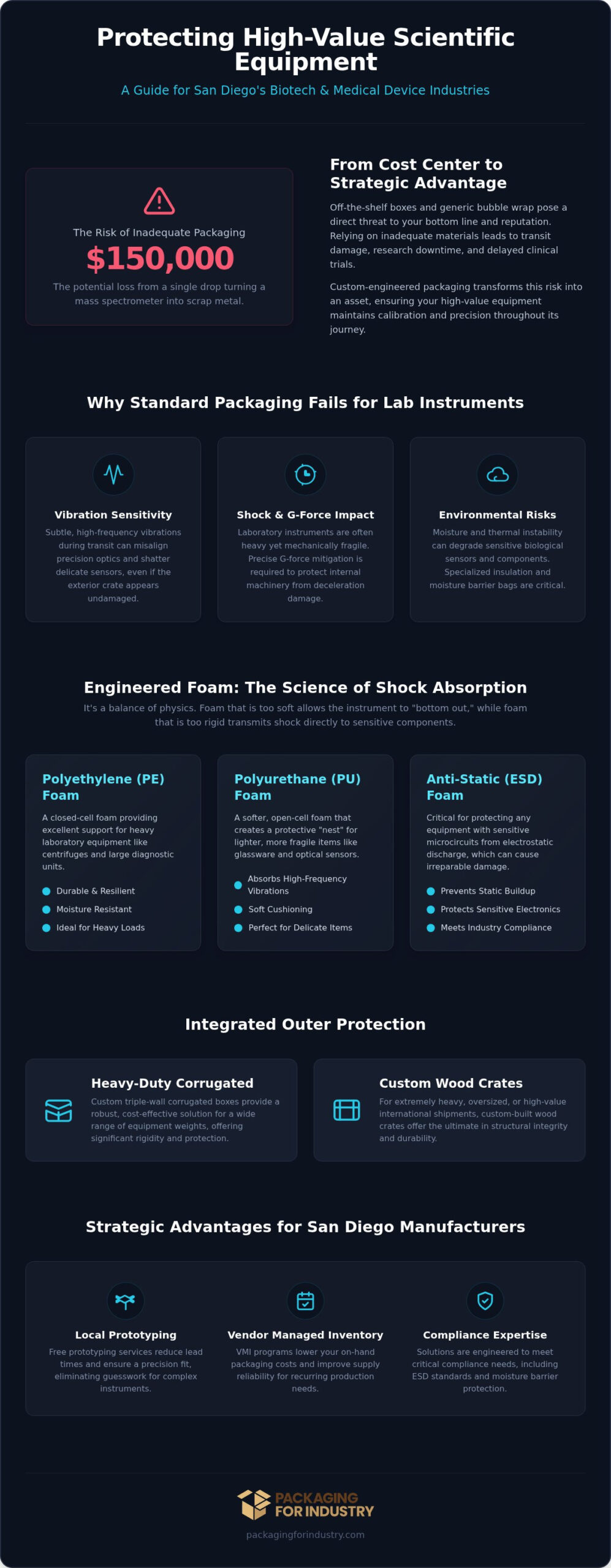
A single drop during transit can turn a $150,000 mass spectrometer into a pile of scrap metal and months of lost research. For San Diego’s biotech and medical device manufacturers, the financial and operational stakes of logistics are exceptionally high. You understand that off-the-shelf boxes and generic bubble wrap don’t provide the shock absorption required for high-value laboratory instruments. Relying on inadequate materials isn’t just a shipping risk; it’s a threat to your bottom line and your reputation for reliability.
Securing professional packaging for sensitive scientific equipment San Diego requires a move away from catalog-grade supplies toward precision engineering. This guide demonstrates how custom-designed solutions, from ESD-safe foam to heavy-duty corrugated crates, eliminate transit damage and reduce total shipping costs. We’ll preview the technical requirements for medical-grade protection and explain how local prototyping and vendor-managed inventory can accelerate your speed to market while ensuring total equipment safety. By focusing on the intersection of engineering and economics, you can transform your packaging from a cost center into a strategic advantage.
Key Takeaways
- Learn how custom-engineered foam density and material selection prevent vibration damage to high-value mass spectrometers and diagnostic devices.
- Identify the critical compliance requirements for packaging for sensitive scientific equipment San Diego, including ESD standards and moisture barrier protection.
- Evaluate the cost-benefit of using custom wood crates versus heavy-duty triple-wall corrugated boxes for different equipment weight classes.
- Discover how local Southern California support and free prototyping services reduce lead times and ensure a precision fit for complex medical instruments.
- Understand how Vendor Managed Inventory (VMI) programs can lower your packaging costs and improve supply reliability for recurring production needs.
The Stakes of Shipping Sensitive Scientific Equipment in San Diego
San Diego’s life sciences sector is a global powerhouse. Companies in Sorrento Valley and Torrey Pines develop instruments that cost more than a high-end luxury car. When you’re moving a mass spectrometer or a complex diagnostic laser, the margin for error is non-existent. Standard shipping methods often fail to account for the intricate internal components that define these devices. A single impact can misalign optics or shatter delicate sensors, leading to catastrophic failure upon arrival. This is why specialized packaging for sensitive scientific equipment San Diego is a non-negotiable requirement for local manufacturers.
The true cost of transit damage extends far beyond the immediate repair bill. For a biotech startup, a damaged instrument means weeks of research downtime. It can delay clinical trials or lead to missed milestones with investors. Custom-engineered solutions ensure that your equipment maintains its calibration and precision throughout the entire freight journey. You aren’t just buying a box; you’re protecting your intellectual property and your company’s reputation for reliability.
Unique Fragility Factors for Lab Instruments
Laboratory instruments are often heavy but mechanically fragile. High-precision devices require advanced shock and vibration protection to survive the rigors of the road. Even if the exterior crate looks intact, internal optical alignments can be compromised by subtle, high-frequency vibrations. Thermal stability is another factor. Some biological sensors require moisture barrier bags or specialized insulation to prevent degradation during transport. We focus on G-force mitigation, ensuring that even if a crate is handled roughly, the internal machinery experiences deceleration levels well within its tolerance.
San Diego’s High-Tech Shipping Environment
Operating in San Diego’s biotech corridor requires a logistics partner that understands the local environment. Moving equipment from a lab in La Jolla to an international hub involves multiple touchpoints where damage can occur. Many firms make the mistake of using “off-the-shelf” boxes to save money. This strategy often backfires, resulting in higher long-term costs due to claims and replacements. Choosing the right packaging for sensitive scientific equipment San Diego isn’t just about buying supplies; it’s about securing a reliable engineering partner.
PFI provides the local Southern California support needed for fast-paced development cycles. We offer custom design packaging that fits your specific device perfectly. Our proximity to San Diego means we can offer faster turnaround times for protective foam and heavy-duty corrugated boxes. For manufacturers in industrial sectors, having a partner just a short drive away ensures that your supply chain remains resilient and your high-value assets remain protected.
Engineering Custom Foam Inserts for Vibration and Shock Protection
Protecting high-value instruments requires more than just filling a box with cushioning. It’s about engineering a controlled environment that manages the physics of deceleration. When we design packaging for sensitive scientific equipment San Diego, we calculate the exact shock levels your device can withstand before internal components fail. If the foam is too soft, the instrument will “bottom out” against the hard outer shell during a drop. If it’s too rigid, the shock energy is transmitted directly to the delicate internal sensors. Finding the “sweet spot” in foam density is the difference between a successful delivery and a costly insurance claim.
Material selection is the first step in this engineering process. Polyethylene (PE) is a closed-cell foam that provides excellent support for heavy laboratory gear, such as centrifuges or large-scale diagnostic units. It’s durable and resists moisture, making it ideal for long-haul freight. For lighter, more fragile items like glassware or optical sensors, open-cell Polyurethane (PU) offers a softer “nest” that absorbs high-frequency vibrations. We also integrate anti-static (ESD) foam for any equipment containing sensitive microprocessors to prevent latent electrical damage that can occur even without physical impact.
Selecting the Right Foam Density
Precision shipping relies on calculating static loading. This involves determining the weight of the instrument relative to the surface area of the foam it rests upon. Proper loading ensures the equipment “floats” within the container, effectively isolating it from road vibration. Our team helps you select between custom die-cut inserts for high-volume production and convoluted “egg-crate” foam for versatile, low-volume needs. You can explore our full range of Custom Foam Packaging options to see which material best suits your specific instrument profile.
Prototyping and CAD Design
Scientific instruments often have complex geometries that won’t fit into standard square cavities. We use CAD/CAM technology to design precise nesting solutions that support every protruding dial, lens, and connector. Before moving to full-scale production, we provide free prototyping to ensure a perfect fit and verify that the design meets the rigorous testing protocols of the International Safe Transit Association (ISTA). This proactive approach eliminates the guesswork and ensures your gear is protected against the specific G-forces it will encounter in the field. If you’re ready to secure your supply chain, request a packaging quote to begin the design process.
Integrated Solutions: Custom Crates and Heavy-Duty Corrugated
Structural integrity starts with selecting the right outer container to complement the internal foam engineering. For those procuring packaging for sensitive scientific equipment San Diego, the choice between timber and fiberboard depends on the unit’s weight and the logistics route. We often incorporate corner boards to protect against strap damage and significantly increase the stacking strength of palletized lab instruments. This integrated approach ensures that even under the stress of double-stacking in a warehouse, your high-value diagnostic tools remain protected from external crushing forces.
The engineering goal is to eliminate movement. Even a small amount of “play” inside a box can lead to cumulative damage over thousands of miles. By combining high-strength outer shells with precision-engineered internals, we create a unified system that manages both impact and vibration. This integrated approach is essential for maintaining the calibration of sensitive diagnostic tools and high-value research assets.
Custom Wood Crates for High-Value Transit
Wood crates provide the ultimate rigid exoskeleton for instruments valued in the six-figure range. These aren’t simple boxes; they’re custom-built environments that neutralize external impact. We use heat-treated lumber to ensure compliance with ISPM-15 export regulations, preventing costly delays during international scientific collaborations. By Engineering Custom Crates for International Transit, we provide the durability required for ocean freight and rough handling at intermodal hubs.
Heavy-Duty Corrugated for Daily Logistics
Triple-wall corrugated offers a lighter, more agile alternative for mid-weight devices. These Custom Corrugated Boxes provide surprising puncture resistance and high bursting strength. We have custom sizes available to match the specific footprint of your equipment, which is a critical strategy to eliminate “dead space.” Reducing the exterior dimensions not only prevents the instrument from shifting but also helps you lower packaging costs by avoiding FedEx and UPS dimensional weight surcharges.
Our team helps you compare packaging pricing across different material combinations to find the most efficient balance of protection and cost. Whether you need a standard RSC box for high-volume consumables or a hybrid foam-lined crate for a prototype laser, we provide the technical expertise to secure your supply chain. Having these integrated solutions ready for local delivery ensures your San Diego facility maintains its operational flow without the risk of transit damage.
Compliance and Standards for Scientific and Medical Logistics
Adhering to rigorous engineering standards is essential when handling high-value laboratory assets. For manufacturers of diagnostic tools and biotech devices, packaging for sensitive scientific equipment San Diego must address more than just physical impact. You also need to account for invisible threats like electrostatic discharge (ESD) and environmental degradation. Failing to meet these compliance standards doesn’t just risk the equipment; it can lead to regulatory delays and contract penalties, especially in government-funded research or clinical environments.
ESD and Cleanroom Protection
Sensitive circuitry requires specialized shielding to prevent latent electrical damage. We distinguish between static shielding bags, which protect against external electrical fields, and anti-static poly bags that merely prevent friction-based charging. In high-precision environments, particulate contamination is another major concern. Standard packaging materials can shed fibers or outgas chemical vapors that ruin sensitive optical alignments. We provide cleanroom-compatible foam inserts and vacuum-sealed moisture barrier bags paired with desiccants to ensure your equipment remains sterile and dry during sea-freight or storage in humid climates.
For San Diego firms working on defense or aerospace projects, mil-spec packaging is often a mandatory requirement. These specifications ensure that materials can withstand extreme conditions while maintaining clear labeling for high-value scientific cargo. Whether you’re shipping across the Sorrento Valley corridor or to an international research facility, using compliant materials is the only way to guarantee the integrity of your results.
The Procurement Checklist for San Diego Lab Managers
Purchasing and operations teams need a streamlined approach to secure packaging for sensitive scientific equipment San Diego. This checklist helps you identify the critical requirements for your next shipment:
- Step 1: Identify weight and fragility G-rating. Determine the maximum shock levels your device can handle before losing calibration.
- Step 2: Determine environmental exposure. Assess if the route involves high humidity, extreme temperature fluctuations, or cleanroom delivery.
- Step 3: Verify local San Diego delivery or VMI needs. Check if your production volume requires a Vendor Managed Inventory (VMI) program for consistent supply.
- Step 4: Request a packaging quote
Why San Diego Firms Partner with Packaging For Industry (PFI)
San Diego manufacturers often face a significant scaling challenge. While your primary R&D facility might be in Sorrento Valley or Torrey Pines, your distribution network likely spans the entire country. PFI bridges this gap by combining local Southern California agility with nationwide shipping capabilities. This means you get the benefit of local next-day delivery for your San Diego production line while relying on a partner who can support your logistics hubs across the U.S. It’s a pragmatic approach that simplifies your vendor list and ensures consistent packaging for sensitive scientific equipment San Diego for every instrument you ship.
Efficiency isn’t just about the box; it’s about the financial bottom line. We work with operations managers to lower packaging costs by auditing current shipping workflows and identifying material waste. When you compare packaging pricing, you’ll find that our custom-tailored response provides better fiscal value than one-size-fits-all catalog options. We prioritize transparency and reliability, ensuring that your high-value assets are protected by a system that’s both engineering-minded and economically optimized.
Optimizing Your Supply Chain
Production stops are unacceptable in medical device manufacturing. Our Vendor Managed Inventory (VMI) program eliminates the risk of stockouts. We monitor your usage levels and replenish your stock of custom foam inserts and heavy-duty crates before you run low. This Just-In-Time (JIT) approach allows you to stock packaging off-site, freeing up valuable lab space for revenue-generating activities. It’s a reliable solution for firms that need to maximize their operational efficiency without sacrificing protection.
Request Your Custom Scientific Packaging Quote
Precision engineering requires direct communication. When you partner with PFI, you gain direct access to our engineering team for your San Diego projects. We have custom sizes available for any instrument profile, ensuring a perfect fit every time. We offer fast turnaround on prototypes and small-batch custom runs to ensure your instruments are secure before you commit to a full production rollout. This reduces buyer anxiety and guarantees that your packaging meets every technical specification from the initial design phase to final delivery.
Protect Your Precision Instruments with Local Engineering Expertise
Securing high-value assets requires a shift from generic supplies to engineered systems. We’ve reviewed how calculated foam density and rigid structural shells work together to neutralize transit shocks and vibrations. Adhering to ESD and Mil-Spec standards ensures your gear arrives calibrated and ready for immediate operation. PFI provides the specialized packaging for sensitive scientific equipment San Diego that biotech and medical manufacturers need to protect their bottom line and research schedules.
Our team offers free prototyping and CAD design support to eliminate fitting errors before your equipment leaves the facility. By utilizing local Southern California next-day delivery and Vendor Managed Inventory, you can reclaim valuable lab space while maintaining a resilient supply chain. These proactive measures turn packaging from a recurring expense into a strategic asset for your logistics operation. We’re committed to helping you find the perfect balance between maximum protection and fiscal responsibility.
Ensuring your instruments reach their destination in perfect condition is our priority. We’re ready to help you optimize your shipping process and eliminate the stress of transit damage. Reach out today to start your next project with a partner who understands the precision your industry demands.
Frequently Asked Questions
What is the best foam for shipping sensitive electronic lab equipment?
Anti-static (ESD) polyurethane or polyethylene foam is the industry standard for electronic lab gear. Polyurethane is open-cell and ideal for lightweight, highly fragile sensors because it provides superior vibration dampening. Polyethylene is closed-cell and better for heavier units that require rigid support. We engineer custom foam inserts that prevent latent electrical damage while ensuring the equipment remains perfectly nested during transit.
Do you provide custom crates for international scientific shipping in San Diego?
Yes, we manufacture custom wood crates that are fully compliant with ISPM-15 heat-treatment standards for international export. These crates are essential for shipping high-value instruments to overseas research partners. Our San Diego clients benefit from local manufacturing, which ensures fast turnaround times and a precise fit for packaging for sensitive scientific equipment San Diego. We also offer foam lining for maximum impact protection during long-haul freight.
Can you design packaging that meets ESD and anti-static requirements?
We provide a full range of ESD-compliant materials, including static shielding bags and anti-static poly bags. These solutions are critical for protecting internal circuitry from electrical discharge. Our engineering team also utilizes pink anti-static foam to ensure that the cushioning material itself doesn’t generate friction-based static. This comprehensive approach prevents both physical and latent electrical damage to your most sensitive laboratory instruments and diagnostic tools.
How does custom packaging help reduce UPS and FedEx shipping surcharges?
Custom-sized boxes eliminate dead space, which directly reduces the dimensional weight of your parcels. Carriers like FedEx and UPS charge based on the box volume if it exceeds the actual weight. By designing a box that fits your equipment’s specific footprint, we help you lower packaging costs and avoid unnecessary surcharges. This precision engineering ensures you aren’t paying to ship air across your distribution network.
Do you offer free prototypes for custom scientific equipment packaging?
Yes, we offer free prototyping and CAD design support for all custom scientific packaging projects. This allows you to verify the fit and shock absorption of the design before committing to a full production run. Our team uses precise CAD/CAM technology to create a nesting solution that supports every dial and lens. This proactive step reduces buyer anxiety and ensures the final packaging for sensitive scientific equipment San Diego meets your exact specifications.
What is the typical lead time for custom foam inserts in Southern California?
Our local presence in Southern California allows us to offer significantly shorter lead times than national catalog suppliers. While specific timelines depend on the complexity of the CAD design, our proximity to San Diego enables us to provide local next-day delivery for many recurring orders. We prioritize fast turnaround for prototypes and small-batch custom runs to keep your biotech research and production schedules on track without delay.
Can PFI manage my packaging inventory through a VMI program?
We offer a comprehensive Vendor Managed Inventory (VMI) program tailored for recurring medical device production. Our team monitors your stock levels of corrugated boxes, foam inserts, and stretch film, replenishing them automatically before you reach a stockout. This Just-In-Time delivery model saves valuable San Diego lab square footage and eliminates the administrative burden of manual purchasing, allowing your team to focus on research and development.
Is triple-wall corrugated strong enough to replace wood crates for medical devices?
Triple-wall corrugated is an excellent, cost-effective alternative to wood crates for mid-weight medical devices. It offers high puncture resistance and stacking strength that far exceeds standard RSC boxes. For equipment that isn’t excessively heavy but still requires industrial-grade protection, triple-wall provides a lighter shipping solution that can reduce freight costs. We often combine it with custom foam inserts to create a hybrid system that rivals the protection of wood.