
The smallest oversight in moisture protection can invalidate months of precision engineering and lead to catastrophic component failure during reflow. You likely already recognize that managing Moisture Sensitivity Levels (MSL) isn’t just a compliance checkbox; it’s a critical factor in maintaining zero-defect production and protecting your bottom line. Relying on national catalog suppliers often leads to long lead times that disrupt your schedule. This guide demonstrates how to select the optimal moisture barrier bags for electronics Orange County firms require to meet rigorous MIL-PRF-131L and IPC/JEDEC J-STD-033D standards without the typical logistical delays.
You’ll discover how to balance material thickness with puncture resistance to ensure full compliance for aerospace and defense contracts. We’ll also highlight how leveraging local Southern California inventory and custom sizes available for your specific components can help you lower packaging costs and eliminate stockouts. From technical specifications to vendor-managed inventory (VMI) advantages, this overview provides the pragmatic solutions needed for efficient, high-reliability electronics storage and shipping.
Key Takeaways
- Learn how to prevent “popcorning” and internal component damage by selecting the correct vapor barrier for your SMT reflow environment.
- Compare 3.6 mil and 4.4 mil options to find the ideal balance between material flexibility and the puncture resistance required for sharp PCB connectors.
- Understand why standard static shielding is insufficient for moisture-sensitive devices and why opaque barrier materials are required for full vapor protection.
- Reduce logistical stress by sourcing the moisture barrier bags for electronics Orange County firms use to achieve zero-defect shipping via local next-day delivery.
- Leverage custom sizes available and VMI programs to maintain compliance with aerospace standards while lowering your overall packaging costs.
Understanding Moisture Barrier Bags (MBB) for Sensitive Electronics
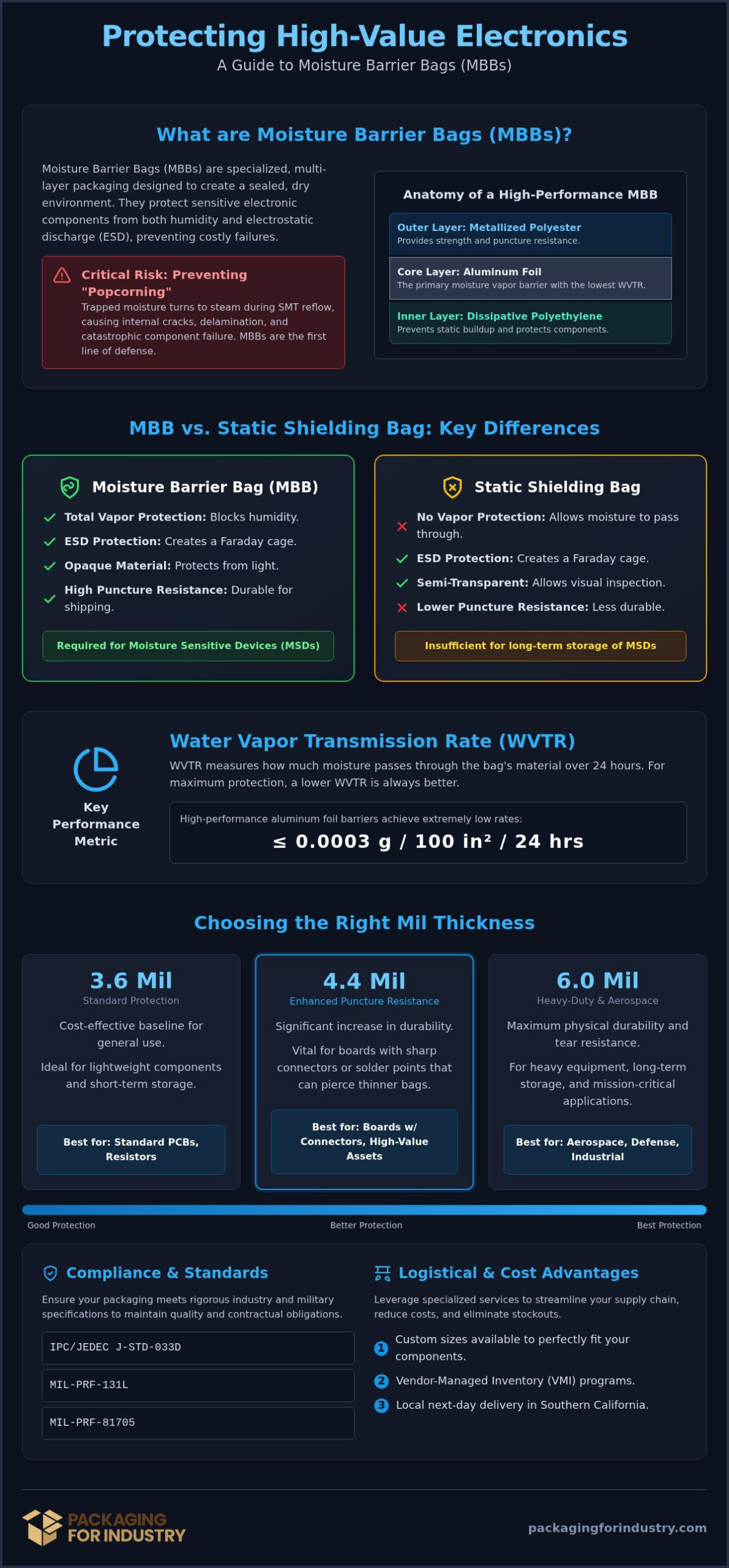
Moisture barrier bags (MBB) are specialized, multi-layer packaging solutions designed to protect moisture-sensitive devices (MSDs) from both atmospheric humidity and electrostatic discharge. Unlike standard poly bags, an MBB creates a hermetically sealed environment that’s essential for preventing “popcorning” during the assembly process. This phenomenon happens when moisture trapped inside a component expands into steam during Surface Mount Technology (SMT) reflow, leading to internal delamination, bond failures, or visible cracks. For firms sourcing moisture barrier bags for electronics Orange County provides a high-density market where these failures can lead to expensive scrap and production delays.
It’s vital to recognize that moisture protection is distinct from simple static control. While many Antistatic, static-dissipative, and shielding bags manage electrical charges, they often lack the vapor-blocking layers required for long-term storage of sensitive semiconductors. MBBs are hybrid tools; they combine a Faraday cage effect with a dense vapor barrier to offer total environmental control. This level of protection is a baseline requirement for the aerospace, medical, and semiconductor sectors that drive the local economy in Irvine and Anaheim.
The Anatomy of a High-Performance Barrier Bag
High-performance bags aren’t just single sheets of plastic. They feature a sophisticated laminate structure, typically including an outer layer of metallized polyester for strength and an inner layer of dissipative polyethylene to prevent static buildup. A core layer of aluminum foil or specialized polyester provides the actual moisture block. This construction ensures the bag maintains high puncture resistance, which is critical when packing heavy PCB assemblies with sharp solder points. Using materials that comply with MIL-PRF-81705 and IPC/JEDEC J-STD-033 ensures your components remain in a “factory dry” state from the warehouse to the assembly line.
Vapor Transmission Rates (WVTR): The Metric of Success
Water Vapor Transmission Rate (WVTR) measures how much moisture permeates the bag over time. It’s the most important metric on any technical data sheet. Aluminum foil barriers generally offer the lowest WVTR, often rated as low as 0.0003 grams per 100 square inches over 24 hours, which significantly extends component shelf life compared to standard metallized polyester. When you evaluate moisture barrier bags for electronics Orange County suppliers should provide clear data sheets showing these rates. Understanding these metrics helps you calculate exact desiccant requirements and establish reliable storage protocols for high-value inventory.
Choosing the Right Mil Thickness for Your Application
Selecting the right mil thickness is the primary defense against physical compromise. A bag that blocks vapor is useless if a PCB corner punctures the film. Most manufacturers in Southern California start with 3.6 mil bags as their baseline. These are cost-effective for lightweight components and short-term storage. However, if you’re shipping high-value assets across the country, upgrading to a thicker gauge is a pragmatic insurance policy. Selecting the right moisture barrier bags for electronics Orange County engineers rely on requires understanding these physical limits before placing a bulk order.
4.4 mil bags offer a significant increase in puncture resistance. This thickness is vital for boards with high-pin-count connectors or sharp solder points that can easily pierce thinner materials. For heavy industrial equipment or long-term aerospace storage, 6.0 mil bags provide the highest level of durability. They resist the mechanical stress of handling and vacuum draw-down better than thinner alternatives. Balancing the cost-per-unit against the value of a high-end circuit board makes the decision to use thicker materials economically sound.
Standard Commercial vs. Heavy-Duty Industrial Needs
Sharp edges are the enemy of a vacuum seal. If your product has through-hole components or rigid connectors, a 3.6 mil bag may fail during transit due to vibration-induced punctures. We recommend a thickness review for specialized manufacturing needs to prevent latent defects. If you need to compare packaging pricing for different mil thicknesses, our technical team can provide data sheets and samples to ensure your assets remain protected.
The ‘Dry Pack’ System: More Than Just a Bag
A bag alone is not a complete solution. It’s part of a “dry pack” system designed to maintain a controlled environment. This system includes the MBB, a desiccant, and a Humidity Indicator Card (HIC). Desiccants, typically clay or silica gel, absorb the moisture trapped inside the bag during the sealing process. Clay desiccants are often preferred for their cost-effectiveness in large volumes, while silica gel is chosen for its high absorption rate in smaller spaces.
The HIC allows your customer to verify seal integrity upon arrival by providing a visual cue of the internal humidity levels. This entire process must align with the ANSI/ESD S20.20 standard to ensure total protection. Vacuum sealing maximizes the barrier’s effectiveness by removing air and bringing the bag material into close contact with the desiccant. Reducing the oxygen and moisture levels inside the bag is a critical step for long-term storage in the humid coastal climates of Southern California.
Moisture Barrier Bags vs. Static Shielding Bags: Key Differences
Many procurement officers mistakenly assume that standard silver static shielding bags provide adequate protection for all electronic components. While static shielding bags are designed to create a Faraday cage to protect against electrostatic discharge, they aren’t vapor-proof. They’re typically semi-transparent to allow for easy part identification, but this transparency indicates the absence of a dense metal foil layer. For components sensitive to humidity, relying on a shielding bag alone can lead to latent defects. Choosing the specific moisture barrier bags for electronics Orange County manufacturers use ensures that your components are shielded from both electrical charges and atmospheric moisture.
The primary physical difference lies in opacity. Moisture Barrier Bags (MBBs) are completely opaque because they contain a thick layer of aluminum foil or a high-density metallized polyester. This layer is what provides the exceptionally low Water Vapor Transmission Rate (WVTR) discussed earlier. In contrast, cheaper anti-static pink poly bags only prevent the generation of static; they don’t provide a shield or a moisture barrier. When you compare packaging pricing, the higher cost of an MBB is offset by the protection it offers for high-value assets that fall under specific Moisture Sensitivity Levels (MSL).
Identifying the MSL of your inventory is the first step in a pragmatic packaging strategy. MSL ratings, ranging from Level 1 to Level 6, dictate how long a component can be exposed to ambient room conditions before it must be baked or resealed. Components at Level 3 or higher essentially require an MBB to guarantee shelf life and assembly integrity. Using a lower-grade bag for these parts is a false economy that risks the entire production run.
When to Prioritize Moisture Barriers
You should prioritize MBBs for any Surface Mount Technology (SMT) components, raw silicon wafers, and sensitive medical device sensors. These items are highly susceptible to humidity-induced corrosion and the “popcorning” effect during reflow. If your facility handles these materials, explore our ESD and Cleanroom solutions to find the right grade of protection. Silicon wafers, in particular, require the highest level of vapor protection to prevent microscopic oxidation that can ruin chip performance.
Standardizing Your Electronics Packaging
Reducing SKU complexity is a proven way to lower packaging costs and improve warehouse efficiency. By standardizing on MBBs for all high-value or sensitive parts, you eliminate the risk of a warehouse worker accidentally placing a moisture-sensitive device in a standard shielding bag. Consistent labeling and bag types allow for faster kitting and more reliable inventory audits. Standardizing on a single high-performance moisture barrier bag reduces procurement errors by simplifying the ordering process and ensuring every sensitive component receives maximum protection by default.
Local Logistics: Sourcing MBBs in Orange County
Sourcing the specific moisture barrier bags for electronics Orange County firms require for daily operations shouldn’t involve the logistical headaches associated with national catalog suppliers. When you partner with a local Orange County packaging supplier, you immediately eliminate the lead time stress that often plagues manufacturing hubs in Irvine, Anaheim, and Costa Mesa. National distributors often struggle with Southern California traffic and regional supply chain bottlenecks, leading to unpredictable arrivals. By sourcing from a local hub, you gain the advantage of next-day delivery for in-stock items, which is critical when a production run depends on maintaining a “dry pack” environment. Reducing the distance between the warehouse and your facility also lowers freight costs, directly contributing to your bottom line.
Vendor Managed Inventory (VMI) for Electronics Firms
Maintaining a steady supply of specialized bags is complex when dealing with multiple sizes and mil thicknesses. Our VMI program transforms how electronics firms manage their consumables. We perform scheduled on-site inventory reviews for high-volume PCB assembly lines, ensuring you never face a stockout during a critical shift. This service is designed to free up expensive OC warehouse space. Instead of dedicating square footage to months of bulk inventory, you can use PFI as your local stocking partner. This shift from reactive ordering to a managed system ensures that your operations remain stable and your fiscal responsibility is prioritized.
Just-In-Time (JIT) Delivery for OC Manufacturers
Lean manufacturing principles demand that materials arrive exactly when needed. Our Just-In-Time (JIT) delivery model is tailored for the fast-paced schedules of OC manufacturers. We coordinate packaging deliveries to align perfectly with your production runs, reducing the clutter on your shop floor. Local support for urgent orders in Irvine and Huntington Beach means we can respond to sudden spikes in demand faster than any out-of-state competitor. Additionally, our custom kitting services allow you to receive pre-assembled sets of bags, desiccants, and humidity indicator cards. This level of logistical integration ensures your team spends less time on prep and more time on assembly.
Partnering with PFI for Electronics Packaging Excellence
PFI isn’t just a supplier; we’re a technical extension of your operations team. We understand that high-value circuits require more than a generic envelope. Our team specializes in Aerospace and Defense requirements, ensuring every shipment meets the current MIL-PRF-131L standards for water-vaporproof and greaseproof protection. By providing the specific moisture barrier bags for electronics Orange County manufacturers need to pass rigorous audits, we help you maintain your status as a Tier 1 supplier in a competitive marketplace.
Protection is often a multi-stage process. We offer integrated solutions that combine high-performance bags with custom foam inserts to provide both environmental and physical cushioning. This dual-layer approach is essential for heavy PCB assemblies or sensitive medical instrumentation that can’t afford even microscopic vibration damage. You have direct access to our packaging engineers for technical consultations, ensuring your protection strategy is both effective and fiscally responsible.
Custom Engineering and Prototyping
Standard off-the-shelf bags often lead to excess material waste or a sloppy fit that compromises vacuum seal integrity. If your component is oversized or has an irregular geometry, we provide custom sizes available to match your exact specifications. We offer free prototyping for custom-sized bags or foam-lined barrier solutions. This allows you to test the fit and seal strength before committing to a bulk production run. This precision engineering reduces material costs and ensures that the moisture barrier bags for electronics Orange County firms use are optimized for their specific assembly lines.
Request a Quote for Bulk Moisture Barrier Bags
Procurement teams often default to national catalog suppliers, but this often leads to higher unit costs and impersonal service. When you lower packaging costs through a local partner, you gain better oversight and faster response times. We invite you to compare packaging pricing for wholesale quantities against any major distributor. Our local logistical advantages and specialized inventory management allow us to provide superior value without sacrificing technical compliance. Taking the next step is simple; our team is ready to review your specifications and provide a pragmatic, cost-effective solution.
Optimize Your Electronics Protection and Logistics
Implementing a robust environmental protection strategy is a fundamental requirement for any high-reliability electronics manufacturer. You’ve learned that moisture barrier bags aren’t just commodities; they’re engineered tools that prevent humidity ingress and “popcorning” during critical reflow stages. By choosing the specific moisture barrier bags for electronics Orange County suppliers like PFI provide, you secure a supply chain backed by local next-day delivery and deep Aerospace & Defense expertise.
Our Vendor Managed Inventory (VMI) programs further reduce the risk of stockouts, allowing your warehouse team to focus on production rather than procurement logistics. This local advantage significantly cuts lead times and shipping costs, providing a pragmatic path to zero-defect shipping. Whether you need custom sizes available for irregular assemblies or standard mil-spec stock, our engineers are prepared to optimize your packaging flow and ensure full compliance with current industry standards. We look forward to helping you stabilize your inventory and protect your high-value assets.
Take the first step toward a more reliable supply chain and superior component protection today. Our team is ready to provide the technical consultation and local support your Orange County facility deserves.
Frequently Asked Questions
What is the difference between a moisture barrier bag and a static shielding bag?
Moisture barrier bags provide both vapor protection and a Faraday cage, whereas static shielding bags only protect against electrostatic discharge. The opaque foil layer in an MBB blocks the humidity that causes component delamination during reflow. Standard shielding bags are semi-transparent and lack the density required to meet Moisture Sensitivity Level (MSL) requirements. This distinction is vital for maintaining the long-term integrity of sensitive surface-mount devices during storage or transit.
Are your moisture barrier bags compliant with MIL-PRF-81705 standards?
Our moisture barrier bags for electronics Orange County inventory are engineered to comply with MIL-PRF-81705 Type I standards. These specifications ensure the material is heat-sealable, electrostatic protective, and water-vapor proof. We verify our stock against current military requirements to support aerospace and defense contractors who need documented compliance for their high-value assemblies. You can request technical data sheets to verify these certifications before placing your bulk order.
Do you offer custom sized moisture barrier bags for large electronics?
We provide custom sizes available for oversized or irregular electronic components that don’t fit standard stock dimensions. Our engineering team offers free prototyping to ensure the bag provides a secure vacuum seal without excess material waste. This custom approach is ideal for large medical imaging equipment or specialized aerospace sensors. Precise sizing improves the effectiveness of the vapor barrier and reduces your overall packaging costs per unit.
Can I get next-day delivery for moisture barrier bags in Orange County?
We provide local next-day delivery for all in-stock moisture barrier bags for electronics Orange County manufacturers require for urgent production runs. Our Southern California warehouse hub allows us to bypass the long lead times common with national catalog suppliers. If you place an order for stock items by our daily cutoff, your materials will arrive at your facility in Irvine, Anaheim, or Costa Mesa the following business day.
How do I determine which mil thickness I need for my PCB assembly?
Mil thickness is determined by the weight of the assembly and the presence of sharp points or connectors. A 3.6 mil bag is the industry standard for lightweight, smooth components. If your PCB has high-pin-count connectors or sharp solder joints, we recommend upgrading to 4.4 mil or 6.0 mil material. Thicker films provide the puncture resistance necessary to maintain a vacuum seal during the mechanical stresses of handling and shipping.
Do you provide desiccants and humidity indicator cards with your bags?
We provide a complete “dry pack” system that includes clay or silica gel desiccants and humidity indicator cards (HIC). These components work together to absorb trapped moisture and provide a visual verification of the internal environment. Using these accessories is essential for meeting IPC/JEDEC J-STD-033D standards. We can bundle these items with your bag order to simplify your procurement process and ensure total component protection from the warehouse to the assembly line.
What is the shelf life of an electronics component inside a vacuum-sealed MBB?
The typical shelf life for components in a properly vacuum-sealed MBB is 12 months from the date of the seal. This duration depends on using the correct amount of desiccant and ensuring the bag’s seal integrity remains uncompromised. Following the IPC/JEDEC J-STD-033 guidelines ensures that moisture-sensitive devices remain in a “factory dry” state. If the humidity indicator card shows a change, the parts may require baking before they are safe for assembly.
Do you support VMI programs for electronics manufacturers in Irvine or Anaheim?
Our team supports comprehensive Vendor Managed Inventory (VMI) programs for manufacturers throughout Irvine, Anaheim, and the surrounding Inland Empire. We perform regular on-site stock checks to ensure your high-volume assembly lines never face a shortage of protective packaging. This service helps you lower packaging costs by optimizing order frequencies and freeing up valuable warehouse space. It’s a pragmatic solution for firms looking to streamline their logistical operations and focus on production.