
Effective shock protection for high-value electronics is a precise engineering calculation, not just a matter of choosing the thickest foam available. For aerospace and defense contractors, the difference between a successful deployment and a costly hardware failure often comes down to how well a case manages G-force impact and sustained vibration. You already know that a single handling error during transit can jeopardize your bottom line and your reputation for reliability. Finding specialized shock mount case inserts for sensitive electronics SoCal companies can rely on is often the biggest bottleneck in your production timeline, especially when national suppliers offer slow lead times and generic products.
This guide explains how to engineer the perfect shock-mounted environment by balancing material density with the specific fragility of your components. We’ll show you how to navigate complex vibration requirements and where to source custom-engineered inserts right here in Southern California. By the end of this article, you’ll understand how to optimize your protective packaging to reduce shipping damage while lowering your long-term operational costs. We will cover technical material selection, the benefits of local prototyping, and the logistics of vendor-managed inventory for recurring production needs.
Key Takeaways
- Learn how to calculate fragility ratings and G-force requirements to prevent critical hardware failure during transit and handling.
- Discover why custom-engineered shock mount case inserts for sensitive electronics SoCal businesses depend on offer superior isolation compared to generic catalog foam.
- Identify the technical specifications needed to request an accurate quote, including precise component dimensions, weight, and Mil-Spec drop height requirements.
- Reduce your lead times and logistics costs by utilizing local Southern California resources like free prototyping and vendor-managed inventory (VMI) programs.
Why Standard Foam Fails: The Role of Shock Mount Case Inserts
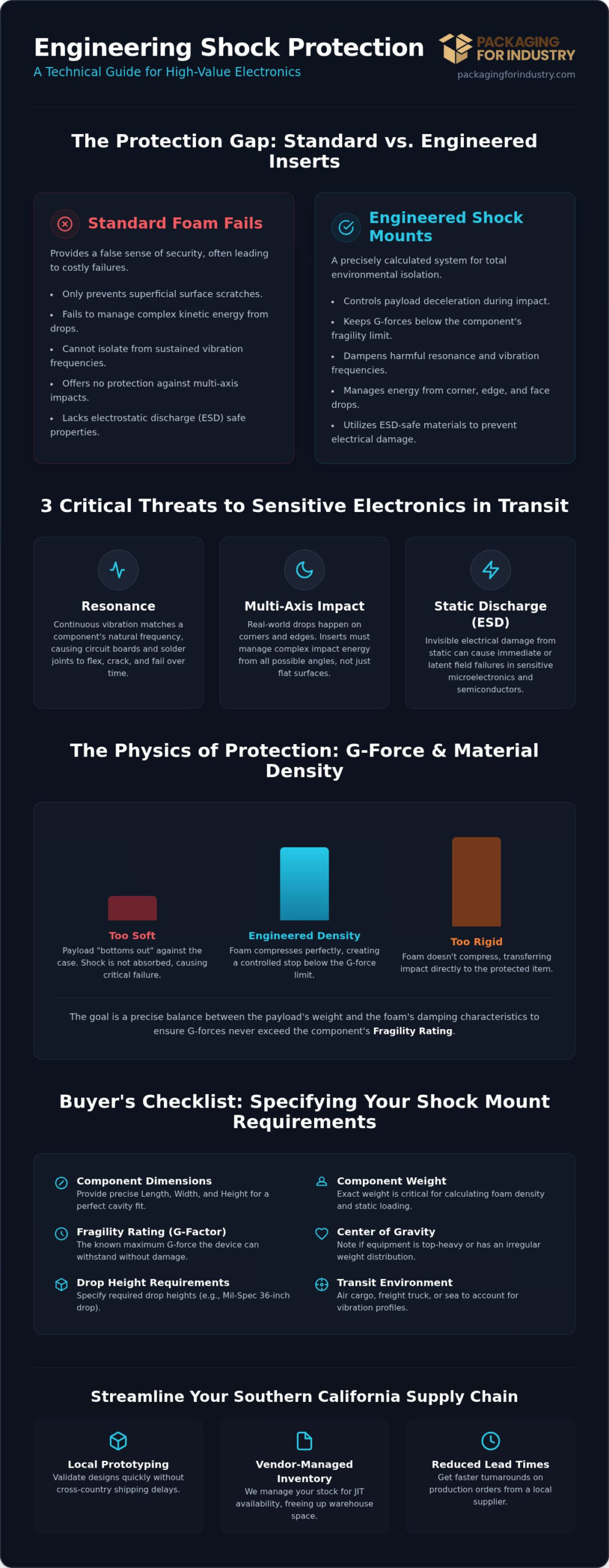
Standard foam sheets or generic pick-and-pluck inserts often provide a false sense of security. While they might prevent surface scratches, they rarely manage the complex kinetic energy transfers that occur during industrial transit. True shock mount inserts are engineered systems designed to decouple sensitive gear from the external environment. Unlike basic cushioning, which simply pads the item, these inserts provide comprehensive shock and vibration isolation by controlling the deceleration of the payload during an impact. For manufacturers seeking shock mount case inserts for sensitive electronics SoCal, the goal is to create a controlled stopping distance inside the case that prevents internal components from exceeding their fragility ratings.
Shipping high-value electronics involves more than just surviving a single drop. Components face three primary threats that standard foam cannot adequately address:
- Resonance: Continuous vibration can match the natural frequency of a circuit board, causing it to flex and eventually snap.
- Multi-Axis Impact: Real-world drops rarely happen on a flat face; inserts must manage energy from every possible angle, including corners and edges.
- Static Discharge: Sensitive semiconductors require ESD-safe foam materials to prevent invisible electrical damage that can lead to field failures.
Aerospace and medical device manufacturers cannot rely on stock solutions. They require precision-engineered inserts that account for the exact center of gravity and weight distribution of their hardware. A generic foam block doesn’t account for top-heavy equipment or delicate protruding sensors that require specific clearance or targeted support.
Understanding Mechanical Shock vs. Vibration
Mechanical shock is a sudden, high-energy impact, such as a case falling off a loading dock or being struck by a forklift. Vibration is a continuous, low-amplitude frequency experienced in the back of a freight truck or the cargo hold of an aircraft. Shock mount case inserts for sensitive electronics SoCal must be designed to mitigate both. Without this dual focus, a device might survive a 36-inch drop but arrive with micro-cracks in its solder joints due to hours of sustained road vibration. Engineered inserts use specific foam densities to dampen these frequencies before they reach the hardware.
The Cost of Inadequate Protection
The true price of packaging isn’t the cost of the foam; it’s the cost of the equipment it fails to protect. High RMA rates and field failures quickly erode profit margins and damage customer trust. By investing in custom-engineered solutions, companies can significantly lower packaging costs over the long term. This is achieved by reducing insurance claims and eliminating the need for expensive secondary repairs or replacements. PFI integrates these high-performance inserts with heavy-duty corrugated boxes and custom crates to provide a total system of protection for Southern California’s tech corridor from our Anaheim headquarters.
The Engineering of Shock Protection: G-Force and Material Density
Engineering shock mount case inserts for sensitive electronics SoCal requires a deep understanding of fragility ratings, often referred to as the G-factor. This rating represents the maximum acceleration or deceleration a component can withstand before critical failure occurs. For example, a ruggedized industrial sensor might handle 50G, while a delicate medical imaging component might fail at 15G. Designing an effective insert means creating a controlled stopping distance within the case to ensure the payload never exceeds its G-limit during a drop or impact.
The physics of deceleration relies heavily on material density and static loading. If the foam is too soft for the payload’s weight, the item will “bottom out” against the hard outer shell of the case during a fall. If the foam is too rigid, it won’t compress enough to absorb energy, passing the shock directly into the electronics. According to NASA research on shock and vibration, the success of any isolation system depends on the precise mathematical relationship between the mass of the object and the damping characteristics of the support material. In Southern California, transit environments add another layer of complexity. High temperatures in the Inland Empire can soften certain polymers, while coastal humidity in Los Angeles or San Diego can impact the performance of open-cell materials over long durations.
Foam Material Selection for Electronics
Selecting the right material is a balance of durability and cushioning. Polyethylene (PE) foam is a closed-cell material preferred for high-durability applications and repeated impacts. It’s excellent for heavy aerospace hardware that requires firm positioning. Polyurethane (PU) foam, an open-cell material, provides a softer “ride” for lightweight, highly delicate parts. For any semiconductor or PCB transport, anti-static or ESD-safe foam is mandatory to prevent electrostatic discharge from frying sensitive circuits. You can explore our full range of custom foam packaging options to see which material fits your specific fragility requirements.
Advanced Shock Mount Technologies
For heavy instrumentation that exceeds the capabilities of standard foam, elastomeric mounts provide superior isolation. These mechanical dampers are often integrated into multi-layer “sandwich” designs, where different foam densities work together to handle both high-frequency vibration and low-frequency shock. When these systems are integrated with custom shipping crates, they provide a comprehensive solution for international or long-haul domestic transit. If you aren’t sure which density or mount style your hardware requires, you can request a quote to speak with our Anaheim-based engineering team about a custom fit.
Custom vs. Stock Inserts: SoCal Procurement Guide
Stock foam inserts often provide a generic fit that fails to secure high-value components during heavy industrial transit. Catalog foam usually lacks verified density consistency, and manual “pick-and-pluck” methods create structural weaknesses that compromise the protective barrier. More importantly, stock solutions rarely offer the ESD-safe properties required for modern semiconductors. When sourcing shock mount case inserts for sensitive electronics SoCal manufacturers prioritize precision-engineered foam that offers 360-degree support. With custom sizes available for nearly any case footprint, these inserts eliminate the gaps and shifting that lead to impact damage.
Transitioning from a stock solution to a custom-cut system enables the use of CAD/CAM technology. This ensures every insert is CNC-routed to the exact dimensions of your hardware, providing a uniform deceleration zone that generic padding cannot replicate. Scalability is also enhanced; you can move from a precision prototype to high-volume production without sacrificing the tight tolerances required for aerospace or medical device housing. This methodical approach to procurement reduces the risk of field failures and protects your long-term profit margins.
The Custom Design Process at PFI
Our design team begins with a comprehensive assessment of your device’s fragility and the intended shipping container. By utilizing custom design packaging services, you receive a precision-modeled solution that identifies potential stress points before manufacturing begins. We offer free prototyping to ensure a perfect sample fit, allowing your operations team to verify the protection level before committing to a full production run. This consultative phase is critical for identifying the most cost-effective material thickness for your specific transit lanes.
Evaluating Local Suppliers in Southern California
Selecting an Anaheim-based supplier provides a clear logistics advantage for businesses in Orange County, Los Angeles, and the Inland Empire. Sourcing shock mount case inserts for sensitive electronics SoCal locally significantly reduces freight costs and removes the lead-time barriers common with national catalog distributors. Our proximity allows for local next-day delivery on critical orders, supporting just-in-time manufacturing lines that cannot afford supply chain interruptions. For recurring needs, our vendor-managed inventory (VMI) programs ensure your warehouse stays lean while maintaining a consistent supply of protective materials ready for immediate assembly.
Buyer’s Checklist: Specifying Your Shock Mount Requirements
Accurate specification is the first step toward effective protection. Procurement for shock mount case inserts for sensitive electronics SoCal requires precise data points to ensure engineering accuracy. Buyers must provide the exact weight and dimensions of the electronics, along with the internal dimensions of the intended outer case. Even a small discrepancy can lead to excessive movement or improper compression, which compromises the entire system. Fragility must be clearly defined in your RFQ; if your hardware requires a Mil-Spec 36-inch drop height certification, the foam density must be calculated to keep G-forces below the failure threshold during that specific event.
ESD protection is a non-negotiable requirement for most Southern California technology firms. If your assembly includes exposed PCBs or semiconductors, you must specify anti-static foam to prevent latent electrical damage during transit. Finally, consider your procurement cycle and volume requirements. A one-time prototype run for a satellite component requires a different logistical approach than a recurring stocking program for high-volume medical sensors. Identifying these needs early helps in choosing between a standard purchase order or a vendor-managed inventory (VMI) arrangement.
Mil-Spec and Industry Compliance
Compliance with military and aerospace standards is often mandatory for government contractors in the Inland Empire and Orange County. Beyond shock absorption, you might need to specify fire-retardant additives or low-outgassing foam for vacuum or high-altitude environments. Our aerospace packaging solutions are designed to meet these rigorous documentation and performance requirements. We ensure that every custom insert aligns with industry-specific regulations, protecting both your hardware and your compliance status.
Requesting an Accurate Quote
To receive an accurate quote, it’s best to have your CAD files ready. These digital models allow our engineering team to program CNC routers for a perfect fit without the need for manual measurements. If CAD data isn’t available, a physical sample or detailed 3D measurements will suffice. Always ask for a cost-reduction analysis during the quoting phase. We often find that optimizing the insert design allows for smaller outer cases, which significantly lowers your long-term freight costs. Providing details about your typical transit method, whether it’s local courier or international air freight, also helps us recommend the most efficient material thickness.
The PFI Advantage for SoCal Electronics Manufacturers
The PFI advantage lies in our ability to provide a complete protective ecosystem that extends beyond the foam. We integrate high-performance shock mount case inserts for sensitive electronics SoCal with heavy-duty RSC boxes and durable corner boards to reinforce high-stress areas during transit. This system-wide approach ensures your payload is secure from the internal circuit level to the external pallet edge. By consolidating these components into a single engineered solution, we help you simplify procurement and ensure total material compatibility across your entire packaging stack.
When you compare packaging pricing, it’s vital to look beyond the unit cost and evaluate the total cost of ownership. Our custom designs reduce excess material and shipping volume, which directly lowers your freight expenses and storage requirements. While our Anaheim headquarters provides local next-day delivery to the tech corridors of Irvine, San Diego, and the Inland Empire, our nationwide shipping capabilities support manufacturers with distribution centers across the country. We also streamline warehouse logistics through specialized kitting services, delivering pre-assembled packaging sets that arrive ready for immediate use on your production floor.
Logistical Reliability and Production Flow
To maintain a consistent production flow, our vendor-managed inventory (VMI) programs prevent stockouts of critical protective supplies. We take full accountability for your packaging availability, allowing your team to focus on manufacturing rather than monitoring supply levels. This proactive approach to inventory management is paired with our just-in-time packaging delivery, ensuring you have the right materials exactly when they’re needed. Whether you’re a medical device startup or an established defense contractor, we provide the engineering depth and logistical scale required to protect your most valuable assets.
We believe in proving the value of our engineering before you commit to a full production run. Our free prototyping process ensures your hardware fits perfectly and meets your specific fragility requirements. If you’re ready to optimize your logistics and eliminate shipping damage, our team can conduct an on-site packaging review at your Southern California facility to identify immediate cost-saving opportunities. It’s time to secure your high-value gear with a partner who understands the intersection of precision engineering and industrial economics.
Secure Your High-Value Electronics with Precision Engineering
Effective protection for sensitive gear requires a calculated system that accounts for fragility, G-force, and environmental variables. By prioritizing custom-engineered shock mount case inserts for sensitive electronics SoCal manufacturers can eliminate the risks of internal damage and micro-cracks that lead to costly field failures. Precision in material density and static loading ensures that your payload remains secure, regardless of the transit method or handling conditions.
Our team in Anaheim provides specialized aerospace and electronics expertise to ensure your hardware survives the most demanding environments. We offer free prototyping and CAD design to guarantee a perfect fit before you commit to a full production run. With local next-day delivery and vendor-managed inventory programs, we help you maintain a lean supply chain and lower packaging costs without compromising on reliability.
We’re ready to help you optimize your logistics and provide the peace of mind that comes with a professionally engineered protection system. Let’s start building a solution that safeguards your technology and your bottom line.
Frequently Asked Questions
What is the best foam for shock mount case inserts?
The best foam depends on your payload’s weight and fragility. Polyethylene (PE) is ideal for heavy components needing repeated impact resistance; Polyurethane (PU) provides a softer ride for lightweight items. We select materials based on technical load-bearing requirements to ensure the foam doesn’t bottom out. For shock mount case inserts for sensitive electronics SoCal companies often use a combination of densities to handle both low-frequency shock and high-frequency vibration.
How do I determine the G-force rating for my electronics packaging?
You can find the G-force rating, or fragility factor, in your product’s engineering specifications or by conducting laboratory drop tests. This number represents the maximum acceleration your component can survive without failure. Our engineers use this data to calculate the required foam thickness and density. This ensures the payload has enough stopping distance inside the case to keep impact forces well below your hardware’s critical limit during transit.
Does PFI offer anti-static (ESD) foam for sensitive electronics?
Yes, we provide a full range of anti-static and ESD-safe foam materials. These are essential for preventing latent electrical damage to semiconductors and printed circuit boards during transit. We offer both pink anti-static polyethylene and black conductive foams depending on your specific shielding requirements. Using these specialized materials is a standard practice for shock mount case inserts for sensitive electronics SoCal manufacturers rely on for safe global shipping and aerospace deployments.
Can I get a custom foam insert prototype before placing a bulk order?
We provide free prototyping to ensure your custom insert fits perfectly before you commit to a full production run. This allows your team to physically test the fit with your actual hardware and verify the damping performance. Our CAD/CAM-driven design process makes it easy to adjust the prototype after the initial fit check. This eliminates the risk of receiving a bulk order that doesn’t meet your exact specifications or performance requirements.
How quickly can PFI deliver custom inserts to Los Angeles or Orange County?
We offer local next-day delivery for many regions within Los Angeles and Orange County from our Anaheim headquarters. Because we manufacture custom inserts locally, we can bypass the long lead times and high freight costs associated with national catalog suppliers. This proximity supports just-in-time manufacturing schedules and allows for rapid design iterations. We also serve the Inland Empire and San Diego with reliable, scheduled logistics support to keep your production lines moving.
What information do I need to provide for a custom shock mount quote?
To provide an accurate quote, we need the dimensions and weight of your electronics, the internal dimensions of your outer case, and the required drop height. Providing CAD files in STEP or DXF format allows us to program our CNC routers for a precision fit. If you don’t have CAD data, a physical sample or detailed measurements will work. We also recommend specifying any ESD requirements or fire-retardant needs for aerospace applications.
Are your case inserts compliant with military shipping standards (Mil-Spec)?
Yes, our inserts are engineered to meet various military shipping standards, including Mil-Std-810 and Mil-Spec drop test requirements. We understand the rigorous documentation and performance testing needed for defense and aerospace contracts. Our team can help you select foams that meet specific fire-retardant, chemical resistance, and low-outgassing specifications. This ensures your packaging system is fully compliant with government transit regulations and maintains hardware integrity in extreme environments during global deployments.
Do you provide shock-mounted inserts for both hard cases and corrugated boxes?
We design and manufacture shock-mounted inserts for both rugged hard cases and heavy-duty corrugated boxes. Whether you’re using a plastic transit case for field deployments or double-wall corrugated containers for one-way shipping, we can engineer an internal foam system to isolate your gear. We often integrate these inserts with custom crates for oversized instrumentation. This flexibility allows you to choose the most cost-effective outer container for your specific shipping lane and protection needs.