
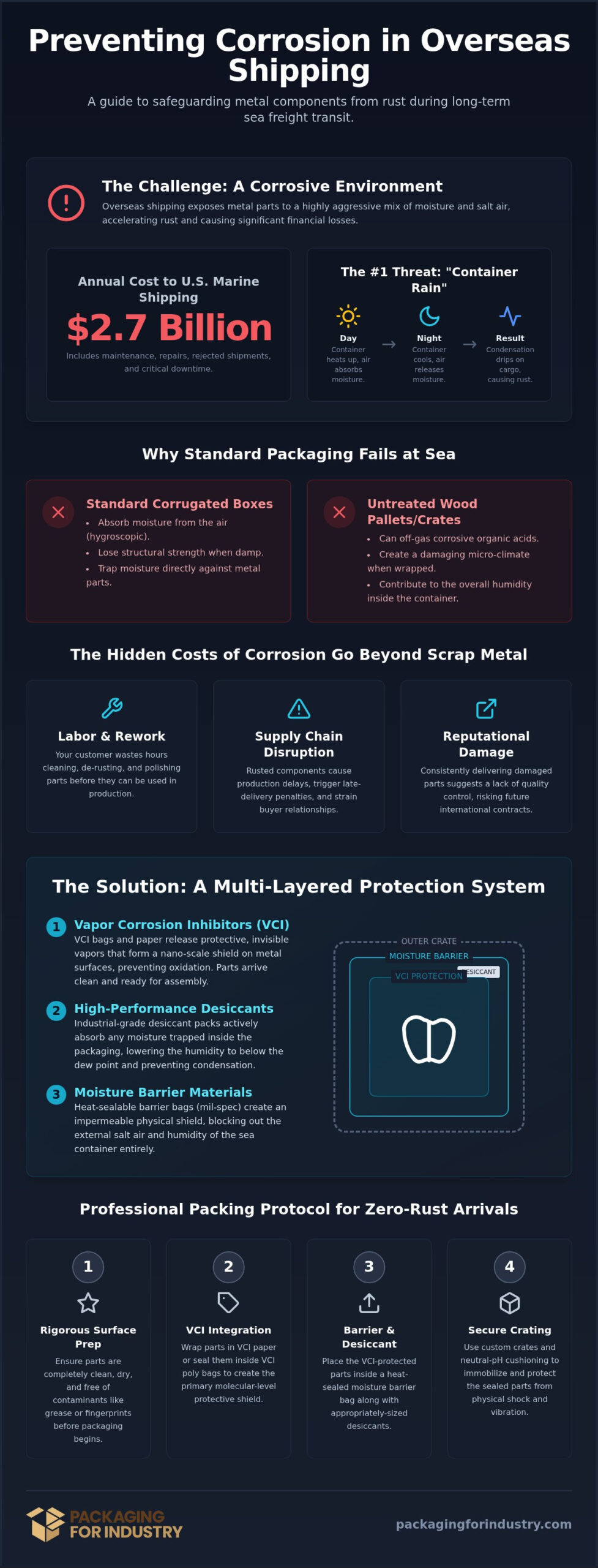
The direct annual cost of corrosion for the U.S. marine shipping industry is estimated at $2.7 billion, a figure that includes maintenance, repairs, and critical downtime. For manufacturers in Southern California and across the country, these costs often manifest as rejected international shipments and halted production lines at the customer site. Learning how to prevent corrosion on parts during overseas shipping is no longer just a technical requirement. It is a vital strategy for maintaining fiscal responsibility and protecting your professional reputation in a competitive global market.
We understand the frustration of opening a container only to find that oxidation has compromised months of precision engineering. You need a solution that balances total protection with operational efficiency. This guide outlines the professional methods for safeguarding metal components from rust during long-term sea freight transit. You will learn how to transition away from messy, labor-intensive sprays toward advanced, clean technologies that leave parts ready for assembly. We provide a comprehensive look at multi-layered systems, including Vapor Corrosion Inhibitors, high-performance desiccants, and custom barrier materials designed to eliminate the micro-climates that cause damage. This overview gives you a roadmap for achieving zero-rust arrivals and a more streamlined packaging process.
Key Takeaways
- Understand the mechanics of “container rain” and how temperature fluctuations during sea freight create high-risk environments for metal components.
- Discover how to prevent corrosion on parts during overseas shipping by using Vapor Corrosion Inhibitors (VCI) to create a molecular-level protective shield.
- Implement a multi-layered protection strategy that combines moisture barrier bags, desiccants, and neutral-pH cushioning to eliminate corrosive micro-climates.
- Adopt a professional packing protocol focused on rigorous surface preparation to ensure parts are free of contaminants before they are sealed for export.
- Lower packaging costs and improve reliability by leveraging custom crates and Vendor Managed Inventory (VMI) to maintain a steady supply of anti-corrosion materials.
The Challenges of Corrosion in Overseas Sea Freight
Corrosion is fundamentally an electrochemical reaction. It occurs when metal surfaces are exposed to oxygen and moisture, leading to oxidation that compromises the structural integrity and appearance of your parts. In the context of transoceanic shipping, this process accelerates due to the presence of salt air. Salt acts as a powerful electrolyte, speeding up the chemical breakdown of ferrous and non-ferrous metals alike. Manufacturers often struggle with how to prevent corrosion on parts during overseas shipping because the environment inside a shipping container is significantly more aggressive than a standard warehouse.
A primary driver of damage is a phenomenon known as “container rain.” During the day, the air inside a shipping container warms up and absorbs moisture from the cargo, pallets, and the air itself. As temperatures drop at night, the container’s steel walls cool rapidly. This causes the internal air to reach its dew point, resulting in heavy condensation that forms on the ceiling and drips directly onto the cargo. Without a professional protection strategy, your components sit in a high-humidity “sauna” for weeks at a time.
Why Standard Packaging Fails at Sea
Standard packaging materials are often insufficient for the rigors of long-term maritime transit. Most corrugated boxes are hygroscopic, meaning they naturally absorb moisture from the surrounding environment. Once a box becomes damp, it loses its structural strength and holds moisture directly against the metal parts it’s supposed to protect. This creates a destructive cycle where the packaging itself contributes to the problem.
The risk extends to the pallets and crates used for transport. Fresh or improperly treated wood pallets can off-gas organic acids. When these vapors are trapped inside a tightly wrapped pallet, they create a corrosive micro-climate. To counter this, many engineers utilize Volatile Corrosion Inhibitor (VCI) technology. Unlike standard plastics, VCI materials release protective vapors that form a molecular shield on the metal, preventing the oxidation process even in the presence of trapped moisture.
The Cost of Corrosion: More Than Just Scrapped Metal
The financial impact of a rejected international shipment is severe. Beyond the direct loss of the scrapped components, you face significant hidden costs that erode your margins. These include:
- Labor and Rework: If the parts are salvageable, your customer must spend hours cleaning, de-rusting, or polishing them before they can enter the production line.
- Supply Chain Disruption: Corroded parts lead to production delays at the destination, which can trigger late-delivery penalties and strain your relationship with the buyer.
- Reputational Damage: Consistently delivering rusted parts suggests a lack of operational oversight, potentially costing you future international contracts.
Understanding how to prevent corrosion on parts during overseas shipping is essential for any Southern California manufacturer looking to maintain a reliable global supply chain. By identifying these environmental hazards early, you can implement the multi-layered defenses necessary for zero-rust arrivals.
Selecting the Right Corrosion Prevention Technology
Choosing the correct technology is the first step in mastering how to prevent corrosion on parts during overseas shipping. While section one detailed the environmental hazards of sea freight, this section focuses on the specific tools used to neutralize those threats. Industrial corrosion prevention generally falls into three categories: volatile inhibitors, physical barriers, and active desiccants. Most successful export strategies utilize a combination of these technologies to create a redundant defense system.
Vapor Corrosion Inhibitors (VCI) are a cornerstone of modern industrial packaging. These materials, often in the form of poly bags or paper, release protective vapors into the enclosed space of a package. These molecules migrate to the metal surface and form an invisible, nano-scale layer that prevents oxygen and moisture from initiating oxidation. This technology is particularly valuable because it requires no messy oils or greases, meaning parts arrive clean and ready for immediate assembly. If you are looking to streamline your operations, you can request a packaging quote to see which VCI format fits your production line.
Moisture barrier bags provide a different type of protection. These are typically constructed from multiple layers of polyethylene and aluminum foil. This structure creates a high-performance shield with an extremely low Moisture Vapor Transmission Rate (MVTR). While a standard poly bag might allow vapor to permeate over a 30-day voyage, a high-quality foil barrier bag effectively seals the internal environment from the outside world.
VCI Film vs. Barrier Bags: Which Should You Use?
The choice between VCI film and barrier bags depends on your part’s geometry and value. VCI film is often the most cost-effective choice for high-volume, smaller components where a simple bag or wrap provides sufficient coverage. However, for large assemblies or high-value aerospace components, we recommend moisture barrier bags. These bags offer superior puncture resistance and a more robust seal against salt air.
Regardless of the material, you must follow a “clean-to-dry” protocol. VCI and barrier bags cannot stop corrosion that has already started due to fingerprints or cutting fluids. For critical applications, combining a VCI emitter inside a heat-sealed barrier bag provides the maximum level of protection available in the industry.
The Role of Desiccants and Humidity Indicators
Desiccants act as the active defense within your packaging. Materials like silica gel or montmorillonite clay pull existing moisture out of the air to keep the relative humidity below the threshold where rust begins. In the industrial sector, desiccant capacity is measured in “units.” A unit is defined as the amount of desiccant that will absorb at least 3 grams of water vapor at 20% relative humidity and at least 6 grams at 40% relative humidity.
Calculating the correct number of units is vital. It’s based on the surface area of the barrier material and the volume of the container. To verify that your seal remained intact throughout the journey, we integrate humidity indicator cards. These cards change color if internal moisture levels exceed safe limits, providing your customer with immediate proof of a successful transit. This level of oversight is standard for manufacturers in Orange County and Los Angeles who prioritize zero-rust arrivals.
Engineering a Multi-Layered Protection System
Effective corrosion prevention is rarely the result of a single product. It’s a multi-layered engineering challenge that combines chemical inhibitors, moisture barriers, and structural design. For manufacturers, the goal is to eliminate the “micro-climates” that form inside a package. One of the most common mistakes is using standard, untreated packaging materials that have a low pH level. Acidic corrugated or wood can actually accelerate oxidation. We address this by selecting neutral-pH cushioning and barrier materials that won’t react with your metal surfaces. This is a critical component of how to prevent corrosion on parts during overseas shipping for high-value industrial assets.
Integrating these components into a unified system is the professional standard for how to prevent corrosion on parts during overseas shipping. When we design a solution, we look at the interaction between every material. For example, a part wrapped in VCI film might still be vulnerable if it’s placed in a crate that allows moisture to pool. By coordinating the chemical protection of VCI with the physical protection of custom-engineered crates and foam, we create a redundant defense that survives even the harshest maritime conditions.
Custom Crates and Liners for Large Equipment
Heavy industrial machinery requires a structural solution that can withstand both physical impact and environmental exposure. We utilize custom shipping crates to stabilize the internal atmosphere. These crates are often fitted with specialized liners, such as heat-sealable aluminum foil barriers. To ensure a vacuum-like environment, our teams use industrial sealing equipment to create a hermetic seal, effectively locking out the salt-laden air of the Pacific or Atlantic routes.
Structural considerations are equally important for moisture management. We design our crates with specific elevations to prevent the cargo from sitting directly on the crate floor. This design prevents moisture from pooling at the base of the machine if condensation occurs. By maintaining a clean, dry, and sealed environment inside the crate, we ensure that heavy equipment arrives at its international destination in factory-new condition.
Foam Inserts: Protection Without the Rust
Cushioning is necessary to prevent abrasion, but the wrong foam can become a liability. Standard open-cell foams can trap moisture against a part, leading to localized pitting corrosion. We solve this by using custom foam packaging made from closed-cell polyethylene. These foams don’t absorb water and provide a chemically inert surface that won’t damage sensitive finishes or coatings.
Our engineering team uses CAD/CAM technology to design foam cutouts that serve two purposes. First, they provide a precision fit to prevent movement. Second, they’re designed with air channels that allow VCI molecules to circulate freely around the part. This ensures that the chemical protection reaches every crevice, providing a comprehensive shield that standard, off-the-shelf foam inserts simply cannot offer.
Step-by-Step Protocol for Packing Parts for Export
Consistency in the warehouse is the final bridge between high-quality materials and successful delivery. Even the most advanced VCI film will fail if the underlying part is contaminated. Establishing a repeatable protocol ensures that your team understands how to prevent corrosion on parts during overseas shipping without slowing down the production line. This process begins the moment a part leaves the manufacturing floor and continues until the pallet is loaded onto the ocean container.
- Step 1: Surface Preparation. Clean parts are mandatory. You must remove all cutting fluids, metal shavings, and industrial oils. Any residual acid or moisture trapped under the packaging will cause pitting during the voyage.
- Step 2: Internal Wrapping. Select the appropriate VCI paper or film based on the metal type. Ferrous metals require different chemistry than non-ferrous alloys. Wrap the part tightly to ensure the protective molecules can reach the surface quickly.
- Step 3: Adding Secondary Protection. Place desiccant units inside the enclosure to manage the initial air volume. Include a humidity indicator card to provide a visual record of the environment during transit.
- Step 4: Final Sealing. Use industrial heat sealers for barrier bags to create an airtight environment. For VCI shrouds, ensure all seams are taped securely to prevent the protective vapors from escaping.
Handling Best Practices for Warehouse Teams
Human error is a frequent cause of rust. Warehouse staff should always wear clean gloves when handling bare metal. Skin oils contain salts and acids that create permanent rust spots under VCI film. Timing is also critical. Parts shouldn’t sit exposed in the warehouse after cleaning; they must be packed immediately to prevent environmental moisture from settling on the surface. Knowing how to prevent corrosion on parts during overseas shipping involves more than just selecting materials; it requires disciplined handling. Additionally, keep your stock of VCI bags and paper sealed in their original boxes. If left open, the active chemicals will dissipate before they ever reach your product.
Final Stabilization and Palletizing
The external packaging must protect the internal anti-corrosion system. We recommend using stretch film to wrap the entire load, creating a secondary weather barrier against salt spray. To prevent the sharp edges of heavy-duty boxes from puncturing your barrier bags, apply corner and edge protection. Finally, ensure all pallets are ISPM-15 export-compliant and completely dry before use. Damp wood inside a container is a primary source of the “container rain” discussed earlier.
Optimizing Your Anti-Corrosion Supply Chain with PFI
Managing a global supply chain requires more than just purchasing bags and boxes. It demands a partner who understands the critical intersection of engineering and economics. For manufacturers in Southern California, PFI provides the technical expertise and logistical reliability needed to master how to prevent corrosion on parts during overseas shipping. We don’t just sell products; we optimize your entire protection system to ensure zero-rust arrivals while keeping your operational costs under control. Our approach focuses on eliminating the professional stress of rejected shipments and production delays.
One of the most effective ways to maintain consistency is through a Vendor Managed Inventory (VMI) program. Anti-corrosion supplies like VCI film and desiccants have specific shelf lives and storage requirements. By letting PFI manage your stock levels, you ensure your warehouse teams always have fresh, active materials on hand. This eliminates the risk of using “expired” VCI that has lost its protective potency. For our clients in Los Angeles and Orange County, our local next-day delivery to cities like Anaheim and Irvine ensures that your production line never stops due to a packaging shortage.
Lowering Costs Through Smart Engineering
Many businesses overspend on generic anti-corrosion solutions that aren’t sized correctly for their specific components. We analyze your current damage rates and shipping routes to find the most cost-effective protection level. By utilizing custom-sized corrugated boxes, we reduce the internal air volume of each package. This directly helps you lower packaging costs because smaller volumes require fewer desiccant units and less VCI material. Additionally, optimizing the weight and size of your protective crates helps reduce international freight costs. This proactive engineering ensures you aren’t paying to ship unnecessary air across the ocean.
Request a Quote for Your Export Packaging Needs
Our team brings specialized experience in aerospace packaging and high-value electronics, where tolerances for oxidation are non-existent. We use CAD/CAM design to prototype custom foam and crating solutions that integrate perfectly with your moisture barrier protocols. If you’re struggling with rejected shipments or want to compare packaging pricing to your current setup, our experts are ready to consult on your specific challenges. We offer custom sizes available for any industrial application, from miniature medical components to heavy machinery. This ensures your strategy for how to prevent corrosion on parts during overseas shipping is both reliable and scalable.
Secure Your International Supply Chain with Professional Protection
Eliminating the threat of oxidation requires a coordinated approach that combines chemical inhibitors with high-performance physical barriers. By implementing the multi-layered systems and warehouse protocols discussed in this guide, you can ensure that your components arrive at their destination in factory-new condition. Mastering how to prevent corrosion on parts during overseas shipping is essential for manufacturers who value fiscal responsibility and long-term customer reliability.
PFI provides the specialized expertise necessary for high-stakes sectors like aerospace and heavy manufacturing. Our team offers custom-engineered solutions, including CAD-designed foam and crates, to solve your most complex logistics challenges. With local next-day delivery across Southern California and comprehensive VMI programs, we help you prevent critical stockouts and maintain a steady production flow.
We look forward to helping you optimize your export packaging and achieve zero-rust arrivals on every voyage.
Frequently Asked Questions
How long does VCI protection last during overseas shipping?
VCI protection typically lasts between two and five years when the packaging is properly sealed and remains unopened. The exact duration depends on the film thickness and the quality of the final hermetic seal. For standard transoceanic voyages lasting 30 to 60 days, VCI provides a significant safety margin. It’s important to keep parts wrapped until they reach the assembly line at the destination to maintain the molecular shield.
Do I need to grease or oil my parts if I use VCI packaging?
You don’t need to apply grease or oil when using VCI packaging. This technology is specifically designed to replace messy rust preventatives that require labor intensive removal at the customer site. Using VCI ensures parts arrive clean and ready for immediate production. If you currently use oils, switching to VCI can help you lower packaging costs by reducing cleaning labor and hazardous waste disposal fees associated with solvents.
What is the difference between a desiccant and a VCI?
Desiccants and VCI serve different but complementary roles in how to prevent corrosion on parts during overseas shipping. Desiccants actively absorb water vapor from the air to lower humidity levels inside the package. VCI releases protective molecules that form a physical shield on the metal surface. While desiccants address the internal environment, VCI protects the part directly. Combining both provides the highest level of reliability for long term sea freight.
Can I reuse VCI bags and film for multiple shipments?
Reusing VCI bags or film is not recommended for international shipping. The active corrosion inhibiting chemicals begin to dissipate the moment the package is opened and exposed to the atmosphere. For manufacturers focused on how to prevent corrosion on parts during overseas shipping, using fresh materials is the only way to guarantee a full strength molecular shield. We offer VMI programs to ensure you always have fresh, custom sized VCI materials available.
How do I calculate how much desiccant I need for a shipping container?
Calculating desiccant requirements involves measuring the internal volume of the enclosure and the surface area of the barrier material. For industrial applications, we follow MIL-STD-2073 guidelines to determine the number of units required. Factors such as the hygroscopic nature of the dunnage and the expected transit time also influence the final count. Our engineers provide precision calculations to ensure your cargo remains dry throughout the entire transoceanic route.
Are there specific anti-corrosion standards for military or aerospace parts?
Yes, military and aerospace sectors must adhere to rigorous standards such as MIL-PRF-131K for moisture barrier bags. These specifications dictate the material’s strength, puncture resistance, and moisture vapor transmission rate. PFI specializes in compliant materials that meet these exacting requirements for defense contractors in Orange County and Los Angeles. We ensure your packaging documentation is accurate and that all materials meet the necessary performance benchmarks for government contracts.
Does humidity affect the performance of VCI paper?
High humidity levels can accelerate the depletion of the active chemicals in VCI paper. While the paper is engineered to work in humid environments, extreme moisture can saturate the carrier material if it’s not protected by an outer barrier bag. To maintain effectiveness, you should store VCI paper in a cool, dry area and ensure the final export package is tightly sealed to maintain the necessary internal chemical concentration.
What is the best way to seal a moisture barrier bag?
The most effective method for sealing a moisture barrier bag is using an industrial heat sealer. A consistent, wide heat seal ensures a hermetic closure that prevents salt air and moisture from entering the package. Taping or folding the bags is insufficient for overseas transit because it allows for vapor leaks. For high value electronics and aerospace components, a professional heat seal is the industry standard for maintaining a vacuum-like environment.