
In aerospace logistics, a single hairline fracture caused by transit vibration can ground a multi-million dollar project and erase months of production margin. You already know that standard catalog boxes aren’t enough for sensitive avionics or precision-machined parts. Protecting these assets requires more than just generic cushioning; it demands custom packaging for aerospace components Southern California manufacturers can rely on to meet rigorous MIL-SPEC standards. When transit damage starts eating into your bottom line and complex regulations complicate your shipping floor, you need a logistical partner who treats packaging as an engineering discipline rather than a commodity.
This guide provides a practical roadmap for specifying and sourcing engineered packaging that balances maximum protection with fiscal responsibility. You’ll learn how to optimize crate sizing to lower freight costs, eliminate the excessive warehouse space taken by bulky inventory, and implement a vendor-managed inventory system that keeps your lines moving. We’ll examine the technical requirements for heavy-duty double and triple wall corrugated materials alongside custom foam inserts. This information will help you achieve a zero-damage rate while ensuring your supply chain remains lean and responsive to the demands of the Southern California aerospace corridor.
Key Takeaways
- Understand how to navigate complex MIL-SPEC and AS9100 requirements to ensure full regulatory compliance for defense and aerospace contracts.
- Learn to specify custom packaging for aerospace components Southern California manufacturers use to eliminate transit damage through precision-engineered foam and heavy-duty crates.
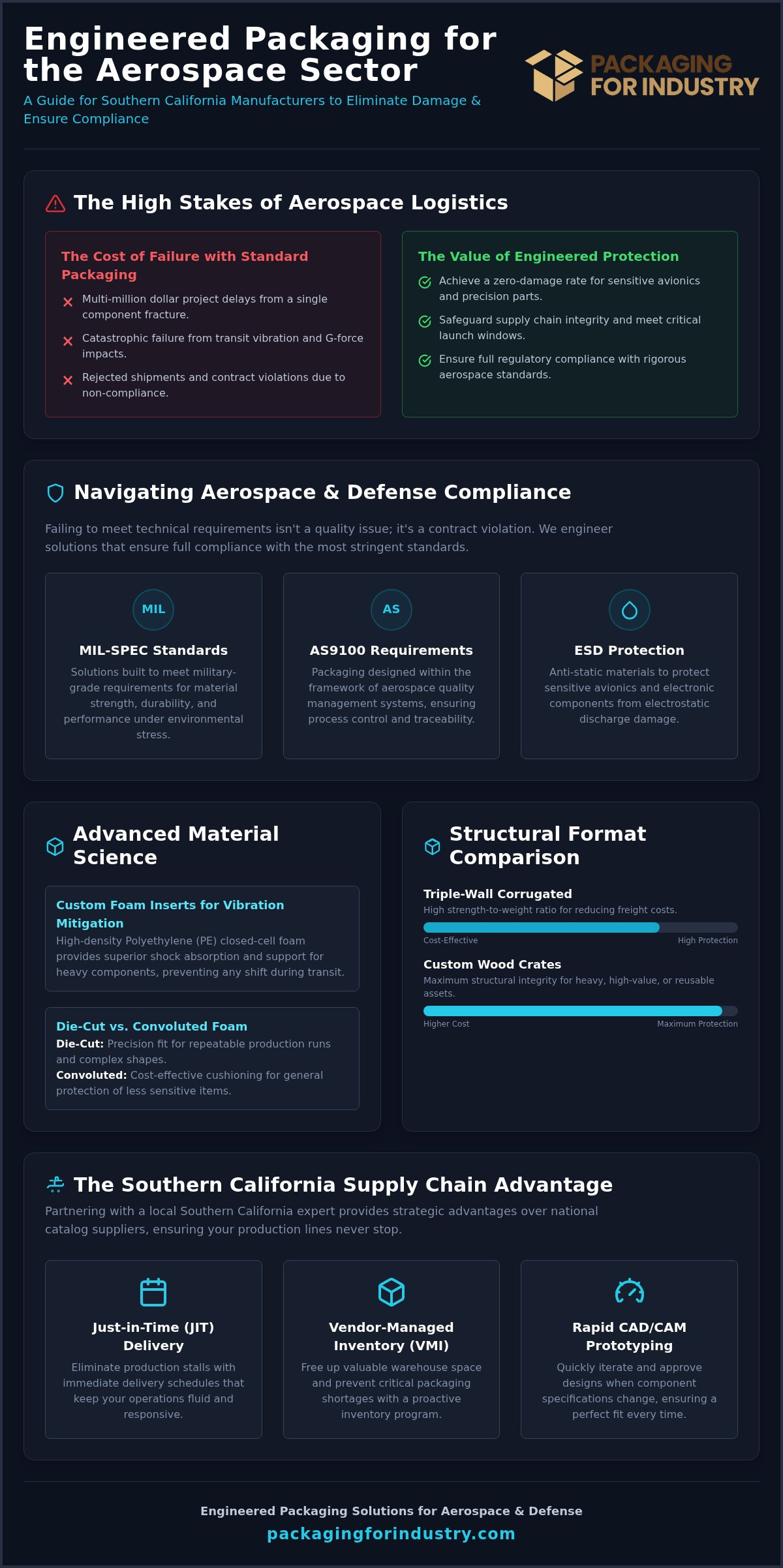
- Compare the functional benefits of triple-wall corrugated boxes versus custom wood crates to reduce freight costs without compromising structural integrity.
- Identify critical supplier benchmarks, including CAD/CAM prototyping capabilities and the ability to provide just-in-time delivery for production line continuity.
- Discover how vendor-managed inventory (VMI) programs can free up valuable warehouse space while preventing critical packaging shortages.
The Strategic Role of Custom Packaging in Southern California’s Aerospace Hub
Southern California serves as the primary global hub for aerospace innovation. For manufacturers in Los Angeles, Orange County, and San Diego, packaging is no longer just a logistical afterthought; it’s a critical component of the engineering lifecycle. Using standard industrial packaging for high-value aerospace components is a significant liability. Generic boxes lack the structural integrity to withstand the specific vibration frequencies and G-force impacts inherent in long-haul transit or international freight. Successful firms are transitioning from basic shipping supplies to engineered protection systems to safeguard precision-machined parts and sensitive avionics.
The High Cost of Damaged Avionics and Assemblies
The true cost of transit damage extends far beyond the invoice price of a replacement component. When a critical assembly arrives with structural compromises, the result is a cascade of project delays, missed launch windows, and expensive forensic engineering reviews. Off-the-shelf corrugated boxes often fail to provide the necessary deceleration for delicate electronics. This leads to internal component failure even when the exterior packaging appears intact. These failures frequently stem from inadequate shock absorption and a lack of adherence to Military Standard or ‘mil spec’ regulations. Custom engineering is mandatory for Tier-1 aerospace suppliers to ensure every shipment meets stringent quality control protocols and avoids the catastrophic costs of grounding a project.
Navigating the Southern California Aerospace Supply Chain
The density of the aerospace cluster in the Inland Empire and greater Los Angeles area makes local proximity a strategic advantage. Relying on national catalog suppliers often results in inconsistent lead times that can stall a Just-In-Time (JIT) production line. By partnering with a regional expert, manufacturers gain access to rapid prototyping and immediate delivery schedules that keep operations fluid. Anaheim-based suppliers like PFI are positioned to support prime contractors and subcontractors with the custom packaging for aerospace components Southern California firms need to maintain a competitive edge. This local support allows for tighter inventory control and the ability to pivot designs quickly when component specifications change. Proximity reduces the carbon footprint of your logistics while ensuring that high-precision crates and foam inserts are available exactly when the assembly line requires them. Learn more about our aerospace packaging capabilities to see how localized engineering improves your supply chain reliability.
Material Specifications: MIL-SPEC, ESD, and High-Density Foam
Aerospace contracts frequently mandate specific material grades to meet rigorous defense-level criteria. These MIL-SPEC standards dictate everything from the burst strength of the corrugated board to the chemical composition of the cushioning. For manufacturers, failing to meet these technical requirements isn’t just a quality issue; it’s a contract violation that can lead to rejected shipments and severe financial penalties. Achieving compliance requires a deep understanding of how different materials interact under environmental stress.
The science of shock absorption relies on choosing the correct foam density for the component’s fragility. We typically utilize a multi-layer approach, often referred to as a foam-in-box system, to provide comprehensive protection. This involves combining a rigid outer shell with engineered internal inserts that isolate the part from external forces. If you aren’t sure which material grade your contract requires, you can request a packaging quote to have our team review your specifications.
Custom Foam Inserts for Vibration Mitigation
Choosing between die-cut and convoluted foam depends on the geometry and weight of your part. Die-cut foam offers a precision fit for repeatable production runs, ensuring that heavy structural components don’t shift during transit. High-density Polyethylene (PE) is a closed-cell foam that provides excellent support for these heavier items. For delicate instruments, softer Polyurethane (PU) foam is often better because it allows for controlled deceleration during a drop. This precision engineering is a hallmark of the custom packaging for aerospace components Southern California firms use to protect high-frequency avionics from vibration damage. Explore our custom foam packaging solutions to find the right density for your application.
ESD and Static Control Standards
Sensitive mission electronics require more than just physical cushioning; they need a barrier against invisible threats. Electrostatic Discharge (ESD) can fry a circuit board without leaving any visible evidence of failure. We solve this by integrating static-control materials into the packaging design. It’s vital to know the difference between anti-static materials, which prevent the generation of static, and static-shielding bags, which create a Faraday cage around the component.
- Static-Shielding Bags: Essential for avionics that are highly sensitive to external electrical fields.
- ESD-Safe Foam: Typically tinted pink or black, these inserts prevent charge buildup within the box.
- Static-Dissipative Corrugated: Provides a controlled path to ground for any accumulated charges.
Ensuring your packaging meets aerospace-grade static control requirements is non-negotiable for mission-critical assemblies. We design these systems to be both compliant and cost-effective, reducing the risk of “dead on arrival” electronics at the integration site.
Crates vs. Heavy-Duty Corrugated: Choosing the Right Format
Choosing between wood and corrugated isn’t just about structural strength; it’s a strategic decision that impacts freight costs, handling efficiency, and warehouse footprint. For heavy aerospace machinery or oversized assemblies, custom wood crates remain the industry standard for maximum load-bearing capacity. However, for mid-sized components and sub-assemblies, heavy-duty triple-wall corrugated can often provide comparable protection at a significantly lower weight. This decision-making process is a core part of the custom packaging for aerospace components Southern California manufacturers use to optimize their logistics budgets.
When analyzing the return on investment (ROI), it’s essential to distinguish between one-way and reusable packaging. One-way corrugated solutions are ideal for outbound shipments where return logistics are cost-prohibitive. Conversely, for closed-loop supply chains between your facility and local subcontractors in the Inland Empire or Orange County, reusable wood crates or heavy-duty plastic containers often provide a lower cost-per-shipment over time. Hybrid systems, which integrate custom foam inserts into triple-wall boxes, offer a middle ground that balances high-level protection with reduced tare weight.
Engineering Custom Shipping Crates for International Transit
International aerospace logistics require strict adherence to export regulations. All wood crates must be ISPM 15 certified, meaning the timber is heat-treated to prevent the spread of invasive pests. For oversized high-precision assemblies, we design foam-lined crates that function as a floating suspension system, isolating the component from the shocks of ocean or air freight. This level of Engineering Custom Crates for International Transit ensures your machinery clears customs without delays while arriving in factory-perfect condition.
Heavy-Duty Corrugated Solutions for Mid-Sized Parts
Triple-wall corrugated boxes are engineered for high stacking strength and puncture resistance. These aren’t standard shipping boxes; they’re industrial-grade containers capable of replacing wood in many applications. By choosing triple-wall RSC boxes, you can lower packaging costs and reduce fuel surcharges associated with heavier wood crates. For components with complex geometries, custom die-cut designs allow for internal bracing that secures the part without the bulk of traditional dunnage. You can view our corrugated box options to compare double-wall and triple-wall specifications for your specific part dimensions.
- Triple-Wall Strength: Capable of supporting thousands of pounds in stacking weight.
- Weight Savings: Significantly lighter than wood, reducing air freight expenses.
- Custom Bracing: Internal die-cut corrugated inserts provide precise part immobilization.
- Recyclability: Easier disposal and higher sustainability ratings compared to treated lumber.
Precision matters in aerospace. Whether you specify a custom crate or a triple-wall container, the goal is to eliminate transit damage while maintaining a lean, efficient supply chain.
How to Evaluate an Aerospace Packaging Supplier in Southern California
Selecting a provider for custom packaging for aerospace components Southern California requires a rigorous vetting process that goes beyond simple price-per-unit comparisons. In this industry, the lowest bid often results in the highest total cost of ownership due to damage claims and rejected shipments. Start your evaluation by assessing a supplier’s engineering support. They should utilize CAD/CAM prototyping to create precise internal geometries that mirror your parts. This technical oversight ensures that complex assemblies remain immobilized during the high-vibration environment of long-haul transport. Verification of MIL-SPEC compliance is the next non-negotiable step. Your supplier must understand the nuances of military-grade materials and provide certifications for your quality audits. Finally, consider the logistical speed. A local partner in Anaheim can offer next-day delivery across Orange County and Los Angeles, providing a level of responsiveness that national catalog suppliers simply can’t match.
The Importance of Free Prototyping and Testing
Physical prototyping is essential to verify fit, form, and function before committing to a full production run. We provide free prototyping because the design phase is where damage prevention is won or lost. By testing a physical sample against your actual component, you can identify potential pressure points or vibration risks. This engineering-first approach eliminates the guesswork common with generic catalog vendors and ensures your production schedule remains on track.
Vendor Managed Inventory (VMI) for Aerospace Production
Warehouse space in Southern California’s industrial hubs is expensive. Dedicating square footage to empty boxes is an inefficient use of capital. Our Vendor Managed Inventory (VMI) programs allow you to reclaim that space for production. We manage stocking levels and provide just-in-time delivery based on your consumption. This eliminates the risk of stockouts while improving your facility’s operational flow. Learn about our VMI services to discover how localized inventory management can lower your overhead.
Reliability is the foundation of any aerospace supply chain. A supplier who offers local next-day delivery and stocking programs acts as an extension of your own warehouse. This proximity ensures the custom packaging for aerospace components Southern California firms require is always available on demand, allowing for immediate adjustments as your component specifications evolve.
Request a Quote: Custom Aerospace Packaging Solutions from PFI
Choosing a partner for your supply chain requires a balance of engineering expertise and fiscal responsibility. Packaging For Industry (PFI) serves as the primary alternative to impersonal, national catalog suppliers that often lack the technical depth required for high-stakes aerospace logistics. While catalog vendors provide convenience for generic shipping supplies, they don’t offer the precision-engineered protection systems necessary to safeguard multi-million dollar avionics. By partnering with PFI, you can compare packaging pricing based on your specific component geometries rather than settling for a one-size-fits-all box. Our focus on optimization helps you lower packaging costs by eliminating excessive dunnage and reducing the overall tare weight of your shipments.
We’ve built our reputation on being a “fixer” for complex logistical challenges. Whether you’re dealing with inconsistent lead times or high damage rates, our team provides a grounded, matter-of-fact approach to protection. We treat your operational challenges as solvable engineering problems. By integrating custom sizes available for every component in your inventory, we ensure that your custom packaging for aerospace components Southern California requirements are met with total accountability from design to final delivery.
Local Service Areas and Nationwide Shipping
Proximity is a strategic asset in the Southern California aerospace corridor. Our headquarters are located in the heart of the region, allowing us to provide local next-day delivery and on-site consultations that keep your production lines moving. We’re proud to support the industrial hubs across the Inland Empire, San Diego, and Los Angeles. For contractors with facilities across the country, we offer nationwide shipping capabilities that maintain consistency across your entire organization. Contact our Anaheim headquarters to discuss how our local presence can streamline your regional operations.
Start Your Custom Packaging Project Today
Securing a custom packaging review is the first step toward a more reliable supply chain. When you submit a request for a quote, providing specific details will ensure a faster and more accurate turnaround. To get the best results, include the following in your RFQ:
- Component Dimensions and Weight: Critical for determining the required burst strength of corrugated or the density of foam inserts.
- Fragility and G-Force Ratings: Helps our engineers specify the correct shock absorption levels.
- Regulatory Requirements: Clearly state any MIL-SPEC, ESD, or ISPM 15 certifications needed.
- Production Volumes: Allows us to offer competitive bulk pricing and set up VMI stocking levels.
We’re ready to help you eliminate transit damage and optimize your logistics spend. Our team will provide a comprehensive cost analysis and prototype design to ensure your components are protected by the most efficient system possible. Don’t let standard packaging become a liability for your high-value assets. Take a proactive step toward a more secure and cost-effective shipping process by reaching out to our specialists today.
Optimizing Your Aerospace Logistics for Long-Term Reliability
Protecting mission-critical avionics requires a shift from standard shipping supplies to precision-engineered systems. You’ve already seen how integrating MIL-SPEC standards and ESD-safe materials eliminates the hidden costs of transit damage. By choosing custom packaging for aerospace components Southern California manufacturers can rely on, you secure both your product integrity and your project timelines. Our local presence in Anaheim ensures you aren’t waiting on national suppliers while your production line sits idle. We offer the technical expertise to navigate complex defense requirements alongside the logistical speed of local next-day delivery.
Leveraging free prototyping allows you to verify every design before a full rollout, ensuring a perfect fit for complex assemblies. This proactive approach reduces freight expenses and warehouse overhead through optimized sizing and VMI programs. We’re ready to help you implement a packaging strategy that treats protection as a profit center rather than an expense. Our team is standing by to analyze your specifications and provide a solution that keeps your operations moving forward with confidence.
Partnering with a local specialist gives you the agility needed to succeed in a demanding industry. Let’s start building a more resilient supply chain today.
Frequently Asked Questions
What are the benefits of using custom foam inserts for aerospace components?
Custom foam inserts provide precise deceleration and vibration isolation tailored to a part’s specific fragility. Unlike generic cushioning, these inserts are engineered to fit the component’s geometry exactly. This prevents shifting during transit and protects sensitive calibrations. We use materials like polyethylene and polyurethane to ensure your high-value assets arrive in factory-perfect condition while reducing the total volume of the package.
How does MIL-SPEC packaging differ from standard industrial packaging?
MIL-SPEC packaging follows rigorous military standards for durability, chemical resistance, and environmental protection that standard industrial packaging cannot match. These specifications ensure materials can withstand extreme temperatures and rough handling without compromising the contents. For manufacturers sourcing custom packaging for aerospace components Southern California defense contracts require, adhering to these standards is mandatory to avoid rejected shipments and contract non-compliance.
Do you provide local next-day delivery in Los Angeles and Orange County?
Yes, we provide local next-day delivery for stock items and scheduled inventory across Los Angeles, Orange County, San Diego, and the Inland Empire. Our headquarters in Anaheim allows us to bypass the delays common with national catalog suppliers. This proximity supports your just-in-time production lines and ensures you have the shipping supplies you need exactly when you need them.
Can custom corrugated boxes replace wood crates for aerospace shipping?
Heavy-duty triple-wall corrugated boxes can often replace wood crates for mid-sized aerospace components to reduce tare weight and freight costs. While wood crates are necessary for oversized machinery, triple-wall corrugated offers significant stacking strength and puncture resistance for many sub-assemblies. This transition helps manufacturers lower logistics expenses while maintaining high levels of protection during transit.
What is a Vendor Managed Inventory (VMI) program for packaging?
A Vendor Managed Inventory (VMI) program is a supply chain solution where we manage your packaging stock levels at your facility or ours. This prevents production line stoppages due to packaging shortages and frees up valuable warehouse space. We monitor your consumption and restock supplies automatically, allowing your team to focus on manufacturing rather than procurement and inventory tracking.
Do you offer ESD-safe packaging for sensitive aerospace electronics?
We offer a full range of ESD-safe packaging solutions including static-shielding bags and anti-static foam inserts for sensitive mission electronics. These materials prevent electrostatic discharge that can damage circuit boards and avionics. Integrating static control into your custom packaging for aerospace components Southern California assemblies ensures that your high-precision electronics remain operational from the assembly line to the final destination.
How long does it take to receive a custom packaging prototype?
Custom packaging prototypes are typically developed and delivered within a few business days depending on the complexity of the design. We utilize CAD/CAM technology to rapidly translate your component specifications into physical samples. This allows you to test for fit, form, and function early in the procurement process, ensuring the final production run meets all engineering requirements without unnecessary delays.
Is your wood packaging ISPM 15 certified for international export?
All our custom wood packaging, including crates and pallets, is ISPM 15 certified for international export. This certification confirms the wood has been heat-treated to eliminate pests, which is a requirement for clearing customs in most foreign ports. Using certified wood prevents costly shipping delays and ensures your international aerospace shipments comply with global phytosanitary regulations.