
A single collapsed core can stall an entire production line and ruin thousands of dollars in high-value roll goods. While many manufacturers view paper tubes as a simple commodity, the reality is that your operational efficiency depends on the precision engineering of your custom paper cores. You’ve likely dealt with the frustration of core collapse during high-speed winding or machine jams caused by slight dimensional variances. It’s a common pain point that stems from using catalog-grade supplies for specialized industrial applications where precision and durability are non-negotiable.
We understand that protecting your bottom line requires more than just a cardboard tube; it requires a structural solution tailored to your specific tension and load requirements. This guide will show you how to specify and engineer custom paper cores that maximize crush strength and eliminate product waste. We’ll explore how to optimize your supply chain through vendor-managed inventory and just-in-time delivery to ensure you always have the right specs on hand without overstocking your warehouse. You’ll learn the exact steps to procure high-strength solutions that lower packaging costs and improve reliability across your facility.
Key Takeaways
- Understand how to specify wall thickness and inside diameter to maximize crush strength and prevent core collapse during high-speed winding.
- Learn the structural distinctions between standard mailing tubes and custom paper cores to ensure your materials are supported from the inside out.
- Discover how to lower packaging costs through bulk pricing strategies and by sourcing from a local supplier to minimize industrial shipping fees.
- Explore the benefits of Vendor Managed Inventory (VMI) and JIT delivery to maintain a reliable supply chain while optimizing your warehouse footprint.
- Gain insights into integrated solutions that combine high-strength cores with custom foam and corrugated packaging to protect high-value roll goods.
Why Custom Paper Cores Matter in Manufacturing
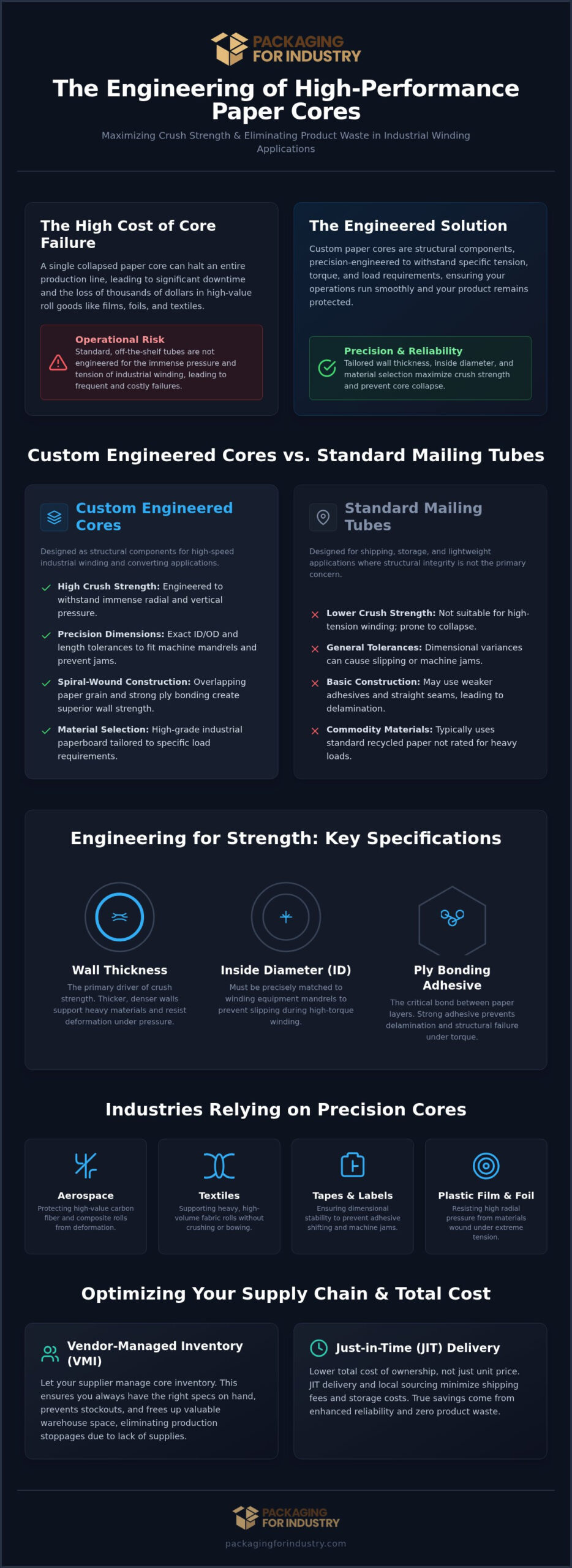
In the converting industry, a paper core is far more than a simple cardboard cylinder. It’s a high-density, spiral-wound tool designed to support materials from the inside out. Whether you’re winding thin plastic film, heavy textiles, or specialized metal foils, the core must maintain its shape under immense pressure. Off-the-shelf tubes often fail because they aren’t engineered for high-speed industrial winding tension. Unlike standard tubes and cores used for basic shipping, custom paper cores are structural components that must resist crushing from the weight and tension of the material wrapped around them. Failure here doesn’t just mean a broken tube; it means scrapped product and hours of machine downtime.
The Anatomy of a High-Performance Paper Core
The strength of a core starts with its construction. Manufacturers create these cylinders by winding layers of heavy paper-based products around a mandrel in a spiral pattern. This technique ensures that the grain of the paper overlaps, creating a much stronger wall than a straight-seam tube could provide. We focus on material selection, choosing between recycled kraft and high-grade industrial paperboard based on the specific load requirements of your operation. Ply bonding is equally critical. The adhesive between each layer must be strong enough to prevent delamination when the core is subjected to the high torque of a winding machine. If the ply bonding is weak, the layers will separate, leading to immediate structural failure.
Industries That Rely on Custom Core Engineering
Precision engineering is a requirement in sectors where dimensional stability is tied to product quality. In the aerospace sector, custom paper cores are used to protect expensive carbon fiber and composite rolls that cannot tolerate any interior deformation. The textile industry relies on these cores to manage high-volume fabric winding, where the weight of the material can easily crush a standard tube. For tape and label manufacturers, dimensional stability is the primary concern. Any variance in the core’s diameter can cause adhesive layers to shift or machine mandrels to jam, stopping production. By opting for an engineered solution, manufacturers in Southern California and nationwide can ensure their high-value goods remain protected while they request a packaging quote for their specific winding needs.
Engineering for Strength: Specifying Dimensions and Wall Thickness
Specifying the correct dimensions for custom paper cores is a technical process that impacts both your production speed and the safety of your inventory. The Inside Diameter (ID) must match your winding equipment mandrels with high precision. If the ID is too large, the core will slip during high-torque winding; if it’s too small, it won’t fit the machine at all. Similarly, wall thickness is the primary driver of crush strength. Thicker walls provide the necessary beam strength to support heavy materials like industrial textiles or metal foils without bowing or collapsing under the weight. Managing the Outside Diameter (OD) is equally important for logistics, as it determines the total footprint of the finished roll and how many units can fit on a standard pallet or inside a shipping container.
Precision cutting ensures that length tolerances remain within your automated production line’s requirements. Even a slight variance in length can cause machine jams or inconsistent winding edges, leading to material waste. When you compare packaging pricing, it’s essential to look beyond the unit price and consider how these tolerances affect your overall operational efficiency.
Calculating Crush Strength and Radial Pressure
Different materials exert different types of pressure on a core. For example, stretch film creates high radial pressure as it’s wound under tension, essentially trying to squeeze the core into a smaller diameter. In contrast, heavy products like carpets or industrial fabrics exert more vertical pressure. Crush strength is the maximum load a core can withstand before structural failure. To prevent deformation, we use high-density paperboard that maintains its integrity under these specific loads. Understanding these variables helps you manage the total cost of paper cores by preventing expensive product losses caused by core collapse.
Custom Finishes and Specialty Liners
Standard cores may fail when exposed to environmental stressors or sensitive materials. We offer moisture-resistant barriers that protect the structural integrity of the core in humid warehouse conditions or during outdoor transport. For manufacturers of high-clarity films, smooth-surface outer plies are available to prevent “core start” impressions that can ruin the first few layers of material. In the electronics and semiconductor sectors, anti-static (ESD) cores are a requirement to prevent static discharge from damaging sensitive components. These specialty finishes ensure that your custom paper cores perform reliably in even the most demanding environments. If you need to optimize your winding process, you can request a packaging quote for engineered solutions tailored to your facility.
Custom Paper Cores vs. Standard Mailing Tubes
Choosing between a core and a tube is about identifying where the stress occurs in your process. A mailing tube is designed for exterior protection; it keeps blueprints, posters, or long parts safe from outside impacts. In contrast, custom paper cores are engineered for interior support. They act as the backbone for materials like film, foil, or textiles, resisting the intense inward radial pressure of tightly wound layers. Because cores must endure high torque and tension during the converting process, they require significantly higher ply-bonding strength than a standard shipping tube. Using a mailing tube for an industrial winding application often leads to immediate structural failure and expensive material loss.
Cost considerations should focus on total operational impact rather than just the unit price. While a standard tube might seem cheaper upfront, the investment in high-strength custom paper cores pays for itself by preventing core collapse. When a core fails under the weight of a high-value substrate, the material often becomes unusable. The resulting machine downtime and product waste can cost your facility thousands in lost productivity. Selecting the right tool for the job ensures that your supply chain remains efficient and your goods arrive intact.
When to Use Heavy-Duty Mailing Tubes
Industrial tubes serve a distinct purpose when the goal is shielding rather than winding. You can protect blueprints and components with industrial tubes when shipping long, slender items like aerospace rods, specialized sensors, or architectural drawings. These tubes act as rigid protective sleeves, preventing scratches, bending, or moisture damage during transit across Southern California or nationwide. They are the ideal solution for finished industrial parts that require a durable barrier against warehouse handling and shipping vibrations.
Selecting the Right Core for Your Substrate
The choice between soft-wind and hard-wind applications determines your core’s final specifications. Soft-wind applications, such as certain fabrics and non-wovens, require cores that can handle weight without needing extreme radial resistance. Hard-wind applications, common in stretch film and tape production, require maximum paperboard density to withstand the “crushing” force of the material wound under high tension. You should also evaluate the ROI of reusable versus single-use cores. High-grade materials allow for multiple uses in closed-loop systems, which can significantly lower your long-term packaging costs. Standardizing your core sizes further simplifies warehouse logistics and makes it easier to implement a Vendor Managed Inventory (VMI) program to maintain consistent stock levels.
Procurement Strategy: Lowering the Total Cost of Paper Cores
Procuring custom paper cores requires a focus on the total cost of ownership rather than just the initial unit price. While it’s tempting to chase the lowest quote, operational costs like freight, storage, and material waste often represent a larger portion of your budget. Evaluating your annual usage allows you to leverage bulk pricing discounts that aren’t available for one-off orders. By committing to a forecasted volume, you secure a stable price point and protect your margins against paperboard market fluctuations. Precision engineering also reduces costs by ensuring you don’t pay for over-engineered specs that exceed your actual structural requirements.
Shipping heavy, high-density cylinders across the country is economically inefficient. High freight costs from national catalog suppliers can quickly erase any perceived savings on the product itself. Sourcing from a local partner in Southern California drastically reduces these logistics expenses while providing more control over your inventory flow. This proximity allows for more agile responses to production spikes without the penalty of expedited shipping fees.
The Benefits of Local Supply in Southern California
Operating in high-density manufacturing hubs like Anaheim, Irvine, and Los Angeles requires a responsive supply chain. Local sourcing allows for next-day delivery, which is vital for preventing production stops when inventory runs low. You gain a reliable packaging supply in Orange County that understands the specific needs of regional aerospace and converting facilities. This proximity also facilitates better quality control and more frequent communication; ensuring your custom paper cores meet your exact tolerances every time.
Implementing Vendor Managed Inventory (VMI) for Cores
Managing a high-volume stock of paper cores can strain your warehouse resources and tie up valuable capital. A Vendor Managed Inventory (VMI) program shifts the burden of stock monitoring to your supplier. We track your usage rates and replenish your supply automatically; ensuring you never run out during a critical production run. Moving to a Just-In-Time (JIT) model allows you to optimize your supply chain with VMI services, freeing up floor space for finished goods rather than bulky packaging materials. This approach minimizes the risk of core damage during long-term storage and improves your facility’s overall logistical flow.
Integrated Solutions: Combining Cores with Protective Packaging
While custom paper cores provide the internal structural integrity needed for winding, they’re only one component of a successful industrial shipping system. Once your material is wound, it requires an external shell to survive the rigors of transit. Many manufacturers make the mistake of sourcing cores and outer packaging from different vendors; this often leads to dimensional mismatches and increased damage rates. An integrated approach ensures that every layer of protection, from the core to the outer carton, works in unison to secure your roll goods. This synergy is vital for maintaining product quality from the production line to the end user.
Protecting the edges of rolled materials is a primary concern for converters and manufacturers. Even a high-strength core can’t prevent a roll from shifting inside a box if it isn’t properly braced. We utilize custom foam end caps, typically made from high-density polyethylene, to suspend the roll within the outer packaging. This design prevents the weight of the material from resting on its own edges; it eliminates flat spots and prevents telescoping. When you combine these with heavy-duty stretch film and corner protectors on the pallet, you create a stable unit load that resists vibration and impact during long-haul shipping across Southern California or nationwide.
Custom Box and Foam Integration
Designing the perfect outer carton requires precise measurements of the finished roll’s outside diameter and total weight. We specialize in creating custom corrugated boxes for industrial shipping that are engineered to withstand stacking pressures in a warehouse environment. By using die-cut foam inserts, we lock the core in place to ensure the product remains centered and immobile. This level of precision is especially critical for aerospace composites and medical-grade films where even minor surface abrasions can lead to total product rejection and significant financial loss.
Requesting a Custom Quote for Your Entire Packaging Line
There’s a distinct operational advantage to utilizing a single-source supplier for your boxes, foam, film, and cores. It simplifies your procurement process and ensures that all components are designed to fit perfectly together from the start. Our engineering team provides free prototyping to verify that your integrated solution meets your specific performance standards before you commit to a bulk order. This holistic oversight reduces the risk of shipping damage and lowers your total packaging costs by eliminating redundant or ill-fitting materials. You can Request a packaging quote for your custom paper cores and integrated supplies to see how a unified system improves your facility’s bottom line.
Optimize Your Winding Operations and Supply Reliability
Securing your production line starts with recognizing that a paper core is a precision-engineered tool. By specifying the exact wall thickness and density required for your custom paper cores, you prevent the structural failures that lead to scrapped materials and machine downtime. This technical approach is especially vital for the specialized manufacturing and aerospace sectors where roll integrity is non-negotiable. Protecting your high-value goods requires a solution that addresses both internal support and external protection through integrated packaging systems.
Beyond the engineering, a strategic procurement model is what drives long-term fiscal responsibility. Utilizing Vendor Managed Inventory (VMI) and JIT programs allows you to optimize warehouse space while maintaining a constant supply of high-strength cores. Our local next-day delivery in Southern California ensures that your facility remains agile and responsive to shifting market demands without the burden of excessive lead times or high freight costs from national catalog suppliers. Moving toward a managed supply chain is the most effective way to lower packaging costs while improving operational stability.
Investing in a precision-engineered core system is a proactive step toward eliminating professional stress and ensuring your logistics flow remains uninterrupted. We’re ready to help you design a reliable solution that protects your product and your bottom line.
Frequently Asked Questions
What is the difference between a paper tube and a paper core?
A paper core is a high-density cylinder designed to support materials from the inside out; a paper tube is a protective sleeve for exterior shielding. While they look similar, custom paper cores require much higher structural integrity and ply-bonding strength to withstand the torque and radial pressure of industrial winding machines. Tubes are typically lighter and used for shipping items like blueprints or posters.
Can I get custom inside diameters for my paper cores?
Yes, we manufacture cores with specific inside diameters (ID) to ensure a precise fit for your winding equipment mandrels. A correct ID is critical because even a slight variance can lead to core slippage or machine jams during high-speed production. We offer a wide range of custom sizes to accommodate various industrial machinery and mandrel specifications.
How do I determine the required wall thickness for my winding tension?
Required wall thickness depends on your material’s weight, the winding speed, and the specific radial pressure exerted by the substrate. For example, materials wound under high tension, like stretch film, require thicker walls to resist crushing forces. Our engineering team can help you calculate the necessary specs to ensure your custom paper cores maintain their structural integrity throughout the entire winding and shipping process.
Do you offer moisture-resistant or specialty finishes for paper cores?
We provide various specialty finishes, including moisture-resistant barriers and anti-static (ESD) liners, to protect your products in challenging environments. Moisture barriers are essential for long-term storage in humid warehouses or outdoor transport. For the electronics and semiconductor industries, ESD cores prevent static discharge from damaging sensitive components during the winding or unwinding phase.
What is the minimum order quantity for custom paper cores?
Minimum order quantities depend on the complexity of your specifications and the dimensions required. We specialize in serving industrial manufacturers and distributors who require bulk quantities and consistent supply chains. To get the most accurate pricing and volume requirements for your specific application, we recommend you request a packaging quote directly from our team.
Do you provide next-day delivery for businesses in Southern California?
We offer local next-day delivery to businesses throughout Southern California, including Orange County, Los Angeles, and San Diego. Our regional logistics network is designed to support high-volume manufacturing facilities that require rapid replenishment to avoid production downtime. This local service helps you lower packaging costs by reducing freight expenses compared to national catalog suppliers.
Can you manage my core inventory through a VMI program?
Our Vendor Managed Inventory (VMI) program allows us to monitor your stock levels and replenish your supply automatically. This service ensures you never run out of critical materials during a production run while freeing up valuable warehouse floor space. By moving to a Just-In-Time (JIT) delivery model, you can optimize your logistical flow and reduce the overhead associated with managing large inventory stockpiles.
Are your paper cores recyclable and eco-friendly?
Our paper cores are manufactured using recyclable paperboard and kraft materials, making them an eco-friendly choice for industrial packaging. Because they are constructed from renewable fibers, they can be easily integrated into existing recycling programs at your facility. This allows you to meet sustainability targets while ensuring your materials are supported by high-strength, precision-engineered solutions.