
A standard cardboard cylinder is often the single point of failure that costs thousands in damaged industrial components. While many treat procurement as a simple line item, high-grade kraft mailing tubes are precision-engineered tools that require a strategic approach to maximize both protection and ROI. You likely understand the frustration of transit-related tube collapse or the logistical headache of inventory stockouts that stall production. It’s a difficult balance to protect long, fragile goods without letting shipping and storage costs spiral out of control.
This guide provides the technical framework you need to specify, source, and optimize your shipping materials for maximum efficiency. You’ll learn how to navigate the July 2026 USPS non-standard parcel regulations and rising kraft paper market trends to maintain fiscal responsibility. We’ll cover critical specifications like custom wall thickness for heavy-duty applications, streamlined inventory management through Vendor Managed Inventory (VMI), and strategies for bulk procurement that outperform standard retail catalogs. By the end of this professional guide, you’ll have the insights required to secure your supply chain and lower your total cost of ownership.
Key Takeaways
- Identify the critical differences between Inside Diameter (ID) and Outside Diameter (OD) to ensure a precision fit and superior protection for long-form goods.
- Reduce overhead by sourcing custom-engineered kraft mailing tubes that minimize dimensional weight surcharges and transit damage.
- Learn to leverage Vendor Managed Inventory (VMI) to solve warehouse space constraints while maintaining a reliable supply of bulky packaging materials.
- Compare packaging pricing and procurement strategies to position your operation as a cost-saving alternative to generic large-scale catalog suppliers.
- Discover how Southern California manufacturers benefit from local next-day delivery and specialized industrial kitting for aerospace and medical sectors.
Understanding Kraft Mailing Tubes for Industrial Applications
Kraft mailing tubes are not merely simple cardboard cylinders; they are precision-engineered spiral-wound paperboard tools designed for high longitudinal strength. In industrial logistics, Shipping tubes offer a distinct mechanical advantage over standard rectangular boxes. While a box concentrates stress at its corners and is prone to buckling under vertical pressure, a cylindrical tube distributes force evenly across its entire surface area. This geometry is essential for protecting rolled items like high-value blueprints, metal rods, or industrial textiles.
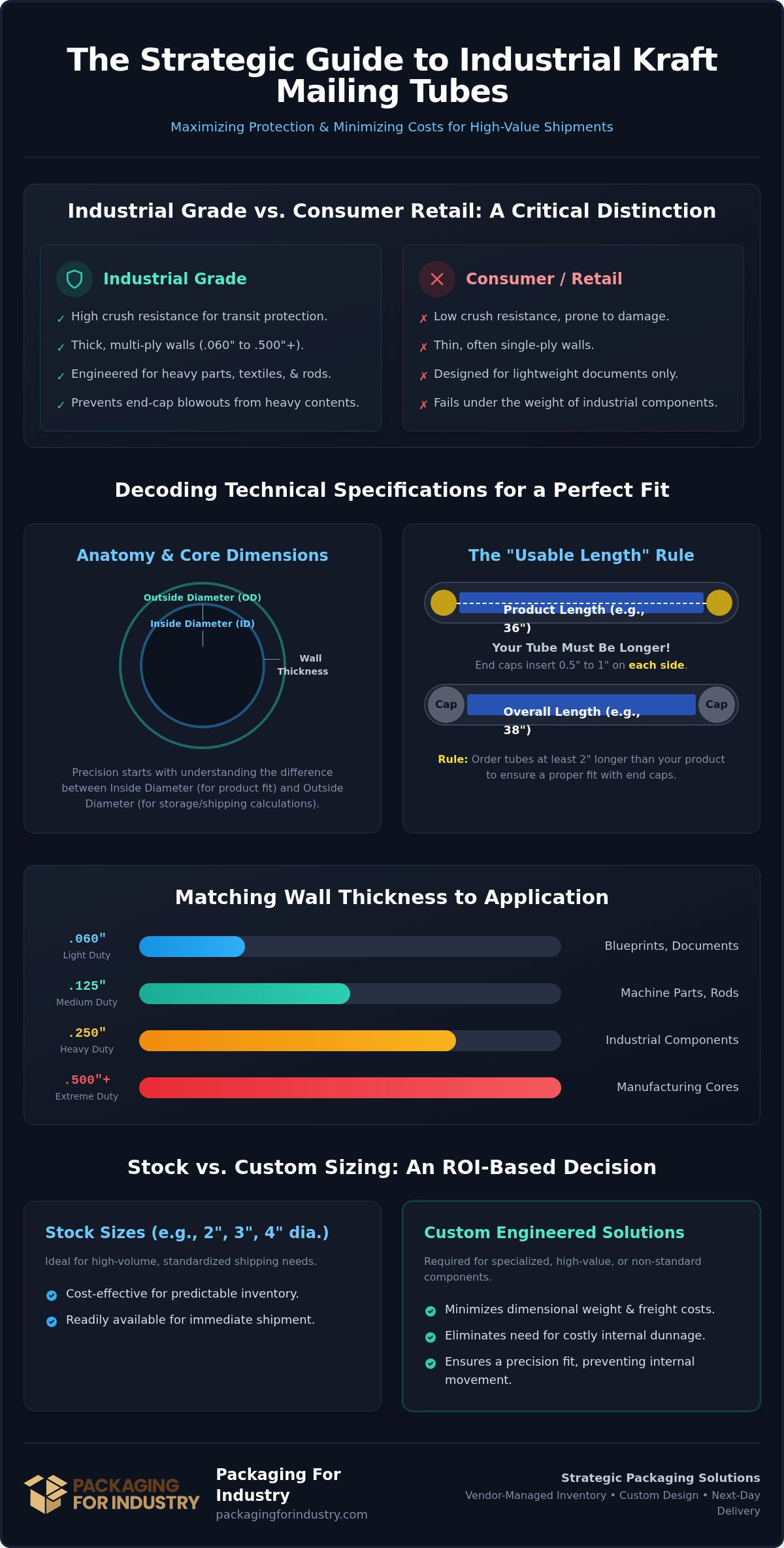
There is a sharp distinction between industrial grade solutions and the flimsy retail tubes found in consumer office supply stores. Industrial applications demand a higher crush resistance and specific wall thicknesses to prevent end-cap blowouts. This failure occurs when the weight of the internal product shifts during transit, forcing the closure out and leaving the contents exposed. Choosing the right kraft mailing tubes ensures your goods arrive intact while maintaining your professional reputation for reliability.
The Anatomy of a Spiral-Wound Tube
The structural integrity of a tube comes from the ply-layering process. Manufacturers wind multiple strips of paperboard around a stationary mandrel, bonding them with industrial adhesives. This spiral construction creates a rigid wall that resists bending and compression. Kraft paper is the preferred material here because it offers an exceptional strength-to-weight ratio. While standard mailing tubes provide sufficient protection for lighter documents, heavy-duty industrial cores are engineered with thicker plies to support massive weights in manufacturing environments. You can view our full range of tubes and cores to see the various specifications available for different load requirements.
Stock vs. Custom Sizes: When to Engineer
Standard operations often rely on stock diameters like 2″, 3″, and 4″ for general shipments. These are cost-effective for high-volume, predictable needs. However, specialized components frequently require a tighter tolerance to prevent movement within the tube. If your product has a non-standard length or a unique diameter, stock solutions can lead to wasted space and increased freight costs. We provide custom design packaging to help you engineer a solution that fits your specific product dimensions perfectly. This precision reduces the need for excessive internal dunnage and ensures that your shipping costs remain optimized.
Technical Specifications: Wall Thickness and Custom Dimensions
Precision in measurement is the foundation of industrial packaging efficiency. When specifying kraft mailing tubes, you must distinguish between Inside Diameter (ID) and Outside Diameter (OD). The ID determines the maximum width of the product that can fit inside, while the OD is critical for calculating pallet footprints and warehouse storage density. The difference between these two figures is your wall thickness. Adhering to federal standards for multi-wall kraft paper ensures that these plies are bonded with the necessary adhesive strength to resist delamination under stress.
Wall thickness typically ranges from .060 inches for lightweight documents to .500 inches or greater for heavy-duty industrial applications. Your choice depends largely on the shipping environment. Parcel carriers like UPS and FedEx utilize high-speed sorting conveyors that subject tubes to frequent drops and impacts. In these scenarios, a thicker wall is necessary to prevent the tube from bending. For Less-Than-Truckload (LTL) shipments, where tubes are often palletized and wrapped, you might prioritize stacking strength over impact resistance to prevent the bottom layer from collapsing under the weight of the load.
One common oversight in procurement is the distinction between “Overall Length” and “Usable Length.” When you utilize plastic end plugs, they typically insert one-half to one full inch into the tube on each side. If you purchase a 36-inch tube for a 36-inch part, the end caps will not fit. You must account for this displacement by ordering a tube that is at least two inches longer than your product. If you’re managing complex requirements for high-value goods, you can request a packaging quote to ensure your dimensions are engineered correctly for your specific application.
Calculating Crush Resistance for Heavy Goods
Crush resistance is the maximum compressive load a tube can withstand before its structural wall fails or deforms. For manufacturers shipping metal rods, heavy textile rolls, or aerospace components, “heavy-duty” cores are non-negotiable. Stacking strength correlates directly to the number of paper plies and the quality of the kraft material used. A tube with a .250 wall thickness provides significantly more vertical support than a standard .125 wall, allowing you to stack pallets higher without risking product damage. This vertical optimization is a key factor in reducing overall warehouse costs.
Closure Systems: End Caps and Crimped Ends
The closure system you choose must match the weight and value of your contents. Plastic end plugs are the industry standard for most kraft mailing tubes because they are cost-effective and easy to install. However, for high-security or extremely heavy shipments, metal end caps provide a superior grip that resists popping out during rough handling. For high-volume, lightweight shipping where speed is a priority, crimped end (snap-seal) tubes eliminate the need for separate caps entirely. To ensure caps stay secure, many industrial shippers use heavy-duty staples or tape to reinforce the closure, especially when the internal product is prone to shifting during transit.
Industrial Use Cases: From Aerospace Blueprints to Textile Rolls
Industrial applications for kraft mailing tubes extend far beyond the generic shipping of posters or retail artwork. In sectors where precision is a baseline requirement, these cylinders serve as critical protective barriers for high-value components and documentation. Whether you’re transporting specialized medical instruments or long industrial shafts, the goal remains the same: total protection against longitudinal stress. It’s not just about getting an item from point A to point B; it’s about ensuring it arrives in a condition that doesn’t compromise production schedules.
Aerospace and Defense Logistics
Large-scale aerospace projects involve massive engineering prints and blueprints that must remain pristine throughout their lifecycle. These documents are often subject to strict compliance standards for long-term storage and frequent handling in hangar environments. A standard box doesn’t provide the necessary rigidity to prevent permanent creasing or edge fraying. By utilizing industrial-grade tubes, defense contractors ensure that technical data remains legible and audit-ready. This level of protection is a hallmark of high-quality manufacturing packaging where reliability is paramount.
Textiles and Synthetic Roll Goods
The textile industry faces a unique challenge known as “core crush.” When fabrics or synthetic films are wound under high tension, the inward pressure can collapse a low-quality core. Heavy-duty kraft mailing tubes are engineered specifically to withstand these winding forces. Proper sizing is also essential. A tube that is even slightly too short will lead to edge damage on expensive rolls of silk, carbon fiber, or industrial vinyl. Ensuring the core matches the material’s width prevents costly scrap and improves winding efficiency.
Beyond documentation and textiles, specialized sectors like medical device manufacturing use tubes to ship long, thin surgical instruments that require a rigid outer shell. In the electronics sector, anti-static or ESD-safe tubes protect components from static discharge during transit. Many of these industries also look to optimize their supply chains by following EPA procurement guidelines for paper products. This commitment to sustainable sourcing allows manufacturers to maintain high performance while meeting environmental corporate social responsibility goals.
Optimizing Procurement: Bulk Ordering and Cost Reduction
Procurement professionals often view packaging as a commodity. However, strategic sourcing is the most effective way to realize packaging cost savings. Bulk ordering kraft mailing tubes reduces the per-unit price and stabilizes your supply chain against the rising paper costs reported in 2026. While stock tubes offer immediate availability, custom-engineered solutions often prove more cost-effective by reducing product damage and optimizing shipping dimensions. We position ourselves as a cost-saving alternative to large catalog suppliers by providing tailored specs that eliminate the need for secondary cushioning materials. This precision ensures you aren’t over-specifying your materials and wasting capital on unnecessary paperboard plies.
Reducing Freight and Surcharge Costs
Carrier surcharges are a significant drain on industrial margins. UPS and FedEx calculate costs based on dimensional weight, which penalizes shipments with excessive “dead space.” Choosing the smallest possible diameter for your kraft mailing tubes minimizes this volume and lowers your freight bill. This optimization is even more critical following the July 2026 USPS regulations that classify cylindrical tubes as non-standard parcels. You must balance tube weight with durability. A tube that is too heavy adds unnecessary shipping expense. Conversely, a tube that is too light risks structural failure during high-speed sorting. Engineering the precise wall thickness for your specific product weight ensures you aren’t paying to ship air. This level of detail is vital for high-volume operations where small per-package savings aggregate into significant annual figures.
The Strategic Value of VMI for Tubes
Mailing tubes are notoriously difficult to store. Their cylindrical shape creates awkward voids and consumes vast amounts of vertical warehouse space. Our Vendor Managed Inventory (VMI) program addresses this operational bottleneck directly. Instead of dedicating valuable floor space to months of bulky inventory, we manage your stock levels so you only store what you need for the immediate production cycle. This proactive approach eliminates the need for expensive emergency rush orders. It also ensures you never experience a stockout that halts your shipping line. By shifting the storage burden to a trusted partner, you free up warehouse capacity for revenue-generating production activities. This system creates a leaner, more responsive supply chain that adapts to your actual usage rates.
Why PFI is Your Strategic Partner for Mailing Tubes and Cores
Choosing a supplier for industrial-grade kraft mailing tubes is a decision that impacts your entire logistical flow. Many distributors simply fulfill orders from a catalog without understanding the specific mechanical stresses of your application. We take a fundamentally different approach by acting as an industrial consultant and a proactive problem-solver. Our primary objective is to eliminate professional stress by solving recurring damage issues and optimizing your procurement costs. While we maintain a deep presence in Southern California, including Anaheim and Los Angeles, our distribution network supports nationwide shipping to ensure consistent reliability for multi-site operations.
Local Service, Nationwide Capability
Our proximity to major industrial hubs like Irvine and Santa Fe Springs provides a distinct logistical advantage. For businesses in Orange County and the Inland Empire, we offer local next-day delivery on many stock items. This local footprint significantly reduces lead times for custom-engineered runs, allowing your team to remain agile in the face of shifting production demands. You don’t have to wait weeks for specialized dimensions to arrive from across the country. If you’re ready to improve your supply chain reliability, you can request a packaging quote to see how our local expertise translates into tangible operational efficiency.
Integrated Packaging Solutions
Efficiency in the warehouse is often hindered by fragmented procurement. Managing separate vendors for kraft mailing tubes, foam packaging, and corrugated boxes creates administrative friction and inconsistent protection levels. We provide an integrated one-stop-shop advantage that streamlines your entire packaging system. For example, we often combine heavy-duty tubes with custom foam inserts to secure high-value medical or aerospace components within a larger shipping crate. This holistic design process includes free prototyping for complex industrial requirements, ensuring that every element of your kitting solution works in unison. By consolidating your packaging needs with a single seasoned partner, you reduce carrying costs and simplify warehouse logistics.
Securing Your Supply Chain with Engineered Protection
Transitioning from commodity procurement to a strategic engineering approach ensures your high-value goods remain protected during transit. By focusing on precise wall thicknesses and custom dimensions, you eliminate the risks of tube collapse and end-cap failure. Integrating solutions like Vendor Managed Inventory (VMI) further optimizes your operation by reclaiming valuable warehouse space and preventing production delays. These strategies move beyond simple purchasing to create a resilient logistical framework.
Our expertise in industrial kitting and free prototyping allows you to solve complex protection challenges before they impact your bottom line. Whether you’re in aerospace, medical manufacturing, or heavy industry, we provide the technical support and local Southern California logistics needed to maintain a lean, efficient operation. Relying on high-grade kraft mailing tubes is a fundamental step toward reducing shipping damage and lowering your total packaging costs. We’re dedicated to providing the stability your supply chain requires through reliable local next-day delivery and nationwide shipping capabilities.
We’re ready to help you streamline your logistics and protect your professional reputation with every shipment.
Frequently Asked Questions
What is the difference between a mailing tube and an industrial core?
A mailing tube is designed as a protective shipping container, whereas an industrial core serves as a structural base for winding materials like textiles, films, or metal foils. While they share a spiral-wound construction, cores typically feature much higher crush resistance to withstand the tension of high-speed winding equipment. Mailing tubes are optimized for longitudinal strength and include closure systems like end caps to secure contents during transit.
How do I choose the correct wall thickness for heavy industrial parts?
You should select wall thickness based on the total product weight and the likely stack height during transit. For heavy components like metal shafts or thick-gauge rods, a thickness between .125 and .500 inches is standard to prevent bending or collapse. If you’re shipping via parcel carriers, a thicker wall is necessary to absorb the high-impact forces of automated sorting systems that can easily crush standard retail-grade tubes.
Can I get custom-length kraft mailing tubes for oversized products?
Yes, we provide kraft mailing tubes in custom lengths and diameters to accommodate oversized or non-standard industrial components. Custom engineering ensures a precision fit, which eliminates the need for excessive internal dunnage and reduces the risk of product movement during shipping. This capability is essential for sectors like aerospace and construction, where products often exceed the dimensions of standard off-the-shelf inventory. Custom sizes available upon request to match your specific requirements.
What types of end caps are best for international shipping?
Metal end caps are the superior choice for international shipping due to their high security and resistance to temperature fluctuations. Unlike plastic plugs, metal caps are often stapled or crimped into the tube wall, ensuring they remain seated during the rough handling associated with maritime or air freight. For high-value exports, this extra level of durability prevents “end-cap blowout” and protects your goods from environmental exposure in foreign ports.
How does a VMI program help manage bulky items like mailing tubes?
A Vendor Managed Inventory (VMI) program reclaims valuable floor space by shifting the storage burden to your supplier. Since mailing tubes are bulky and consume significant vertical space, our VMI system ensures you only maintain a few days of stock on-site. We monitor your usage rates and replenish your inventory automatically; this eliminates emergency rush orders and allows you to dedicate your warehouse capacity to revenue-generating production activities.
Do you offer local next-day delivery for businesses in Orange County?
We provide local next-day delivery for businesses throughout Orange County, including Anaheim, Irvine, and Brea. This service is designed to support just-in-time manufacturing schedules and reduce the lead times associated with nationwide freight. By leveraging our local Southern California logistics network, we help you maintain lean inventory levels while ensuring that your shipping department always has the necessary materials to meet your daily fulfillment targets.
Are kraft mailing tubes recyclable or eco-friendly for industrial use?
Kraft mailing tubes are highly eco-friendly as they’re manufactured from 100% recyclable paperboard. Most industrial tubes are also biodegradable and can be easily integrated into existing corporate recycling programs. By choosing paper-based cylindrical protection over plastic alternatives, you align your procurement with environmental standards and sustainability goals. This material choice provides a high strength-to-weight ratio without the long-term environmental impact of non-recyclable synthetic packaging solutions.
How can I reduce dimensional weight surcharges when shipping tubes via FedEx or UPS?
To lower packaging costs and avoid dimensional weight surcharges, you must minimize the “dead space” inside the tube. Select the smallest possible inside diameter that safely fits your product and use custom lengths to avoid excessive overhang. Since FedEx and UPS calculate shipping rates based on the volume of the package, reducing the outside diameter by even half an inch can result in significant annual savings for high-volume industrial shippers.