
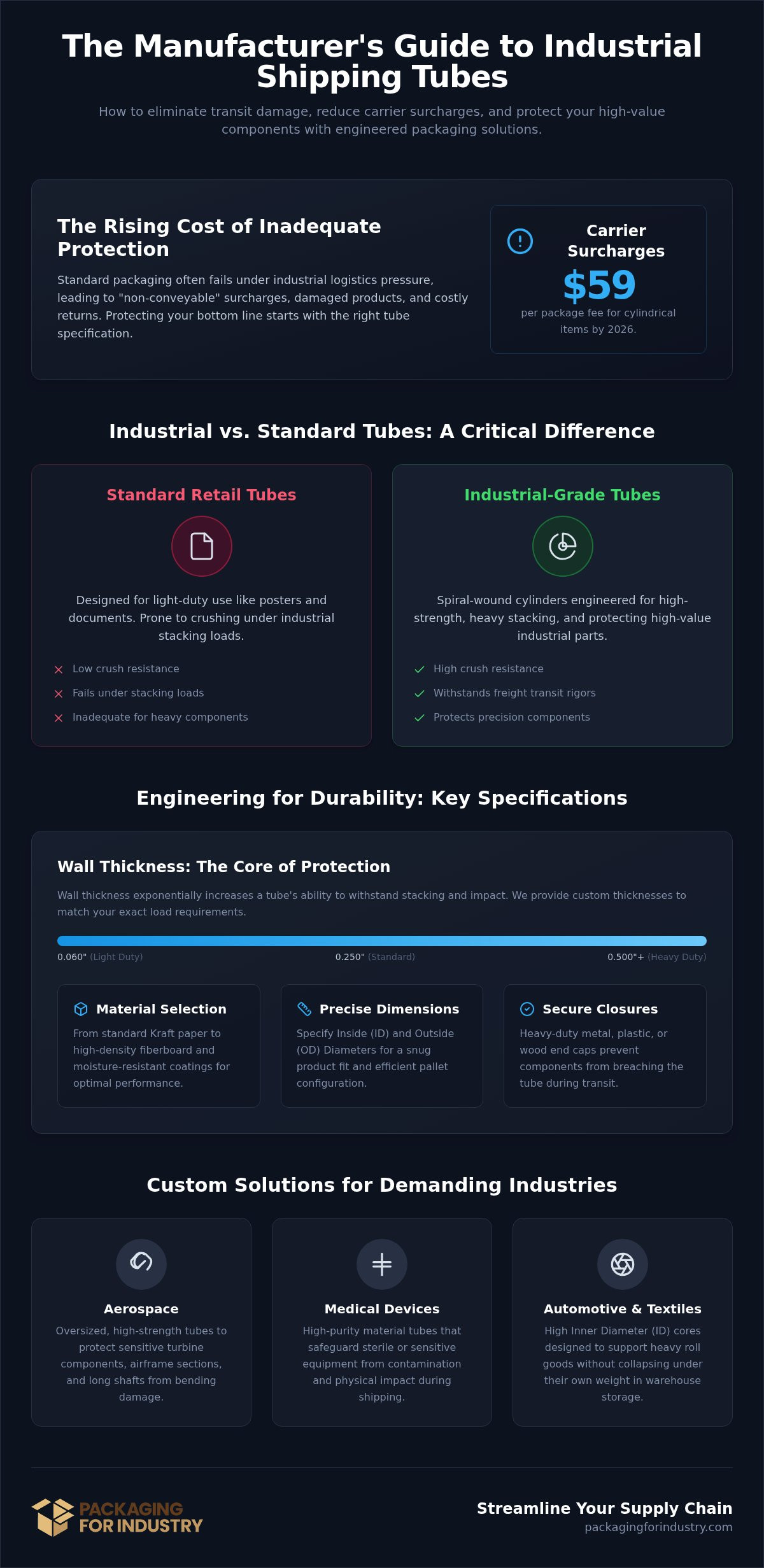
Is your bottom line being eroded by “non-conveyable” surcharges and the hidden costs of transit damage? As of 2026, major carriers have increased additional handling fees for cylindrical items to as much as $59 per package, making the choice of shipping tubes for manufacturers a high-stakes financial decision. You likely already know that a single dented tube can compromise a precision-engineered component, leading to costly returns and strained client relationships. It’s a frustrating cycle of paying more for shipping while still dealing with the fallout of inadequate protection from weak-walled materials.
This guide provides the technical roadmap you need to select, specify, and source industrial-grade tubes that safeguard your products and your margins. We’ll show you how to move beyond generic catalog options to find customized solutions that fit your specific lengths and diameters perfectly. From understanding the impact of 2026 USPS dimensional weight changes to leveraging vendor-managed inventory for local next-day delivery in Southern California, you’ll learn how to transform your packaging from a vulnerability into a streamlined operational asset that ensures zero transit damage for your longest components.
Key Takeaways
- Learn why spiral-wound industrial tubes provide the crush resistance necessary for heavy stacking, unlike standard retail alternatives.
- Understand how to specify wall thicknesses from 0.060″ to 0.500″+ to ensure both vertical and horizontal protection for high-value components.
- Discover how custom shipping tubes for manufacturers eliminate transit damage and reduce logistics costs for oversized or specialized aerospace parts.
- Identify the correct closure materials, such as heavy-duty metal end stops, to prevent heavy components from breaching the packaging during transit.
- Explore how Vendor Managed Inventory (VMI) and Just-in-Time delivery can eliminate stockouts while freeing up valuable warehouse floor space.
Beyond the Catalog: Why Manufacturers Need Industrial-Grade Shipping Tubes
Industrial shipping tubes for manufacturers aren’t just larger versions of the mailing tubes found in office supply stores. They are heavy-duty, spiral-wound cylinders specifically engineered for high crush resistance and structural integrity. While a standard shipping tube might suffice for a poster or a basic document, industrial applications require a product that can withstand the rigors of freight transit and vertical stacking in a warehouse. These components are designed to serve as a rigid protective barrier for everything from precision blueprints to specialized metal extrusions.
Many procurement teams fall into the “catalog trap,” sourcing tubes from general retail suppliers that prioritize low-cost materials over performance. These standard tubes often fail under industrial stacking loads, leading to buckled walls and crushed contents. Packaging For Industry (PFI) bridges this gap by offering a transition from stock availability to custom engineering. We ensure that your protective packaging matches the value of the components inside, preventing the financial fallout of transit damage.
Protecting High-Value Industrial Assets
Long-form products like specialized metal extrusions or precision shafts are highly susceptible to bending and torque damage during manual handling. Industrial-grade tubes provide the rigid outer shell necessary to prevent these deformations. Beyond structural strength, PFI utilizes specialized kraft paper grades that offer enhanced moisture resistance for long-term storage or sea-freight transit. When a tube fails, the impact on your manufacturing bottom line extends far beyond the cost of the packaging. It includes the price of the damaged asset, the cost of expedited replacement shipping, and potential delays in your customer’s production schedule. We help you lower packaging costs by getting the specification right the first time.
Industries Served: From Aerospace to Medical Devices
Different sectors demand specific performance profiles from their tubes and cores. High-performance shipping tubes for manufacturers are essential in the aerospace industry, where requirements often focus on oversized, high-strength tubes capable of protecting sensitive turbine components or airframe sections. Medical device manufacturers require high-purity materials to protect sterile or sensitive tubing from contamination and physical impact. For automotive and textile companies, the focus shifts to high-ID (inner diameter) cores that can support heavy roll goods without collapsing under their own weight. PFI provides custom sizes available to meet these exacting standards, ensuring your logistics chain remains reliable and damage-free.
Engineering for Durability: Wall Thickness and Material Specifications
The structural integrity of industrial cylinders starts with the spiral-wound manufacturing process. During this phase, multiple plies of industrial-grade paper are wound around a mandrel and bonded with high-strength adhesives. This overlapping structure creates a continuous, rigid wall that distributes stress evenly across the surface. For procurement teams, the primary variable in this process is wall thickness, which typically ranges from 0.060″ to 0.500″ or more. A thicker wall doesn’t just add weight; it exponentially increases the tube’s ability to withstand both vertical stacking and horizontal impact during freight handling.
Material choice is equally critical for long-term reliability. Standard Kraft paper provides a cost-effective solution for many applications, but high-performance shipping tubes for manufacturers often require specialized substrates. High-density fiberboard offers maximum rigidity for heavy machinery parts, while moisture-resistant coatings protect the integrity of the tube in humid warehouse environments or during overseas shipping. Precision engineering also requires a clear understanding of the difference between Inside Diameter (ID) and Outside Diameter (OD). The ID must be specified to provide a snug fit for your product, while the OD is essential for calculating pallet footprints and carrier clearance.
Calculating Required Wall Thickness
Selecting the right wall thickness requires balancing the weight of your component against the expected stacking height. Lightweight extrusions may only need a 0.125″ wall, but heavy steel shafts often require 0.250″ or 0.375″ to prevent the tube from ovaling under its own weight. In cases where external protection isn’t enough, we recommend upgrading to heavy-duty cores that provide internal structural support for the product itself. Crush resistance is the measure of a tube’s ability to maintain its structural integrity under the compressive force of stacked pallet loads during transit and storage.
Custom Sizes and Tolerances
Precision is a requirement, not a luxury, when shipping tubes for manufacturers are integrated into automated kitting or assembly lines. Even a slight deviation in length can cause jams in automated equipment or lead to inconsistent pallet loads. PFI utilizes CAD/CAM support to engineer custom tubes with tight tolerances, ensuring every unit meets your exact specifications. By utilizing exact-fit diameters, you eliminate the need for expensive void fill materials like bubble wrap or foam peanuts. This precision reduces your total landed cost and streamlines your packing process. If you are looking to optimize your current specifications for better protection, you can request a packaging quote to see how custom engineering can improve your bottom line.
Custom vs. Stock Tubes: Optimizing Protection for Industrial Components
Stock mailing tubes are frequently sufficient for standard documentation and lightweight plastic parts where structural demands are minimal. However, specialized sectors like aerospace and heavy machinery require shipping tubes for manufacturers that are engineered to exact tolerances. Using a “close enough” stock size often results in excessive movement within the tube, which leads to surface abrasions and internal impact damage. Custom tubes solve this by securing the component in place, providing a rigid protective barrier that stock options cannot match. This precision is essential for maintaining the integrity of high-value parts during long-haul freight.
Beyond physical protection, custom lengths play a critical role in controlling logistics expenses. Carriers like FedEx and UPS apply significant surcharges for oversized packages and “non-standard” shapes. When you use a stock tube that is several inches longer than necessary, you’re paying to ship air. By specifying custom lengths that fit your product exactly, you eliminate wasted space and avoid the “Additional Handling” fees that can erode your profit margins. PFI takes this protection further by integrating custom foam packaging inserts. These inserts provide internal bracing that prevents heavy components from shifting or punching through the end caps during transit.
Evaluating the Total Cost of Ownership (TCO)
A low-cost stock tube becomes expensive the moment it fails to protect a high-value part. When calculating TCO, you must weigh the unit price of the tube against the potential cost of transit damage, expedited replacements, and lost customer trust. PFI offers free prototyping to ensure a perfect product fit before you commit to bulk production. This engineering-first approach allows you to optimize tube sizing to reduce dimensional weight (DIM) charges. Since carriers bill based on volume as much as weight, even a small reduction in diameter or length can lead to substantial savings across high-volume shipping cycles.
Integrated Solutions for Manufacturers
Industrial tubes aren’t only for outward shipping; they’re vital internal components for production and storage. Our heavy-duty cores serve as the foundation for stretch film, foils, and textile roll goods, where high-tensile strength prevents the core from collapsing under winding tension. For palletized shipments, we often combine these tubes with corner and edge protection to create a reinforced unit load that resists shifting. To further streamline your operations, we offer custom kitting services where shipping tubes for manufacturers are delivered pre-assembled with end caps and internal inserts. This allows your team to move products straight from the assembly line into the shipping container without searching for components, significantly improving warehouse throughput.
Selecting the Right Closures and End Caps for Secure Transit
The structural integrity of heavy-duty shipping tubes for manufacturers is only as reliable as the closures at either end. Even the thickest spiral-wound wall cannot protect a component if the end cap fails during transit. Plastic end caps are the industry standard for lightweight and medium-duty applications. They provide a secure friction fit that is easy to install and remove. However, for manufacturers shipping heavy metal shafts or precision-machined parts, plastic is often insufficient. These heavy components can generate significant kinetic energy during handling, leading to “punch-through” where the part pierces the plastic cap and slides out of the tube.
To mitigate this risk, we recommend heavy-duty metal end stops for high-weight industrial applications. These metal closures are designed to withstand high impact and maintain their seat even under extreme pressure. For high-volume fulfillment environments where speed is critical, crimped ends or Snap-Loc designs are an excellent alternative. These solutions eliminate the need for adhesive tape, allowing your warehouse team to seal packages in seconds. If your production line handles variable-length products, telescopic shipping tubes for manufacturers provide a flexible solution. These two-piece systems slide over one another to create a custom-length container, ensuring a snug fit regardless of the individual part’s dimensions.
Closure Security and Tamper Evident Options
Securing end caps in an industrial environment requires more than just a friction fit. For medium-duty shipments, heavy-duty packing tape applied in a cross-pattern is usually sufficient. However, for heavy-duty transit involving metal end stops, stapling the closure directly into the tube wall provides the highest level of security. This prevents the cap from vibrating loose during long-haul trucking or sea-freight. Ensuring total closure integrity is paramount for high-value aerospace parts to prevent foreign object debris from entering the tube and to maintain strict environmental controls. If your logistics chain requires proof of custody, we also offer custom sizes available with tamper-evident seals and security ribbons.
Specialized Core Ends
Beyond standard shipping, many manufacturers require specialized core ends for internal production processes. Notched ends are essential for winding applications, allowing the core to lock onto a drive shaft for the consistent winding of films, foils, or textiles. For reusable industrial tubes, we provide reinforced rims that prevent the tube ends from fraying or deforming over multiple uses. Our engineering team can also develop custom closure designs for unique part geometries, such as components with protruding flanges or delicate sensors that cannot touch the end cap. By matching the closure to the specific weight class and geometry of your product, you significantly lower packaging costs associated with transit damage and rework.
Streamlining Your Supply Chain with PFI’s Tube and Core Solutions
Manufacturers often treat packaging as an afterthought, but a disrupted supply of shipping tubes can halt an entire production line. PFI transitions your procurement from reactive purchasing to a proactive, integrated system. By utilizing Vendor Managed Inventory (VMI), you eliminate the risk of stockouts while reducing the administrative burden on your purchasing department. Our team monitors your usage and replenishes stock automatically, ensuring you always have the necessary protection for your components without tying up excessive capital in inventory.
This efficiency extends to your warehouse floor. With our Just-in-Time (JIT) delivery programs, we help you free up valuable square footage that would otherwise be consumed by bulky tube bundles. For our partners in Southern California, we provide local next-day delivery across Anaheim, Irvine, and Los Angeles. This regional proximity allows for rapid response times that catalog suppliers cannot match. For multi-site manufacturing operations, our nationwide shipping capabilities ensure consistent packaging quality and pricing across all your facilities.
The PFI Procurement Advantage
The true value of a packaging partner lies in their ability to identify hidden costs. We conduct comprehensive packaging reviews to analyze your current tube usage and identify opportunities for optimization. This process often reveals where over-specification is wasting money or where a slight design change could prevent recurring damage. Our dedicated account managers understand the complexities of manufacturing logistics and act as a bridge between your engineering and operations teams. This consultative approach helps you lower packaging costs while maintaining the high standards required for industrial transit.
Request a Custom Quote Today
Moving to a high-performance supply chain starts with accurate specifications. When you’re ready to upgrade your shipping tubes for manufacturers, prepare your requirements including inside diameter (ID), total length, wall thickness, and estimated annual quantity. Our engineering team uses CAD/CAM technology and free prototyping to ensure a perfect fit for your specific product before full-scale production begins. This eliminates the guesswork and ensures your high-value components reach their destination without a scratch. We have custom sizes available to meet even the most demanding aerospace or medical specifications.
Ready to lower your packaging costs? Request a custom shipping tube quote now.
Optimizing Your Industrial Protective Logistics
High-performance protective packaging is a requirement for maintaining the integrity of specialized industrial components. By moving beyond standard catalogs and engineering shipping tubes for manufacturers with precise wall thicknesses and custom lengths, you eliminate the risk of buckled walls and “punch-through” failures. These tailored solutions don’t just protect the product; they also lower packaging costs by avoiding unnecessary carrier handling fees and wasted dimensional space.
PFI provides the technical expertise and local Southern California support needed to streamline your procurement. Our free prototyping ensures a perfect fit for your high-value assets, while Vendor Managed Inventory (VMI) programs prevent stockouts on the production line. With custom sizes available and reliable next-day delivery in the Inland Empire and Orange County, we’re ready to help you optimize your shipping reliability and operational efficiency.
We look forward to engineering a more reliable and cost-effective shipping strategy for your manufacturing operations. It’s time to ensure your products arrive in perfect condition every time.
Frequently Asked Questions
What is the standard wall thickness for industrial shipping tubes?
Standard wall thicknesses for industrial applications typically range from 0.060″ to over 0.500″. Most manufacturers select a thickness between 0.125″ and 0.250″ to balance weight and crush resistance. The specific requirement depends on your product’s weight and the anticipated stacking height during freight. Choosing the correct thickness is vital for protecting high-value components while you aim to lower packaging costs over long shipping cycles.
Can shipping tubes be customized for extra-long manufacturing components?
Yes, shipping tubes for manufacturers can be produced in virtually any length to accommodate oversized components. Specialized items like aerospace extrusions or precision shafts often exceed standard catalog dimensions. We provide custom lengths to ensure a perfect fit, which also helps you avoid the excessive surcharges carriers apply to packages with significant empty space. Precision cutting ensures every tube meets your specific engineering tolerances.
How do I prevent heavy parts from punching through tube end caps?
You can prevent heavy parts from punching through end caps by upgrading from plastic closures to heavy-duty metal end stops. For maximum security, these metal ends should be stapled directly into the tube wall. This mechanical fastening ensures the closure remains intact even if the package is dropped or subjected to heavy vibrations. It’s a critical specification for manufacturers shipping high-density metal parts that generate significant kinetic energy.
Does PFI offer bulk discounts for recurring shipping tube orders?
PFI provides competitive bulk pricing for recurring and high-volume industrial orders. While we don’t publish a fixed price list, our goal is to help you compare packaging pricing and secure the most cost-effective rate for your specific usage. High-volume manufacturing clients often find that our custom solutions offer a better total value than retail catalogs, especially when considering the reduction in transit damage and improved supply reliability.
What is the difference between a shipping tube and a heavy-duty core?
A shipping tube is designed as a protective outer container, while a heavy-duty core serves as an internal structural support for winding materials. Cores require high-tensile strength to prevent collapsing under the pressure of films, foils, or textiles. While they share similar spiral-wound construction, cores often have tighter ID tolerances and reinforced rims to lock onto winding machinery. PFI specializes in both protective tubes and high-performance industrial cores.
How does Vendor Managed Inventory (VMI) work for tube supplies?
Vendor Managed Inventory allows PFI to take full responsibility for monitoring and replenishing your packaging supplies. We track your usage rates and automatically schedule deliveries to ensure you never face a stockout. This system reduces your purchasing team’s administrative workload and eliminates the need for emergency rush orders. It’s an ideal solution for high-volume facilities that need to streamline their warehouse operations and maintain consistent throughput.
Can I get local next-day delivery for shipping tubes in Orange County?
We offer local next-day delivery for shipping tubes for manufacturers throughout Orange County from our Anaheim headquarters. This service extends to the Inland Empire, Los Angeles, and San Diego. Regional proximity allows us to support Just-in-Time inventory strategies, which frees up valuable floor space in your facility. Our local fleet ensures that your production lines remain operational without the long lead times associated with nationwide catalog suppliers.
Are custom-sized shipping tubes more expensive than stock options?
Custom-sized tubes may have a higher initial unit price than stock options, but they often result in a lower total cost of ownership. Exact-fit dimensions eliminate the need for expensive void fill and reduce dimensional weight surcharges from carriers. By specifying the perfect diameter and length, you also significantly reduce the likelihood of transit damage. Custom sizes available through PFI ensure your high-value assets receive the precise protection they require.