
Is your entire production line held hostage by a three-inch piece of engineered cardboard? You’ve likely seen the chaos that follows when industrial paper cores crush under high winding tension or when a shipment arrives with inconsistent wall thicknesses. These aren’t just commodity items; they’re critical components that dictate your machine uptime and freight efficiency. If you’re tired of paying freight surcharges for inefficient core sizing or dealing with the fallout of damaged materials, you aren’t alone in seeking a more stable solution.
We understand that dealing with unpredictable lead times from national catalog suppliers and rising input costs, like the 7% price hikes seen in July 2026, adds unnecessary stress to your operations. This article provides the technical roadmap you need to specify, source, and optimize your core usage. You’ll learn how to match crush strengths to your specific applications, navigate California’s SB 54 compliance, and implement stocking programs that eliminate waste. We’ll explore how local Southern California expertise and custom sizing can help you lower your total packaging costs while maintaining a seamless supply chain.
Key Takeaways
- Learn how to specify the correct wall thickness and crush strength to prevent core collapse during high-tension winding operations.
- Discover why custom-engineered industrial paper cores outperform standard catalog options in demanding sectors like aerospace and heavy manufacturing.
- Implement Vendor Managed Inventory (VMI) programs to eliminate production downtime and optimize your warehouse storage space.
- Leverage local next-day delivery in Orange County, Los Angeles, and the Inland Empire to reduce lead times and eliminate freight surcharges.
- Identify procurement strategies to lower packaging costs by matching core specifications to your specific machine requirements and material weights.
What are Industrial Paper Cores and Why Do They Fail?
To understand the engineering behind high-performance winding, we must first define What are Industrial Paper Cores. These are high-density, spiral-wound tubes designed specifically to support the weight and tension of materials during high-speed winding and unwinding processes. While they might look like standard mailing tubes to the untrained eye, industrial-grade cores are structural components built to withstand extreme radial pressure and torque. Using a standard tube for an industrial application is a recipe for disaster; mailing tubes lack the ply-bonding and wall density required to handle machine-driven tension.
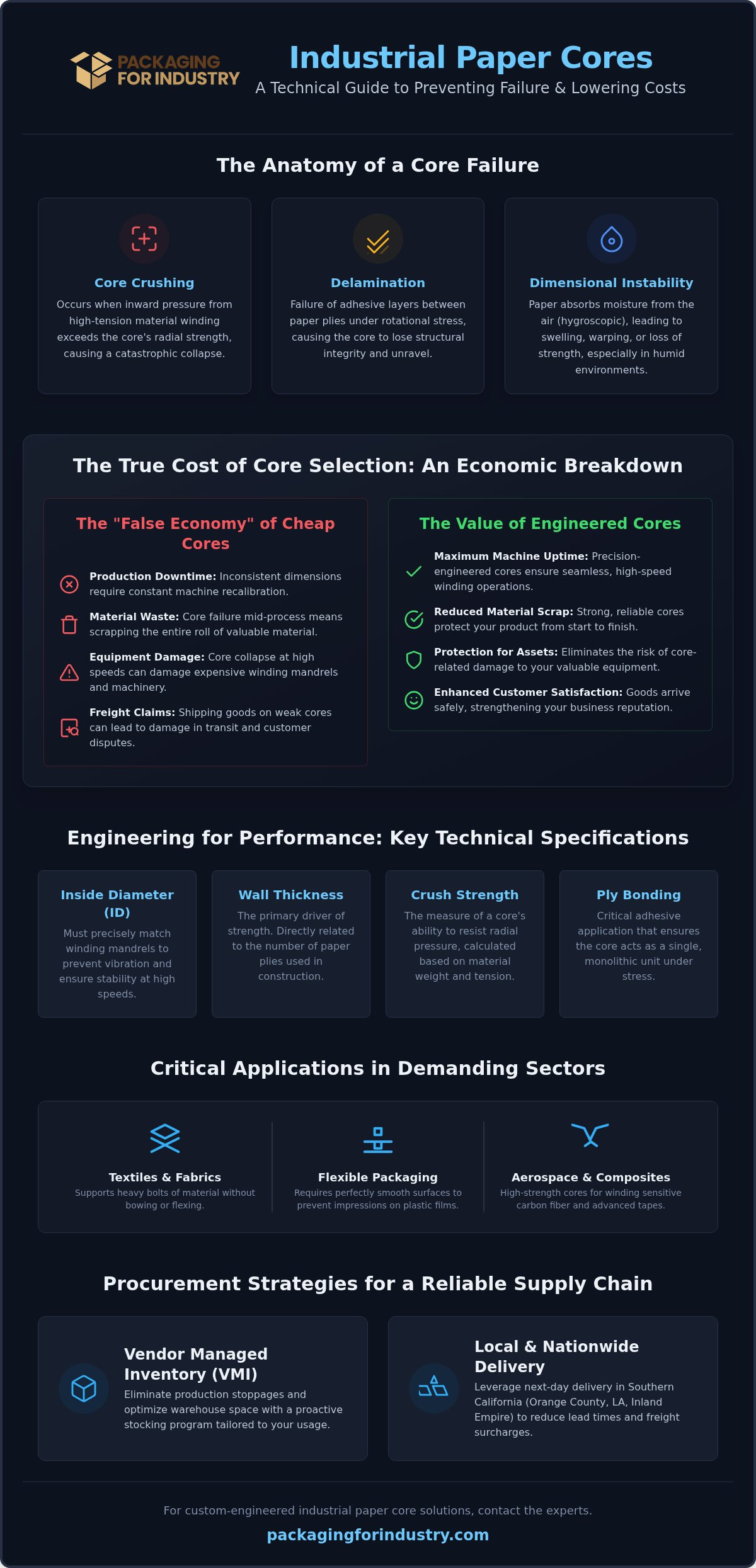
Failure in industrial paper cores typically stems from three primary issues. Core crushing occurs when the material wound onto the tube exerts more inward pressure than the core’s radial strength can support. Delamination happens when the adhesive layers between the paper plies fail, causing the core to lose its structural integrity. Finally, dimensional instability is often caused by humidity. Because paper is hygroscopic, it absorbs moisture from the air, which can cause the core to swell or warp. These failures don’t just ruin a single tube. They lead to significant production downtime, damaged winding equipment, and thousands of dollars in material waste.
Key Applications Across Manufacturing Sectors
Different industries require specific core profiles to maintain operational flow. In the textile and fabric industry, cores must support high-volume winding without bowing under the weight of heavy bolts. For plastic film and flexible packaging converters, the surface of the core must be perfectly smooth to prevent “core start” impressions on the first few layers of film. In specialized sectors like aerospace, manufacturers use high-strength cores for carbon fiber composites and sensitive tapes where precision is non-negotiable. Each of these applications demands a core engineered for its specific environment.
The True Cost of ‘Cheap’ Paper Cores
Procuring low-cost cores from generic catalog suppliers often creates a “false economy.” While the unit price might look attractive, the hidden expenses are substantial. If your cores have inconsistent inside diameters (ID), your operators must constantly stop the line to recalibrate equipment. This inconsistency ruins your throughput. Furthermore, if a core fails mid-process, you’re forced to scrap the entire roll of material and may face freight claims from customers who receive damaged goods. Choosing high-quality industrial paper cores is an investment in reliability that protects your bottom line and ensures your machinery runs at peak efficiency.
Technical Specifications: Wall Thickness and Crush Strength
Selecting the right industrial paper cores requires a deep dive into technical specifications that go beyond simple dimensions. The Inside Diameter (ID) is your starting point; it must align perfectly with your winding mandrels to ensure stability. Even a slight mismatch leads to mechanical vibration, which degrades material quality. Once the ID is set, the wall thickness becomes the primary driver of performance. There is a direct mathematical relationship between the number of plies and the core’s ability to resist radial pressure. For most standard applications, recycled kraft paper offers sufficient durability. However, when dealing with high-tension metal coils or heavy-duty textiles, high-strength virgin fibers provide the necessary structural reinforcement.
Ply bonding techniques are equally critical. High-speed rotations create centrifugal forces that can pull the layers apart if the adhesive isn’t applied with precision. Advanced bonding ensures the core remains a single, monolithic unit under stress. If you’re unsure which material grade or thickness your application demands, you can request a packaging quote to get an expert assessment of your specific load requirements. Using the correct industrial paper cores ensures that your winding equipment operates at peak efficiency without risk of core collapse.
Calculating Your Core Requirements
To calculate the necessary specifications, start by measuring the maximum weight of the wound material relative to the total core length. This ratio determines the required crush strength, which is defined as the amount of pressure a core can withstand before collapsing. Professional testing often adheres to the TAPPI/ANSI T 822 om-22 standard to verify these limits. You must also consider the direction of the force. While side-to-side (radial) compression is the most common concern during winding, end-to-end (axial) compression is vital if you stack finished rolls vertically in your warehouse. Failing to account for both can lead to a telescoping effect that ruins the material.
Customizing Dimensions for Precision Fit
Customizing the length of your cores is one of the fastest ways to lower packaging costs. Standard stock lengths often result in overhanging material, which increases the total shipping volume and leads to unnecessary freight charges. By ordering custom sizes, you ensure a precision fit that maximizes pallet density. In automated production lines, tolerances are non-negotiable. Leading manufacturers adhere to a tolerance standard of +/- 1/16th of an inch to prevent equipment jams and calibration errors. You can also specify specialized coatings, such as moisture barriers for humid environments or non-slip surfaces to improve the initial grab of the material during the core start.
Comparing Custom Cores vs. Stock Catalog Options
Manufacturers often face a choice between the immediate convenience of stock catalog options and the long-term performance of custom-engineered industrial paper cores. Stock catalog items provide fast availability for standard dimensions, but they rarely account for the specific torque and tension of your unique machinery. These off-the-shelf tubes typically offer a limited range of strength profiles; this means you either settle for a core that is under-specified for your load or pay for an over-engineered product that adds unnecessary weight and cost. Custom cores, by contrast, are designed to match your specific material weights and machine speeds, ensuring that every ply of paper contributes to the structural integrity of your production run.
The “Catalog Trap” is a common procurement pitfall where paying for standard sizes leads to significant hidden expenses. When you use a core that is even an inch longer than necessary, you aren’t just paying for wasted paperboard. You’re also paying for the extra volume that material occupies in a shipping container. In the world of logistics, UPS and FedEx dimensional weight surcharges can drastically inflate your shipping costs. Precision-cut industrial paper cores eliminate this overhanging material, allowing you to use smaller outer cartons and maximize your pallet density. This simple adjustment often yields a higher ROI than chasing the lowest unit price in a generic catalog.
When to Switch to Custom Engineered Cores
If you notice “ovaling” in your finished rolls or hear mechanical vibration during high-speed winding, your current cores are likely under-specified. These are clear indicators that the radial pressure of your material is exceeding the core’s crush strength. Transitioning from standard kraft tubes to heavy-duty industrial variants allows you to maintain higher winding tensions without risking structural collapse. For specialized sectors, integrating these high-strength cores with custom foam packaging provides a total protection system. This is particularly vital for aerospace and medical applications where the material must remain perfectly centered and suspended within a crate to avoid flat spots or surface damage.
Operational Efficiency and Waste Reduction
Precision cores directly impact your scrap rates and machine throughput. When a core is manufactured to tight tolerances, it ensures a smooth “core start,” preventing the first several feet of material from wrinkling or tearing. This reduction in waste is critical for high-value materials like specialized films or technical textiles. Furthermore, a core that fits your mandrel perfectly allows for higher rotation speeds without the risk of slippage. By optimizing your core specs to your specific equipment, you reduce the time lost to machine jams and calibration resets, turning your packaging components into a driver of operational efficiency rather than a bottleneck.
Procurement Strategies: Lowering Costs and Improving Reliability
Industrial paper cores present a unique logistical challenge because they are essentially cylinders of air. This volume makes them expensive to transport and even more expensive to store in high-rent districts. To lower packaging costs, savvy procurement managers look beyond the unit price and focus on total landed cost. One effective method is consolidating your core orders with other bulky supplies like corrugated boxes. By filling the “dead space” inside a trailer with these items, you significantly reduce the freight-per-unit cost and maximize the efficiency of every delivery.
Bulk ordering offers the lowest price per core, but the storage requirements can create severe bottlenecks in your warehouse. Just-In-Time (JIT) delivery programs solve this by synchronizing shipments with your production schedule. This ensures you always have the necessary industrial paper cores on hand without sacrificing valuable floor space to stacks of empty tubes. It’s a strategy that prioritizes flow over sheer volume, reducing the risk of material handling damage that often occurs when inventory sits idle for too long.
The Benefits of Packaging VMI for Cores
Implementing Vendor Managed Inventory (VMI) is the most efficient way to handle high-volume core usage. Under a VMI program, your supplier monitors your stock levels and triggers automated replenishment before you hit a critical shortage. This prevents production stops and improves your cash flow, as you only pay for the inventory as it is pulled for use. In the high-rent markets of Southern California, freeing up warehouse floor space by offloading bulk storage to a local partner is a major operational win that allows you to expand your manufacturing capacity without increasing your footprint.
Strategic Sourcing for Manufacturing
When evaluating suppliers, consistency in lead times is just as important as technical expertise. A reliable partner should offer technical support to ensure your industrial paper cores meet the exact tolerances required by your machinery. Local support in Orange County and Los Angeles is vital for emergency orders when a sudden production spike threatens to deplete your stock. For even greater efficiency, consider packaging kitting, where your cores are delivered already paired with end caps or protective foam for one-step assembly on your production line. This level of coordination reduces labor costs and ensures that all components arrive exactly when they are needed.
Why PFI is the Preferred Industrial Core Supplier in Southern California
PFI isn’t just a distributor; we’re an extension of your engineering team. We specialize in custom design packaging that addresses the specific stresses found in aerospace and heavy manufacturing. Our approach starts with a comprehensive engineering review to identify where you’re over-spending on over-engineered cores or losing money to under-performing ones. By optimizing the wall thickness and paper grade of your industrial paper cores, we help you achieve a balance between durability and fiscal responsibility.
While we maintain robust nationwide shipping capabilities for multi-location operations, our local presence in Southern California offers a distinct competitive advantage. We provide local next-day delivery across Orange County, Los Angeles, and the Inland Empire. This proximity eliminates the long-haul freight surcharges and lead time volatility associated with national catalog suppliers. When your production schedule shifts unexpectedly, having a local partner ensures your industrial paper cores arrive in time to keep the machines running.
Serving Anaheim and the Greater Los Angeles Area
Our strategic location allows us to provide rapid response times to key industrial hubs like Irvine and Santa Fe Springs. You won’t deal with a generic call center. Instead, you’ll work with a dedicated industrial sales team that understands the nuances of Southern California logistics. This personalized service means we can troubleshoot equipment calibration issues or supply chain bottlenecks in real-time. It’s the advantage of having a partner who knows your warehouse floor as well as you do.
Request Your Custom Industrial Core Quote
Ready to optimize your winding operations? You can request a quote for custom paper cores today to begin your engineering review. We offer free prototyping and packaging reviews to ensure your new specs perform perfectly under your specific machine tension. Whether you’re winding sensitive medical films or heavy aerospace composites, PFI provides the structural reliability and logistical speed required to keep your production and shipping moving. Don’t let inconsistent suppliers slow your growth.
Optimize Your Production with Engineered Core Solutions
Industrial paper cores are more than just winding accessories; they’re structural components that determine your manufacturing efficiency. By matching technical specifications like crush strength to your specific machine tension, you eliminate the risk of core collapse and material waste. Transitioning from generic catalog options to custom-engineered sizes allows you to lower packaging costs by reducing shipping volume and improving pallet density across your entire inventory.
Partnering with PFI gives you access to specialized expertise in aerospace and medical manufacturing. Our local next-day delivery in Orange County and LA, combined with cost-saving VMI and JIT stocking programs, ensures your supply chain remains resilient even during market volatility. We’re ready to help you implement a predictable stocking program that eliminates professional stress and supports your long-term operational growth.
We look forward to helping you streamline your operations and secure your materials with precision-engineered packaging solutions.
Frequently Asked Questions
What is the difference between a paper tube and an industrial paper core?
The difference lies in structural density and intended application. While standard paper tubes are designed for mailing or light protection, industrial paper cores are high-density components engineered to withstand radial pressure and mechanical torque. They utilize specific ply-bonding adhesives and high-grade kraft paper to support heavy loads during high-speed winding processes without collapsing or delaminating under extreme tension.
How do I determine the correct wall thickness for my industrial core?
Determining the correct wall thickness depends on the weight of the wound material, the winding tension, and the length of the core. Heavier loads or higher machine speeds exert greater inward pressure, necessitating a thicker wall to prevent crushing. PFI offers engineering reviews to calculate the exact specifications required for your specific equipment, ensuring you don’t pay for over-engineered materials while maintaining structural integrity.
Can PFI provide custom-sized cores for high-tension winding applications?
Yes, PFI provides custom-sized cores specifically for high-tension winding applications. We can adjust the Inside Diameter (ID), wall thickness, and paper grade to meet the rigorous demands of aerospace composites and specialized films. Customizing these dimensions prevents “ovaling” and dimensional instability, which are common failure points in standard stock catalog options when used in high-speed industrial environments.
Does PFI offer local next-day delivery for paper cores in Orange County?
PFI offers local next-day delivery for industrial paper cores throughout Orange County, Los Angeles, and the Inland Empire. This proximity allows Southern California manufacturers to reduce on-site inventory levels and eliminate high freight surcharges often associated with national catalog suppliers. Our local fleet ensures your production line stays moving without the lead time volatility of long-haul shipping.
How can a VMI program help manage my paper core inventory?
A Vendor Managed Inventory (VMI) program transfers the responsibility of stock monitoring to PFI. We track your core usage and trigger automated replenishment shipments to prevent production stops. This strategy improves your cash flow by allowing you to pay for inventory as it is used and frees up warehouse floor space by eliminating the need for massive safety stocks of bulky tubes.
Are heavy-duty paper cores recyclable after use?
Heavy-duty paper cores are fully recyclable because they are primarily constructed from recycled kraft paperboard. Recycling these components helps manufacturers comply with environmental regulations like California’s SB 54, which mandates significant reductions in packaging waste. Using recyclable cores also demonstrates a commitment to sustainable operations, which is increasingly important for fulfilling corporate social responsibility goals and meeting the requirements of eco-conscious clients.
What industries benefit most from custom engineered paper cores?
Aerospace, medical device manufacturing, and flexible packaging sectors benefit most from custom engineered cores. These industries often wind high-value or sensitive materials that require precise tension control and perfectly smooth core surfaces. Custom cores prevent “core start” impressions and winding vibrations that could damage expensive materials. Any high-volume manufacturing operation using automated winding equipment will see a significant ROI through reduced scrap rates and improved machine uptime.
How do I request a quote for bulk industrial paper cores?
You can request a packaging quote by visiting our online quote portal or contacting our sales team directly. To provide an accurate estimate, we’ll need your required Inside Diameter (ID), wall thickness, and core length, along with your estimated annual volume. We offer competitive pricing for bulk quantities and can help you compare packaging pricing against your current suppliers to find significant cost-saving opportunities.