
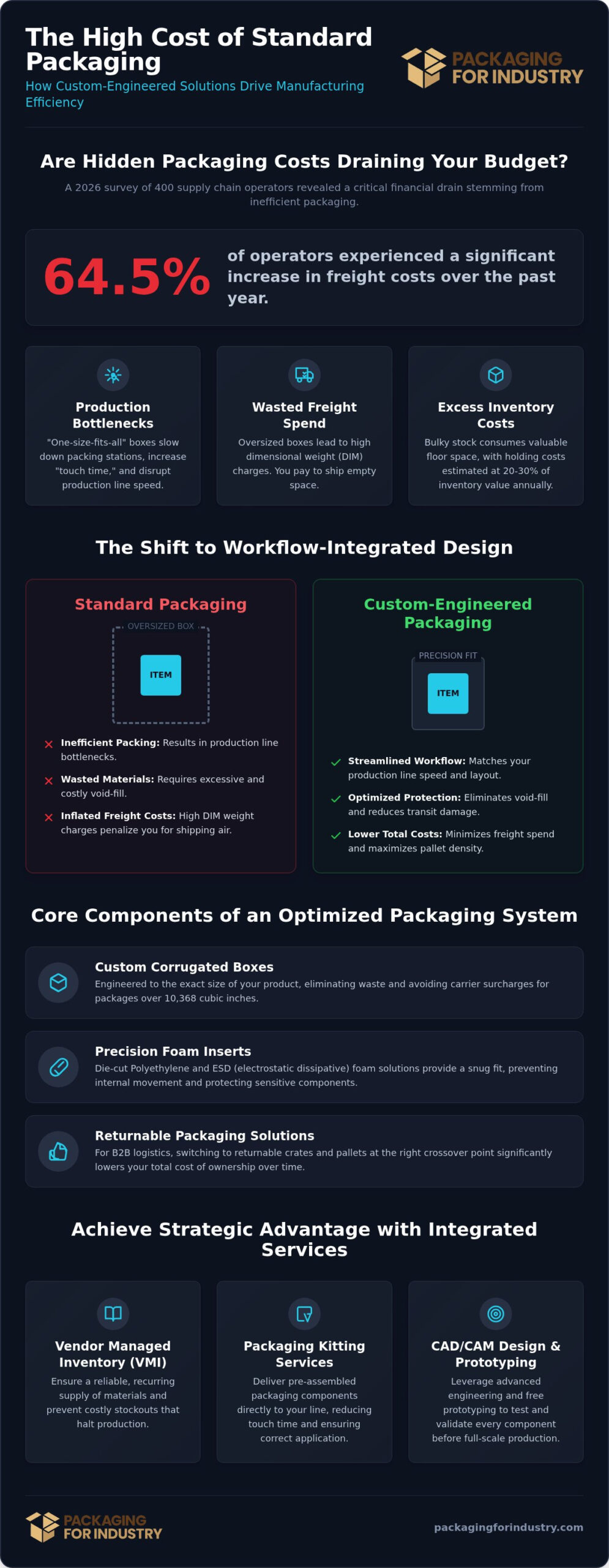
A 2026 survey of 400 supply chain operators revealed that 64.5% experienced a significant increase in freight costs over the past year. Much of this financial drain stems from oversized boxes and inefficient packing stations that fail to keep pace with production. Integrating custom packaging for manufacturing workflows isn’t just about protection; it’s a strategic move to reclaim floor space and eliminate the bottlenecks that slow down your throughput. When your packaging is engineered to fit your specific components, you stop paying for air and start shipping with precision.
We understand that high damage rates and bulky, unorganized stock are constant sources of professional stress for operations managers. This article outlines how custom-engineered solutions and returnable packaging integrate into your lines to reduce transit damage and lower your total cost of ownership. We’ll preview the benefits of Vendor Managed Inventory (VMI) to prevent stockouts and explain how to optimize for the current 139 dimensional weight divisor used by major carriers. From heavy-duty corrugated boxes to precision foam inserts, you’ll discover a path toward a more reliable, recurring supply chain.
Key Takeaways
- Standard packaging often creates production bottlenecks; learn how to design protection that matches your production line speed and layout.
- Reduce shipping damage and carrier surcharges by engineering protective solutions that combine precision-cut foam with custom corrugated boxes.
- Identify the specific crossover point where switching to returnable crates and pallets lowers your total cost of ownership in B2B logistics.
- Optimize procurement by integrating custom packaging for manufacturing workflows with VMI programs that ensure a reliable, recurring supply of materials.
- Leverage CAD/CAM design and free prototyping to ensure every packaging component is engineered for the specific requirements of your industrial application.
Beyond the Box: Why Standard Packaging Disrupts Manufacturing Workflows
Standard packaging is often treated as a post-production afterthought, yet it remains a primary driver of operational friction. In an industrial setting, “one-size-fits-all” solutions rarely fit the reality of the assembly line. We define workflow-integrated packaging as protection specifically engineered to match the speed and physical layout of your production line. When packaging doesn’t align with these workflows, the hidden costs accumulate rapidly through increased labor, excessive use of void-fill, and preventable transit damage. Moving toward custom packaging for manufacturing workflows allows your facility to transition from reactive purchasing to a strategic engineering model. This shift is the most effective way to lower packaging costs while simultaneously increasing your daily output.
Identifying Bottlenecks in Your Packing Station
Efficiency dies at the packing station when workers must manually kit multiple components or struggle with oversized stock. Analyze the “touch time” required for each unit. If your team spends three minutes wrapping a part in bubble wrap because the box is too large, you’ve identified a significant bottleneck. Disorganized, bulky packaging stock also consumes valuable warehouse floor space. Since the annual cost of holding inventory is estimated to be between 20% and 30% of its total value, wasting square footage on air-filled boxes is a fiscal liability. Streamlining this process through professional packaging kitting ensures that every material is ready for immediate use, matching the pace of your production line.
The Role of Custom Sizing in Reducing Freight Costs
Carriers have become increasingly aggressive with pricing structures that penalize inefficient shippers. Dimensional weight is a billing technique used by carriers to calculate shipping costs based on a package’s volume relative to its actual weight. As of 2026, UPS, FedEx, and USPS all utilize a dimensional weight (DIM) divisor of 139. This means that even a light package can trigger high costs if it occupies too much space. Furthermore, carriers now round every fractional inch up to the next whole inch, making precision in custom design packaging more critical than ever.
By utilizing custom corrugated boxes, you eliminate the need for excessive void-fill and reduce the overall cube size of your shipments. This optimization serves two purposes. First, it avoids “Additional Handling” surcharges, which are triggered in 2026 for packages exceeding 10,368 cubic inches. Second, it maximizes pallet density. When custom packaging for manufacturing workflows is designed correctly, you can often fit more units per pallet, significantly lowering your total freight spend and improving the overall efficiency of your B2B supply chain.
Engineering Protection: Custom Foam and Corrugated Solutions for Production Lines
Protection for industrial components requires more than just a container. It demands a symbiotic relationship between internal cushioning and external structural integrity. Engineering custom packaging for manufacturing workflows means looking at the assembly line first. We design for the high-value component’s specific center of gravity and fragility. By integrating kitting services, we deliver pre-assembled packaging components directly to your line. This eliminates the time-consuming process of workers hunting for the right foam piece or box size. It also ensures that the right protection is applied every single time, regardless of production speed.
Custom Foam Inserts for Sensitive Industrial Gear
Sensitive gear requires precise material selection to prevent damage. Custom foam packaging solutions often involve die-cut polyethylene for heavy machinery or ESD (electrostatic dissipative) foam for semiconductors and electronics. Die-cut foam is ideal for complex geometries, providing a snug fit that prevents internal movement during vibration. Convoluted foam, or “egg crate,” offers versatile cushioning for less specific shapes or lighter components. Prototyping is essential to this process. We use CAD/CAM design to create physical samples, allowing you to test the fit on your actual products before full production rollout. Whether you are shipping delicate medical lasers or heavy aerospace engine parts, we have custom sizes available to meet your exact specifications.
Heavy-Duty Corrugated for Industrial Durability
External protection must withstand the rigors of B2B transit and warehouse stacking. Standard single-wall boxes often fail under the weight of heavy industrial parts. We specify industrial corrugated box options such as double-wall or triple-wall constructions for heavy machinery and metal components. For international shipments or long-term storage, weather-resistant or mil-spec corrugated options provide necessary barriers against humidity and rough handling. These materials are engineered to maintain their compression strength even in challenging environments. This holistic engineering approach ensures that custom packaging for manufacturing workflows protects your bottom line by eliminating the costs associated with “dead stock” or transit damage.
If you’re seeing high damage rates or inefficient packing stations, it’s beneficial to request a packaging quote for an engineered solution.
Returnable Packaging Solutions for B2B Supply Chains: Cost vs. Efficiency
For many industrial operations, the recurring cost of single-use corrugated boxes becomes a significant line item that warrants re-evaluation. Returnable packaging, which includes custom crates and heavy-duty plastic pallets, operates within a closed-loop system where materials are used, returned, and reused multiple times. Integrating returnable solutions into custom packaging for manufacturing workflows is a strategic move for high-frequency shipments between established partners. While the initial investment in returnable assets is higher than single-use alternatives, the long-term fiscal benefits are realized once you reach the crossover point. This is the specific number of cycles where the cost-per-trip of a returnable crate falls below the price of a standard box.
Successful B2B returnable programs require precise logistical coordination. This is particularly evident in the aerospace sector, where components frequently move between Tier 1 and Tier 2 suppliers. In these scenarios, the risk of damage to high-value parts is mitigated by the superior structural integrity of engineered crates. When custom packaging for manufacturing workflows is designed for reuse, it doesn’t just protect the product; it stabilizes the entire procurement cycle. You stop managing a constant stream of waste and start managing a valuable logistical asset.
Designing Custom Crates for Repeated Use
Engineering a returnable container requires a focus on durability and ease of maintenance. We specialize in engineering custom crates for international transit and domestic closed-loop systems. These crates often feature precision foam lining to secure high-value gear. Material choice is critical. While wood is a traditional choice for heavy parts, composite materials or high-density plastics may offer better long-term viability due to their resistance to moisture and ease of cleaning. Every crate must be designed to withstand dozens, or even hundreds, of trips without compromising the safety of the contents.
Closed-Loop Logistics and Tracking
The primary challenge of a returnable program is managing reverse logistics. You must have a reliable system for returning empty packaging to the start of the production line. This process requires a dedicated workflow to ensure packaging cleanliness and structural integrity between cycles. Beyond the direct cost savings, returnable solutions significantly impact corporate sustainability goals by eliminating thousands of pounds of packaging waste from the supply chain. This transition from disposable to durable materials creates a more resilient and predictable logistics model for your business.
Streamlining Procurement: Implementing VMI and JIT Packaging Programs
Supply chain volatility has made operational agility a primary survival requirement for manufacturers. One of the most common causes of production stops is a simple stockout of critical packaging materials. Integrating custom packaging for manufacturing workflows with a Vendor Managed Inventory (VMI) program eliminates this risk by shifting the responsibility of stock levels to the supplier. This proactive approach prevents the scenario where a high-value shipment is delayed because the facility ran out of a specific die-cut foam insert or double-wall box. By moving toward a “Predictive JIT” strategy, you can anticipate material needs and maintain a seamless flow without overstocking your warehouse.
Implementing a successful VMI program follows a structured 5-step process. First, we conduct a comprehensive data analysis of your usage history. Second, we establish minimum and maximum stocking levels based on your production cycles. Third, we implement a monitoring system to track real-time inventory depletion. Fourth, we execute automated, scheduled replenishments. Finally, we perform quarterly reviews to optimize these levels as your production demands shift. This system reduces the capital tied up in excess inventory, ensuring that your cash flow remains focused on production rather than sitting on a warehouse shelf.
The VMI Assessment: Usage History and Lead Times
The transition begins with a deep dive into your operational constraints. Our team reviews your current packaging items and warehouse floor space to identify where bulk stock is causing congestion. We pay special attention to long lead-time items like custom foam and specialized military-spec packaging. By establishing clear stocking thresholds through our Vendor Managed Inventory services, we ensure that custom sizes are always available for immediate pull. This assessment cleans up your warehouse floor and simplifies the purchasing cycle for your procurement team.
JIT Delivery for Southern California Manufacturers
For facilities in Southern California, proximity is a major logistical advantage. We leverage localized next-day delivery in Orange County, Los Angeles, San Diego, and the Inland Empire to support Just-in-Time inventory management. This capability is especially vital for high-volume custom packaging for manufacturing workflows that would otherwise occupy massive amounts of square footage. Whether you are located in Anaheim, Irvine, San Diego, or Santa Fe Springs, our localized fleet ensures that your packing stations remain stocked with the exact corrugated boxes and cushioning materials needed for the day’s output. This lean approach minimizes the accumulation of obsolete stock and maximizes your operational efficiency.
Designing Your Workflow: Custom Packaging Engineering with PFI
Our approach to custom packaging for manufacturing workflows begins with a fundamental principle: we consult first and manufacture second. We don’t view packaging as a commodity purchase, but as a critical industrial component that must perform under pressure. This engineering-led mindset allows us to identify exactly where your current system is failing. Whether the issue is excessive shipping damage or a packing station that can’t keep up with production speed, we focus on the root cause. By combining heavy-duty corrugated boxes, precision-cut foam, and high-performance stretch film into a single integrated kit, we simplify your internal logistics. Your team no longer needs to manage multiple SKUs for one shipping unit; they receive a complete, ready-to-use solution that matches your production rhythm.
From Prototype to Production Rollout
The design phase is where we solve your most complex logistical challenges. We provide free prototyping and CAD/CAM support for our industrial clients to ensure a perfect fit before any capital is committed to a full production run. Testing custom designs with actual product samples is non-negotiable for sectors like aerospace and medical devices. In these industries, even a fraction of an inch of movement can lead to expensive transit damage. Our custom design packaging services allow you to validate the protection levels in real-world scenarios. Once the prototype is approved, we scale production from small batches for specialized gear to high-volume recurring orders that feed your daily manufacturing output.
Local Support for Southern California Industry
A localized supply chain is the most effective way to insulate your operations from broader market volatility. We provide direct support to facilities in Anaheim, Brea, Irvine, and across the Inland Empire. This local presence does more than just reduce freight costs. It improves the speed of communication and allows for on-site consultations to troubleshoot line inefficiencies. When your packaging partner is just a few miles away, you gain the agility needed to adjust orders in real-time. Our localized next-day delivery ensures that your facility in Santa Fe Springs or Carson never waits for critical supplies. This proximity allows us to act as a proactive partner in your growth rather than just a distant vendor.
We’re committed to helping you build a more resilient and cost-effective logistics operation that supports your long-term growth.
Frequently Asked Questions
What is the difference between custom and standard packaging for manufacturers?
Standard packaging relies on stock RSC box sizes that often require excessive void-fill to secure components. Custom solutions are engineered to match your specific part dimensions and production line speed. By choosing custom packaging for manufacturing workflows, you eliminate the labor bottlenecks associated with manual kitting. This integration ensures that your team doesn’t waste time “making it fit,” which improves both throughput and the structural integrity of every shipped unit.
How can custom packaging reduce my UPS and FedEx shipping surcharges?
Carriers use a dimensional weight divisor of 139 to calculate costs based on volume rather than just actual weight. Custom sizing reduces the cubic footprint of your shipments, which directly avoids “Additional Handling” surcharges applied to packages over 10,368 cubic inches. We engineer boxes to fit your products precisely. This eliminates the “air” in your shipments and ensures you don’t pay for space you aren’t using on the truck.
When does returnable packaging make sense for a B2B supply chain?
Returnable solutions are ideal for closed-loop B2B supply chains with high-frequency shipments between established partners. They make financial sense when the cost-per-trip of a durable crate falls below the price of single-use corrugated boxes. This crossover point is typically reached in industries like aerospace or automotive manufacturing. These systems also support corporate sustainability goals by removing thousands of pounds of disposable waste from the recurring logistical cycle.
What industries benefit most from custom foam packaging?
Aerospace, medical, and electronics sectors benefit most from custom foam inserts. These industries require specialized protection like ESD foam for semiconductors or high-density polyethylene for heavy medical equipment. Custom-cut foam prevents internal movement during transit, which is the primary cause of damage for sensitive components. We use CAD/CAM design to ensure every insert provides a snug, reliable fit for complex geometries that standard cushioning cannot protect.
How does a Vendor Managed Inventory (VMI) program work for packaging?
A Vendor Managed Inventory (VMI) program involves your supplier monitoring your packaging stock levels and executing scheduled replenishments. This system shifts the responsibility of inventory management to PFI, preventing production-stopping stockouts. It also improves your cash flow because you only pay for materials as they are pulled for use. It’s a proactive way to manage custom packaging for manufacturing workflows without tying up excessive warehouse floor space.
What is the lead time for custom corrugated box prototypes?
Prototype lead times depend on the complexity of the design and the specific materials required for the application. PFI utilizes CAD/CAM support and free prototyping to help industrial clients validate their designs before full production. This process involves creating physical samples that you can test with actual product parts to ensure fit. Because we serve Southern California locally, we can often move from initial consultation to a physical prototype faster than distant vendors.
Does PFI provide military-spec (mil-spec) packaging for defense contractors?
Yes, PFI provides a comprehensive range of military-spec packaging designed for defense contractors and aerospace manufacturers. These solutions include heavy-duty corrugated boxes, specialized crates, and moisture-barrier materials that meet strict government durability standards. We understand the complex compliance requirements involved in military logistics. Our team ensures that your shipments are protected against the extreme environmental conditions often encountered in international transit or field operations.
Can custom packaging help reduce product damage for heavy industrial equipment?
Custom packaging is essential for heavy industrial equipment to prevent shifting and crushing during transit. We specify double-wall or triple-wall corrugated boxes and engineered pallets to handle extreme weights safely. Stabilization materials like corner boards and heavy-duty stretch film are integrated into the design to maintain load integrity. This holistic engineering approach ensures that even the heaviest components reach their destination without the structural failures common in standard packaging.