
Shipping damage isn’t just a line item on your balance sheet; it’s a direct threat to your brand’s reputation and operational stability. You likely already understand that oversized boxes and generic cushioning are draining your margins through excessive freight fees and wasted warehouse space. For manufacturers in the aerospace, medical device, and electronics sectors, the inconsistent lead times and rising material costs from national catalog suppliers make it difficult to maintain a predictable bottom line. With foam prices fluctuating due to recent chemical supply chain disruptions, sticking with outdated packaging methods is a financial risk you can’t afford.
This guide will show you how to leverage custom foam packaging Southern California strategies to achieve zero-damage shipping for high-value components while lowering your per-unit costs. We’ll examine the technical engineering specs required for precision protection and explain how local supply programs like Vendor Managed Inventory (VMI) can stabilize your logistics. By the end of this article, you’ll have a clear roadmap for selecting the right materials and supply chain partners to eliminate shipping stress and optimize your industrial operations.
Key Takeaways
- Identify the optimal foam density and cell structure required to protect sensitive components based on specific G-force impact tolerances.
- Streamline your supply chain by utilizing custom foam packaging Southern California strategies, including vendor-managed inventory and local next-day delivery.
- Reduce per-unit assembly costs by replacing generic void fill with precision die-cut foam inserts designed for high-volume industrial lines.
- Learn to specify your requirements based on the shipping environment, whether you’re managing LTL freight or international export.
- Combine custom-engineered foam with heavy-duty corrugated boxes to create an integrated solution that lowers both damage rates and total freight weight.
The Strategic Role of Custom Foam Packaging in Southern California Industry
Southern California’s manufacturing landscape, stretching from San Diego to Los Angeles, demands logistical precision that national catalog suppliers often can’t provide. High-value sectors like aerospace and medical technology face unique transit stresses, including multi-modal handling and extreme vibration. Relying on a robust custom foam packaging Southern California strategy allows regional manufacturers to bypass the limitations of generic supplies. While bubble wrap or loose fill might suffice for consumer goods, industrial components often possess complex geometries and sensitive calibration that require exact tolerances. Off-the-shelf solutions frequently fail because they don’t account for specific G-force tolerances or the delicate surface finishes of industrial-grade components.
Targeting Zero-Damage Logistics
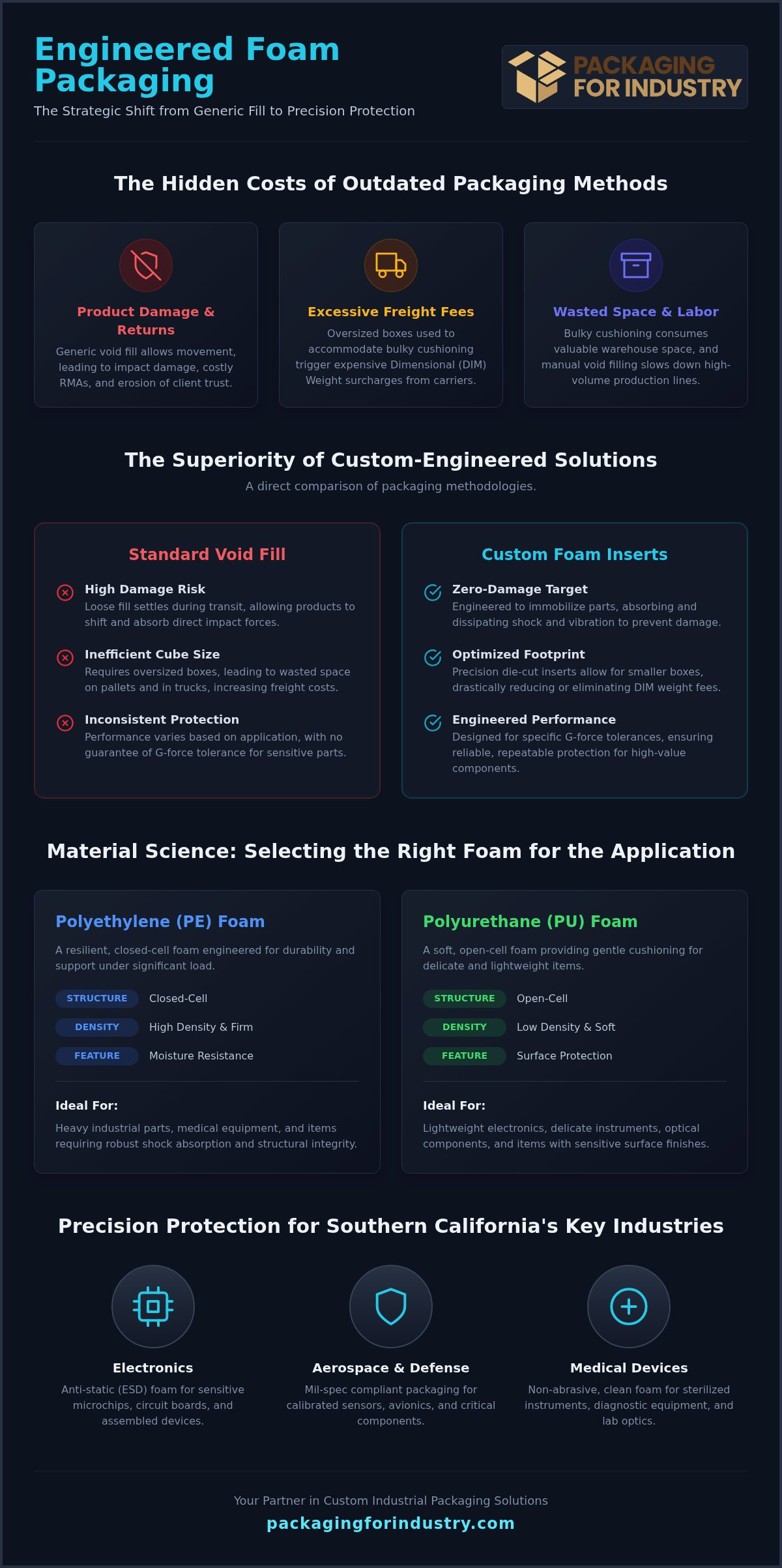
Shipping damage creates a ripple effect of hidden costs that extend far beyond the price of a replacement part. You have to account for administrative labor in RMA processing, expedited freight for replacement units, and the potential loss of long term client trust. Engineering specific Package cushioning materials into your workflow ensures that fragile items, such as aerospace sensors or medical optics, remain completely stationary. Unlike generic void fill that settles during transit, custom-engineered foam provides a contoured fit that absorbs kinetic energy and prevents internal movement. This stabilization is critical for maintaining “zero-damage” targets in high-stakes industrial sectors where even a minor misalignment renders a component useless.
The Economic Impact of Precision Sizing
Many businesses overspend on freight because they use oversized boxes to accommodate bulky, inefficient cushioning. Major carriers like UPS and FedEx apply heavy dimensional (DIM) weight surcharges when a package’s volume is disproportionately large compared to its actual weight. By optimizing foam density, we can reduce the overall footprint of the container without sacrificing protection. Pairing precision foam inserts with custom corrugated boxes allows for a tighter, more efficient profile. This approach helps you lower packaging costs by eliminating unnecessary air and bulk. With custom sizes available for every application, PFI’s cost-reduction packaging analysis ensures your custom foam packaging Southern California strategy is as fiscally responsible as it is durable. Our Anaheim headquarters supports this efficiency with local next-day delivery and Vendor Managed Inventory (VMI) programs, helping you maintain lean inventory levels across Orange County and the Inland Empire without the risk of stockouts.
Engineering the Right Fit: Material Selection and Design Options
Effective custom foam packaging Southern California relies on a precise understanding of material science and mechanical engineering. Rather than simply filling empty space, custom cushioning is designed to accommodate the specific geometry and fragility of industrial components. This process begins with understanding the science of polymer-based packaging, where density and cell structure are selected to manage energy transfer during impact. Higher density foams offer greater resistance to deformation, while lower density options provide a softer deceleration for lighter items. Selecting the wrong specification leads to either bottoming out during a drop or transferring too much shock directly to the product.
Polyethylene (PE) vs. Polyurethane (PU) Foam
Choosing between Polyethylene and Polyurethane depends on your product’s weight and the required drop test performance. Polyethylene is a closed-cell material known for its durability and moisture resistance. It’s the standard for heavy industrial parts because it maintains its shape under significant loads. Polyurethane is an open-cell foam that offers a softer, more flexible cushioning profile. It’s ideal for protecting delicate surfaces or lightweight instruments that require gentle support. If you’re unsure which material fits your application, you can compare packaging pricing and material specs with our engineering team to find the most cost-effective balance of protection and weight.
Specialized ESD and Anti-Static Foam Inserts
For Southern California’s semiconductor and medical device sectors, protection from physical impact is only half the battle. Electrostatic discharge (ESD) can destroy sensitive electronic components without leaving any visible damage. We provide two primary solutions for these environments. Pink anti-static foam is treated with a topical agent to prevent the buildup of static electricity during handling. Black conductive foam, often used for long-term storage or high-sensitivity kitting, provides a more permanent path for static to dissipate. These specialized foam packaging options are essential for maintaining the integrity of circuit boards and sensors throughout the assembly and shipping process.
Before moving to full-scale production, prototyping is a critical step in our design process. It allows you to verify the fit and function of the inserts within your specific shipping containers. We offer free prototyping services to ensure that every dimension is accurate and that the chosen material meets your G-force requirements. This proactive approach eliminates the risk of costly production errors and ensures your final packaging solution is optimized for real-world logistical challenges.
Custom Foam Inserts vs. Standard Protective Solutions
Relying on generic cushioning materials like bubble wrap or packing peanuts often creates a false sense of security for industrial shippers. These “one-size-fits-all” solutions are inherently reactive, forcing warehouse personnel to guess how much material is sufficient for a specific part. This inconsistency leads to unpredictable damage rates and excessive material waste. Custom die-cut foam removes this variability by providing a repeatable, engineered environment for every shipment. For firms implementing custom foam packaging Southern California strategies, the transition from loose fill to bespoke inserts usually marks the end of constant logistics troubleshooting and the beginning of operational stability.
Labor Efficiency and Kitting
In high-volume manufacturing environments, every second saved on the assembly line directly impacts the bottom line. Generic materials require time-consuming wrapping, taping, and stuffing, which adds significant labor costs over thousands of units. Custom inserts allow for a “place-and-go” workflow that is intuitive and nearly impossible to perform incorrectly. This design reduces human error, ensuring that even seasonal or new staff can pack sensitive components with the same precision as a veteran employee. By utilizing PFI kitting and assembly services, you can receive pre-assembled components that further streamline your warehouse floor. This proactive approach is far more efficient than standard methods that inevitably drive up long-term operational expenses through labor inefficiency.
Total Cost of Ownership (TCO) Analysis
While the initial design of custom foam packaging may carry a higher upfront cost than a bulk roll of generic wrap, the Return on Investment (ROI) is realized through the reduction of damage claims and replacement shipments. Generic void fill often leads to over-packing, which consumes more material than necessary and increases the overall container size. Precision-cut foam uses only the specific volume required to protect the product’s G-force tolerance, minimizing waste and helping to lower packaging costs over the product’s lifecycle.
Professional packaging also plays a critical role in brand perception. When an aerospace or medical device client receives a high-value component in a professionally engineered foam insert, it reinforces your company’s commitment to quality and precision. This experience stands in stark contrast to the unprofessional appearance of digging a delicate part out of messy packing peanuts. Choosing custom foam packaging Southern California ensures that your protection strategy aligns with your brand’s reputation for excellence while keeping your total cost of ownership under control.
Procurement Checklist: Specifying Your Foam Requirements
Specifying the right materials for custom foam packaging Southern California requires a methodical approach to engineering and procurement. Logistics managers must look beyond unit price to ensure the final product meets the mechanical demands of the supply chain. A failure to define technical requirements early leads to inconsistent protection and unexpected damage claims. Use this four-step checklist to streamline your specification process and ensure your components arrive in factory condition.
- Step 1: Define Fragility and G-Force Tolerance: Work with your engineering team to determine the maximum shock your product can withstand. This data dictates the thickness and density of the foam required to decelerate the item safely during an impact.
- Step 2: Determine the Shipping Environment: Identify if your goods will travel via LTL (Less-Than-Truckload), parcel carriers, or international export. Parcel shipping often involves more frequent drops and mechanical sorting, requiring more robust cushioning than palletized LTL freight.
- Step 3: Select Density and Thickness: Match the weight of your product to the appropriate foam density. Heavier parts need denser foam to prevent “bottoming out,” while lighter parts require softer foam to ensure the cushioning actually compresses upon impact.
- Step 4: Evaluate Secondary Requirements: Determine if your application needs specialized properties such as ESD protection for electronics or moisture resistance for long term storage.
Technical Specifications for B2B Buyers
When you compare packaging pricing, it’s vital to speak the language of material science. Foam density is measured in pcf (pounds per cubic foot). For example, a 1.7 pcf polyethylene foam is a standard choice for medium weight industrial parts, while a 2.2 pcf or higher may be necessary for heavy machinery components. Precision is equally critical; specify your die-cut tolerances to ensure a tight-fit security that prevents part migration. For complex geometries, we recommend a CAD/CAM design review. This allows our team to create digital prototypes that optimize material usage and lower packaging costs by eliminating unnecessary bulk.
Compliance and Military Standards
Southern California is a primary hub for defense and aerospace contractors who must adhere to strict regulatory standards. Navigating mil-spec packaging requirements requires a partner who understands specialized material certifications and durability testing. Custom foam plays a central role in aerospace packaging solutions, where components often require high-performance cushioning that meets specific fire retardant or outgassing standards. Whether you are shipping to a local military installation or managing international export, ensuring your foam-lined boxes meet ISPM-15 and other global standards is essential for avoiding customs delays and fines.
Why PFI is the Preferred Custom Foam Supplier in Southern California
Choosing a packaging partner requires more than just finding a vendor with a catalog. It requires a strategic ally that understands the logistical pressures of the local industrial landscape. Packaging For Industry (PFI) operates as a dedicated consultant for manufacturers who need to lower packaging costs without compromising on material integrity. Based in Anaheim, we provide the technical expertise and rapid response times that national suppliers simply can’t match. Our focus remains on creating a seamless bridge between your production line and the final delivery point.
We specialize in integrated solutions that provide total accountability for your shipment’s safety. By combining custom corrugated boxes with precision foam inserts, we eliminate the compatibility issues that often arise when sourcing components from multiple vendors. To ensure your operations remain efficient, we offer free prototyping services. This allows your team to verify the fit and protective qualities of a design before committing to a bulk production run, effectively removing the risk of costly engineering errors.
Local Service, Nationwide Capabilities
Our location provides a distinct logistical advantage for businesses operating in Orange County, Los Angeles, San Diego, and the Inland Empire. We offer local next-day delivery throughout Southern California’s primary industrial corridors, ensuring your warehouse never grinds to a halt due to packaging shortages. While our local roots are deep, our reach is expansive. We provide nationwide shipping for clients with multiple distribution points across the country, maintaining consistent quality across your entire network. You have direct access to Anaheim-based packaging experts who can provide on-site support and immediate design adjustments when your product specifications change.
Optimizing Your Supply Chain Flow
Efficiency in custom foam packaging Southern California isn’t just about the material; it’s about how that material moves through your facility. Our VMI programs are designed to eliminate stockouts and reclaim valuable warehouse floor space by allowing us to manage your stock levels for you. We also implement just-in-time (JIT) delivery strategies to keep your assembly lines moving with minimal on-hand inventory. If you’re looking to identify hidden inefficiencies in your current workflow, you can request a packaging cost-reduction analysis. Our team will evaluate your entire process, from material waste to freight dimensions, to ensure your packaging strategy is contributing to your company’s fiscal health.
Securing Your Supply Chain with Engineered Protection
Selecting the right protective materials is a strategic decision that directly impacts your operational efficiency and bottom line. By prioritizing precision material specs and leveraging local supply chain advantages, you can eliminate the recurring costs of transit damage and oversized freight. Our Anaheim based production facility is equipped to handle the most demanding aerospace and industrial specifications. This ensures your high value components are protected by rigorous engineering rather than guesswork.
Implementing a custom foam packaging Southern California strategy allows your business to maintain a lean inventory while benefiting from expert CAD design and free prototyping services. These integrated solutions simplify procurement and reclaim valuable warehouse space. You don’t have to settle for the inconsistent lead times or generic materials of national catalog suppliers when a specialized local partner is available.
Transitioning to an engineered packaging model provides the stability your logistics team needs to scale effectively. We’re ready to help you optimize your shipping flow and reduce your total cost of ownership through practical, solution-oriented design. Our specialists are standing by to turn your logistical challenges into a streamlined, cost-effective operation.
Frequently Asked Questions
What is the most cost-effective foam for high-volume industrial shipping?
Polyethylene (PE) foam is typically the most cost-effective choice for high-volume industrial shipping due to its durability and repeatable performance. This closed-cell material maintains its structure across multiple impacts, which reduces the need for excessive wrapping or secondary void fill. When you compare packaging pricing, PE foam often provides the best balance of protection and material cost. It’s particularly effective for manufacturers looking to stabilize heavy components without the high price of specialty open-cell materials.
How do I know if my product requires ESD-safe anti-static foam?
You should use ESD-safe foam if your product contains sensitive electronic components that are vulnerable to electrostatic discharge. This includes items like semiconductors, circuit boards, and advanced medical sensors. Static damage is often invisible and can lead to high failure rates in the field. Our custom foam packaging Southern California specialists provide both black conductive and pink anti-static options to ensure your electronics remain protected throughout the entire shipping and handling process.
Can PFI design a custom foam insert that fits into my existing shipping boxes?
We can certainly design bespoke inserts that integrate seamlessly with your existing corrugated boxes. This approach allows you to upgrade your internal protection without discarding your current container inventory. Our design team uses precision die-cutting to ensure the foam fits snugly within your specific box dimensions. This strategy is an effective way to lower packaging costs while significantly improving the shock absorption and stabilization of your high-value industrial products.
What information do I need to provide for a custom foam packaging quote?
To provide an accurate custom foam packaging Southern California quote, we require your product’s dimensions, weight, and fragility requirements. It’s also helpful to know your shipping method, such as LTL or parcel, to determine the necessary foam density. If you have a CAD file or a physical sample of the part, our Anaheim engineers can use it to create a precise prototype. These details allow us to optimize material usage and provide competitive pricing.
Do you offer free prototypes for custom foam designs in Southern California?
Yes, we offer free prototyping services for custom designs to ensure the packaging meets your exact specifications before you commit to a bulk order. Our Anaheim-based design team works closely with local manufacturers to test different foam densities and thicknesses. This proactive step eliminates the risk of fitment issues or inadequate protection. It provides the peace of mind that your final production run will perform exactly as required in real-world shipping environments.
What is the lead time for custom die-cut foam production in Anaheim?
While lead times depend on the complexity of the design and the material selected, our local Anaheim headquarters ensures faster delivery than out-of-state suppliers. We specialize in rapid turnaround for Southern California manufacturers who need to keep their production lines moving. For clients enrolled in our Vendor Managed Inventory (VMI) or just-in-time programs, we can even provide local next-day delivery. This reliability helps you avoid the stockouts often associated with national catalog suppliers.
Can custom foam packaging help reduce my UPS or FedEx dimensional weight charges?
Custom foam allows you to reduce the overall exterior dimensions of your shipping containers, which directly lowers dimensional weight charges. Generic void fill often requires oversized boxes to provide adequate cushioning, leading to expensive surcharges from UPS and FedEx. By engineering a precision-fit insert, we can use a smaller container while maintaining superior protection. This optimization ensures you’re only paying for the volume you actually need, helping you consistently lower packaging costs.