
Your packaging supplier shouldn’t be a simple line item on a spreadsheet; they should be the primary reason you hit your quarterly performance targets. If you’re constantly battling rising freight costs from oversized boxes or managing the fallout of high damage rates, your current vendor is likely a bottleneck rather than an asset. Most operations managers feel the strain of warehouse clutter caused by over-ordering stock supplies just to avoid a stockout. It’s a reactive cycle that drains your budget and your time.
Choosing a packaging partner that helps me meet my department’s KPIs requires a shift from commodity buying to strategic engineering. You deserve a collaborator who understands that a well-designed corrugated box or a custom foam insert is a tool for fiscal responsibility. This article outlines how to evaluate industrial vendors based on their ability to lower your total cost of ownership and eliminate shipping surcharges. We’ll explore how reliable, just-in-time supply chains and precision prototyping can transform your logistics from a cost center into a streamlined, efficient operation that supports your bottom line.
Key Takeaways
- Evaluate vendors based on the total cost of packaging, focusing on how material choices impact labor, freight surcharges, and long-term storage expenses.
- Utilize custom-engineered corrugated boxes and protective foam to reduce damage rates, protecting both high-value products and your department’s quality KPIs.
- Selecting a packaging partner that helps me meet my department’s KPIs involves implementing Vendor Managed Inventory (VMI) to reclaim warehouse floor space and prevent stockouts.
- Ensure your supplier has the technical expertise to meet rigorous industry standards, such as Mil-Spec and aerospace requirements, to maintain contract compliance.
- Leverage local next-day delivery and just-in-time logistics in Southern California to build a more responsive and reliable industrial supply chain.
The Link Between Packaging Strategy and Departmental KPIs
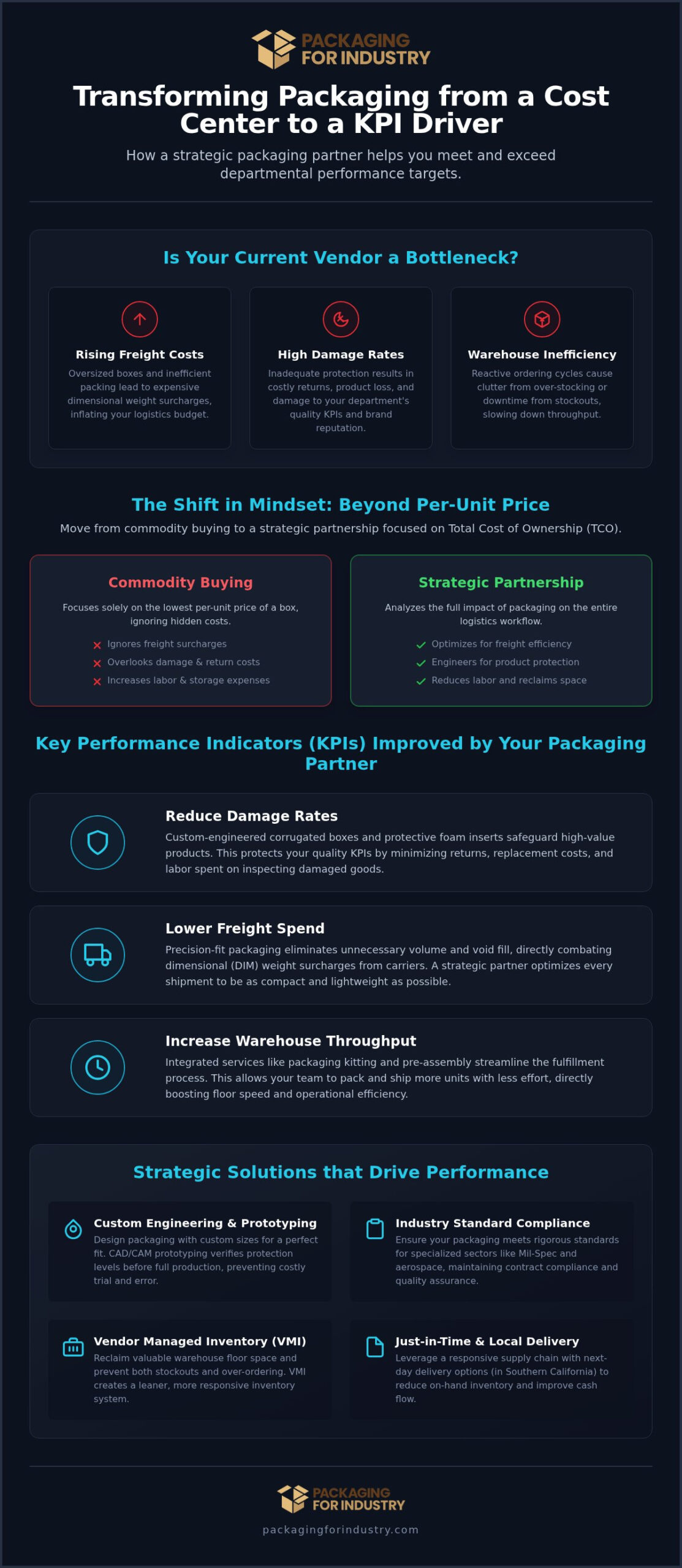
Many procurement managers still view shipping supplies as a simple commodity, focusing solely on the per-unit price of a box. This narrow focus often hides the true impact on the bottom line. When you sit down to compare packaging pricing, you must look beyond the initial invoice. Finding a packaging partner that helps me meet my department’s KPIs requires a deep dive into the total cost of ownership. This calculation includes warehouse labor, freight efficiency, and the long-term cost of replacement goods. A strategic supplier helps you transition from basic catalog-buying to partner-sourcing, where every design choice supports a specific business outcome.
Understanding The Link Between Packaging Strategy and Departmental KPIs is essential for any logistics or manufacturing leader. Packaging provides the physical protection necessary to meet customer satisfaction targets and ensures your brand reputation remains intact. While standard RSC boxes are the industry baseline, their effectiveness depends on structural integrity and material grade. When these containers are engineered correctly, they directly support your department’s most critical financial goals by removing the hidden costs of poor logistical planning.
Key Performance Indicators Impacted by Your Vendor
Your choice of supplier influences several high-level metrics that define your department’s success. By prioritizing lower packaging costs through better design, you can improve the following KPIs:
- Damage Rates: High return rates are a KPI killer. Every damaged shipment incurs costs for return freight, warehouse labor to inspect the goods, and the lost value of the product itself.
- Freight Spend: Carriers calculate costs based on dimensional weight. Poorly sized containers result in expensive surcharges that inflate your logistics budget.
- Warehouse Throughput: Speed on the floor is vital. Integrated services like packaging kitting and assembly streamline the fulfillment process, allowing your team to move more units with less effort.
Why a ‘Cheap’ Box Can Ruin Your Departmental Budget
A low-cost box often lacks the structural integrity needed for industrial environments. If a stack of corrugated containers collapses in the warehouse, the labor costs for cleanup and the potential for injury create a massive deficit. You should analyze your current damage-to-shipment ratio before choosing a partner. Precision engineering reduces material waste by using the exact amount of protection required, rather than over-packing with generic fillers. A “cheap” solution is rarely the most cost-effective one when you calculate the long-term impact on your departmental budget. A packaging partner that helps me meet my department’s KPIs will always prioritize durability and efficiency over the initial price tag.
Custom Engineering: Hitting Product Protection and Freight KPIs
While standard RSC boxes are suitable for some applications, achieving peak operational efficiency requires a more tailored approach. Custom engineering bridges the gap between basic containment and strategic logistical protection. With custom sizes available for every product line, you can eliminate the unnecessary volume that drives up shipping costs. A packaging partner that helps me meet my department’s KPIs will prioritize a precise fit, utilizing custom corrugated boxes that are designed specifically for your product’s footprint. This eliminates the need for expensive void fill and reduces the labor time spent on complex manual wrapping.
Precision prototyping is the foundation of this engineering process. By using CAD/CAM technology, our team develops physical samples that allow you to verify product fit and protection levels before a full production rollout. This proactive step ensures that your custom design packaging performs as expected in the real world. It prevents the costly trial-and-error approach that often results in high damage rates and wasted materials, keeping your quality metrics on track from the first shipment.
Optimizing for DIM Weight and Freight Surcharges
Dimensional (DIM) weight is a critical factor in your logistics KPI. Carriers like UPS and FedEx calculate shipping rates based on the volume of a package rather than its actual weight. If your boxes are even slightly oversized, you are paying a premium to ship empty space. Engineering a box to be just two inches smaller in each dimension can lead to significant annual freight savings across high-volume shipping cycles. This adjustment helps you avoid the steep surcharges that often penalize manufacturing and distribution departments. You can request a packaging review to identify which items in your current inventory are triggering these unnecessary costs.
Material Science: Polyethylene vs. Polyurethane Foam
Protecting delicate industrial components requires a deep understanding of material properties. Specialized protective foam packaging is engineered to handle specific shock and vibration requirements. Polyethylene foam is a closed-cell material known for its high load-bearing capacity, making it perfect for heavy machinery or aerospace parts. Polyurethane is an open-cell foam that provides a softer cushion for lighter, more fragile items. Selecting the correct density is a major step in optimizing inventory and ensuring product integrity.
- ESD and Anti-Static Foam: Essential for the electronics and semiconductor sectors to prevent static discharge damage.
- Precision Die-Cutting: Die-cut foam inserts provide a secure, professional presentation while keeping sensitive parts stationary.
- Shock Absorption: Engineering the foam to meet specific G-force requirements reduces the damage-to-shipment ratio.
A packaging partner that helps me meet my department’s KPIs understands that the right material choice is an economic decision. By using precision engineering to reduce damage and lower freight spend, you create a more stable and predictable departmental budget.
Inventory Models: Optimizing Warehouse Space and Cash Flow
Warehouse floor space is a premium asset in any industrial facility. When your aisles are cluttered with pallets of unused boxes or bulk rolls of stretch film, you’re essentially paying for storage rather than production. A packaging partner that helps me meet my department’s KPIs understands that reclaiming this floor space is a critical operational goal. By shifting the burden of storage to your supplier, you can dedicate more square footage to manufacturing and assembly, which directly improves your Warehouse Efficiency KPI. This shift transforms your facility from a storage hub into a high-throughput production center.
Automated replenishment systems also reduce the administrative load on your purchasing team. Instead of manually tracking stock levels and placing emergency orders, an integrated partner manages the data for you. This transition from reactive buying to a proactive supply chain improves cash flow, as you only pay for materials as they’re pulled into production. It turns a bulky inventory liability into a streamlined, just-in-time asset that supports your fiscal responsibility targets.
Vendor Managed Inventory (VMI) vs. Traditional Bulk Ordering
Traditional ordering often leads to the bullwhip effect, where over-ordering creates excess stock that eventually becomes obsolete. Vendor Managed Inventory (VMI) eliminates this risk through structured review cycles. Depending on your throughput, these reviews can occur on a weekly, biweekly, or monthly basis to ensure your stock levels remain optimal. This model provides several strategic advantages:
- Safety Stock: Your supplier maintains a reserve of your custom packaging, ensuring you never halt production due to a box shortage.
- Eliminating Emergency Costs: Proactive management removes the need for expensive overnight shipping or emergency production runs that wreck departmental budgets.
- Data-Driven Decisions: Usage reports help you forecast future needs with precision, keeping your inventory lean and your budget predictable.
Just-In-Time (JIT) Logistics for Industrial Hubs
Timing is everything in a well-oiled supply chain. Just-In-Time (JIT) logistics allow you to coordinate packaging arrivals with your actual production schedule. This is particularly effective for businesses in Southern California industrial hubs like Anaheim, Irvine, San Diego, and the Inland Empire. Local suppliers can provide next-day delivery, acting as a virtual extension of your own warehouse. This proximity is a core component of a packaging partner that helps me meet my department’s KPIs, especially regarding supply reliability.
This responsiveness protects you from the risk of obsolete inventory. If a product design changes or a customer updates their shipping requirements, you aren’t stuck with thousands of outdated boxes. You remain agile. For operations managers from Los Angeles County to San Diego, leveraging local delivery means you can respond to market shifts without the financial drag of dead stock. It ensures your supply chain is as flexible as your manufacturing process requires.
Compliance and Quality: Meeting Industry-Specific Standards
Compliance is a critical performance metric that directly affects your bottom line. In specialized sectors like aerospace and defense, a single non-compliant shipment can lead to immediate rejection, heavy fines, or the loss of a government contract. A packaging partner that helps me meet my department’s KPIs understands that quality assurance is as important as the physical box. Whether you’re managing electronics that require ESD-safe environments or international exports needing ISPM-15 heat-treated pallets, your supplier must be an expert in the regulations governing your specific industry. Failing to meet these standards doesn’t just delay a shipment; it damages your professional reputation and disrupts the entire supply chain.
Aerospace and Aviation Packaging Precision
High-value components such as turbine engines or avionics systems require specialized handling that standard shipping containers simply can’t provide. We engineer custom crates that combine heavy-duty wood structures with precision-cut foam packaging to secure these critical assets. This dual-layer protection prevents internal shifting during transit, which is a leading cause of damage in heavy industrial logistics. Additionally, industrial sectors demand full documentation and traceability for every component. A reliable partner maintains records that prove every material used meets the required engineering specifications, ensuring your quality control KPIs remain green and audit-ready.
Mil-Spec Packaging: Compliance Without the Headache
Military contracts involve complex standards like MIL-STD-2073, which dictates exactly how items must be preserved and packed for the Department of Defense. Managing these requirements is difficult without a partner who specializes in military-grade moisture and static barriers. These barriers protect sensitive hardware from corrosion and electrical discharge during long-term storage or overseas deployment. By choosing a packaging partner that helps me meet my department’s KPIs, you ensure that every shipment arrives at the depot ready for immediate acceptance. Compliance-ready packaging prevents the costly headache of re-packaging rejected goods at the eleventh hour, which often involves expensive labor and materials.
For electronics manufacturing, adhering to cleanroom and ESD standards is vital for maintaining product integrity. Using specialized polyethylene or anti-static foam ensures that delicate circuit boards aren’t compromised by static electricity during the kitting process. Similarly, international export KPIs rely on ISPM-15 compliant pallets to clear customs without delays. This level of technical precision is what separates a generic vendor from a strategic consultant who understands the high stakes of industrial manufacturing.
The PFI Advantage: Your Partner for KPI-Driven Packaging
Success in industrial logistics requires more than just a list of supplies. It demands a comprehensive system of protection and logistical optimization. Packaging For Industry (PFI) provides this by acting as a direct extension of your operations team. By consolidating your procurement of corrugated boxes, custom foam, and stretch film into a single, integrated plan, you reduce the logistical friction of managing multiple vendors. This holistic approach ensures that every material used in your facility is engineered to work together, supporting your goals for cost reduction and supply chain reliability.
Choosing a packaging partner that helps me meet my department’s KPIs means selecting a supplier that offers both local agility and national scale. While we provide nationwide support for companies with multi-regional distribution needs, our core strength lies in our ability to deliver highly personalized service. Our team understands the pressure of hitting quarterly targets. We don’t just sell products; we solve the specific engineering and economic challenges that keep your department from reaching its full potential.
Southern California’s Industrial Packaging Specialist
Our strategic location in Anaheim allows us to offer rapid response times across Orange County, Los Angeles, and the Inland Empire. This local presence is a significant advantage for your supply reliability KPI. We provide next-day delivery on stock items, which keeps your production lines moving without the need for massive on-site inventory. Proximity also allows for face-to-face packaging reviews and audits, where our engineers can visit your facility to identify inefficiencies in your current packing process.
Reducing lead times for custom-engineered items is another area where PFI excels. Whether you need specialized crates for aerospace components or die-cut foam for medical devices, our local manufacturing capabilities mean you aren’t waiting weeks for critical supplies. This speed allows you to remain agile, responding to customer demands or design changes without the risk of stockouts or production delays.
Next Steps: Request a Quote and KPI Audit
The path to a more efficient operation starts with a detailed packaging cost-reduction analysis. Our team doesn’t rely on guesswork. We use a data-driven approach to evaluate your current spending on materials, labor, and freight. From there, we move into the prototyping phase. Using CAD/CAM technology, we create a precision design for your product and produce a physical sample for testing. This ensures the solution works in the real world before you commit to a full production rollout.
A packaging partner that helps me meet my department’s KPIs should be proactive, not just reactive. We invite you to contact our team to discuss your specific operational challenges and learn how our VMI and JIT programs can reclaim your warehouse space. Our goal is to provide the peace of mind that comes from a steady, dependable supply chain. You can request a packaging quote today to begin optimizing your industrial logistics and improving your bottom line.
Optimize Your Industrial Logistics for Long-Term Success
Transitioning from a standard vendor to a strategic consultant allows you to reclaim your warehouse floor space and eliminate the hidden costs of shipping damage. By focusing on the total cost of ownership rather than just the invoice price, you turn your packaging from a simple expense into a tool for operational efficiency. Finding a packaging partner that helps me meet my department’s KPIs ensures your logistics strategy aligns perfectly with your financial and quality targets.
PFI brings specialized Aerospace and Mil-Spec expertise to every project. We use custom CAD/CAM prototyping to guarantee product fit before production begins, while our local next-day delivery across Southern California keeps your supply chain reliable. We’re ready to help you lower packaging costs and streamline your distribution network through precision engineering and managed inventory programs.
Your department’s success depends on a steady, dependable partnership. We’re here to engineer a solution that supports your growth and eliminates the stress of logistical bottlenecks.
Frequently Asked Questions
How can a packaging partner help reduce my shipping damage rates?
A packaging partner reduces damage by engineering custom inserts that match the specific fragility of your product. Instead of relying on generic bubble wrap, we use precision-cut polyethylene or polyurethane foam to absorb shock and vibration during transit. This engineering-minded approach ensures your goods remain stationary and protected. By selecting a packaging partner that helps me meet my department’s KPIs, you can significantly lower return rates and the labor costs associated with processing damaged goods.
What is Vendor Managed Inventory (VMI) in the packaging industry?
Vendor Managed Inventory is a supply chain model where the supplier monitors and replenishes your stock levels based on actual usage. We perform regular reviews on weekly, biweekly, or monthly cycles to ensure you always have a safety stock of corrugated boxes and foam. This eliminates the risk of production stops due to inventory shortages. It also improves cash flow because you only pay for the materials as they are pulled into your production line.
How does custom packaging help lower freight costs?
Custom packaging lowers freight costs by optimizing the dimensional (DIM) weight of every shipment. Carriers charge based on the volume of the box, so shipping oversized containers leads to expensive surcharges. We design custom corrugated boxes that fit your product with minimal wasted space. This eliminates the need for excessive void fill and allows you to fit more units on each pallet, which directly supports your logistics and freight spend KPIs.
Do you provide mil-spec compliant packaging for aerospace?
Yes, we provide comprehensive Mil-Spec and aerospace-compliant packaging solutions that meet rigorous government standards. We understand the complexities of MIL-STD-2073 and provide the specialized moisture and static barriers required for defense hardware. Our team ensures all documentation and traceability requirements are met, preventing costly shipment rejections at the depot. This technical expertise is vital for maintaining contract compliance and protecting high-value components during long-term storage or international deployment.
Can PFI help with packaging kitting and assembly?
PFI provides full packaging kitting and assembly services to improve your warehouse throughput. We deliver pre-assembled kits that include the corrugated box, custom foam inserts, and necessary labels in one ready-to-use package. This allows your team to focus on the core production process rather than spending time on secondary packaging tasks. It is an efficient way to speed up the line and reduce the total labor hours required for every fulfillment cycle.
Is next-day delivery available for Southern California businesses?
Yes, we offer local next-day delivery to businesses located throughout Southern California, including Orange County, Los Angeles, and the Inland Empire. Our strategic hub in Anaheim allows us to provide rapid response times that larger national catalog suppliers cannot match. This proximity is a core part of being a packaging partner that helps me meet my department’s KPIs, as it ensures supply reliability and allows for just-in-time logistics in your facility.
How do I switch from a large catalog supplier to a custom partner like PFI?
Switching begins with a comprehensive KPI audit where we analyze your current packaging costs, damage rates, and warehouse efficiency. We then use CAD/CAM technology to develop custom prototypes for your most critical items. Once you approve the physical samples, we transition you into a managed inventory program that automates your replenishment. This consultative approach ensures a smooth migration from generic stock supplies to an engineered, cost-effective system tailored specifically to your operations.
What industries do you specialize in for custom packaging?
We specialize in high-stakes industrial sectors that require precision and compliance. This includes aerospace and defense, medical device manufacturing, electronics, and semiconductor production. We also serve large-scale distributors and specialized manufacturing hubs that need heavy-duty corrugated boxes, custom crates, and ESD-safe protective foam. Our expertise in these fields allows us to provide the specialized protection and regulatory documentation necessary to keep complex supply chains moving without interruption or quality failures.