
With the average LTL damage claim now costing industrial shippers approximately $1,796 per incident, simply hoping for the best is no longer a viable logistics strategy. In 2026, Southern California manufacturers face a unique set of pressures, from rising port congestion at Long Beach to compounding freight surcharges that make replacement shipments prohibitively expensive. Learning how to reduce shipping damage costs in Southern California requires moving past a basic price-per-box mindset and adopting a rigorous engineering approach to your supply chain.
You already know that your high-value aerospace or electronic components deserve better than one-size-fits-all protection, yet inconsistent warehouse kitting continues to eat into your margins and strain procurement relationships. This guide provides a repeatable framework to audit your current vulnerabilities and implement data-driven packaging choices that protect your bottom line. We will examine the specific engineering strategies and logistical shifts necessary to lower your Total Cost of Damage (TCD) while ensuring your freight arrives intact every time. From custom foam inserts to heavy-duty corrugated solutions, it’s time to turn your packaging from a line-item expense into a competitive advantage and a source of professional peace of mind.
Key Takeaways
- Learn why the “cheapest box” often leads to the highest operational overhead by calculating your Total Cost of Damage (TCD), which includes labor and double freight.
- Discover how to reduce shipping damage costs in Southern California by utilizing custom foam packaging and heavy-duty triple-wall corrugated boxes for high-value industrial components.
- Prevent the majority of transit damage caused by load shifting in LTL shipping through the science of stretch film containment and proper palletization strategies.
- Implement a five-step floor-level packaging audit to identify hidden vulnerabilities in your “last mile” and “first touch” warehouse processes.
- Streamline your local supply chain and prevent stockouts with Vendor Managed Inventory (VMI) and just-in-time delivery across Orange County and the Inland Empire.
The Financial Reality of Shipping Damage: Calculating Your TCD
Many procurement teams prioritize the unit price of a box while ignoring the catastrophic impact of transit failure. This “cheapest box” mentality often leads to the highest operational overhead because it fails to account for the Total Cost of Damage (TCD). In 2026, Southern California logistics are more expensive than ever. With FedEx and UPS implementing average rate increases of 5.9%, and effective costs rising up to 12% due to surcharges, the price of shipping a replacement item often exceeds the original profit margin. For manufacturers in Anaheim or the Inland Empire, understanding how to reduce shipping damage costs in Southern California begins with a shift from commodity buying to engineering-focused custom packaging solutions.
The industry average for LTL damage claims is approximately 1.24%. This means roughly one in every 80 shipments arrives compromised. When a high-value aerospace component or medical device is damaged, the loss isn’t just the product’s value. It’s the wasted labor, the double freight costs, and the risk of a breached contract. In high-stakes sectors, a single damaged shipment can jeopardize a long-term relationship with a prime contractor. Protecting your bottom line requires a precise calculation of every variable involved in a transit failure.
The Formula for Total Cost of Damage
Total Cost of Damage is defined as the aggregate sum of freight expenses, warehouse labor, product replacement value, and brand reputation loss. To justify an investment in protective materials, you must present procurement with a complete data set. This includes “invisible” costs such as the time warehouse staff spends inspecting returns, filing claims, and repacking goods. When you quantify these hours alongside 2026’s volatile fuel surcharges, the business case for heavy-duty corrugated or custom foam becomes undeniable. Transitioning to better materials is a documented path to packaging cost savings that improves the bottom line.
Why Carrier Insurance Often Fails Industrial Shippers
Relying on carrier liability is a dangerous gamble for industrial shippers. Most LTL carriers limit their liability to a specific dollar amount per pound. This rarely covers the actual value of specialized electronics or aerospace parts. Filing a claim is a resource-heavy process that rarely yields a full recovery of the $1,796 average cost for a damage claim incident. Prevention is consistently more profitable than litigation. By implementing a proactive strategy for how to reduce shipping damage costs in Southern California, you eliminate the need to navigate complex insurance hurdles while maintaining your reputation for reliability.
Foam Inserts: Precision Engineering for Sensitive Gear
Precision cushioning is a science. Selecting the right material is critical for long-term reliability. Polyethylene foam offers excellent durability and vibration dampening for heavier items, while Polyurethane is better suited for lighter, more delicate instruments that require a softer landing. For electronics, anti-static (ESD) foam is mandatory to prevent latent electrical damage that might not be visible upon delivery but causes failure in the field. Utilizing custom foam packaging ensures that every component is isolated from external shocks during transit.
Custom Crating for Heavy Industrial Equipment
There are instances where even the strongest corrugated material is insufficient. When shipping oversized machinery or extremely high-value aerospace assemblies, the transition to wood crates is necessary for total protection. These crates are often foam-lined to provide a dual layer of shock absorption and structural rigidity. Proper crating also ensures compliance with cargo securement rules, which is vital for safe transit through the busy corridors of Los Angeles and the Inland Empire. This level of stabilization is a core component of how to reduce shipping damage costs in Southern California for heavy-duty manufacturing. If you’re unsure which material level your product requires, you can compare packaging pricing for various custom options. You can also learn more about engineering custom crates for specialized logistics to ensure your most valuable assets arrive without a scratch.
Load Stabilization Strategies for Southern California Logistics
Load shifting remains the primary culprit for transit failure, accounting for approximately 60% of damage in Less-Than-Truckload (LTL) environments. In the high-volume corridors of the Inland Empire and Los Angeles, pallets are frequently moved, restacked, and subjected to significant vibration on routes like the I-15 and CA-60. This technical approach is essential for any business looking for how to reduce shipping damage costs in Southern California while maintaining high throughput. Without proper stabilization, even the most expensive heavy-duty corrugated boxes will fail when the load shifts during a sudden stop or sharp turn.
Conducting a comprehensive packaging audit often reveals that stabilization issues stem from a lack of standardized wrapping protocols. In the Inland Empire specifically, the sheer volume of truck traffic and the frequency of cross-docking, where your pallet is moved from one trailer to another, increases the risk of stabilization failure. Every time a forklift touches your pallet, the integrity of the wrap and the underlying structure is tested.
Stretch Film Optimization and Pallet Integrity
Consistency is the foundation of load stabilization. While hand wrapping is common in smaller operations, machine stretch film provides the uniform tension necessary to maintain pallet integrity throughout the supply chain. Hand wrapping often suffers from operator fatigue, leading to loose top layers that are prone to toppling during transit. We offer high-performance stretch film products designed to maximize containment force while reducing material waste. Beyond the film itself, the way you stack your goods matters. Improper pallet stacking creates uneven weight distribution, which eventually compromises the structural integrity of the bottom layer of RSC boxes.
The Role of Corner and Edge Protection
Vertical pressure is a silent killer in Southern California warehouses where high-density stacking is the norm to save on floor space. Corner and edge protection serve as a critical defense against crushed corners caused by tight strapping or heavy overhead loads. By integrating heavy-duty corner and edge protection, you can distribute vertical pressure more effectively. This simple addition can increase stack strength by up to 20%, allowing for safer stacking and significantly lower packaging costs over time. These boards also prevent strapping from cutting into corrugated edges, which is a common point of failure for high-value industrial shipments. This is a proven method for how to reduce shipping damage costs in Southern California while optimizing your warehouse footprint.
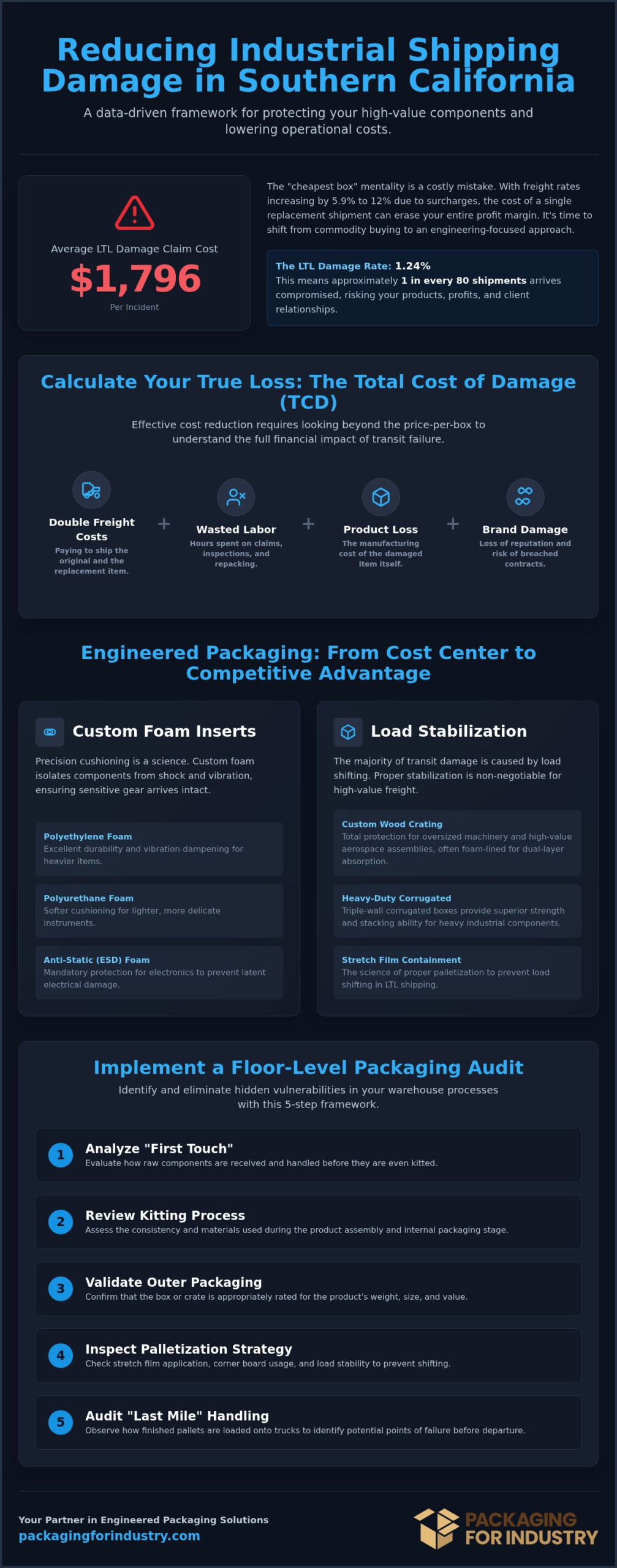
How to Conduct a Local Packaging Audit in 5 Steps
Walking your warehouse floor is the only way to uncover the structural vulnerabilities that data reports miss. While spreadsheets show you the financial loss, a physical audit reveals why your RSC boxes are collapsing or why your protective foam isn’t performing as engineered. If you’re serious about learning how to reduce shipping damage costs in Southern California, you must examine the “first touch” in the warehouse and the “last mile” on the delivery truck. This process identifies where standard kitting procedures fail and where environmental factors compromise your materials.
A thorough packaging audit provides the objective evidence needed to justify a shift in your procurement strategy. It moves the conversation from the unit price of a box to the long-term reliability of your entire logistics system.
Step-by-Step Audit Framework
- Step 1: Analyze Historical Damage Data: Review your claims by SKU and carrier to identify recurring failure patterns. If specific high-value components consistently arrive damaged, the issue is likely a design flaw rather than a carrier error.
- Step 2: Inspect the Packing Station: Watch your team in action. Inconsistent material usage, such as using too little dunnage or the wrong tape, often stems from a lack of standardized kitting instructions.
- Step 3: Perform Prototype Testing: Don’t wait for a customer to report a failure. Conduct drop tests or vibration tests on your current packaging to see how it handles simulated transit stress.
- Step 4: Evaluate Palletization: Measure your containment force. Ensure your stretch film is providing enough tension to prevent the load from shifting during the frequent stops and turns of local drayage.
- Step 5: Review the Storage Environment: Check for moisture or temperature risks. Packaging materials stored in non-climate-controlled areas can lose structural integrity before they ever leave your dock.
Addressing Regional Logistical Pain Points
Southern California presents unique environmental stressors that can degrade packaging performance. During peak summer months, temperatures inside trailers in the Inland Empire can soar, causing some adhesives to soften and stretch film to lose its memory. This leads to load failure even if the pallet was wrapped correctly at the start. Near the Port of Long Beach and the Port of LA, high humidity levels can weaken corrugated fibers, reducing the stacking strength of your boxes by a significant margin. Preparing your packaging for these specific conditions is a critical step in how to reduce shipping damage costs in Southern California. For manufacturers needing localized expertise, our Anaheim packaging support team can help you design solutions that withstand these regional challenges.
Streamlining Protection with VMI and Custom Design
A common but overlooked cause of transit failure is the “emergency substitute” box. When a warehouse runs out of a specific triple-wall RSC box or custom-cut foam insert, staff often resort to using whatever is available on the shelf. This compromise immediately invalidates your engineering efforts and introduces unnecessary risk. Understanding how to reduce shipping damage costs in Southern California requires more than just better materials; it requires a management system that ensures those materials are always available. For manufacturers in Orange County and LA, local supply reliability is the final piece of the damage-reduction puzzle.
Eliminating Shortages with VMI
Vendor Managed Inventory (VMI) is the primary tool for maintaining consistency in high-stakes manufacturing environments. By utilizing our Vendor Managed Inventory services, you shift the responsibility of stock levels to us. We monitor your usage and replenish supplies before a shortage occurs. This proactive approach prevents the use of subpar alternatives and improves your cash flow by reducing the amount of capital tied up in on-site inventory. Our local next-day delivery capabilities ensure that your warehouse remains lean while maintaining 100% protection for every shipment. Consistency is further enhanced through packaging kitting and assembly services, which eliminate human error by providing pre-assembled protection for your staff.
Custom Design and Free Prototyping
Generic catalog suppliers often provide “one-size-fits-all” solutions that fail under the unique stresses of the Southern California logistics hub. PFI stands apart as a local partner that understands the specific demands of the Anaheim and Inland Empire corridors. We offer custom design packaging that is tailored to your product’s specific fragility and transit requirements. Unlike generic alternatives, we don’t just sell boxes; we sell engineered systems designed to protect your bottom line.
A key advantage of working with a local specialist is the ability to conduct rapid testing. We provide free prototyping to ensure a perfect fit before you commit to a bulk order. This agility allows you to refine your strategy for how to reduce shipping damage costs in Southern California in real-time. Instead of waiting weeks for a sample from a national distributor, you can have a functional prototype on your dock for immediate evaluation. This level of service provides the professional peace of mind that comes from knowing your high-value assets are secured by the best possible protection.
Secure Your Supply Chain for 2026 and Beyond
Transit damage is an engineering problem with a direct impact on your fiscal health. By shifting from a price-per-box mindset to a Total Cost of Damage framework, you can protect high-value aerospace and electronic components from the rigors of the Southern California logistics hub. Implementing rigorous audits and stabilizing loads with proper stretch film containment ensures your goods survive the high-vibration routes of the Inland Empire. This comprehensive approach is the only way to master how to reduce shipping damage costs in Southern California while maintaining a lean, responsive operation.
PFI provides the specialized aerospace expertise and free prototyping required to eliminate vulnerabilities before they reach the customer. With local next-day delivery across Orange County and Los Angeles, we ensure you never face the “emergency substitute” problem that leads to transit failure. We’re ready to help you optimize your protection and stabilize your margins today.
Frequently Asked Questions
What is the most common cause of shipping damage in industrial logistics?
Load shifting in Less-Than-Truckload (LTL) environments is the leading cause of transit failure, responsible for approximately 60% of damage incidents. This occurs when pallets aren’t properly secured or when containment force is insufficient for the frequent stops and turns of local drayage. Utilizing high-performance stretch film and corner boards is a critical strategy for how to reduce shipping damage costs in Southern California. Standardizing your wrapping protocols prevents the toppling of top-heavy loads during transit.
How do I calculate the Total Cost of Damage (TCD) for my business?
To calculate Total Cost of Damage (TCD), you must aggregate the original product value, warehouse labor for processing returns, and the cost of double freight for the replacement shipment. You should also factor in the “invisible” administrative costs of filing claims and the potential loss of future contracts. Presenting this total figure to decision-makers demonstrates that the unit price of a box is only a fraction of the actual operational expense.
Is custom foam packaging worth the extra cost for aerospace parts?
Custom foam packaging is essential for aerospace components because it provides precision cushioning against G-force impacts that generic dunnage cannot absorb. While the initial material price is higher, the investment prevents the catastrophic loss of high-value parts and ensures compliance with strict quality standards. Using specialized Polyethylene or anti-static Polyurethane inserts creates a repeatable kitting process that eliminates human error in the warehouse and protects your professional reputation.
Can I reduce shipping costs by using smaller boxes?
Reducing box size can lower shipping costs by optimizing dimensional (DIM) weight, but it must be balanced against the need for adequate protective clearance. If a box is too small, there isn’t enough space for the cushioning materials required to absorb shocks. Right-sizing your packaging involves finding the intersection between minimum volume and maximum protection. We recommend using free prototyping to test if a smaller footprint still meets your structural requirements.
What is the difference between double-wall and triple-wall corrugated boxes?
The primary difference lies in the number of fluted layers and linerboards used for structural rigidity. Double-wall corrugated consists of two layers of fluting and three linerboards, making it suitable for standard industrial goods. Triple-wall boxes add a third fluted layer, providing the extreme stacking strength and puncture resistance needed for heavy machinery or aerospace assemblies. Moving to triple-wall materials is often a necessary step for how to reduce shipping damage costs in Southern California.
How does Southern California heat affect stretch film and adhesive tapes?
High temperatures inside trailers in the Inland Empire can cause some adhesives to soften and stretch film to lose its elastic memory. This degradation leads to load failure even if the pallet was wrapped correctly in a climate-controlled warehouse. You should specify high-tack tapes and premium films designed for thermal stability to ensure your loads remain stable during long hauls through the desert or while staged on hot asphalt docks.
What are the benefits of a Vendor Managed Inventory (VMI) program for packaging?
Vendor Managed Inventory (VMI) eliminates the “emergency substitute” problem by ensuring your custom boxes and foam inserts are always in stock. Instead of reacting to shortages, our team monitors your levels and replenishes supplies automatically. This improves your cash flow by reducing on-site inventory and ensures that every product is packed with the correct engineered components. VMI is a proven method to maintain consistency and lower packaging costs over time.
How do I get my procurement team to approve a more expensive packaging supplier?
Shifting the conversation from “price-per-box” to “Total Cost of Ownership” is the most effective way to gain procurement approval. Use the TCD framework to show how a cheaper supplier actually increases operational overhead through higher damage rates and replacement freight. Highlighting PFI’s specialized aerospace expertise and local next-day delivery provides the data-driven justification needed to prioritize supply reliability and long-term fiscal responsibility over short-term savings.