
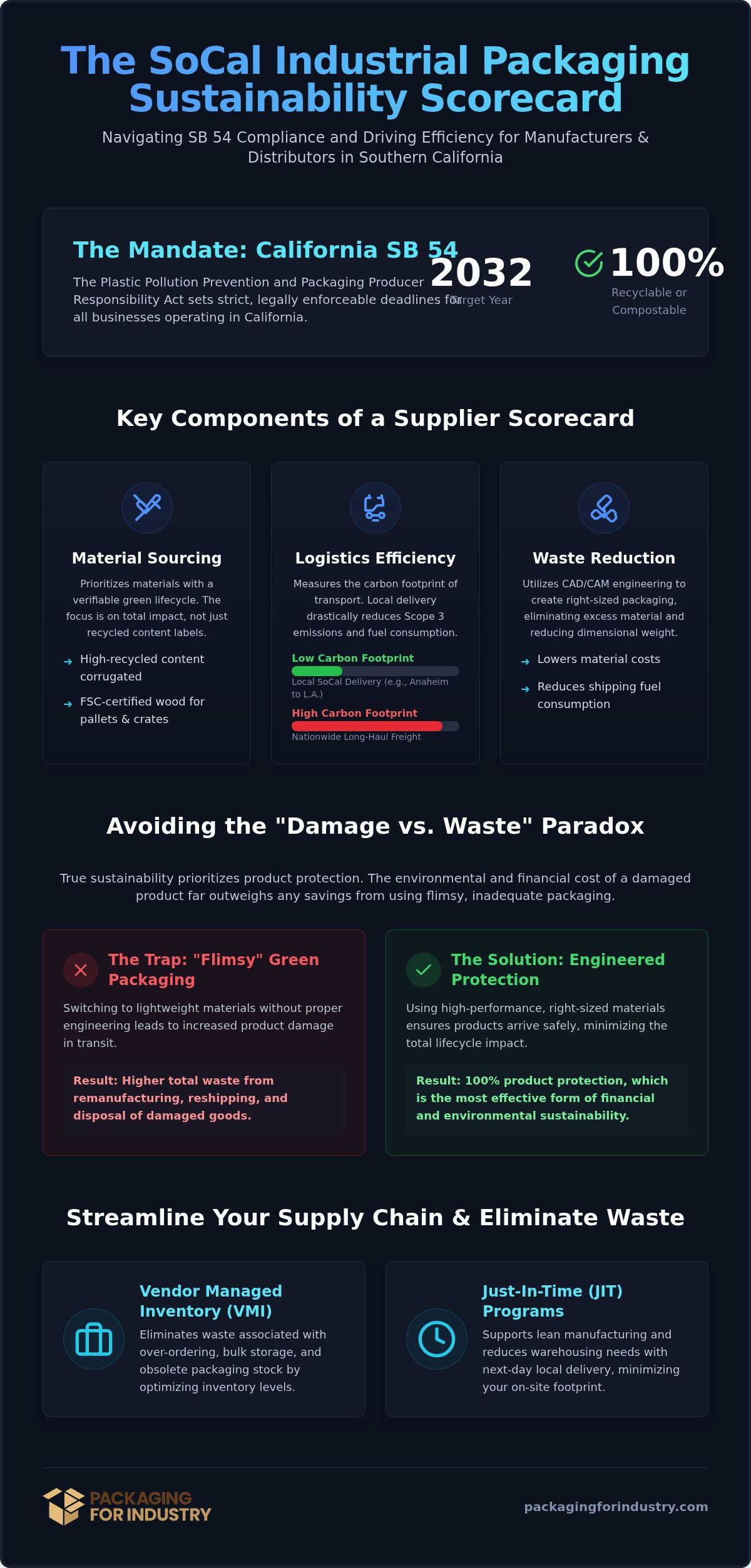
By 2032, every piece of single-use packaging in California must be 100% recyclable or compostable. For manufacturers and distributors, finding a packaging supplier with a strong sustainability scorecard SoCal is no longer just a corporate goal; it’s a strict regulatory requirement under SB 54. You’re likely feeling the heat from stakeholders to produce verifiable green metrics while simultaneously trying to cut down on the waste generated by damaged goods and over-ordered inventory.
We understand that “green” often feels like a synonym for “expensive” or “flimsy.” However, true sustainability in industrial logistics actually drives fiscal efficiency. This guide helps you navigate the transition by showing you how to evaluate suppliers through the lens of engineering and economics. You’ll learn how to identify partners who use local logistics to slash carbon footprints and precision CAD/CAM prototyping to eliminate material waste. We’ll break down the specific metrics that matter for ESG compliance, ensuring your packaging protects both your products and your profit margins.
Key Takeaways
- Evaluate any packaging supplier with a strong sustainability scorecard SoCal by looking beyond material labels to prioritize total lifecycle impact and SB 54 regulatory compliance.
- Avoid the “damage vs. waste” paradox by selecting high-performance materials that prevent product loss, which is the costliest form of environmental and financial waste.
- Use precision CAD/CAM engineering and prototyping to create right-sized packaging that eliminates excess material and reduces fuel consumption during transport.
- Implement Vendor Managed Inventory (VMI) and JIT programs to streamline your supply chain and eliminate the waste associated with over-ordering or obsolete stock.
- Leverage integrated solutions that combine corrugated, foam, and crates to meet the rigorous ESG standards of specialized sectors like aerospace and medical manufacturing.
Defining the Sustainability Scorecard for SoCal Industrial Packaging
A sustainability scorecard in a B2B industrial context is a quantitative framework used to evaluate the environmental footprint of your supply chain. It moves beyond “green” labels into hard data that procurement teams use to mitigate risk and improve fiscal performance. By 2026, the industry has shifted focus from simple recycled content percentages to total lifecycle impact. This comprehensive metric accounts for the energy consumed during manufacturing, the carbon emitted during transport, and the material’s end-of-life status. For manufacturers in the Inland Empire or Orange County, partnering with a packaging supplier with a strong sustainability scorecard SoCal is a strategic move to ensure long-term ESG compliance.
Key Components of a Supplier Scorecard
A verifiable scorecard focuses on three primary pillars. First, material sourcing must prioritize high-recycled content corrugated and FSC-certified wood for pallets and crates. Second, logistics efficiency measures the carbon footprint of moving goods. Local logistics efficiency is best measured by the distance from the warehouse to your facility. A supplier moving goods from Anaheim to Los Angeles or Orange County creates a significantly smaller carbon footprint than one relying on nationwide freight. Third, waste reduction is achieved through custom design packaging. This engineering approach eliminates excess material and reduces dimensional weight, which directly lowers shipping costs and fuel consumption. Within a Sustainable packaging framework, these metrics provide a clear path toward reducing your overall environmental footprint.
Local Regulations and Southern California ESG Standards
California’s SB 54, the Plastic Pollution Prevention and Packaging Producer Responsibility Act, became legally enforceable on May 1, 2026. This law mandates that 100% of single-use packaging in the state must be recyclable or compostable by 2032. For SoCal businesses, this means your packaging choices are now regulatory decisions. Working with a local partner allows for just-in-time inventory management and next-day delivery. This local logistics model isn’t just about speed; it’s a green strategy that drastically reduces the fuel consumption associated with long-haul freight. Procurement managers increasingly look for a packaging supplier with a strong sustainability scorecard SoCal to simplify their reporting. These scorecards provide the data needed to satisfy auditors and meet the August 1, 2026, deadline for submitting Individual Source Reduction Plans under SB 54. Using a local supplier also helps reduce Scope 3 emissions, which are often the most difficult to track and control in a complex supply chain.
Industrial Metrics: Evaluating Material Performance and Eco-Impact
Industrial packaging decisions shouldn’t be based on marketing labels alone. They require a rigorous evaluation of material performance against environmental impact. According to Sustainable Materials Management principles, the most effective strategy is reducing the total volume of material entering the waste stream. When comparing corrugated, plastic, and wood, corrugated often leads in carbon efficiency. However, a packaging supplier with a strong sustainability scorecard SoCal will prioritize the material that offers the highest protection with the lowest mass. If a material is recyclable but fails to protect the product, it’s not a sustainable choice.
We frequently see businesses fall into the “Damage vs. Waste” paradox. This occurs when a company switches to flimsy, lightweight “green” materials to reduce shipping weight, only to see an increase in shipping damage. If a high-value aerospace component or medical device is destroyed in transit, the environmental cost of manufacturing a replacement far outweighs any savings from the original packaging. True sustainability means ensuring 100% protection through engineering. You can identify these hidden costs by requesting a packaging cost savings analysis to pinpoint where material waste and damage overlap.
Corrugated Boxes: The Backbone of Sustainable Shipping
For many industrial applications, heavy-duty double-wall and triple-wall boxes serve as a 100% recyclable alternative to heavier wood crates. These corrugated solutions provide the structural integrity needed for bulk shipments while remaining easy to process in standard recycling streams. We also utilize weather-resistant corrugated coatings that can replace plastic-heavy alternatives like poly bags or excessive layers of stretch film. By choosing high-performance corrugated, you can lower packaging costs without sacrificing the durability required for the Southern California shipping environment.
Protective Foam and Sustainability
In specialized sectors like electronics, custom foam inserts are critical for preventing product loss. Polyethylene (PE) foam is highly durable and often reusable in closed-loop systems, making it a preferred choice for long-term logistics. Polyurethane (PU) foam offers superior cushioning for lighter, fragile items that require delicate handling. For electronics manufacturing, we provide anti-static and ESD foam options. These materials prevent electrostatic discharge damage, which is a primary cause of electronic waste and costly returns.
Custom-engineered inserts can reduce total material volume by up to 30%. This precision approach ensures you aren’t paying to ship air or using more foam than necessary. With custom sizes available for every industrial application, we ensure a perfect fit for your specific payload. If you want to see how engineered materials can streamline your operations, you can request a packaging quote to compare material options tailored to your needs.
How Engineering Reduces Your Packaging Carbon Footprint
Engineering is the primary differentiator between a standard vendor and a packaging supplier with a strong sustainability scorecard SoCal. While many businesses focus solely on material types, the greatest environmental gains are found in precision design. By utilizing CAD/CAM support, we create “right-sized” packaging that eliminates the common practice of shipping empty space. This engineering approach aligns with sustainable packaging principles by minimizing resource consumption at the source. When dimensions are optimized, you reduce the dimensional weight of your shipments, which directly lowers the fuel consumption and carbon emissions of carriers like UPS and FedEx.
Prototyping serves as a critical safeguard against material waste. Before a full production rollout, we develop physical samples to ensure a perfect fit for your industrial components. This process identifies potential failure points and eliminates the need for excess dunnage or over-packaging. Additionally, integrated services like packaging kitting and assembly streamline your warehouse operations. By receiving pre-assembled kits, your team reduces the operational energy and time required for packing, which improves overall warehouse throughput and reduces the total carbon footprint of your internal processes.
Custom Crates and Wood Packaging
Industrial logistics often require the durability of wood, but sustainability remains a priority. We focus on engineering custom crates that maximize pallet density. By calculating the exact footprint needed for international or domestic transit, we ensure more units fit on a single truck or container. Our use of heat-treated pallets and export crates meets ISPM 15 standards without the use of harmful chemicals. For companies with regular transit routes, we can design reusable packaging programs for closed-loop systems, allowing crates to be returned, inspected, and redeployed rather than entering the waste stream after a single use.
Advanced Edge and Corner Protection
Load stabilization is often achieved through excessive layers of stretch film, which creates significant plastic waste. However, implementing cardboard edge protectors provides the structural integrity needed to stabilize a pallet with less total wrap. These protectors distribute the tension of the film more effectively, allowing for a secure load with fewer revolutions. Beyond material savings, corner boards prevent the “scrap” of damaged industrial components. In sectors like aerospace or electronics, a single dented corner can render a part unusable. Preventing this damage is a core component of a packaging supplier with a strong sustainability scorecard SoCal, as it avoids the massive environmental cost of remanufacturing and re-shipping heavy industrial goods.
Sustainable Logistics: VMI and JIT in Southern California
A packaging supplier with a strong sustainability scorecard SoCal doesn’t just sell corrugated boxes; they manage the flow of goods to minimize environmental impact. Vendor Managed Inventory (VMI) is a critical tool for waste reduction. In many warehouses, over-ordering leads to “obsolete inventory”—packaging that sits for years before being scrapped due to design changes or degradation. VMI eliminates this by using planned replenishment cycles based on real-world usage. This ensures you only have what you need, when you need it, preventing hundreds of pounds of high-quality material from ending up in a landfill.
By implementing Just-In-Time (JIT) inventory, you directly reduce your facility’s energy needs. Less inventory means fewer pallets to move, less square footage to light, and reduced climate control requirements. It also mitigates the high environmental cost of emergency rush orders. Scheduled local deliveries are far more carbon-efficient than overnight nationwide air freight, which is often the only option when inventory runs dry. Reliability in your supply chain is a prerequisite for a truly green operation.
Reducing Warehouse Footprint in SoCal
Industrial real estate in Southern California is among the most expensive in the nation. Freeing up floor space in high-cost areas like Irvine and Anaheim is both a fiscal and environmental win. When a supplier manages your custom boxes and long lead-time items, you can downsize your storage requirements or repurpose that space for manufacturing. This level of inventory control is the missing link between operational efficiency and long-term fiscal sustainability. You’re no longer paying to store “air” or excess corrugated, which keeps your overhead low and your warehouse agile.
Local Delivery: The Anaheim Advantage
Calculating the carbon savings of local Orange County distribution reveals a stark difference compared to out-of-state vendors. A packaging supplier with a strong sustainability scorecard SoCal utilizes local routes to provide next-day delivery, which generates a fraction of the emissions produced by nationwide freight. Our Anaheim-based distribution model supports the local manufacturing economy while providing the reliability needed to maintain a lean supply chain. Choosing a local partner isn’t just a matter of convenience; it’s a strategic decision to lower your Scope 3 emissions by shortening the distance your supplies travel.
Selecting Your Partner: Why PFI Leads the SoCal Scorecard
PFI distinguishes itself as a packaging supplier with a strong sustainability scorecard SoCal by moving beyond the role of a commodity vendor. We provide an integrated system that combines heavy-duty corrugated boxes, precision-cut foam, and custom-engineered crates. This holistic approach ensures that every material works in synergy; this is critical for high-stakes sectors like aerospace and medical manufacturing. When your packaging is engineered as a single unit, you eliminate the redundancies that drive up both material costs and carbon emissions. We focus on the intersection of engineering and economics to ensure that your environmental goals align with your fiscal responsibilities.
The PFI Audit Process
Our engagement begins with a structured audit designed to produce measurable results. We don’t just look at what you buy; we look at how it performs in the field. This methodical approach allows us to act as a seasoned industrial consultant for your team. The process follows three distinct stages:
- Step 1: We assess current material waste and damage rates to identify where your current system is failing.
- Step 2: Our engineers develop custom prototypes using CAD/CAM technology to ensure zero material waste before full production.
- Step 3: We implement a Vendor Managed Inventory (VMI) program to maintain a lean supply chain and reduce your warehouse footprint.
This process ensures that your sustainability metrics are based on actual performance rather than theoretical labels. It provides the peace of mind that comes from knowing your operational challenges are understood and solved through precise engineering.
Commitment to Industrial Excellence
Standard commodity suppliers often prioritize volume over precision. Their one-size-fits-all model leads to over-packaging and excessive shipping weights; these factors can’t match the sustainability scores achieved through custom engineering. PFI offers a local, specialized alternative that targets the specific logistical challenges of the Inland Empire and Los Angeles. While our Anaheim facility serves as a hub for Southern California, we also maintain nationwide shipping capabilities to support your distribution networks across the country. This allows you to maintain a consistent sustainability scorecard regardless of your facility’s location.
If you’re ready to improve your ESG compliance and lower your operational costs, it’s time to request a packaging quote. Partnering with PFI means choosing a cleaner, more efficient supply chain backed by verified sustainability metrics and local expertise. We are dedicated to providing the reliability and protection your high-value products require.
Optimizing Your Industrial Supply Chain for 2026 and Beyond
Transitioning to an ESG-compliant supply chain requires a strategic shift from generic catalog shopping to precision engineering. You’ve seen how custom CAD/CAM prototyping eliminates material waste before production begins and how localized logistics from our Anaheim headquarters slash transportation emissions. By integrating proven VMI programs, you don’t just reduce your warehouse footprint; you eliminate the environmental and financial cost of obsolete inventory.
Selecting a packaging supplier with a strong sustainability scorecard SoCal ensures your business stays ahead of California’s strict SB 54 mandates while maintaining industrial-grade protection. True efficiency is found at the intersection of engineering and economics. It’s about protecting your high-value assets while simultaneously reducing your carbon footprint. We’re ready to help you optimize every corrugated box, custom crate, and foam insert for maximum performance and minimal waste. Our team provides the data and the designs you need to satisfy stakeholders and improve your bottom line.
We look forward to partnering with you to build a more resilient and responsible industrial operation.
Frequently Asked Questions
What makes a packaging supplier have a ‘strong’ sustainability scorecard?
A strong scorecard is defined by measurable data across the entire product lifecycle. This includes using high-recycled content, FSC-certified materials, and achieving low carbon emissions through local distribution. When evaluating a packaging supplier with a strong sustainability scorecard SoCal, look for evidence of engineering-led waste reduction. It’s not just about the material type; it’s about how that material is optimized to reduce total mass and shipping fuel.
How can custom packaging design reduce my company’s carbon footprint?
Custom design reduces your footprint by eliminating “shipped air” and reducing the dimensional weight of your parcels. By using CAD/CAM prototyping, we create right-sized boxes that require less material and stabilize loads more effectively. This optimization allows more units to fit on a single truck, which directly lowers the fuel consumption and carbon emissions associated with your logistics. It’s an engineering solution that balances material savings with total protection.
Does sustainable industrial packaging cost more than standard options?
Sustainable options often lower your total operational costs even if the per-unit material price varies. When you compare packaging pricing, you’ll find that engineered solutions reduce shipping damage and dimensional weight surcharges. High-performance corrugated and custom inserts prevent the massive financial and environmental costs of remanufacturing and re-shipping damaged goods. True fiscal sustainability comes from eliminating waste throughout the entire supply chain rather than just buying the cheapest material.
What are the benefits of a local SoCal packaging supplier for sustainability?
A local supplier drastically reduces Scope 3 emissions by shortening the distance materials travel from the warehouse to your facility. Our Anaheim headquarters provides local next-day delivery across Orange County, Los Angeles, San Diego, and the Inland Empire. This proximity eliminates the high carbon footprint of long-haul freight. Supporting a packaging supplier with a strong sustainability scorecard SoCal also ensures more reliable lead times and allows for frequent, smaller shipments that optimize your warehouse space.
How does Vendor Managed Inventory (VMI) contribute to ESG goals?
VMI programs contribute to ESG goals by preventing the waste of obsolete inventory. When we manage your stock levels based on real-time usage, you don’t over-order materials that might eventually be scrapped due to design changes. This lean approach reduces your warehouse’s energy footprint and floor space requirements. It’s a pragmatic solution for manufacturers who want to lower packaging costs while maintaining a verifiable commitment to resource conservation and operational efficiency.
Can heavy-duty corrugated boxes be recycled as easily as standard boxes?
Heavy-duty double-wall and triple-wall corrugated boxes are 100% recyclable in standard industrial recycling streams. Despite their increased strength and durability, they’re made from the same cellulose fibers as standard RSC boxes. This makes them an excellent sustainable alternative to wood crates or plastic containers for bulk shipping. Using high-performance corrugated ensures your facility can maintain high recycling rates without sacrificing the structural integrity needed for heavy industrial components or aerospace parts.
How does PFI help reduce shipping damage and associated waste?
We reduce damage through custom-engineered inserts and load stabilization techniques that are tailored to your specific product. Shipping damage is an environmental disaster because it doubles the carbon footprint of the product through remanufacturing and return logistics. Our fixer approach involves auditing your current damage rates and designing prototypes that provide total protection. You can request a packaging quote to see how our custom foam and heavy-duty corrugated solutions can eliminate shipping waste.
Is custom foam packaging considered sustainable?
Custom foam is sustainable when it’s engineered to prevent high-value product loss and electronic waste. While foam is a plastic-based product, its ability to provide 100% protection for delicate medical or electronic devices often results in a lower total environmental impact than using less effective materials. We offer polyethylene and polyurethane options that are durable enough for multiple uses in closed-loop systems. Precision-cut inserts also reduce the total volume of material needed compared to loose-fill options.