
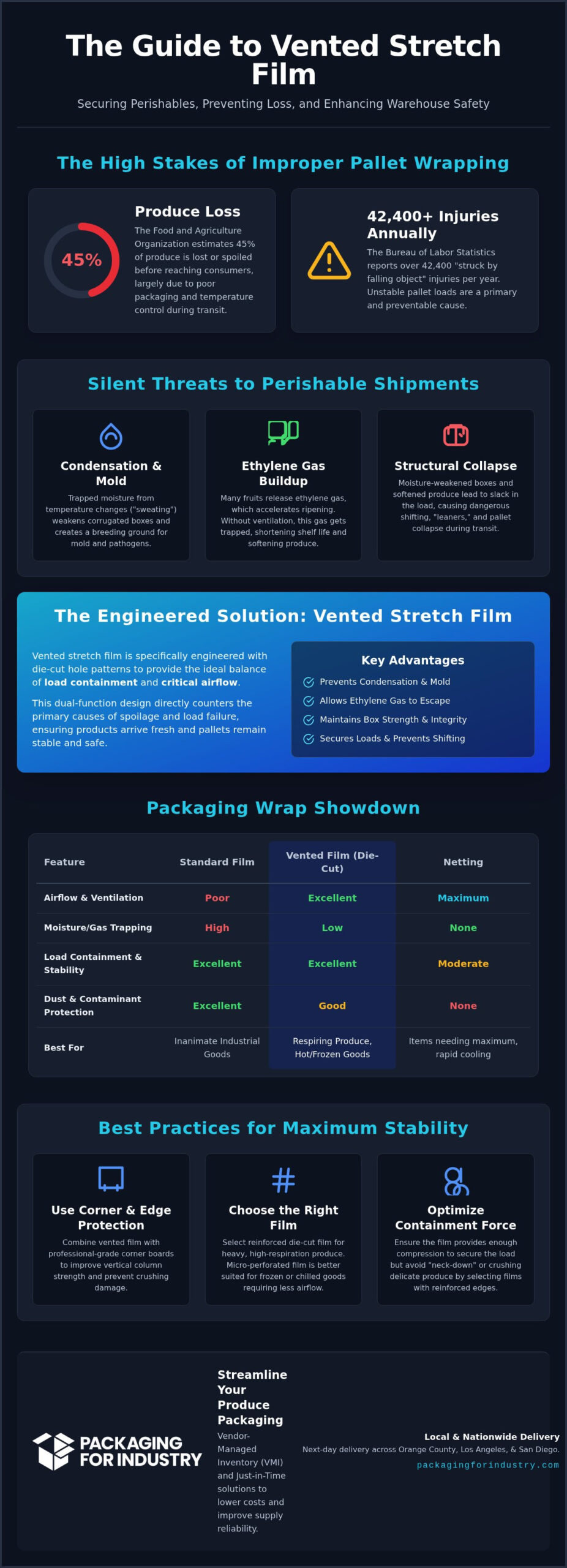
The Food and Agriculture Organization estimates that 45% of produce is lost or spoiled before it reaches consumers, often due to poor temperature control and inadequate packaging during transit. If you manage a warehouse or distribution center, you’ve likely dealt with the dual headache of ethylene gas buildup ripening fruit too fast and moisture-weakened boxes causing entire loads to shift. It’s a high-stakes environment where a single unstable pallet can lead to significant financial loss or a recordable safety incident. According to the Bureau of Labor Statistics, over 42,400 “struck by falling object” injuries occur annually, making load stability a non-negotiable priority for any operation.
We understand that protecting perishables requires more than just a standard wrap; it requires a strategic approach to airflow and containment. By implementing advanced pallet wrapping techniques for warehouse safety, you can maintain the structural integrity of your shipments while allowing produce to breathe. In this article, you’ll learn how to utilize vented stretch film to eliminate condensation, manage respiration rates, and ensure your goods arrive in peak condition. We’ll examine the technical balance between tension and ventilation that secures your cargo without compromising its shelf life.
Key Takeaways
- Prevent produce spoilage and structural box failure by identifying how breathable stretch film manages moisture and ethylene gas release.
- Implement specialized pallet wrapping techniques for warehouse safety that secure heavy loads without compromising the airflow required for refrigerated transport.
- Compare the technical advantages of die-cut hole patterns against traditional netting to ensure maximum load containment and dust protection.
- Improve vertical column strength and prevent transit damage by combining vented film with professional-grade corner and edge protection.
- Reduce logistical friction through vendor-managed inventory and next-day delivery options available for operations across Orange County, Los Angeles, and San Diego.
Why Breathable Stretch Film is Essential for Produce Shipping and Safety
Breathable stretch film, also known as vented film, is engineered with a specific die-cut hole pattern designed to facilitate airflow while maintaining high tensile strength. While standard stretch wrap is ideal for securing inanimate industrial goods, it often acts as a catalyst for spoilage in the food and beverage sector. Traditional films trap heat and moisture, leading to “sweating” that compromises both the product and the packaging. By utilizing vented stretch film, operators can achieve the necessary compression to secure a load without creating a hermetically sealed environment that breeds mold.
Combating Condensation and Mold Growth
Temperature fluctuations are a constant reality in cold chain logistics. When a pallet moves from a refrigerated warehouse to a loading dock, condensation quickly forms on the produce surface. Without proper ventilation, these water droplets are trapped against the fruit or vegetables, creating a breeding ground for pathogens. This moisture eventually migrates into your corrugated boxes. As the fibers absorb water, the boxes lose their stacking strength and begin to crush. This structural failure is a primary reason why mastering pallet wrapping techniques for warehouse safety is essential; a soggy box cannot support the weight of the layers above it, leading to “leaners” and dangerous collapses during transport.
Ethylene Gas Dissipation and Safety
Many fruits and vegetables, such as tomatoes and avocados, are climacteric, meaning they continue to respire and release ethylene gas after harvest. In a sealed environment, this gas builds up rapidly, accelerating the ripening process and significantly shortening shelf life. Vented film allows this gas to dissipate, ensuring the produce remains at the desired maturity level during transit. Beyond product quality, this ventilation is a critical component of pallet wrapping techniques for warehouse safety. When produce over-ripens, it softens and loses volume. This creates “slack” within the boxes, which causes the entire load to shift during transport. By managing the respiration of the produce, you maintain the mechanical stability of the pallet, preventing the types of shifting loads that lead to forklift accidents or falling objects in the warehouse.
Effective vented film provides a dual benefit. It offers the ventilation required to keep produce fresh while delivering the high-performance containment needed to meet safety standards. Choosing the right hole pattern and stretch rate ensures that you don’t have to sacrifice safety for shelf life.
Technical Specifications: Airflow, Load Containment, and Stretch Rates
Selecting the correct vented film requires a technical understanding of hole patterns and stretch capabilities. Micro-perforated films feature thousands of tiny punctures, making them suitable for products requiring minimal airflow, such as frozen goods or chilled meats. Conversely, reinforced die-cut holes are essential for high-respiration produce like citrus or onions. These larger apertures allow for maximum gas exchange, which is a critical factor when transporting perishable foods across long distances. While standard 80-gauge cast film is the industry benchmark for stability, modern vented films are often manufactured at lower gauges while delivering equivalent or superior containment through advanced resin blends.
Load Stability and Containment Force
Maintaining structural integrity is the primary challenge when using breathable stretch film. Standard films can sometimes experience “neck-down,” where the film narrows under tension, reducing the surface area covered. High-quality vented films utilize reinforced edges to prevent this narrowing and stop tears from propagating between the ventilation holes. When calculating containment force for heavy produce like potatoes, you must ensure the film provides enough compression to prevent the load from shifting without crushing the delicate product inside. These specialized pallet wrapping techniques for warehouse safety ensure that the load remains a single, cohesive unit throughout the vibration and G-forces of transit.
Hand vs. Machine Vented Film Efficiency
The choice between hand and machine application depends largely on your throughput and the uniformity of your loads. Hand-applied vented wrap is effective for low-volume operations or specialized kitting where pallet dimensions vary. For larger distribution hubs in Southern California, high-speed machine wrappers are the standard. These machines can be calibrated to specific stretch rates, often reaching 200% or more, which maximizes film yield and lowers your overall packaging costs. Pre-stretched vented film is another viable option, as it requires less physical effort from warehouse staff and provides consistent tension regardless of the operator’s strength.
If you’re looking to optimize your line speed or compare packaging pricing for high-performance vented materials, our team can help you select the right gauge and pattern for your specific application. Using the right pallet wrapping techniques for warehouse safety doesn’t just protect your workers; it protects your bottom line by reducing transit-related product loss.
Vented Film vs. Traditional Wrap and Netting: A Comparison
Choosing the right material for produce shipping requires a technical trade-off between airflow and mechanical stability. Traditional cast film is frequently labeled the “Produce Killer” by logistics professionals. While it provides high containment force, its lack of breathability leads to rapid ethylene buildup and moisture entrapment. Conversely, pallet netting offers maximum ventilation but fails to provide adequate load stability. Netting lacks the elastic memory and cling of film, which often results in the wrap loosening during transit vibrations. This instability increases the risk of shifting loads, a primary concern for any operation focused on pallet wrapping techniques for warehouse safety.
Vented stretch film serves as the engineered middle ground. It delivers the structural strength of industrial-grade film while facilitating the gas exchange required to prevent premature ripening. By choosing a material that balances these needs, you can lower packaging costs associated with product loss and transit damage. It’s a pragmatic solution that addresses the physical requirements of the load and the biological requirements of the product.
When to Use Vented Film over Traditional Netting
Warehouse personnel generally prefer vented film over netting because it streamlines the wrapping process. Netting is prone to tangling, is difficult to cut, and offers zero protection against dust or debris. In busy distribution centers across Los Angeles and Orange County, application speed is vital for maintaining throughput. Vented film maintains a superior “cling” factor, ensuring the wrap remains secure even as the load settles during long-haul transport. Adhering to OSHA warehouse safety guidelines for securement is more consistent with film because it provides uniform tension across the entire pallet surface. Additionally, vented film is often more compatible with existing recycling programs, reducing the environmental impact of your shipping waste.
The Economics of Spoilage Reduction
The financial justification for switching to breathable film is centered on the total cost of ownership. When you compare packaging pricing, it’s essential to factor in the reduction of cargo claims and the extension of shelf life. Traditional film acts as an insulator, forcing refrigeration units to work harder to cool the center of the pallet. Breathable film allows for faster air penetration in blast chillers, which significantly reduces cooling times. This efficiency helps you move product through the cold chain faster, saving on energy costs and ensuring produce reaches the customer in peak condition. By optimizing your pallet wrapping techniques for warehouse safety and freshness, you protect both your personnel and your profit margins.
Best Practices for Optimizing Produce Pallet Stability
Achieving maximum stability with vented stretch film requires a precise application process that differs from standard wrapping. The foundation of any secure load begins at the pallet base. You must anchor the film to the pallet itself by starting at the bottom and completing at least three full revolutions around the base and the first layer of corrugated boxes. This creates a mechanical bond that prevents the entire load from sliding off the wood during high-vibration transit. Without this anchor, even the tightest wrap won’t prevent a catastrophic shift during a sudden stop or sharp turn.
Proper pallet wrapping techniques for warehouse safety rely on the “50% overlap” rule. Each subsequent layer of film should cover half of the previous layer. This technique creates a continuous web of tension that distributes containment force evenly across the load. When using vented film, you must ensure that this overlap doesn’t completely block the die-cut holes. Maintaining a clear path for airflow is the only way to reap the biological benefits of the film while securing the physical mass of the shipment.
The Role of Corner Boards in Load Safety
Vented film provides excellent horizontal containment, but it doesn’t offer significant vertical support. Integrating corner and edge protection is essential for produce pallets, as these shipments often involve heavy, moisture-sensitive containers. Corner boards provide the vertical column strength needed to prevent the bottom boxes from crushing under the tension of the stretch wrap. Cardboard protectors are typically preferred for produce because they can absorb minor surface moisture without losing their grip. For exceptionally wet or iced environments, plastic edge protectors offer superior durability. PFI often bundles these stabilization tools for distributors to ensure a comprehensive safety solution that lowers packaging costs by reducing transit damage.
Temperature Management in the Cold Chain
Maintaining the cold chain is a race against time. Vented film plays a critical role here by allowing refrigerated air to reach the pallet core quickly. This is especially vital during the “warming” phase at cross-docks or ports where temperature spikes can occur. Using vented film reduces time in the precooler by up to 40% compared to standard film, which directly improves your facility’s throughput. By mastering these pallet wrapping techniques for warehouse safety, you ensure that moisture doesn’t accumulate during the transition from cold storage to the trailer, preserving the structural integrity of your packaging and the quality of your goods.
Streamlining Produce Packaging with PFI in Southern California
PFI serves as a strategic partner for Southern California distribution hubs, providing a full inventory of stock and custom stretch film specifically engineered for agricultural applications. We recognize that industrial buyers in the produce sector require more than just a roll of plastic; they need a reliable supply chain that prevents operational downtime. Our local logistics network enables next-day delivery across Orange County, Los Angeles, and San Diego, ensuring your warehouse never runs out of critical materials during peak harvest seasons. By positioning ourselves as a cost-effective alternative to large catalog suppliers, we help you lower packaging costs while maintaining professional grade standards.
Managing recurring needs is simplified through our Vendor Managed Inventory (VMI) program. We take over the tracking and replenishment of your vented film, corner boards, and pallets, allowing your operations team to focus on throughput rather than procurement. Our team also conducts custom packaging reviews to identify specific vulnerabilities in your current shipping methods. We analyze your pallet wrapping techniques for warehouse safety to ensure you’re using the optimal containment force and hole pattern for your specific produce type, which directly reduces cargo claims and transit damage.
Local Support for SoCal Agriculture and Distribution
We support major produce hubs throughout Anaheim, Irvine, and the Inland Empire with on-site consultations. Our specialists visit your facility to evaluate how your manufacturing packaging integrates with your automated wrapping equipment. This hands-on approach ensures that your pallet wrapping techniques for warehouse safety are standardized across all shifts. For multi-location industrial operations, our reliable nationwide shipping capabilities provide consistency in material quality and pricing, regardless of where your distribution centers are located.
Request a Packaging Quote Today
Obtaining a tailored quote for bulk breathable film is a straightforward process designed for high-volume users. We provide competitive pricing based on your specific annual usage and required technical specifications. Many of our clients find additional value by bundling their film orders with heavy-duty corrugated boxes and protective foam inserts. This consolidated procurement strategy streamlines your vendor list and reduces administrative overhead. Contact our Anaheim headquarters to discuss your logistics challenges and receive a comprehensive assessment of your packaging needs.
Secure Your Supply Chain with Professional-Grade Vented Film
Implementing advanced pallet wrapping techniques for warehouse safety allows your operation to move perishables with maximum confidence. You’ve seen how breathable film prevents the moisture buildup and ethylene entrapment that lead to spoilage and structural failure. By combining this specialized wrap with reinforced corner protection and precise anchoring methods, you eliminate the shifting loads that threaten worker safety and product quality.
PFI provides the technical expertise and local inventory needed to optimize these logistics processes for industrial manufacturers. Our Vendor Managed Inventory (VMI) programs and next-day delivery across Orange County, Los Angeles, and San Diego ensure your distribution lines remain efficient and cost-effective. We’re dedicated to helping you find the right balance between containment force and ventilation to protect your bottom line.
We look forward to helping you streamline your logistics and improve your shipping reliability with custom-tailored solutions that meet your specific operational needs.
Frequently Asked Questions
What is the difference between vented stretch film and pallet netting?
Vented stretch film provides significantly better load containment and elastic memory than traditional netting. While netting offers maximum airflow, it lacks the “cling” required to prevent heavy loads from shifting during transit vibrations. Vented film also protects your cargo from dust and debris while remaining much easier for warehouse teams to cut and apply. It represents a more balanced solution for operations prioritizing both shelf life and pallet stability.
Can breathable stretch film be used with standard pallet wrapping machines?
Yes, breathable stretch film is compatible with most standard semi-automatic and automatic pallet wrapping machines currently used in distribution centers. You don’t need to invest in specialized equipment to implement these pallet wrapping techniques for warehouse safety. We recommend adjusting your machine’s tension settings to ensure the die-cut holes provide maximum ventilation without over-stretching the reinforced edges of the film during the application process.
How does vented film help reduce spoilage in produce shipping?
Vented film reduces spoilage by facilitating the dissipation of ethylene gas and preventing moisture buildup. When condensation is trapped inside a pallet, it weakens your corrugated boxes and encourages mold growth. By allowing the produce to breathe, you maintain the structural integrity of your packaging and ensure that climacteric fruits don’t ripen prematurely. This technical approach to airflow is a critical component of professional produce logistics.
Is breathable stretch film strong enough for heavy pallet loads like citrus or potatoes?
Modern high-performance vented films are engineered with reinforced resin blends specifically for heavy industrial loads. They provide the containment force necessary to secure dense products like citrus, potatoes, or onions. When you integrate these films with corner and edge protection, you create a rigid structure that rivals the stability of standard 80-gauge cast film. This ensures your heavy shipments remain cohesive and safe throughout the entire supply chain.
Does vented film work effectively in refrigerated or cold storage environments?
Vented film is exceptionally effective in cold storage because it allows refrigerated air to reach the pallet core much faster than traditional wraps. This increased airflow can reduce time in the precooler by up to 40%, which improves your facility’s throughput and energy efficiency. It also prevents the “sweating” that occurs when pallets move between different temperature zones, keeping your labels legible and your boxes dry.
What is the typical stretch rate for high-performance vented film compared to cast film?
High-performance vented films typically offer stretch rates between 150% and 250%, depending on the specific hole pattern and gauge. While some premium cast films can reach 300%, the reinforced design of vented film ensures that it maintains its tension without tearing at the ventilation points. This allows you to lower packaging costs by maximizing the yield of each roll while still achieving the containment force required for secure transport.
How do I determine the right hole pattern for my specific produce type?
The optimal hole pattern depends on the respiration rate and moisture sensitivity of your produce. High-respiration items like berries or leafy greens require larger die-cut holes to manage gas exchange effectively. Conversely, frozen goods or low-respiration items may only need micro-perforations. Our team provides custom reviews to help you identify the correct specifications for your inventory, ensuring you utilize the most effective pallet wrapping techniques for warehouse safety.
Where can I buy wholesale breathable stretch film in Southern California?
You can purchase wholesale breathable stretch film and related stabilization supplies directly from Packaging For Industry (PFI). We maintain a deep inventory at our Anaheim headquarters and provide local next-day delivery to Orange County, Los Angeles, and San Diego. Our team can help you compare packaging pricing and implement Vendor Managed Inventory (VMI) programs to ensure your warehouse is always stocked with the custom sizes and gauges you need.