
Is transit damage an unavoidable cost of doing business, or is it simply a sign of an under-engineered supply chain? Many operations managers accept high replacement rates as a standard line item, but learning how to reduce shipping damage costs for my business often starts with rethinking the physics of the package itself. When high-value components arrive broken, the fallout goes beyond the price of the part. It damages your professional reputation and triggers unnecessary surcharges for poorly packed items.
We understand that a damaged delivery is a logistical failure that creates professional stress and drains your bottom line. You need a reliable, repeatable method to protect your goods without overspending on generic materials that don’t fit your specific products. This guide provides professional strategies to eliminate transit damage through custom industrial packaging design and precise material selection.
You’ll discover how an engineering-first approach optimizes your logistics flow. We’ll examine the benefits of heavy-duty corrugated materials, custom foam cushioning, and specialized solutions like mil-spec packaging. This overview provides a clear roadmap to lower overall logistics costs and build a more resilient distribution process for your high-value goods.
Key Takeaways
- Quantify the full financial impact of transit failures by analyzing hidden labor costs and RMA processing fees alongside direct replacement expenses.
- Discover how to reduce shipping damage costs for my business by matching the structural integrity of double-wall corrugated boxes with custom-engineered foam inserts.
- Improve pallet integrity and prevent load shifting through the strategic application of high-performance stretch film and rigid corner protection.
- Standardize warehouse operations with precise kitting instructions and final quality control checks to eliminate packing errors before products leave the dock.
- Leverage custom packaging design and Vendor Managed Inventory (VMI) to ensure your facility always has the correct protective materials in stock for high-value shipments.
Calculating the True Cost of Shipping Damage for Your Business
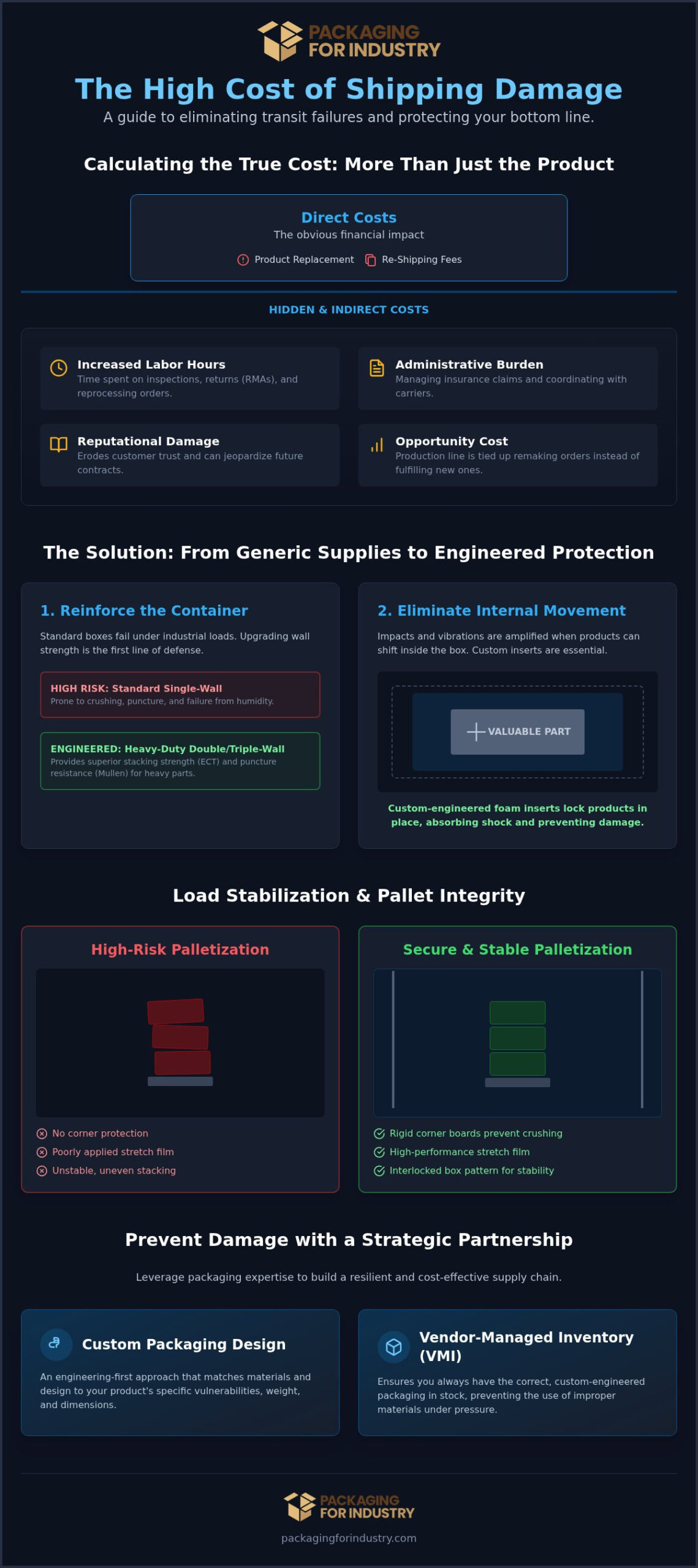
Many operations managers view transit damage as an unavoidable tax on doing business. However, a pragmatic analysis reveals that the line-item cost of a broken part is only the tip of the iceberg. To truly understand how to reduce shipping damage costs for my business, you must quantify the secondary expenses that erode your margins. These include the obvious costs of product replacement and re-shipping fees, but they also encompass significant “soft” costs that often go untracked.
When a high-value industrial component arrives damaged, your warehouse team must stop their standard workflow to process the return. This involves inspecting the item, documenting the failure for insurance claims, and managing the reverse logistics. These labor hours represent a direct drain on your facility’s efficiency. In high-stakes B2B relationships, frequent damage incidents jeopardize contract renewals and long-term partnerships. Reliability is a currency in industrial logistics; every broken delivery devalues your brand.
The Ripple Effect: Beyond the Invoice Price
The administrative burden of damage extends far beyond the warehouse floor. Staff often spend hours coordinating with carriers like UPS or FedEx to resolve claims. This time is a fixed cost that yields no growth. Additionally, consider the opportunity cost: when your production line must prioritize a replacement order, you delay the fulfillment of a new, profitable sale. This creates a bottleneck that limits your total throughput.
Environmental factors also play a role. Damaged goods lead to wasted raw materials and the unnecessary consumption of fuel for secondary transit. By investing in packaging cost savings through better engineering, you reduce this waste and improve your overall operational sustainability.
Using Damage Rates as a KPI for Operations
To fix a problem, you must first measure it. Establishing a baseline damage rate allows you to treat packaging as a controllable variable rather than a fixed expense. High-performing manufacturers track damage through specific metrics to identify “red flag” areas:
- Damage rates by carrier and route to identify systemic handling issues.
- Labor hours spent on RMA processing and inspections.
- Total cost of secondary freight and replacement materials.
Linking these metrics directly to profit margins provides the data needed to justify a shift from generic supplies to engineered solutions. When you present a clear ROI based on reduced labor and lower replacement rates, a higher packaging budget becomes a strategic investment in fiscal responsibility. You aren’t just buying corrugated boxes; you’re buying insurance for your bottom line.
Material Engineering: Choosing the Right Protection Level
Reducing transit damage requires a shift from generic supplies to engineered solutions. If you’re investigating how to reduce shipping damage costs for my business, the most effective starting point is the structural integrity of your primary container. While standard RSC boxes (Regular Slotted Containers) are the workhorse of the industry, they often fail when used for heavy industrial components without proper wall reinforcement. Using custom corrugated boxes allows you to match the material’s structural capacity to the specific footprint and weight of your product.
Corrugated Strength: Understanding ECT and Wall Construction
Industrial logistics professionals must distinguish between two primary testing standards: the Mullen Burst Test and the Edge Crush Test (ECT). The Mullen test measures the pressure required to puncture the box wall, making it ideal for heavy, dense items with sharp corners. Conversely, ECT measures the stacking strength of the board, which is critical for warehouse efficiency and preventing pallet collapse. For most manufacturing applications, upgrading from standard single-wall RSC boxes to heavy-duty double-wall or triple-wall corrugated is a pragmatic move to prevent structural failure. It’s also vital to consider weather-resistant corrugated coatings. High humidity can weaken standard fiberboard significantly, leading to box fatigue and crushed deliveries during long-haul transit.
Custom Foam Inserts: The Science of Impact Absorption
Engineering a “floating” environment using protective foam packaging ensures your goods remain isolated from vibration. The choice of foam depends entirely on the product’s fragility and weight. Polyethylene (PE) foam is a closed-cell material that provides excellent support for heavier industrial parts, often meeting the rigorous requirements for mil-spec packaging. Polyurethane (PU) is an open-cell, softer foam designed to cushion lighter, highly sensitive equipment. For electronics and semiconductors, ESD (Anti-Static) foam is a mandatory requirement to prevent electrostatic discharge from ruining internal circuits. Die-cut foam inserts provide a precision fit that generic materials simply cannot match. To see how engineered materials can protect your specific products, you can request a packaging quote for a custom-fit solution.
Load Stabilization and Pallet Logistics Strategies
Individual boxes can be perfectly engineered, yet the shipment can still fail if the pallet isn’t stabilized. In industrial logistics, we focus on the concept of a “unitized load.” This means the pallet, the product, and the packaging act as a single, rigid entity. If the load shifts even slightly during transit, the resulting vibration and impact can cause internal breakage. Mastering this stabilization is a critical component of how to reduce shipping damage costs for my business.
The foundation of this unitized load is the pallet itself. You must select a pallet type that matches your load weight and destination requirements. For instance, heavy machinery often requires custom skids, while international shipments demand heat-treated pallets to comply with export regulations. A weak foundation leads to a collapsed shipment, regardless of the quality of the boxes on top. When the foundation fails, the entire engineering of the package becomes irrelevant.
Maximizing Stretch Film Performance
Many warehouses use generic wrap without considering the material’s physics. To secure industrial loads, you must choose between cast and blown stretch film. Blown film offers superior puncture resistance and high “cling,” making it ideal for heavy, irregular loads with sharp edges. Cast film is quieter and more transparent, which helps with barcode scanning, but it lacks the extreme durability of blown film. Selecting the correct gauge is equally vital. Using a film that’s too thin results in snap-backs and load shifting during sudden stops. Conversely, using an excessively thick film increases your material costs without adding functional protection. We help you find the optimal containment force to ensure your products remain anchored to the pallet throughout the journey.
The Role of Corner Boards in High-Stacking
Vertical strength is often the weak point in warehouse logistics. Implementing corner and edge protection is a pragmatic way to reinforce your shipments. These rigid boards prevent “box crush” by distributing the vertical weight of stacked pallets across the corners of the load. This is especially important for long-term storage in high-density racking systems where bottom-layer boxes are under constant stress. Beyond stacking, corner guards protect your products from the immense pressure of plastic or steel strapping. They prevent the straps from cutting into the corrugated walls, which preserves the structural integrity of the primary container. Using edge protection also reduces the risk of “racked” pallets, where the load begins to lean during transit, a common precursor to total pallet collapse and significant product loss.
Warehouse Workflow: Preventing Damage Before the Truck Arrives
Engineering the right materials is only half the battle. If your internal operations lack structure, even the best triple-wall box won’t prevent failure. Standardizing how items are packed is a fundamental step in how to reduce shipping damage costs for my business. We recommend implementing a final quality control check at the sealing station. This ensures every pallet is wrapped correctly and every box is sealed with the appropriate tension. When you remove variability from the packing process, you create a predictable environment for your high-value goods.
Kitting and Assembly for Consistent Protection
Many manufacturers lose money because of packing “guesswork.” When employees choose void fill on the fly, protection consistency vanishes. By utilizing packaging kitting services, you provide your team with pre-configured sets of materials tailored to specific SKUs. Every component has a designated place within a custom foam insert, ensuring a perfect fit every time. This methodical approach reduces labor time and guarantees that fragile industrial parts are never under-protected due to human error. Pre-assembled kits eliminate the decision-making process at the packing table, which is where most internal damage begins.
Handling Protocols for Fragile Industrial Goods
Your warehouse staff must understand the specific vulnerabilities of the products they move. We suggest defining strict handling protocols, such as “Do Not Stack” limits for double-wall corrugated loads. Forklift operators require specific training for handling custom wood crates, as improper blade placement can compromise the base and lead to a tip-over. Implementing these protocols is a pragmatic way to address how to reduce shipping damage costs for my business by stopping errors at the source.
Tracking is also essential for long-term improvement. Maintain a “Damage Log” to identify exactly where in the facility incidents occur. If damage frequently happens at the loading dock, it may indicate a need for better lighting or revised traffic patterns. Combining these internal audits with specialized labeling, such as ShockWatch or orientation indicators, influences how carriers handle your shipments once they leave your control. These labels serve as a visual deterrent against rough handling and provide accountability during the claims process.
Strategic Partnerships: Custom Design and VMI Programs
Solving how to reduce shipping damage costs for my business is a long-term operational objective that requires more than just transactional purchasing. It demands a strategic partnership with a supplier that integrates engineering expertise directly into your supply chain. By moving beyond one-size-fits-all solutions, you can address complex logistical hurdles such as carrier surcharges and recurring transit failures. A dedicated partnership ensures that your packaging evolves alongside your product line, maintaining high protection levels while you lower packaging costs through dimensional optimization.
Specialized Expertise for High-Stakes Industries
PFI serves as a technical consultant for sectors where the margin for error is zero. We provide tailored solutions for the following industries:
- Aerospace & Defense: Engineering precision-fit mil-spec packaging and custom crates for high-value flight components.
- Medical & Life Sciences: Designing sterile-compliant cushioning and protective inserts for sensitive diagnostic equipment.
- Electronics & Semiconductors: Implementing comprehensive ESD protection to safeguard circuits from electrostatic discharge during transit.
- Industrial Manufacturing: Developing heavy-duty RSC boxes and double-wall corrugated solutions for heavy machinery and automotive parts.
The Value of Prototyping in Damage Reduction
Effective protection starts on the drawing board. Utilizing custom design packaging with free prototyping allows you to identify structural weak points before you commit to a full production run. Our team uses CAD/CAM design support to simulate transit stresses and ensure a precision fit for your specific components. We test various foam densities and corrugated wall strengths against real-world product samples to find the “minimum effective protection.” This engineering approach prevents over-packaging, which wastes money, while ensuring your goods aren’t under-protected. It’s a pragmatic way to balance the physics of protection with the economics of the supply chain.
Eliminating Shortages with Just-In-Time Inventory
Operations often fail when the correct materials aren’t available. When a warehouse runs out of the specified protective inserts, staff often resort to using “whatever is on hand,” leading to poor packing and increased damage. Implementing Vendor Managed Inventory (VMI) or Just-In-Time (JIT) programs eliminates this risk. We monitor your stock levels and deliver packaging supplies exactly when they’re needed, ensuring your production lines never stall. This system provides a reliable flow of materials while freeing up valuable warehouse space. To compare packaging pricing for an optimized inventory program, we recommend a full site audit to align your supply levels with your actual throughput.
Optimize Your Supply Chain for Maximum Protection
Transit damage is a solvable engineering problem that requires a transition from generic supplies to precision-designed systems. By analyzing the true cost of failures and matching material strength to product weight, you protect both your goods and your professional reputation. Implementing load stabilization techniques and standardized warehouse workflows ensures that every shipment remains secure from the loading dock to the final destination.
Learning how to reduce shipping damage costs for my business starts with a commitment to better engineering and strategic inventory management. Packaging For Industry (PFI) provides the specialized expertise needed for high-stakes sectors like aerospace and medical manufacturing. Our team offers free prototyping and CAD/CAM design support to identify the most efficient materials for your specific needs. With local next-day delivery across Southern California, we ensure your facility stays operational without the burden of excess inventory.
Take control of your logistics today and build a more resilient, cost-effective distribution process that supports your long-term growth.
Frequently Asked Questions
How do I calculate the cost of shipping damage for my business?
Calculating the total financial impact requires adding direct replacement expenses to hidden labor costs for RMA processing and warehouse inspections. When you quantify these variables, you can effectively demonstrate how to reduce shipping damage costs for my business while identifying ways to lower packaging costs through better engineering. By tracking these metrics, operations managers can shift from reactive spending to proactive protection that preserves profit margins and client relationships.
What is the best packaging material for fragile industrial parts?
The best material depends on the specific fragility and weight of your industrial components. We typically recommend heavy-duty corrugated boxes paired with custom foam inserts like Polyethylene for heavy parts or Polyurethane for sensitive electronics. With custom sizes available for all our stock and bespoke materials, you ensure a precision fit that eliminates the internal movement responsible for most transit damage in high-stakes industries.
Can custom packaging actually lower my total shipping costs?
Yes, custom engineering reduces total logistics spend by eliminating the waste and damage associated with generic supplies. When you compare packaging pricing, you must look beyond the unit cost and consider the savings from reduced dimensional weight and lower replacement rates. We invite you to request a packaging quote to see how optimized dimensions can remove unnecessary carrier surcharges while protecting your bottom line.
How do I know if I need double-wall or triple-wall corrugated boxes?
Weight and stacking requirements are the primary indicators for box wall selection. Double-wall corrugated is standard for shipments over 80 pounds, while triple-wall is the pragmatic choice for heavy machinery or items requiring maximum vertical strength. Choosing the correct Edge Crush Test (ECT) rating ensures your bottom-layer boxes don’t collapse during long-term warehouse storage or high-stacking in transit, preventing structural failure before it starts.
What is a packaging review and how can it reduce damage rates?
A packaging review is a technical audit of your current protection levels and transit stresses. Our engineers use CAD/CAM design and prototyping to find the minimum effective protection for your goods. This data-driven approach reduces damage rates by addressing structural failures before they occur in the field, ensuring your high-stakes shipments arrive intact without overspending on unnecessary materials or inefficient packing processes.
Does stretch film really help prevent product damage?
Stretch film is critical for maintaining load containment and preventing individual boxes from shifting on a pallet. High-performance blown film provides the extreme puncture resistance needed for heavy industrial loads, creating a unitized shipment that resists vibration. This stabilization is an essential part of how to reduce shipping damage costs for my business, especially during the rough handling common in LTL freight environments.
How can I avoid UPS and FedEx oversized surcharges with better packaging?
Avoiding surcharges requires optimizing your exterior dimensions to stay within carrier girth and length limits. UPS and FedEx apply significant fees for oversized items that don’t fit their automated sorting systems. We engineer custom boxes and crates that maximize internal cushioning while minimizing the outer footprint, effectively protecting your goods while bypassing the expensive penalties triggered by using generic, one-size-fits-all packaging solutions.
What are the benefits of using a local packaging supplier in Southern California?
Local suppliers offer faster lead times and reduced inbound freight costs for facilities in San Diego, Orange County, Los Angeles, and the Inland Empire. From our Anaheim headquarters, we provide next-day delivery and on-site consultations to help you solve urgent logistical failures. This proximity allows for tighter inventory management through VMI programs, ensuring your Southern California operations always have a reliable supply of protective materials.