
What if the most expensive part of your drone fleet isn’t the avionics, but the inadequate foam you’re using to transport them? For industrial UAV operators, a single hard landing in the back of a transport vehicle can lead to misaligned gimbals, cracked rotors, or damaged sensors that stall an entire project. You’ve likely experienced the limitations of “pick-and-pluck” foam that degrades after a few weeks of field use, leaving your high-value assets loose and vulnerable during transit.
It’s a frustrating reality, but you don’t have to settle for inconsistent quality or long lead times from distant catalog suppliers. This guide will show you how to secure high-performance CNC routed foam for drone cases Los Angeles enterprises rely on for mission-critical protection. By moving away from generic options and toward engineered solutions, you can significantly reduce equipment replacement costs and improve your operational flow.
We’ll walk you through the process of specifying the correct material densities, sourcing custom inserts that fit your specific fleet requirements, and optimizing your gear kits for a professional, branded appearance. You’ll also learn how local Southern California manufacturing provides the speed and reliability needed to maintain your equipment’s readiness for every deployment.
Key Takeaways
- Understand why precision CNC routing is necessary for protecting sensitive gimbals and sensors compared to standard off-the-shelf foam.
- Identify the best protective materials, such as high-density polyethylene (PE) foam, to ensure long-term durability for industrial UAV fleets.
- Learn how to source specialized CNC routed foam for drone cases Los Angeles suppliers provide to meet strict aerospace and defense requirements.
- Discover how to lower unit costs and eliminate supply chain delays by utilizing bulk production runs and Vendor Managed Inventory (VMI) programs.
- Use a professional buyer’s checklist to prepare CAD files and layout specifications for a custom design packaging quote that maximizes protection.
Why Precision CNC Routed Foam is Essential for Drone Logistics
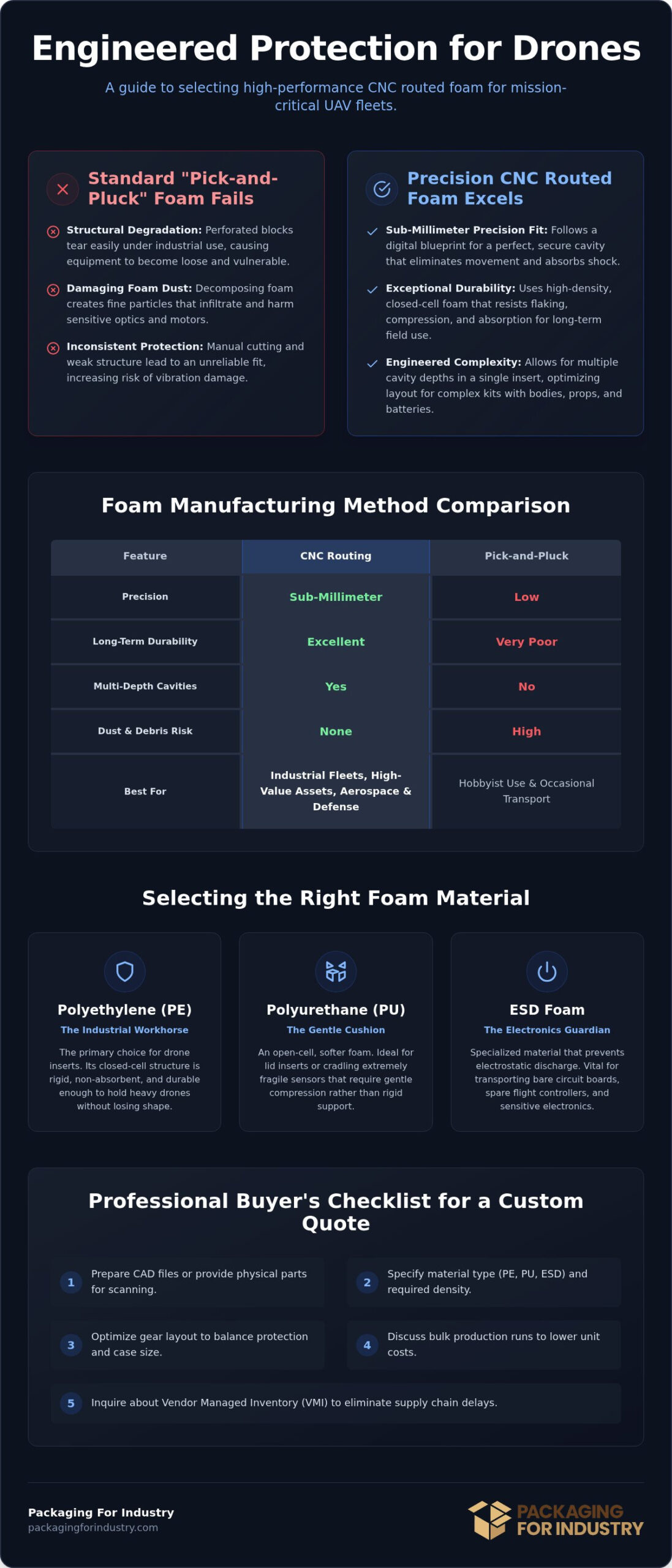
CNC (Computer Numerical Control) routing is a manufacturing process that uses computer-guided bits to mill protective foam packaging with sub-millimeter precision. For industrial UAV operators, this technology represents a shift from “good enough” to “mission ready.” When you utilize CNC routed foam for drone cases Los Angeles facilities produce, you’re securing your fleet with inserts designed specifically for the complex geometries of modern avionics. Unlike manual cutting methods, CNC routing follows a digital blueprint with absolute fidelity, ensuring every battery, controller, and peripheral has a designated, high-tolerance cavity.
This precision is a logistical necessity. High-value drone fleets often feature delicate gimbals, exposed sensors, and specialized optics that cannot tolerate movement during transit. A secure fit prevents micro-vibrations and impact damage that lead to costly downtime. Furthermore, using high-quality polyethylene (PE) foam ensures that your protection doesn’t degrade. PE is a closed-cell material that provides superior shock absorption without flaking or compressing over time, maintaining the same level of protection on the hundredth flight as it did on the first.
The Limitations of Standard Case Foam
Standard pick-and-pluck foam is often the first point of failure in drone logistics. While convenient for hobbyists, it fails under the rigors of industrial use. These perforated foam blocks rely on small connective points that inevitably tear, causing the insert to lose its structural integrity. As the foam breaks down, it creates “foam dust.” These tiny particles are a significant threat to sensitive drone optics and brushless motors. Once dust enters a motor’s internal housing or settles on a lens, it can cause mechanical friction or image degradation. Manual cutting also introduces human error, resulting in inconsistent protection levels across a large fleet. CNC routed foam for drone cases Los Angeles manufacturers provide eliminates these variables by delivering a clean, dust-free, and uniform product every time.
CNC Routing vs. Die-Cutting for Drone Inserts
While die-cutting is a common method for high-volume foam production, it’s often insufficient for complex drone kits. Die-cutting uses a steel rule die to punch shapes through foam, which generally limits the design to a single depth. CNC routing is superior because it allows for multiple cavity depths within a single piece of foam. This is critical for aerospace and aviation packaging where a drone might need a deep pocket for the body but shallow, contoured recesses for the landing gear or props. By using CAD/CAM design, engineers can optimize the layout to balance gear density with the necessary wall thickness to maintain foam integrity. This tailored approach ensures maximum protection while minimizing the overall footprint of the transport case.
Selecting the Right Foam Material for Drone Protection
Selecting the correct material is as critical as the precision of the cut. Foam density determines how well the insert absorbs kinetic energy during a drop or impact. For heavy industrial drones, a higher density is required to prevent the equipment from sinking through the material and hitting the case wall. Conversely, lighter UAVs benefit from lower density foams that provide more “give” to cushion delicate components. When you specify protective foam packaging, you’re choosing the physical barrier between your investment and the rigors of the supply chain.
- Polyethylene (PE): This is the primary choice for industrial drone inserts. Its closed-cell structure makes it incredibly durable and rigid enough to hold heavy drones in place without losing shape.
- Polyurethane (PU): An open-cell foam that is much softer and more flexible. It’s ideal for lid foam or for cradling extremely fragile sensors that require gentle compression rather than rigid support.
- ESD (Electrostatic Discharge) Foam: A specialized material treated to prevent the buildup of static electricity, which is vital for transporting bare circuit boards or spare flight controllers.
Polyethylene Foam: The Industrial Workhorse
PE foam is the standard for field-deployed drone kits because it is virtually non-absorbent. If your team operates in humid or rainy environments, PE foam won’t soak up water or harbor mildew. It also offers excellent chemical resistance, which is vital if your kits are exposed to battery electrolytes or industrial cleaning agents. When specifying CNC routed foam for drone cases Los Angeles technicians often prioritize multi-colored PE foam. A high-visibility top layer over a contrasting base creates an immediate visual indicator if a piece of gear is missing from the kit, improving warehouse accountability and field efficiency.
The Critical Role of ESD Foam in Drone Cases
Sensitive flight controllers and spare motherboard kits are highly susceptible to electrostatic discharge. Even a small static spark can fry unshielded circuits, leading to catastrophic flight failure. When you order CNC routed foam for drone cases Los Angeles operations require, you must consider the electrical properties of the material for your spare parts. ESD-safe foam is typically identified by its uniform pink or black color. Using anti-static materials for spare parts storage ensures that your backup components remain functional and ready for immediate field replacement. Finding the right balance between these materials is part of the custom engineering process. You can request a packaging quote to determine which material combination best suits your specific UAV fleet.
Specifying Your Custom Drone Foam: A Buyer’s Checklist
Precision in drone logistics starts with the data you provide during the design phase. To receive an accurate custom design packaging quote, you need to move beyond rough sketches. While smaller shops might require you to bring physical gear to their location, an industrial-scale approach utilizes digital blueprints. This allows for sub-millimeter tolerances without the risk of shipping your high-value assets back and forth. When specifying CNC routed foam for drone cases Los Angeles manufacturers use these CAD files to account for every antenna, sensor port, and protruding gimbal lock.
The layout of your case must balance gear density with structural integrity. It’s tempting to pack as many batteries and accessories as possible into a single footprint, but leaving insufficient foam “walls” between cavities can lead to structural failure. A professional designer will help you determine the optimal spacing to ensure the foam doesn’t collapse under the weight of heavy ground stations or multi-bay chargers. This phase is also the time to decide on your outer container. Depending on your logistics chain, you may need to match your foam to heavy-duty corrugated boxes for domestic shipping or ruggedized hard cases for field deployment.
Gathering Technical Specifications
High-performance UAVs aren’t uniform shapes. Gathering technical specs involves providing 3D STEP files that represent the drone’s true footprint. You must also define the fragility of your equipment. If your flight controller or camera payload has a low G-force tolerance, the foam cavity must be engineered with specific “crush zones” to dissipate energy during an impact. Don’t forget operational ergonomics. Adding finger-pulls and “easy-out” slots ensures technicians can deploy gear rapidly in the field without fumbling or putting unnecessary stress on delicate components. These small details are what differentiate a standard insert from a professional industrial solution.
Integrated Packaging: Foam + External Protection
The foam insert is only half of the protection equation. For international shipping or heavy-duty logistics, you might require foam-lined custom wood crates. These provide the rigid exterior needed to withstand forklift handling and stacking in cargo holds. Conversely, for the domestic distribution of smaller units, designing inserts for retail-ready corrugated shipping boxes can significantly reduce overall shipping weight. This multi-material approach ensures that your CNC routed foam for drone cases Los Angeles project is both physically secure and economically optimized for your specific supply chain.
Optimizing Procurement for Drone Fleet Manufacturers
Scaling from a single specialized prototype to a production run of thousands requires a partner that understands industrial logistics. Once your design is finalized, optimizing the procurement process becomes the primary driver of fiscal efficiency. When sourcing CNC routed foam for drone cases Los Angeles manufacturers can lower unit costs by scheduling bulk production runs that maximize material yield and reduce machine setup time. This approach is particularly effective for drone fleets that utilize standardized chassis and battery configurations across multiple product lines.
PFI supports these high-volume needs through Just-in-Time (JIT) delivery across Southern California. This ensures that your assembly lines in Los Angeles or Orange County never stall due to a lack of protective inserts. By integrating packaging into your broader supply chain strategy, you can maintain a lean operation while ensuring that every unit shipped is protected by the same sub-millimeter precision found in your initial prototype.
The Financial Benefits of VMI for Packaging
Storing large volumes of custom foam inserts on-site consumes valuable square footage that could be better utilized for drone assembly or testing. Utilizing a Vendor Managed Inventory (VMI) program allows you to stock your CNC routed foam for drone cases Los Angeles inventory off-site at a PFI facility. This improves your operational cash flow because you only pay for the packaging as it is delivered and used. It also eliminates the stress of emergency rush order fees, as PFI monitors your stock levels to ensure a consistent supply is always available for recurring drone models.
Prototyping and Quality Control
Perfect gear fit is non-negotiable in the aerospace sector. PFI offers free prototyping to verify tolerances and ensure that every sensor and peripheral is securely cradled before a full production rollout. This phase often includes “drop testing” the foam inserts to simulate real-world transport accidents, providing data-backed confidence in the packaging’s performance. Maintaining consistent tolerances across multi-year production cycles is essential for fleet uniformity. Our engineering-minded approach ensures that the thousandth insert produced is identical to the first, protecting your brand reputation as much as your hardware.
Why Source CNC Routed Foam in Los Angeles from PFI?
PFI provides a level of logistical integration that standard national vendors simply can’t match. When you source CNC routed foam for drone cases Los Angeles from our facility, you aren’t just buying an insert; you’re securing a comprehensive protection system. We offer integrated solutions that combine custom foam with heavy-duty corrugated boxes and specialized pallets. This single-source approach eliminates the logistical headache of coordinating with multiple vendors and ensures every component of your kit fits together perfectly. It also positions PFI as a proactive, cost-saving alternative to large catalog suppliers. By avoiding high retail markups on stock items, you can redirect those savings back into your core UAV engineering and development.
Our local presence in Southern California allows us to offer next-day delivery in Los Angeles and Orange County. This operational speed is critical for manufacturers who operate on tight production schedules and can’t afford the long lead times associated with out-of-state fabricators. We act as a local extension of your warehouse, providing the reliability you need to maintain a continuous, high-speed supply chain.
Serving the Southern California Aerospace Corridor
Our facilities are strategically located near LAX and the major aerospace hubs in Torrance and Carson. This proximity allows for direct engineering consultations and rapid prototyping that distant suppliers can’t provide. We understand the rigorous standards required for the aerospace and defense sectors, especially regarding defense-grade UAV packaging. Our team is well-versed in the specific tolerances and mil-spec material requirements needed to pass strict quality inspections. We provide a local support system that understands the technical demands and fast-paced nature of the Los Angeles tech industry.
Request Your Custom Foam Quote
Securing professional, industrial-grade protection for your fleet shouldn’t be a complex or slow process. Our quoting system is designed for speed and technical accuracy, allowing you to move from a CAD file to a finished prototype without unnecessary delays or communication gaps. We’re committed to helping you lower packaging costs while improving the overall reliability of your drone fleet’s transit cycle. Whether you need a small batch of specialized inserts for high-end sensors or a large-scale production run for a new UAV line, PFI has the industrial capacity to deliver on your requirements.
We’re ready to help you optimize your drone logistics and protect your high-value assets with precision and reliability.
Frequently Asked Questions
What is the turnaround time for custom CNC routed foam in Los Angeles?
Turnaround times depend on design complexity and volume, but local Southern California production allows for significantly faster delivery than out-of-state suppliers. For recurring orders, PFI utilizes next-day delivery within Los Angeles and Orange County to keep your production lines moving. Standard custom projects usually move from design approval to final production within a few business days. This rapid response is a primary benefit of sourcing CNC routed foam for drone cases Los Angeles from a local industrial partner.
Can you design foam inserts if I only have 3D CAD files of my drone?
We can design precision foam inserts using your 3D STEP or CAD files without needing the physical drone. Our engineering team uses these digital blueprints to create sub-millimeter tolerances for gimbals, sensors, and peripherals. This digital-first approach is ideal for manufacturers who need to finalize packaging during the product development phase. It eliminates the risk and expense of shipping high-value prototypes back and forth for fit testing.
Is CNC routed foam more expensive than pick-and-pluck foam?
CNC routed foam typically has a higher initial cost than pick-and-pluck, but it offers superior long-term value through better protection and durability. Pick-and-pluck foam degrades quickly and creates dust that can damage motors and optics. In contrast, CNC routed polyethylene is a closed-cell material that maintains its integrity over hundreds of deployments. When you compare packaging pricing over the life of a drone fleet, the reduction in equipment damage makes CNC routing the more cost-effective choice.
What is the best foam density for protecting sensitive drone gimbals?
The ideal foam density depends on the weight and fragility of your specific UAV, but a 2.0 lb density polyethylene is the standard for most industrial applications. This density provides the rigid support needed to hold gimbals in place while still offering enough shock absorption to dissipate impact energy. For extremely light sensors, we may integrate softer polyurethane lid foam to provide a gentle cradle effect without applying excessive pressure to delicate components.
Do you offer ESD-safe foam for drone electronics and avionics?
Yes, we provide specialized anti-static (ESD) foam designed specifically for drone electronics and spare avionics kits. These materials prevent the buildup of static electricity that can permanently damage unshielded flight controllers and motherboards during transit. ESD foam is essential for any industrial drone kit that includes spare parts or exposed circuit boards. You can specify these materials when you request a packaging quote to ensure your electronics remain functional and ready for deployment.
Can I get a prototype of my drone foam before placing a bulk order?
PFI offers free prototyping to ensure a perfect fit for your equipment before you commit to a full production run. This fit-verification stage allows you to test the ergonomics and protection levels of the insert with your actual gear. Once the prototype is approved, we maintain those exact tolerances for every unit in your bulk order. This process ensures consistent quality and eliminates the risk of receiving thousands of inserts that don’t meet your specifications.
Do you provide the external cases or just the foam inserts?
We provide integrated solutions that include both the protective foam inserts and the external containers. This includes heavy-duty corrugated boxes, custom wood crates, and ruggedized hard cases. By sourcing the entire kit from a single supplier, you ensure that the foam and case are perfectly matched for maximum protection. This holistic approach simplifies your procurement process and reduces the logistical complexity of managing multiple vendors for your custom drone transport kits.
What are the benefits of a VMI program for drone manufacturers?
A Vendor Managed Inventory (VMI) program allows drone manufacturers to store their CNC routed foam for drone cases Los Angeles inventory at our facility. This reduces the amount of warehouse space you need to dedicate to packaging and improves your operational cash flow. You only pay for the packaging as it is delivered to your production line. It also prevents supply chain disruptions by ensuring that custom inserts are always available for immediate deployment.