
What if the greatest risk to your precision sensors isn’t a major impact, but the constant micro-vibrations occurring during a standard cross-country haul? For labs and manufacturers in Orange County, ensuring that a metrology tool arrives with its calibration intact is often more difficult than the engineering of the device itself. Finding the right protective packaging for scientific measurement devices Irvine is no longer just about padding; it’s about vibration neutralization. You understand that when a high-value instrument arrives out of spec, the cost isn’t just the repair, it’s the lost time and damaged reputation.
This 2026 buyer’s guide will show you how to secure your most sensitive instruments with custom-engineered packaging that eliminates transit damage and protects delicate internal components. We’ll examine how moving away from expensive, oversized catalog suppliers like Uline in favor of local, just-in-time solutions can solve your warehouse clutter problems. You’ll learn how to combine precision-cut foam inserts with heavy-duty corrugated boxes to achieve zero-damage shipping. By the end of this guide, you’ll have a clear strategy to lower your total cost of ownership per unit while reclaiming your lab’s floor space.
Key Takeaways
- Identify the specific foam densities and ESD materials required to neutralize micro-vibrations and protect sensitive sensor calibration.
- Compare the long-term fiscal benefits of custom-engineered protective packaging for scientific measurement devices Irvine versus generic stock shipping supplies.
- Streamline your procurement process using a professional checklist that accounts for instrument fragility, center of gravity, and environmental sensitivity.
- Reduce warehouse overhead and eliminate stockouts by leveraging local just-in-time delivery and Vendor Managed Inventory (VMI) programs.
- Utilize free prototyping services to verify product fit and shock absorption before committing to high-volume packaging orders.
Why Irvine’s Scientific Hub Demands Specialized Protective Packaging
Irvine’s industrial landscape is built on absolute precision. From the aerospace engineering firms near the John Wayne Airport to the advanced biotech labs bordering UC Irvine, the city serves as a global center for high-stakes manufacturing. In these sectors, the difference between a successful delivery and a costly failure often comes down to the microscopic level. When you ship a metrology tool or a laser sensor, you aren’t just moving a product; you’re moving a calibrated state of being.
Standard shipping supplies are typically designed for general retail goods. They provide basic cushioning against drops but fail to address the specific needs of calibration-sensitive instruments. Securing effective protective packaging for scientific measurement devices Irvine requires a transition from generic padding to engineered protection. Relying on “off-the-shelf” solutions from large catalog suppliers often leaves your most sensitive equipment vulnerable to the hidden stresses of the modern supply chain.
The Risks of Precision Instrument Transit
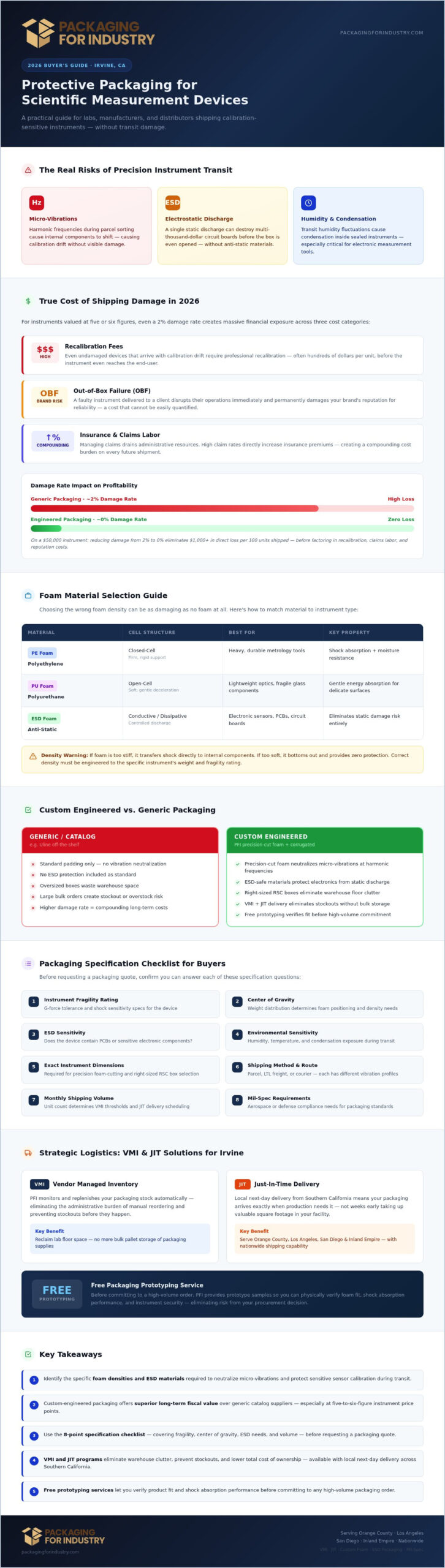
While a visible crack in a casing is a clear sign of damage, the most dangerous transit failures are invisible. Micro-vibrations occurring at specific harmonic frequencies can cause internal components to shift or loosen. This leads to “calibration drift,” where the device appears functional but provides inaccurate data. This is especially prevalent in parcel shipping environments where packages undergo high-speed sorting and multiple transfers.
Environmental factors in Southern California also play a significant role. Although the climate is generally mild, fluctuations in humidity during transit or storage can cause condensation within sealed units. Additionally, electronic measurement tools face constant risks from Electrostatic Discharge (ESD). Without specialized custom design packaging that incorporates anti-static materials, a single discharge can fry a multi-thousand-dollar circuit board before the box is even opened.
Economic Impact of Shipping Damage in 2026
The cost of shipping damage extends far beyond the price of the instrument itself. In 2026, scientific manufacturers must account for the total cost of ownership, which includes the following financial drains:
- Recalibration Fees: Even if a device isn’t physically broken, a “failed” status upon arrival requires professional recalibration, often costing hundreds of dollars per unit.
- Out-of-Box Failure (OBF): When a client receives a faulty instrument, it disrupts their operations and damages your brand’s reputation for reliability.
- Insurance and Claims Labor: Managing shipping claims is a drain on administrative resources. High claim rates also lead to increased insurance premiums for your freight.
By investing in engineered protection, Irvine businesses can lower their packaging costs over the long term. Reducing the damage rate from 2% to 0% provides a massive return on investment when dealing with instruments valued at five or six figures. It’s a pragmatic approach to logistics that prioritizes fiscal responsibility through technical excellence.
Engineering Protection for Calibration: Foam and Material Selection
Selecting the right protective packaging for scientific measurement devices Irvine requires a deep understanding of how different foam polymers react to kinetic energy. For scientific instruments, the goal isn’t just preventing a break; it’s maintaining a calibration often measured in microns or millivolts. This level of precision demands a material-first approach to engineering. You can’t rely on generic bubble wrap when the integrity of a five-figure sensor is on the line. Instead, you need a solution that accounts for the specific fragility and weight of the device.
Material Science for Measurement Devices
Polyethylene (PE) foam is the industry standard for heavy, durable equipment. Its closed-cell structure provides excellent shock absorption and resists moisture, making it ideal for large metrology tools. Conversely, Polyurethane (PU) foam is an open-cell material that offers a softer deceleration for lightweight optics or fragile glass components. Choosing the wrong density can be disastrous. If the foam is too stiff, it transfers shock directly to the sensor; if it’s too soft, the instrument bottoms out against the outer corrugated wall. We utilize specific G-force calculations to determine the exact density required to keep your equipment safe during a standard drop height.
ESD and Cleanroom Compliance
Static is a silent killer for electronic metrology tools and semiconductor-grade sensors. We recommend using anti-static or conductive foam packaging to dissipate electrical charges before they reach sensitive circuits. For devices used in medical or aerospace cleanrooms, the packaging must also be low-outgassing and lint-free. This prevents particulates from contaminating lenses or delicate mechanical assemblies during the unboxing process. Combining these foams with moisture-barrier poly bags ensures your equipment remains in a pristine, lab-ready state regardless of the shipping environment.
Simple die-cut inserts often fail because they don’t account for an instrument’s offset center of gravity. Custom foam assemblies allow for multi-layer protection, combining rigid PE for structural support with soft PU for contact points. This hybrid approach ensures the device remains stationary and isolated from the micro-vibrations discussed in previous sections. You can compare packaging pricing and material options by speaking with our engineering team about your specific instrument’s dimensions and fragility rating. This proactive step reduces the risk of out-of-box failures and protects your company’s bottom line.
Custom Foam Inserts vs. Generic Packaging: A Cost-Benefit Analysis
Procurement managers in Irvine often default to large catalog suppliers because the initial unit price for a stock box appears lower. This surface-level comparison ignores the total cost of ownership. Generic packaging for high-value instruments requires excessive manual labor and secondary materials like bubble wrap or void fill. Over time, these hidden costs erode your margins. Choosing custom-engineered protective packaging for scientific measurement devices Irvine provides a more efficient path to fiscal responsibility.
Labor and Efficiency Gains
Standardizing your pack stations with custom foam inserts eliminates the need for excessive tape and loose-fill peanuts. Using packaging kitting speeds up production lines by providing a ready-to-use assembly. Your warehouse staff won’t spend time measuring or cutting materials. Instead, they follow a repeatable process that guarantees the instrument is isolated from micro-vibrations. This level of consistency is impossible to achieve with generic supplies. It ensures that every unit shipped meets your exact quality standards without requiring a master packer on every shift.
Freight Cost Reduction
Box size directly impacts your bottom line through Dimensional Weight (DIM) surcharges. Stock boxes are rarely a perfect fit, which means you’re frequently paying to ship empty space. Custom-sized corrugated boxes allow you to optimize every cubic inch of the shipping container. This optimization leads to significant freight savings on both domestic and international shipments. Heavy-duty double-wall boxes also provide superior load stability, which is essential for stacking sensitive metrology gear on pallets. To understand the potential savings, you can request a packaging quote and compare your current freight spend against an optimized solution.
We offer free prototyping to ensure your instrument fits perfectly within the custom foam assembly. This step allows you to verify shock absorption and fit without financial risk. It’s a solution-oriented approach that catalog suppliers simply can’t match. When you source protective packaging for scientific measurement devices Irvine from a local specialist, you gain the advantage of precision engineering without the typical overhead of a massive supplier. You also reduce the warehouse clutter caused by over-ordering bulky stock supplies that don’t quite fit your needs.
Specifying Your Packaging Requirements: A Checklist for Buyers
Procuring the right protective packaging for scientific measurement devices Irvine requires a methodical approach that balances engineering specs with logistical realities. Guesswork is unacceptable for high-value metrology gear. Instead, follow this structured checklist to ensure your RFQ yields an accurate, high-performance solution.
- Fragility and Center of Gravity: Define the maximum G-force your instrument can withstand before calibration drift occurs. Identify if the device is top-heavy or has protruding sensors that require specific clearance.
- Sensitivity Profile: Determine if the device requires ESD-safe foam or moisture-barrier poly bags to prevent environmental degradation during transit.
- Shipping Cycle: Specify if the units will move via domestic parcel carriers, which involve high-impact sorting, or international ocean freight, where humidity and stacking strength are primary concerns.
- Operational Constraints: Assess your available warehouse space. If you have limited floor space in Irvine, you’ll need a supplier that offers just-in-time delivery to prevent inventory bloat.
The Design and Prototyping Phase
Effective protection starts with custom design packaging that mirrors the exact geometry of your instrument. Providing CAD drawings or physical samples allows our engineers to create a precise fit that eliminates internal movement. We recommend iterative testing for shock and vibration protection. This process ensures the prototype performs as expected under real-world drop conditions before you commit to a full production run. It’s about verifying the engineering before the first shipment leaves your dock.
Navigating the RFQ Process
Evaluating a quote for protective packaging for scientific measurement devices Irvine involves more than looking at the bottom line. When you’re ready to compare packaging pricing, your request should include more than just dimensions. Provide your expected monthly volume, typical lead times, and any specific cleanroom requirements. Look beyond the price per unit. A cheaper box from a distant supplier often carries hidden costs in the form of high freight fees and longer lead times. Reliability is a currency in industrial logistics. Prioritize local partners who offer next-day delivery in Orange County and can provide on-site consultations to solve complex logistical challenges.
Strategic Logistics in Irvine: PFI’s VMI and JIT Solutions
Industrial real estate in Irvine represents some of the highest overhead costs in Southern California. For scientific labs and metrology firms, every square foot dedicated to storing empty corrugated boxes or bulky foam blocks is a square foot not being used for revenue-generating R&D. Managing the logistics of protective packaging for scientific measurement devices Irvine requires more than just high-quality materials; it demands a supply chain strategy that respects your facility’s spatial constraints. We provide logistical systems that turn your packaging from a storage burden into a streamlined flow.
Optimizing Your Irvine Warehouse
Many manufacturers fall into the trap of over-ordering packaging to avoid stockouts. This leads to cluttered aisles and inefficient warehouse operations. Our Vendor Managed Inventory for Irvine Businesses solves this by shifting the inventory management responsibility to us. We monitor your usage levels and handle replenishment automatically. This approach frees up your floor space for production lines and expensive testing equipment. Instead of managing a warehouse full of empty boxes, you receive exactly what you need based on your actual shipping volume. It’s a pragmatic way to lower packaging costs while maintaining 100% supply reliability.
Next-Day Delivery and Local Support
Proximity is a major advantage when dealing with high-value scientific instruments. While national catalog suppliers might offer a broad selection, they can’t match the responsiveness of a local partner. Our delivery network provides consistent support across Orange County, ensuring that your custom foam inserts and heavy-duty crates arrive exactly when your production schedule requires them. This proximity allows for just-in-time (JIT) delivery, which is essential for labs operating under lean manufacturing principles.
Local support also means faster resolution for technical challenges. If a new instrument design requires a rapid packaging adjustment, our engineers can be on-site in Irvine to verify the fit and shock protection requirements. You won’t wait weeks for a prototype to arrive from a distant warehouse. We understand that your transit schedules are tight and your instruments are sensitive. By combining custom-engineered protective packaging for scientific measurement devices Irvine with local logistical oversight, we help you eliminate the risk of transit damage while optimizing your total cost of ownership. You can compare packaging pricing and logistical options to see how a local partner improves your operational efficiency.
Securing the Future of Irvine’s Scientific Innovation
Securing your technical assets requires a shift from standard cushioning to engineered vibration neutralization. This guide has outlined the necessity of protective packaging for scientific measurement devices Irvine for companies that value precision and fiscal responsibility. By utilizing custom foam assemblies and heavy-duty corrugated boxes, you protect your sensors from the invisible risks of transit while optimizing your freight spend. Protecting calibration is just as important as protecting the outer casing.
Our team brings specialized expertise in aerospace and medical device packaging to every project. We offer free prototyping and engineering support to ensure your equipment is isolated from shock and static. Local Southern California next-day delivery and VMI solutions allow you to maintain a lean operation without the risk of packaging shortages. These systems turn your packaging from a warehouse burden into a competitive advantage.
It’s time to align your logistical standards with your engineering goals. We look forward to helping you achieve zero-damage shipping and improved supply reliability through professional, custom-engineered protection.
Frequently Asked Questions
What is the best foam for shipping sensitive scientific measurement devices?
Polyethylene and Polyurethane are the primary choices for high-value instruments. Polyethylene provides rigid shock absorption for heavy gear, while Polyurethane offers soft cushioning for lightweight optics. We select foam density based on specific G-force requirements to ensure the device stays within its calibration window. This engineering-first approach prevents internal component shifting. You can request a packaging quote to determine the exact material blend your instrument requires for safe transit.
How can custom packaging lower my total shipping costs in Irvine?
Custom solutions lower costs by optimizing box dimensions and reducing manual labor. Standard boxes often require excessive void fill and tape, which increases material spend and packing time. By using custom-engineered protective packaging for scientific measurement devices Irvine, you also avoid Dimensional Weight surcharges from carriers. Minimizing damage rates eliminates the high costs of returns, repairs, and recalibrations. This provides a significant long-term return on your investment while improving supply reliability.
Does PFI provide ESD-compliant packaging for electronic instruments?
Yes, we provide a full range of ESD-compliant foam and anti-static poly bags. Electronic instruments are highly susceptible to static discharge which can damage internal circuits without visible signs. Our pink anti-static or black conductive foams dissipate electrical charges before they reach your sensitive sensors. This is essential for semiconductor-grade tools and medical electronics. We ensure your packaging meets the necessary industrial standards for static protection and cleanroom compatibility.
Can I get a prototype of my custom foam insert before placing a bulk order?
We offer free prototyping to verify product fit and shock protection before you commit to a full production run. This allows your engineering team to test the custom foam insert with a physical sample or CAD drawing. Free prototyping ensures that the final assembly meets your specific fragility requirements and center of gravity offsets. It’s a proactive step that eliminates the risk of ordering bulk quantities that don’t provide adequate protection.
What is Vendor Managed Inventory (VMI) and how does it help my lab?
Vendor Managed Inventory is a supply chain service where we monitor your stock levels and handle replenishment automatically. For Irvine labs with limited floor space, this prevents warehouse clutter and eliminates the risk of packaging shortages. We deliver supplies based on your actual usage, freeing up your facility for revenue-generating research and production. It’s a steady, dependable system that streamlines your procurement and lowers your total cost of ownership.
Does PFI offer local next-day delivery for Irvine scientific businesses?
We provide local next-day delivery for businesses throughout Irvine and the greater Orange County area. Our local delivery network supports just-in-time manufacturing schedules, ensuring you never face production delays due to missing packaging. This proximity also allows for faster response times on emergency orders or design adjustments. Partnering with a local Southern California supplier gives you the reliability and logistical speed that national catalog distributors simply cannot match.
How do heavy-duty corrugated boxes protect against calibration drift?
Heavy-duty corrugated boxes, such as double-wall or triple-wall RSC boxes, provide the structural rigidity needed to prevent calibration drift. These boxes resist crushing and maintain their shape during stacking, which isolates the internal foam assembly from external pressure. When combined with precision-cut foam, they neutralize the micro-vibrations that cause sensitive components to shift. This is a key component of effective protective packaging for scientific measurement devices Irvine.
Can PFI design custom crates for international scientific equipment export?
We design and manufacture custom wood crates specifically for international scientific equipment export. These crates are engineered to withstand the rigors of ocean freight and long-haul transport, including humidity and rough handling. We incorporate internal foam blocking and bracing to ensure the instrument remains stationary. Our crates meet all international shipping regulations for heat-treated wood, ensuring your high-value measurement tools arrive at their global destination without customs delays or physical damage.