
A precision-engineered sensor or robotic arm is only as valuable as its condition upon arrival at the farm. For manufacturers, shipping high-value hardware often feels like a gamble against physics and poor handling. You’ve likely experienced the frustration of delicate instruments arriving damaged or standard shipping containers failing to support the weight of industrial components. These failures don’t just cost money; they erode customer trust and disrupt critical agricultural cycles.
We understand that effective packaging for agricultural technology (AgTech) in Southern California requires more than a one-size-fits-all approach. This guide outlines how custom-engineered crates and protective foam solutions can safeguard your equipment while reducing overall shipping costs. You’ll learn how to optimize your supply chain through localized support and vendor-managed inventory (VMI) programs. We’ll examine the technical requirements for protecting sensitive electronics and heavy machinery, ensuring your products move from the warehouse to the field with total reliability. It’s time to stop relying on generic catalog suppliers and start using a logistics strategy that matches the sophistication of your technology.
Key Takeaways
- Identify why high-value hardware requires custom-engineered protection to eliminate transit damage and protect your bottom line.
- Compare the structural benefits of triple-wall corrugated containers versus custom wood crates for heavy-duty robotic components.
- Learn how specialized packaging for agricultural technology (AgTech) in Southern California uses anti-static (ESD) foam and precision die-cut inserts to safeguard sensitive sensors.
- Discover how local Vendor Managed Inventory (VMI) programs in the Inland Empire and Orange County prevent production delays and optimize warehouse space.
- Understand the financial advantages of multi-material integrated solutions and how to request a packaging quote for your specific manufacturing requirements.
The Critical Role of Packaging in Southern California AgTech Logistics
Southern California has established itself as a critical hub for agricultural innovation. From the tech corridors of Irvine to the manufacturing centers in the Inland Empire, local companies are developing the hardware that powers modern farming. However, the transition from a laboratory prototype to a field-ready unit often reveals a significant vulnerability: the supply chain. This vulnerability is costly. Standard shipping containers aren’t built to withstand the rigors of industrial transport while protecting delicate internal components. Effective packaging for agricultural technology (AgTech) in Southern California requires an engineering-first approach that prioritizes both structural integrity and internal cushioning.
High-Value Components and Sensitive Electronics
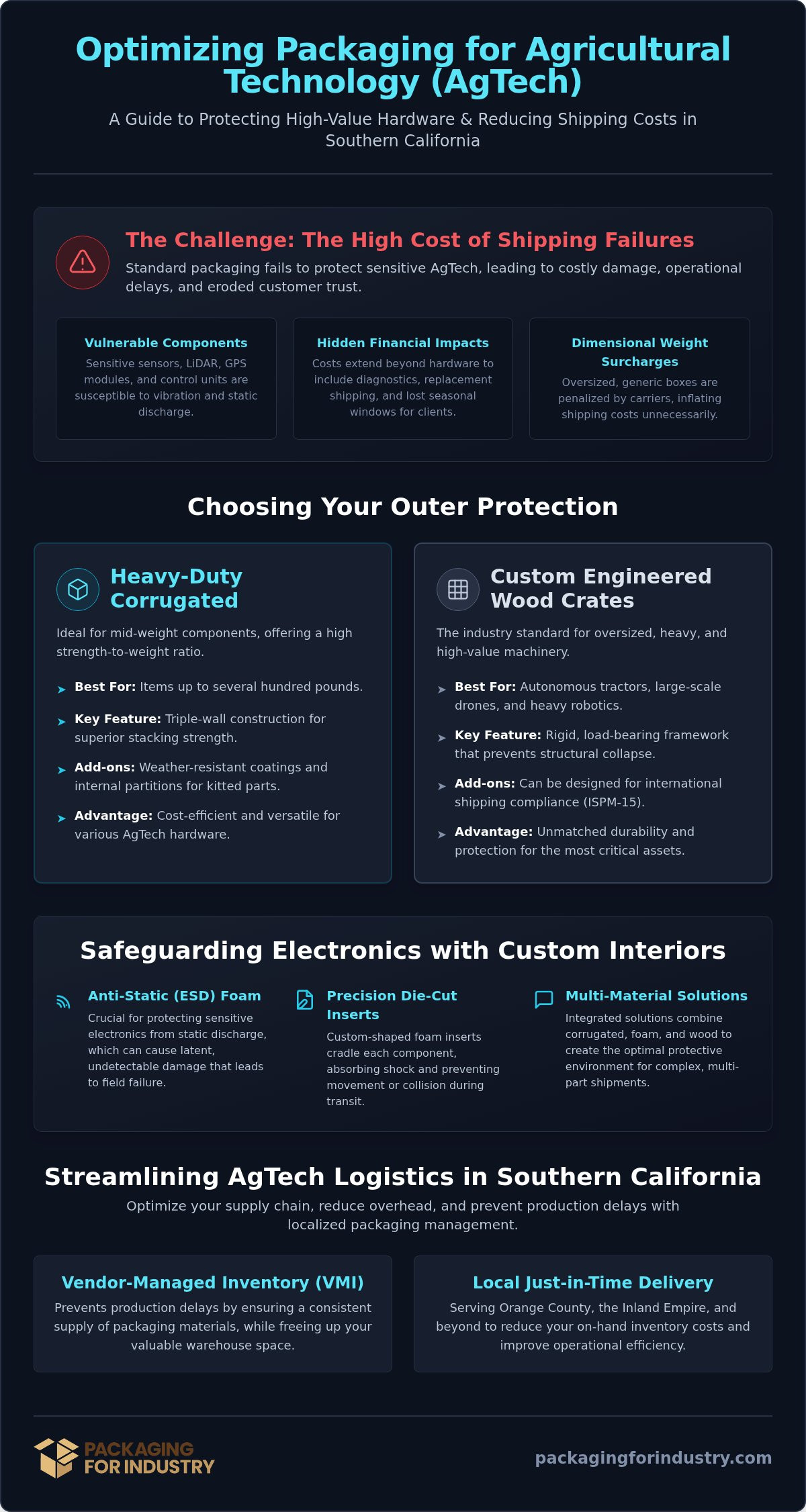
AgTech hardware often relies on a suite of expensive sensors, including LiDAR, GPS modules, and autonomous control units. These “brains” of the machinery are susceptible to even minor vibrations or static discharge. Using generic corrugated boxes without specialized support often leads to catastrophic failure. Sensitive electronics require protective foam packaging with anti-static (ESD) properties to prevent latent damage that might not appear until the unit is powered on in the field. When you consider the weight of robotic components, standard single-wall boxes simply don’t offer the stacking strength required for safe transit.
The Cost of Shipping Failures in the 2026 AgTech Market
The financial impact of a damaged shipment extends far beyond the cost of the hardware itself. You have to account for the labor involved in diagnostic testing, the cost of expedited replacement shipping, and the potential loss of a seasonal window for your client. Investing in custom design packaging provides a measurable return on investment by virtually eliminating these hidden costs. Beyond damage protection, engineered solutions help lower packaging costs by optimizing the exterior dimensions of the container. This reduces dimensional weight surcharges from carriers like FedEx and UPS, which often penalize shippers for using oversized, generic boxes. Manufacturers looking to optimize their logistics should request a packaging quote to see how specialized packaging for agricultural technology (AgTech) in Southern California compares to generic catalog options.
Custom Corrugated vs. Wood Crates: Comparing Outer Protection
Choosing the right exterior material depends on the weight, fragility, and destination of your equipment. For packaging for agricultural technology (AgTech) in Southern California, manufacturers often balance the cost-efficiency of corrugated with the extreme durability of timber. Heavy robotics and machinery require load-bearing structures that maintain their shape under the pressure of stacking and forklift movement. Selecting the wrong material leads to structural collapse, which can damage internal sensors even if the exterior remains intact.
Heavy-Duty Corrugated Solutions
Mid-weight AgTech components often benefit from custom corrugated boxes. While standard boxes fail quickly, triple-wall corrugated offers a high strength-to-weight ratio suitable for items up to several hundred pounds. This approach is essential for specialized packaging for agricultural technology (AgTech) in Southern California where equipment often moves between high-tech labs and dusty field environments. For equipment destined for outdoor farm sites, weather-resistant coatings protect the integrity of the container against humidity. You can also use internal partitions to organize sensitive kitted parts, ensuring they don’t collide during transit.
Custom Engineered Wood Crates
When shipping autonomous tractors or large-scale drones, custom shipping crates are the industry standard. These crates provide the rigid framework necessary for oversized hardware that corrugated cannot support. If you’re an exporter in Orange County or Los Angeles, your wood packaging must meet ISPM-15 international standards to avoid customs delays. We design these crates with foam-lined interiors to maximize shock absorption, which is vital for long-haul transit across varying terrains. The rigid nature of wood allows for secure anchoring of heavy frames, preventing the equipment from shifting inside the container.
Hybrid designs are frequently the most efficient choice for Southern California manufacturers. By combining a heavy-duty wood base with a corrugated sleeve, you get the structural support of a pallet with the lightweight protection of a box. This reduces the total weight of the shipment while providing a stable platform for heavy machinery. It’s a pragmatic way to lower shipping costs without compromising on safety. To find the most cost-effective balance for your specific product dimensions, you can compare packaging pricing for these different configurations.
Safeguarding Sensors and Robotics with Custom Foam and ESD Packaging
While the outer container provides structural defense, the internal cushioning determines the survival of high-precision components. Packaging for agricultural technology (AgTech) in Southern California often involves shipping LiDAR sensors or intricate circuit boards that cannot tolerate G-force spikes during transit. Custom foam doesn’t just fill space; it manages kinetic energy. By engineering specific deceleration rates into the foam design, you ensure that even a dropped crate doesn’t result in a shattered lens or a cracked motherboard.
Material Selection: Polyethylene vs. Polyurethane
Selecting between polyethylene and polyurethane is a matter of calculating load and fragility. Polyethylene is a closed-cell foam packaging that offers excellent support for heavy robotic limbs and chassis components. It’s durable and resistant to chemicals; this makes it ideal for the agricultural sector where exposure to residues is common. Conversely, polyurethane is an open-cell, softer material. It’s better suited for lightweight, highly sensitive optical sensors that require a more delicate touch to prevent surface scratches or internal misalignment.
Custom Foam Engineering and Prototyping
Effective foam inserts require precision that manual cutting cannot achieve. We utilize CAD/CAM support to design die-cut or CNC-routed inserts that mirror the exact geometry of your hardware. Our process includes free prototyping to ensure a perfect fit before you commit to mass production. For palletized loads, we often combine these custom inserts with corner and edge protection to prevent the internal assembly from shifting under the pressure of stretch film. This multi-material approach ensures that your high-value assets remain stationary and shock-insulated throughout the entire shipping cycle.
Electronic control systems require specialized ESD (electrostatic discharge) foam. This anti-static material prevents the buildup of static electricity that can fry sensitive circuit boards before they ever reach the field. For companies managing service and repair loops, reusable foam packaging offers a pragmatic way to lower packaging costs. High-quality foam maintains its structural memory over multiple trips. This allows you to ship components back and forth for maintenance without needing to replace the internal protection every time, ensuring that your packaging for agricultural technology (AgTech) in Southern California remains both efficient and cost-effective.
Streamlining AgTech Logistics in Southern California
Manufacturing efficiency relies on the proximity of your suppliers. For packaging for agricultural technology (AgTech) in Southern California, working with a local partner eliminates the logistical delays that plague national supply chains. When your production facility is in Riverside or the Inland Empire, waiting for a shipment from out-of-state can halt your assembly line. Localizing your packaging supply ensures that your hardware moves from final assembly to the customer without unnecessary downtime. It’s a proactive way to maintain your production schedule while keeping overhead costs low.
Optimizing the Southern California Supply Chain
Speed to market is critical for high-growth hardware startups. Companies located in Irvine and Anaheim benefit from next-day delivery options that national catalog suppliers simply can’t match. This responsiveness allows you to manage recurring packaging needs without maintaining massive on-site stockpiles. By reducing lead times for custom-engineered boxes and crates, you can adapt quickly to design changes in your hardware. It’s a pragmatic approach that aligns your packaging supply with the rapid pace of AgTech innovation.
Vendor Managed Inventory (VMI) for AgTech
Managing a complex inventory of foam inserts, corrugated sleeves, and pallets is a secondary task that distracts from your core engineering goals. Our VMI services provide a hands-off solution for inventory management. We monitor your stock levels and replenish supplies automatically, which eliminates the hidden costs of emergency orders and expedited shipping. This system improves your cash flow because you only pay for the packaging you need for current production cycles. You don’t have to worry about stockouts during peak shipping seasons.
Standardizing your packaging across multiple facilities in Southern California also ensures brand consistency and reduces procurement complexity. Using Just-in-Time (JIT) delivery frees up valuable warehouse floor space. In regions where industrial real estate carries a premium, every square foot should be dedicated to R&D or production rather than storing empty boxes. This logistical optimization is a key component of effective packaging for agricultural technology (AgTech) in Southern California, turning your supply chain into a competitive advantage.
Engineering Protection: Why PFI is the Choice for AgTech Manufacturers
PFI provides more than just materials; we deliver engineered systems designed to survive the journey from the assembly line to the field. Our expertise in packaging for agricultural technology (AgTech) in Southern California allows us to integrate diverse materials like heavy-duty corrugated, custom wood crates, and precision-cut foam into a single, cohesive unit. This multi-material approach is essential for protecting the complex geometry of modern robotics and autonomous sensors. By consolidating these elements, we help you reduce the complexity of your supply chain while increasing the safety of your high-value assets. It’s a pragmatic strategy that prioritizes both physical protection and logistical efficiency.
From Prototype to Production
We don’t believe in guesswork. Our engineers collaborate directly with your team to develop custom AgTech hardware protection that meets your specific transit requirements. We offer free prototyping to ensure every component fits perfectly before you scale to full production. Whether your equipment needs to meet strict industrial benchmarks or specific military-spec standards for ruggedized performance, we have the technical capability to design and test the solution. By treating each project as a unique case study, we solve the complex shipping challenges that generic suppliers often ignore, ensuring your innovation is never compromised by poor handling.
Comprehensive Industrial Support
While custom engineering is our specialty, we also serve as a single source for all your manufacturing packaging needs. This includes access to wholesale stretch film for pallet stabilization and custom mailing tubes for protecting blueprints or technical documentation. Our goal is to streamline your procurement process so you can focus on innovation rather than managing multiple vendors. From manufacturing packaging supplies to complex integrated crates, PFI provides the reliability required to keep Southern California production lines moving without interruption. Our comprehensive approach to packaging for agricultural technology (AgTech) in Southern California ensures that every part of your shipment is accounted for.
Choosing the right partner means finding a balance between engineering precision and economic efficiency. We help you lower packaging costs by reducing damage rates and optimizing your logistical flow through our Anaheim-based facility. If you’re ready to upgrade your shipping strategy and protect your high-value hardware, it’s time to request a packaging quote for your next AgTech project. We provide the expertise and local support necessary to ensure your technology arrives in peak condition, every time.
Secure Your Agricultural Innovation
Protecting your investment requires a shift from generic supplies to engineered systems. We’ve examined how custom foam and heavy-duty crates eliminate transit damage while reducing dimensional surcharges. By localizing your supply chain through PFI, you gain access to free prototyping and next-day delivery that keeps your production lines moving. Our specialized expertise in industrial hardware ensures your sensors and robotics arrive ready for the field.
Effective packaging for agricultural technology (AgTech) in Southern California isn’t just a logistics cost; it’s a safeguard for your brand reputation. Utilizing VMI programs allows you to focus on innovation while we handle the inventory management. This approach frees up warehouse space and improves cash flow by aligning your supply with actual production needs. You can rely on our Anaheim-based team to provide the stability and precision your high-value hardware demands.
We are ready to help you streamline your operations and secure your equipment for any destination. Let’s build a more reliable supply chain together.
Frequently Asked Questions
What is the best way to ship sensitive AgTech sensors to avoid damage?
The most effective method involves using custom-engineered foam inserts within a rigid outer container like a triple-wall corrugated box or wood crate. These inserts provide precision shock absorption tailored to the sensor’s specific weight and fragility. By isolating the hardware from vibration and impact, you eliminate the primary causes of transit failure. You should also ensure the outer container is properly sealed and palletized to prevent shifting during long-haul transport.
How can Southern California AgTech companies lower their packaging costs?
Manufacturers can lower packaging costs by switching from generic catalog boxes to custom-engineered sizes that reduce dimensional weight surcharges. Utilizing a local Southern California supplier also eliminates high inbound freight costs for packaging materials. Additionally, implementing a Vendor Managed Inventory (VMI) program reduces warehouse overhead and prevents the hidden expenses associated with stockouts and emergency expedited orders. You should request a packaging quote to compare these long-term savings against standard off-the-shelf options.
Does PFI offer custom-size boxes for oversized AgTech equipment?
Yes, we specialize in custom sizes available for any equipment dimensions, ranging from small sensors to large autonomous machinery. For oversized hardware, we often recommend heavy-duty triple-wall corrugated containers or custom-engineered wood crates. These solutions provide the structural integrity required for heavy loads while ensuring a precision fit. Our team works with your engineers to determine the best load-bearing design for your specific robotic or industrial components.
What are the benefits of using a local SoCal packaging supplier over a national catalog?
Partnering with a local supplier provides next-day delivery across Orange County, Los Angeles, and the Inland Empire, which national catalogs cannot guarantee. This proximity allows for faster prototyping and on-site consultations to address complex engineering challenges. Localized supply also reduces your carbon footprint and inbound shipping expenses. It’s a pragmatic way to ensure your packaging for agricultural technology (AgTech) in Southern California is responsive to your production schedule and design changes.
Can PFI help design packaging for autonomous agricultural robotics?
Our engineering team has extensive experience designing multi-material integrated solutions for autonomous robotics. We use CAD/CAM technology to create precision-cut foam and structural crates that protect robotic limbs, chassis, and internal electronics. We offer free prototyping to verify the fit and performance of the design before mass production. This collaborative process ensures that your robotics are protected against the unique environmental stressors encountered during transit to agricultural sites.
What is the typical lead time for custom AgTech foam inserts in Anaheim?
While specific lead times vary based on the complexity of the design, our Anaheim facility is optimized for rapid turnaround. Since we manage the entire process locally, we significantly reduce the delays common with out-of-state suppliers. For recurring orders, our Vendor Managed Inventory (VMI) program ensures that custom foam inserts are always in stock and ready for next-day delivery. This reliability helps you maintain a steady production flow without worrying about supply chain interruptions.
How does a Vendor Managed Inventory (VMI) program work for AgTech startups?
A VMI program allows us to take full responsibility for monitoring and replenishing your packaging stock. We track your usage rates and automatically deliver new supplies before you run out, which eliminates the need for manual ordering. This system is particularly beneficial for startups because it improves cash flow by aligning expenses with actual production. You only store and pay for what you need, freeing up valuable warehouse space for your core R&D activities.
Do you provide ESD-safe packaging for AgTech electronics?
We provide a full range of ESD-safe packaging options designed specifically for sensitive electronics like GPS modules and control units. This includes anti-static foam inserts and specialized corrugated materials that prevent electrostatic discharge during handling and transit. Protecting the brains of your hardware is a critical part of effective packaging for agricultural technology (AgTech) in Southern California. These materials ensure that your electronic components remain functional and free from latent damage.