
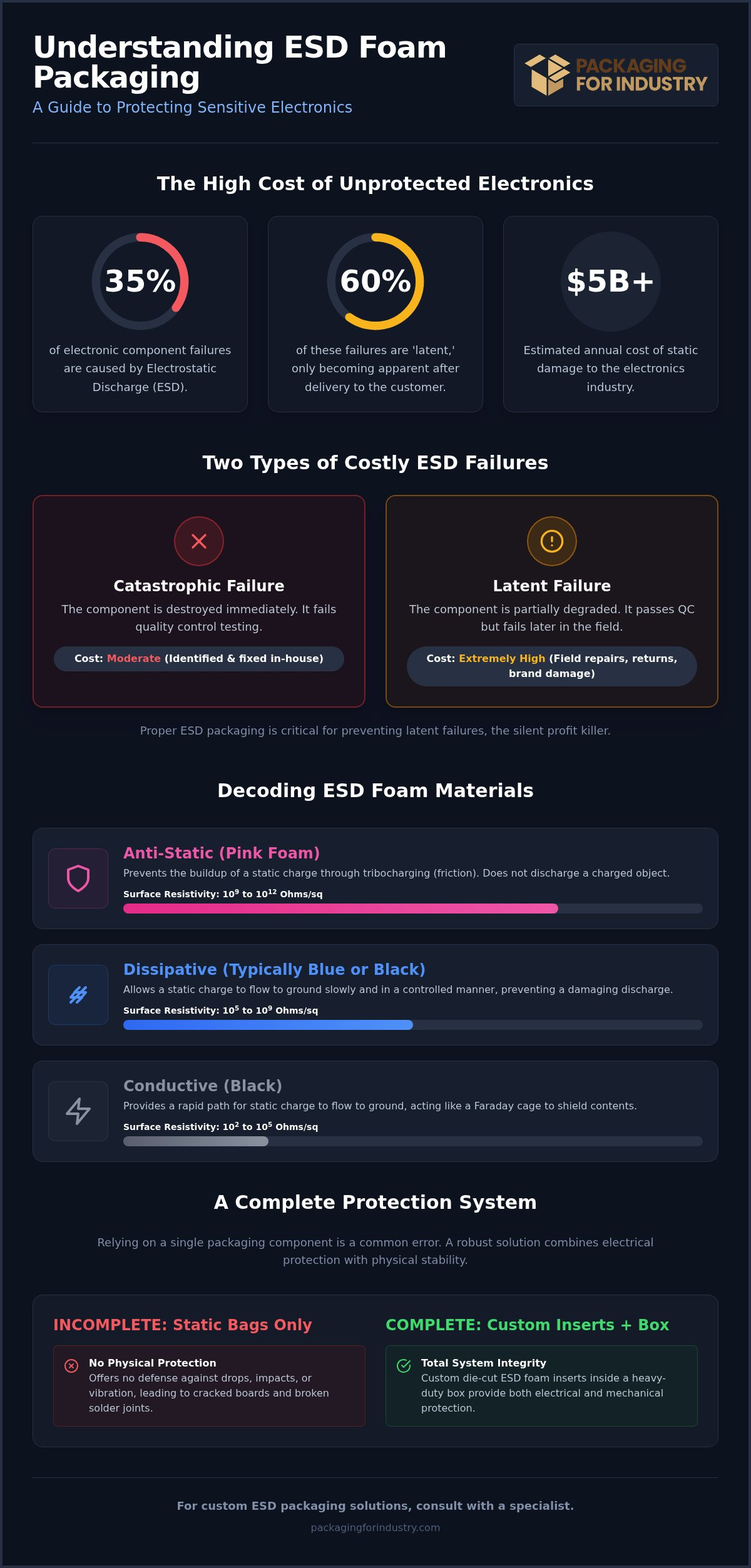
Electrostatic discharge is responsible for up to 35% of all electronic component failures in manufacturing environments, yet over 60% of these issues aren’t detected until the product is already in the field. If you’re managing an electronics supply chain in Orange County or Los Angeles, you know that latent damage is a silent profit killer that compromises your brand reputation. Sourcing reliable ESD foam packaging for printed circuit boards Southern California shouldn’t involve the long lead times or excessive shipping costs typical of national catalog suppliers. You need a solution that balances technical precision with logistical efficiency.
We understand that your goal is a zero-damage shipping cycle that doesn’t inflate your packaging footprint or freight expenses. This guide explains how to select the right dissipative and conductive materials to meet ANSI/ESD S541-2026 standards while leveraging local manufacturing for better agility. You’ll learn how to source high-performance ESD foam to eliminate latent failures and optimize your Southern California electronics supply chain. We’ll also look at how custom die-cut inserts and vendor-managed inventory can reduce your warehouse overhead and ensure you always have the protection you need for your most sensitive PCBs.
Key Takeaways
- Understand the critical technical differences between anti-static, dissipative, and conductive foam to ensure your materials meet the ANSI/ESD S541-2026 standard.
- Learn how high-performance foam inserts eliminate latent circuit board failures that bypass initial quality control but cause expensive field issues later.
- Discover how custom-engineered ESD foam packaging for printed circuit boards Southern California reduces labor time in the warehouse and lowers your total shipping costs.
- Optimize your logistics by sourcing directly from an Anaheim hub to secure local next-day delivery and eliminate the long lead times of national catalog suppliers.
- Master the quoting process with a professional buyer’s checklist designed to help you compare packaging pricing and secure volume discounts for your electronics supply chain.
The High Cost of Static: Why ESD Foam Packaging for Printed Circuit Boards is Essential
Modern electronics manufacturing has reached a level of miniaturization where components like System-on-Chips (SoCs) and Field-Programmable Gate Arrays (FPGAs) operate at extremely low voltages. This precision makes modern printed circuit boards (PCBs) incredibly vulnerable to electrostatic discharge. Research indicates that ESD is responsible for 25% to 35% of all electronic component failures in manufacturing environments. For firms managing high-density production in Orange County or Los Angeles, securing high-performance ESD foam packaging for printed circuit boards Southern California is a financial necessity, not an optional upgrade. The industry loses an estimated $5 billion annually to static damage, much of which occurs during the transit and handling phases of the supply chain.
Effective protection requires a material that functions as both a mechanical dampener and an electrical regulator. While many buyers rely on standard pink anti-static foam, this material is often insufficient for high-value assemblies. Pink foam is typically treated with a topical surfactant that can wear off or outgas over time. For long-term reliability, engineers prefer protective foam packaging with permanent conductive, dissipative, and anti-static properties. These materials don’t just prevent a charge from building up; they control the rate of discharge to ensure sensitive traces aren’t vaporized by a sudden spike.
Catastrophic vs. Latent ESD Failures
Catastrophic failures are easy to manage because they are immediate. A board dies on the test bench, and you pull it from the line. Latent failures are far more insidious and expensive. Latent failure is a microscopic circuit degradation that passes initial testing but fails under operational stress. These “walking wounded” components make it to your customer’s site before failing, leading to costly field service calls and damaged brand reputation. Much of this damage stems from tribocharging, which occurs when boards vibrate against improper packaging materials during shipping. High-quality ESD foam packaging for printed circuit boards Southern California prevents this friction while providing a controlled path to ground.
Beyond the Bag: The Role of Cushioning in Electronics
Relying solely on static shielding bags is a common logistical error. While bags provide an effective Faraday cage, they offer zero protection against physical impact or high-frequency vibration. Heavy or fragile boards can easily crack or lose solder joint integrity if they aren’t secured. Integrating custom-designed foam inserts within heavy-duty corrugated boxes creates a comprehensive protection system. This approach provides the structural stability needed for aerospace and medical electronics, ensuring that the physical and electrical integrity of the board remains intact from the cleanroom to the final installation point.
Decoding ESD Foam Materials: Anti-Static, Dissipative, and Conductive
Selecting the right material for ESD foam packaging for printed circuit boards Southern California requires more than just picking a color. The primary metric for protection is surface resistivity, measured in Ohms per square. This scale determines how quickly a material allows an electrical charge to move across its surface. For purchasing managers and operations leads, understanding this technical specification is key to avoiding over-specifying, which increases costs, or under-specifying, which leads to the latent damage discussed earlier. Precision in material selection is the foundation of a reliable electronics supply chain.
Environmental factors play a significant role in material performance. Many low-cost pink foams are topically treated with surfactants that rely on ambient humidity to function. In the dry heat of the Inland Empire or during Southern California wind events, these materials can lose their effectiveness as moisture levels drop. Permanent ESD materials, which incorporate conductive elements like carbon during the manufacturing process, provide consistent protection regardless of local climate fluctuations. To ensure your selection meets industry handling standards, you must distinguish between dissipative and conductive properties based on your component sensitivity.
Dissipative vs. Conductive Foam: Which Do You Need?
Dissipative foam (10^5 to 10^11 ohms) is generally the preferred choice for PCB assemblies. It allows for a controlled, slower bleed-off of static electricity, which prevents the sudden “spark” that causes circuit degradation. Conductive foam, with a resistivity of less than 10^5 ohms, is designed for rapid grounding and shielding. While conductive materials are excellent for certain applications, they can occasionally cause a “hard discharge” if a highly charged component makes contact too quickly. Matching the resistivity to your board’s specific sensitivity is the most effective way to lower packaging costs by reducing preventable scrap.
Polyethylene vs. Polyurethane for Electronics
The physical structure of the foam is just as important as its electrical properties. Polyethylene (PE) is a closed-cell, high-density foam that’s extremely durable and moisture-resistant. It’s the standard for heavy boards or aerospace components that require repeated handling or long-term storage. Polyurethane (PU) is an open-cell, softer material that provides superior cushioning for lightweight, fragile electronics with low G-force tolerances. Selecting the correct density ensures you don’t pay for excess material while still achieving a zero-damage shipping cycle. If you aren’t sure which density fits your PCB geometry, you can request a packaging quote that includes a technical material recommendation. This helps you compare packaging pricing based on actual engineering requirements rather than just bulk volume.
Custom ESD Foam Inserts vs. Stock Cushioning: A Cost-Benefit Analysis
Purchasing decisions for ESD foam packaging for printed circuit boards Southern California often hinge on a narrow view of material costs. While stock foam planks or convoluted sheets have a lower unit price, they frequently lead to higher total costs of ownership. Custom die-cut inserts are engineered for specific PCB geometries, which drastically reduces the labor time required for pack-out. In a high-volume Southern California warehouse, shaving minutes off every shipment significantly impacts the bottom line. The High Cost of Static isn’t just about component damage; it’s also about the operational inefficiencies of inadequate packaging.
Customization also offers logistical advantages by optimizing the packaging footprint. Standard stock cushioning often requires larger outer boxes to provide sufficient protection, which triggers dimensional weight (DIM) surcharges from carriers like FedEx and UPS. Custom-engineered inserts allow for a smaller, more precise packaging profile. This reduction in volume lowers freight costs and minimizes the amount of storage space required in your facility. When you optimize your ESD foam packaging for printed circuit boards Southern California, you’re essentially buying back warehouse space and reducing shipping overhead.
The Engineering Process: Prototyping and CAD Support
Precision is the hallmark of a fixer mentality in industrial logistics. PFI utilizes CAD/CAM support to design precise PCB cavities that eliminate board movement during transit. A tight fit is essential to prevent the friction-based charging mentioned previously. We offer free prototyping to ensure a perfect component fit before you commit to a full production run. This proactive approach eliminates the risk of ordering thousands of units that don’t meet your protection requirements. You can request a packaging quote to begin the prototyping phase for your specific board geometry.
When Stock Foam Makes Sense
There are scenarios where standard materials remain the most pragmatic choice. If you’re shipping low-volume, varying PCB sizes or non-sensitive peripherals, stock convoluted foam or standard planks can be cost-effective. These materials work best when combined with custom corrugated boxes to provide a hybrid protection system. This setup offers flexibility for secondary components while maintaining a professional and secure shipping cycle. Identifying the right balance between stock and custom solutions is how we help manufacturers lower packaging costs without sacrificing reliability.
Sourcing ESD Packaging in Southern California: Logistics and Lead Times
Sourcing ESD foam packaging for printed circuit boards Southern California shouldn’t be a logistical headache. National catalog suppliers often impose long lead times and high freight costs because foam is a high-volume, low-weight product that’s expensive to ship over long distances. When you source from a local Anaheim-based partner, you eliminate the “dead air” shipping costs and gain direct access to engineering support. For stock ESD supplies, we offer local next-day delivery, ensuring your production line never stalls due to a packaging shortage. Managing lead times for custom die-cut ESD foam is also simplified when the manufacturing plant is in your backyard, allowing for tighter production windows and more reliable delivery schedules.
Service Areas: Orange County, LA, and the Inland Empire
Our strategic location in Anaheim allows us to serve the dense electronics manufacturing hubs in Irvine and across Orange County with unmatched speed. We also support the aerospace and defense sectors in Long Beach and San Diego. Proximity isn’t just about delivery speed; it’s about collaboration. Local manufacturers benefit from on-site packaging reviews and faster design revisions for custom die-cut foam inserts. This local presence means we can physically inspect your PCB geometries and provide a prototype that works the first time, reducing the back-and-forth typical of out-of-state vendors.
Vendor Managed Inventory (VMI) for PCB Manufacturers
For high-volume PCB manufacturers, warehouse space is at a premium and inventory management is a constant challenge. Our VMI programs are designed to prevent production stops by managing your ESD foam stock levels based on your actual production schedule. We monitor your usage and store your custom-engineered foam at our Southern California facility, delivering it just-in-time as needed. This approach eliminates warehouse clutter and frees up valuable floor space for your assembly lines. It’s a pragmatic solution that shifts the logistical burden to us, providing the peace of mind that your protective materials are always ready when your boards come off the line.
How to Request a Quote and Lower Your ESD Packaging Costs
Optimizing your spend on ESD foam packaging for printed circuit boards Southern California begins with a precise scope of work. Many procurement officers default to national catalog suppliers like Uline, assuming that high-volume stock items offer the lowest entry point. However, when you factor in the technical support, custom CAD design, and reduced freight costs of a local Anaheim supplier, the total cost of ownership is often lower with a specialized partner. We leverage our local manufacturing capabilities to offer volume discounts on high-density polyethylene foam that rival or beat national averages, especially when regional transit costs are included.
To further lower packaging costs, many electronics firms integrate their foam orders with our kitting and assembly services. This integration allows you to receive a complete, ready-to-use packaging unit, including the outer corrugated box and the ESD foam insert already in place. This reduces the labor burden on your warehouse team and speeds up your pack-out process, turning packaging from a bottleneck into a streamlined component of your production line.
Information Needed for Your Custom Quote
Precision matters when calculating material yields and pricing. To provide an accurate quote for your ESD foam packaging for printed circuit boards Southern California, our engineering team requires specific data points to ensure the protection matches the sensitivity of your electronics. Providing this information upfront allows us to compare packaging pricing models and find the most efficient material usage for your project.
- PCB Dimensions and Weight: We need the length, width, and height of the board, including any protruding components, along with the total weight to determine the required foam density.
- Usage Volumes: Provide estimated monthly or annual usage figures so we can calculate volume discounts and suggest VMI stocking levels.
- ESD Requirements: Specify whether you require dissipative or conductive properties based on your internal manufacturing standards.
- Shipping Method: Knowing if your product ships via parcel (FedEx/UPS) or LTL freight helps us optimize the cushioning thickness to prevent damage from varying drop heights.
The PFI Advantage: Reliability and Engineering
Southern California manufacturers in the aerospace and medical sectors trust PFI because we don’t just sell foam; we provide a system of protection. Our engineering-minded approach ensures that your packaging eliminates field failures while streamlining your logistics. We’re committed to reducing shipping damage and helping you maintain a lean, efficient supply chain from our Anaheim hub. Request a custom ESD packaging quote today to see how our local support and custom designs can improve your bottom line.
Secure Your Electronics Supply Chain with Local Expertise
Protecting sensitive components doesn’t require complex guesswork; it requires precision engineering. By selecting the correct dissipative or conductive materials, you eliminate the latent damage that compromises long-term product reliability. Sourcing your ESD foam packaging for printed circuit boards Southern California through a local partner provides the agility needed to manage fluctuating production schedules in Orange County and Los Angeles.
PFI combines specialized ESD engineering expertise with the logistical advantages of local Southern California delivery. We offer free custom prototyping to ensure your boards fit perfectly, reducing both material waste and shipping footprints. This proactive approach helps you lower packaging costs while maintaining the highest standards of protection for aerospace and medical electronics. Our Anaheim hub is equipped to support your team with vendor-managed inventory and just-in-time delivery.
Eliminating professional stress means knowing your PCBs will arrive at their destination in perfect working order. By moving away from generic stock solutions and embracing custom-engineered inserts, you reduce labor time and warehouse clutter simultaneously. Our team functions as a dedicated partner in your logistics chain, ensuring that every piece of foam serves both an economic and technical purpose.
We’re ready to help you optimize your shipping cycle and protect your bottom line.
Frequently Asked Questions
What is the difference between pink anti-static foam and black conductive foam?
Pink anti-static foam is topically treated and designed only to prevent charge generation from friction. It doesn’t shield against external ESD events and can lose effectiveness as the surfactant wears off over time. Black conductive foam is impregnated with carbon, providing permanent electrical properties and a reliable path to ground. For high-value electronics, dissipative or conductive materials are superior because they offer consistent performance regardless of humidity levels or the age of the foam.
How much does custom die-cut ESD foam packaging cost?
Custom die-cut ESD foam pricing is based on material density, board geometry, and usage volumes. While custom inserts require an initial engineering phase, they often lower packaging costs by increasing pack-out speed and reducing outer box sizes. This optimization helps you avoid carrier dimensional weight surcharges. We recommend that buyers request a packaging quote to compare the total cost of ownership between custom die-cuts and standard stock cushioning materials.
Does PFI offer local delivery in Southern California for ESD supplies?
PFI offers local next-day delivery for stock ESD supplies across Orange County, Los Angeles, and the Inland Empire. Sourcing from our Anaheim headquarters allows you to lower packaging costs by eliminating expensive long-distance freight charges for high-volume foam orders. Our local presence also supports faster design revisions and on-site reviews for custom projects. This proximity ensures your electronics supply chain remains agile and responsive to shifting production demands without the delays of national catalog vendors.
Can I get a prototype of my PCB foam insert before placing a bulk order?
You can receive a free prototype of your custom PCB foam insert to verify the fit and protection levels before placing a bulk order. Our engineering team utilizes CAD/CAM support to design precise cavities that match your board’s specific geometry. This prototyping phase is crucial for identifying potential issues before mass production begins. It ensures your final packaging solution provides the structural stability and electrical shielding required for a zero-damage shipping cycle.
What is the typical lead time for custom ESD foam inserts in Anaheim?
Lead times for custom ESD foam packaging for printed circuit boards Southern California vary based on design complexity and material stock. Sourcing from our Anaheim facility typically provides a much faster turnaround than national suppliers who ship from out-of-state hubs. We focus on pragmatic, local manufacturing to help you maintain a reliable supply chain. Reach out to our team to confirm current lead times for your specific custom foam project.
Is polyethylene or polyurethane foam better for shipping printed circuit boards?
Polyethylene (PE) is a closed-cell, durable foam best for heavy boards, while Polyurethane (PU) is a softer, open-cell material ideal for lightweight, fragile components. PE provides excellent moisture resistance and is frequently used for aerospace and military-spec packaging. PU offers superior shock absorption for electronics with low G-force tolerances. The choice depends on your board’s weight and sensitivity. We help you compare packaging pricing for both materials to find the most cost-effective solution for your PCBs.
How does ESD foam prevent latent failures in electronics?
ESD foam prevents latent failures by regulating surface resistivity and dampening physical vibrations that cause static buildup. Latent damage is a microscopic circuit degradation that passes initial testing but fails later in the field. Using ESD foam packaging for printed circuit boards Southern California ensures that charges are dissipated at a controlled rate. This protection is essential for modern micro-circuitry that is increasingly sensitive to even minor electrostatic events during the shipping and handling cycle.
Do you offer Vendor Managed Inventory (VMI) for electronics packaging?
We offer Vendor Managed Inventory (VMI) programs specifically tailored for Southern California electronics manufacturers. Our team manages your stock levels of custom ESD foam and corrugated boxes, delivering them just-in-time based on your production schedule. This service eliminates warehouse clutter and frees up valuable floor space for your assembly lines. By storing your packaging inventory at our Anaheim facility, you reduce overhead costs and ensure that your production line never stops due to material shortages.