
What if the most significant risk to your aerospace production timeline isn’t a supply chain shortage, but a single failed vibration test during shipping? You likely already know that high-value avionics and sensitive composite components require far more than standard cushioning. When you’re managing the strict MIL-STD-2073 requirements of the Los Angeles and Orange County aerospace hubs, there’s no room for transit damage or compliance errors. Precision foam fabrication for the aerospace industry in Southern California serves as a critical logistical safeguard that ensures your components arrive ready for flight.
This guide will show you how custom-engineered foam protects your bottom line and how to identify a local partner that consistently meets AS9100 and Mil-Spec standards. We’ll explore specialized material selection like MIL-PRF-26514G polyurethane, the benefits of local just-in-time delivery to save warehouse space, and how to eliminate the risks of out-of-state lead times. By the end, you’ll have a clear roadmap for securing a reliable supply chain that prioritizes zero-damage shipping and total regulatory compliance.
Key Takeaways
- Learn how to select precision foam fabrication for the aerospace industry in Southern California that complies with MIL-STD-2073 and MIL-PRF-26514G requirements.
- Compare the technical properties of Polyethylene and Polyurethane foams to ensure sensitive avionics receive the correct level of vibration and impact protection.
- Determine whether CNC routing or die-cutting offers the best balance of precision and cost-efficiency for your specific component geometries and production volumes.
- Discover how local Just-in-Time delivery and Vendor Managed Inventory (VMI) programs can eliminate packaging shortages while freeing up valuable warehouse space.
- Identify the critical criteria for a fabrication partner, including the availability of free prototyping and integrated solutions like custom foam-lined crates.
Precision Foam Fabrication for Southern California Aerospace
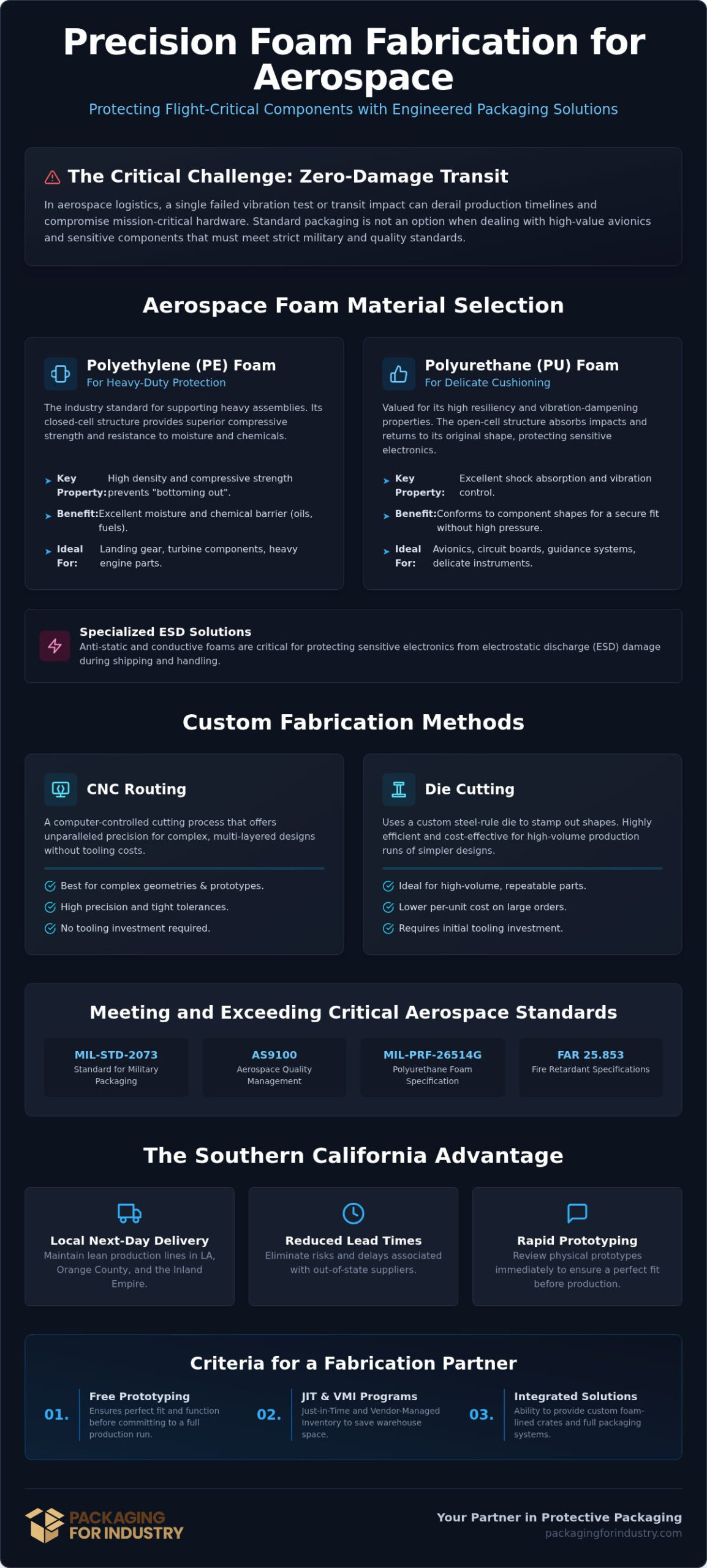
Aerospace foam fabrication is the discipline of creating precision-engineered protective environments for high-value, flight-critical components. Unlike generic cushioning, these systems are designed to withstand the unique G-forces, atmospheric shifts, and handling rigors inherent in aviation logistics. Southern California remains the global epicenter for this work. With major hubs in Orange County, Los Angeles, and San Diego, the region demands a supply chain that moves at the speed of innovation. Sourcing local foam fabrication for the aerospace industry in Southern California isn’t just a matter of convenience; it’s a strategic decision to eliminate the transit risks associated with long-distance shipping of custom packaging materials. The primary goal is simple: achieve zero-damage transit while maintaining strict compliance with AS9100 quality standards.
Meeting AS9100 and Mil-Spec Requirements
Standard off-the-shelf foam fails because it lacks the chemical stability and physical resilience required by aerospace durability standards. High-performance materials, such as syntactic foams used in structural applications, set a high bar for engineering that protective packaging must match in terms of precision. For defense-related contracts, compliance with MIL-STD-2073 is non-negotiable. This standard dictates exactly how components must be preserved and packed to prevent degradation. A professional fabricator ensures full material traceability and adherence to AS9100 quality management systems. This provides the documentation necessary for audit readiness and contract fulfillment. Standard foam often fails to meet these rigorous needs due to:
- Lack of anti-static properties for sensitive avionics.
- Insufficient density to support heavy engine components.
- Inconsistent cell structures that lead to material fatigue.
- Non-compliance with fire-retardant specifications like FAR 25.853.
The Southern California Advantage: Proximity and Speed
Operating within the SoCal aerospace corridor provides immediate logistical benefits. Manufacturers in Torrance or Irvine can’t afford the long lead times of out-of-state suppliers. Working with an Anaheim-based supplier allows for local next-day delivery, which is essential for maintaining a lean production line. By choosing local foam fabrication for the aerospace industry in Southern California, you gain a partner who understands the specific pace of the South Bay and Inland Empire markets. This proximity also facilitates face-to-face design consultations. Your engineers can review physical prototypes immediately, ensuring a perfect fit for complex geometries before the full production run begins. This local loop reduces freight costs, minimizes the carbon footprint of your operations, and provides the agility needed to handle aerospace packaging emergencies.
Aerospace Foam Materials: PE, PU, and ESD Solutions
Material selection dictates the success of any protective system. In the high-stakes environment of aerospace logistics, using a generic material is a liability. Precision foam fabrication for the aerospace industry in Southern California requires a deep understanding of polymer performance under stress. Engineers must balance weight, density, and chemical resistance to ensure that flight-critical hardware remains immobilized and protected from environmental hazards. Choosing the correct foam prevents component migration during transit and shields sensitive parts from the vibration frequencies encountered in cargo holds.
Polyethylene Foam for Heavy-Duty Protection
High-density polyethylene (PE) is the industry standard for supporting heavy assemblies such as landing gear or turbine components. Its closed-cell structure provides superior compressive strength, which prevents the material from “bottoming out” during high-impact events. Beyond physical support, PE offers excellent moisture and chemical resistance. Closed-cell foam acts as a functional barrier that prevents the absorption of oils, fuels, and hydraulic fluids commonly found in hangar environments. For components with highly polished or “Class A” surfaces, we utilize cross-linked polyethylene (XLPE). This material features a smoother, non-abrasive cell structure that eliminates the risk of surface scratching or micro-abrasion during long-haul transit.
While PE handles the heavy lifting, polyurethane (PU) provides the soft cushioning needed for lightweight, delicate instruments. Specialized aerospace applications, such as those detailed in NASA’s spray application procedures, demonstrate the high level of precision required for PU foam deployment in technical environments. In a packaging context, open-cell PU foam absorbs energy by allowing air to move through its cells, providing a “gentle” deceleration for fragile sensors.
ESD Foam for Avionics and Sensitive Electronics
Avionics and sensors require protection from both physical shock and electrostatic discharge (ESD). Static buildup can permanently damage micro-circuitry before a component even reaches the assembly line. We utilize two primary types of ESD-safe materials: anti-static (pink) and conductive (black) foam. Pink anti-static foam is treated with a topical agent to prevent static generation, while black conductive foam contains carbon to dissipate existing charges safely. Maintaining compliance with ESD S20.20 standards during the kitting process is essential for electronics manufacturers. If you’re ready to secure your high-value electronics, you can compare packaging pricing and material specs with our engineering team.
Custom Engineering: CNC Routing vs. Die-Cutting
Selecting the optimal fabrication method is as critical as the material itself when protecting high-value flight hardware. The choice between CNC routing and die-cutting depends on your production volume, the complexity of the part geometry, and your specific requirements for precision. Professional foam fabrication for the aerospace industry in Southern California relies on advanced CAD/CAM support to translate complex engineering drawings into physical protective environments. This technical oversight ensures that every insert meets the rigorous tolerances required for “shadowing,” a process essential for Foreign Object Damage (FOD) prevention where every tool and component has a dedicated, visible home.
Our engineering team also ensures that all manufacturing processes adhere to the latest environmental regulations for foam production. This compliance protects your supply chain from regulatory disruptions while maintaining the high performance required for aerospace applications.
CNC Routing for Complex Aerospace Geometries
CNC routing is the preferred method for low-volume production and highly complex parts such as engine components or multi-piece avionics kits. By utilizing multi-axis routing machines, fabricators can create deep cavities and multi-level inserts that perfectly mirror the profile of an aircraft component. This method eliminates the need for expensive tooling, allowing for rapid design changes and custom design packaging adjustments on the fly. It’s the most efficient solution for:
- Large, bulky components like landing gear assemblies.
- Deep-pocket inserts that require multiple depth levels.
- Prototyping new designs before committing to high-volume tooling.
- Low-volume specialized defense contracts.
Die-Cutting for High-Volume Production Runs
When your operation requires standardized parts in large quantities, die-cutting is the superior choice to lower packaging costs. This process uses a custom steel-rule die to punch out shapes with high speed and repeatability. While there’s an initial investment in tooling, the per-unit savings for high-volume runs of foam end caps, simple pads, or standard gaskets are significant. Die-cutting provides the consistency needed for high-speed assembly lines in the Inland Empire and San Diego regions. For maximum protection during international transport, these precision-cut foam assemblies are often integrated into custom wood crates. This integrated approach ensures that the internal foam cushioning works in tandem with the external structural integrity of the crate to prevent any component migration or impact damage during transit.
Selecting a Foam Fabrication Partner in SoCal
Choosing a partner for foam fabrication for the aerospace industry in Southern California requires more than a simple price comparison. You need a supplier capable of handling the rigorous quality standards of the South Bay and Orange County aerospace corridors while providing the logistical agility to prevent production delays. A reliable partner acts as a consultant; they should evaluate your current transit damage rates and offer engineering improvements that lower packaging costs over time. Local support is vital for maintaining a lean operation. Verify that your supplier can provide dependable delivery to facilities in the Inland Empire and San Diego to keep your production lines moving without interruption.
The Role of Free Prototyping in Risk Mitigation
You shouldn’t commit to a full production run of custom inserts without first testing a physical prototype. Prototyping allows your engineering team to verify the exact part fit and shock absorption capabilities before a single high-value component leaves your facility. Our design team utilizes free prototyping to optimize box sizing and material density. By refining the dimensions of the internal cushioning, we often reduce the overall footprint of the shipping container. This optimization directly slashes freight costs and maximizes pallet density, ensuring you don’t pay to ship unnecessary air.
Integrated Solutions: Beyond the Foam Insert
Efficiency in the aerospace supply chain often comes from consolidating vendors and reducing touchpoints. Selecting a single-source supplier for foam packaging and heavy-duty corrugated boxes eliminates the logistical friction of coordinating multiple deliveries from different regions. This integrated approach allows for seamless kitting and assembly services. Your team receives a completed package, with foam already precision-fitted into the box, which streamlines your internal production line and reduces warehouse labor costs.
For larger, palletized aerospace shipments, we combine precision foam with specialized corner and edge protection. This multi-layered strategy ensures that sensitive avionics or composite panels remain immobilized even during the turbulence of international air freight. Whether you require low-volume custom kits or high-volume repeat orders for standardized parts, your fabricator must demonstrate the capacity to scale without compromising on AS9100 or Mil-Spec compliance. We maintain the inventory levels necessary to support bulk quantities, ensuring your specialized packaging is always available when production ramps up.
Optimizing Your Supply Chain with PFI’s Aerospace Solutions
Precision engineering and material science are only half of the equation. For a supply chain to remain resilient, the physical packaging must be available precisely when your production line requires it. High-performance foam fabrication for the aerospace industry in Southern California requires a partner who understands that warehouse space in Los Angeles and Orange County is a premium asset. We focus on logistical optimization that reduces your overhead while ensuring your flight-critical components never sit unprotected. By integrating custom sizes and specialized protection into a streamlined delivery model, we help you maintain the agility needed for modern aerospace manufacturing.
Vendor Managed Inventory (VMI) for Aerospace
Stockouts of custom packaging can halt a multi-million dollar production line. Our VMI programs eliminate this risk by placing the responsibility for inventory levels on our team. We monitor your usage patterns and restock your supply of custom foam inserts before you hit a critical low. This system simplifies the purchasing process for procurement teams working in high-pressure defense and commercial environments. It also provides a significant boost to your cash flow, as you don’t pay for the packaging until it’s ready for use. Procurement becomes a predictable, automated process rather than a constant source of operational stress.
Local Next-Day Delivery Across Southern California
Proximity is your greatest defense against supply chain disruption. We serve the primary aerospace hubs of the region with a dedicated local fleet, providing a level of reliability that national freight carriers can’t match. Whether your facility is in Irvine, Huntington Beach, Carson, or Torrance, our local presence ensures you receive your materials exactly when promised. This proximity is essential for:
- Maintaining Just-in-Time (JIT) production schedules to save floor space.
- Responding immediately to emergency packaging needs for AOG (Aircraft on Ground) situations.
- Reducing the freight costs and carbon footprint associated with long-distance shipping.
- Ensuring consistent handling by drivers who understand industrial delivery protocols.
Our expertise in foam fabrication for the aerospace industry in Southern California extends from the initial design phase to final doorstep delivery. We understand the technical requirements of AS9100 standards and the economic requirements of your bottom line. By sourcing locally, you gain a partner that’s as invested in your production timeline as you are. If you’re looking to lower packaging costs and improve your logistical flow, it’s time to transition to a provider that offers comprehensive oversight and total accountability.
It’s time to transition to a packaging system that offers total accountability and engineered reliability. We look forward to helping your facility achieve zero-damage shipping and a more efficient logistical future.
Frequently Asked Questions
What is the best foam for shipping sensitive aerospace electronics?
The best choice is typically Electrostatic Discharge (ESD) safe foam, specifically anti-static Polyurethane for delicate sensors or conductive Polyethylene for heavier avionics. These materials prevent static buildup that can destroy micro-circuitry. We provide custom sizes available in both pink anti-static and black conductive options. Our engineering team helps you compare packaging pricing and material specs to ensure your sensitive components remain protected throughout the entire shipping and handling cycle.
How does custom foam fabrication help prevent Foreign Object Damage (FOD)?
Custom foam fabrication prevents Foreign Object Damage (FOD) through high-precision tool shadowing. By creating exact cutouts for every component, technicians can instantly verify if a tool or part is missing from a kit. This visual accountability is a critical requirement in many AS9100-certified facilities. We use CNC routing to create these intricate cavities, ensuring that no loose debris or missing tools enter a flight-critical environment. This system simplifies inspections and improves overall hangar safety.
Can you provide Mil-Spec compliant foam inserts in Southern California?
Yes, we specialize in providing Mil-Spec compliant inserts for defense and aviation contracts. Our foam fabrication for the aerospace industry in Southern California adheres to MIL-STD-2073 and MIL-PRF-26514G requirements. We ensure full material traceability and documentation for every order. When you request a packaging quote, our experts verify that all materials meet the necessary military standards. This proactive approach prevents compliance errors and ensures your high-value components are protected during long-term storage or transit.
What is the difference between CNC routing and die-cutting for foam?
CNC routing is a tool-less process ideal for low-volume, highly complex parts with multiple depth levels. It allows for rapid design changes without upfront costs. Die-cutting uses a steel-rule die to punch out simple shapes at high speeds, which is the most efficient way to lower packaging costs for large production runs. We help you evaluate which method fits your budget and volume requirements. Both processes deliver the precision needed for modern, high-value aerospace components.
Does PFI offer free prototyping for custom aerospace foam designs?
We offer free prototyping for all custom aerospace foam designs to eliminate technical risk before production. You can request a packaging quote and receive a physical sample to verify the part fit and shock absorption qualities. This step is critical for ensuring that complex avionics or composite panels are perfectly immobilized. Our designers use these prototypes to refine box dimensions, which often leads to reduced freight costs and improved warehouse storage efficiency for your facility.
How can a VMI program help my aerospace manufacturing facility?
A Vendor Managed Inventory (VMI) program eliminates the risk of packaging shortages by automating the replenishment process. We monitor your stock levels and deliver custom foam inserts before you hit a critical low. This system improves your cash flow because you only pay for the packaging you use. It also saves significant time for procurement teams, allowing them to focus on high-value operations instead of managing bulky packaging inventory in limited Southern California warehouse space.
What Southern California cities do you provide next-day delivery to?
We provide local next-day delivery to major aerospace hubs throughout the region. This includes Orange County cities like Anaheim, Irvine, and Huntington Beach, alongside Los Angeles County locations like Carson and Torrance. Our local presence ensures that your foam fabrication for the aerospace industry in Southern California arrives exactly when your production line needs it. We also offer dependable shipping to the Inland Empire and San Diego, helping you avoid the long lead times of out-of-state suppliers.
Do you offer anti-static foam for avionics kitting?
Yes, we provide specialized anti-static and conductive foam for kitting and assembly lines. These materials are essential for preventing electrostatic discharge during the handling of sensors, circuit boards, and other avionics. We can supply custom-sized foam inserts that integrate directly into RSC boxes or custom crates. This single-source approach streamlines your internal production flow and ensures that every kit component remains protected from both physical impact and static damage during assembly and final shipping.