
A single hairline fracture on a specialized surgical instrument isn’t just a logistical headache; it’s a direct threat to patient safety and your brand’s reputation. You already know that high-value medical devices require far more than standard padding to survive the rigors of transit and clinical handling. For manufacturers across Southern California, sourcing precision die cut foam inserts for medical trays San Diego is often the missing link between a vulnerable supply chain and total operational confidence. It’s about ensuring every tray arrives in the operating room exactly as intended: organized, sterile, and ready for immediate, flawless use.
In this guide, you’ll learn how to specify, source, and optimize these critical foam components to protect your most sensitive equipment while you simultaneously work to lower packaging costs. We’ll explore how custom-engineered foam solutions can eliminate shipping damage and provide the professional tray organization that surgeons expect in high-stakes environments. We’ll also cover how leveraging local resources like vendor-managed inventory and next-day delivery can transform your San Diego logistics from a warehouse bottleneck into a streamlined, competitive advantage for your business.
Key Takeaways
- Identify the performance differences between PE, PU, and ESD foams to match the right material to your device’s weight and sensitivity.
- Understand why precision die cut foam inserts for medical trays San Diego are the industry standard for achieving the tight tolerances required in surgical environments.
- Streamline your procurement process using a professional sourcing checklist that covers instrument geometry, foam density, and material selection.
- Reduce operational overhead and lower packaging costs by utilizing local services like vendor-managed inventory and next-day delivery in Southern California.
- Learn how to combine custom-engineered foam with heavy-duty corrugated boxes to create a comprehensive, damage-resistant shipping solution.
The High Stakes of Medical Tray Packaging in San Diego
San Diego’s biotech corridor and Sorrento Valley are home to some of the world’s most sophisticated medical device manufacturers. For these companies, off-the-shelf packaging isn’t just inadequate; it’s a liability. Generic foam lacks the density and precision required to secure high-value surgical tools. When instruments shift during transit, the resulting vibration can compromise calibrated optics or dull the fine edges of cutting tools. By investing in die cut foam inserts for medical trays San Diego manufacturers can ensure their products arrive in factory-perfect condition. This transition from generic to custom solutions is a primary driver for companies looking to lower packaging costs by eliminating the high price of replacement kits and expedited re-shipping.
Protecting Sensitive Medical Components
Fragile electronics and sensitive optics require specific G-force protection that only custom engineering provides. Standard foam often collapses under the weight of heavy instruments or fails to dampen the high-frequency vibrations of air and truck transport. Beyond impact protection, surface abrasion is a major concern. If a component rubs against its packaging, it can compromise sterile barriers or scratch delicate finishes. Precision Die Cutting allows for a “snug-fit” geometry that eliminates movement entirely. This process ensures that even the most intricate components remain stationary throughout the entire supply chain. The failure of a single surgical kit due to transit damage can result in substantial financial losses and critical delays in patient care.
Organization for Clinical Workflows
Surgeons and clinical staff operate in high-pressure environments where every second counts. Tray organization is a direct reflection of your brand’s commitment to quality. Professional “shadowing,” where the foam cutout mirrors the exact shape of the instrument, allows for immediate visual verification of a complete kit. It also ensures that tools are always presented in the same orientation, which is vital for automated assembly lines and rapid clinical deployment. Customized die cut foam inserts for medical trays San Diego provide the exact tolerances needed for complex instrument sets. When every tool has a dedicated, clearly defined space, the risk of procedural errors decreases. For companies looking to custom design packaging that meets these rigorous standards, local expertise is essential. High-quality presentation doesn’t just protect the product; it reinforces the surgeon’s trust in the device itself.
Selecting Medical-Grade Foam: PE vs. PU vs. ESD
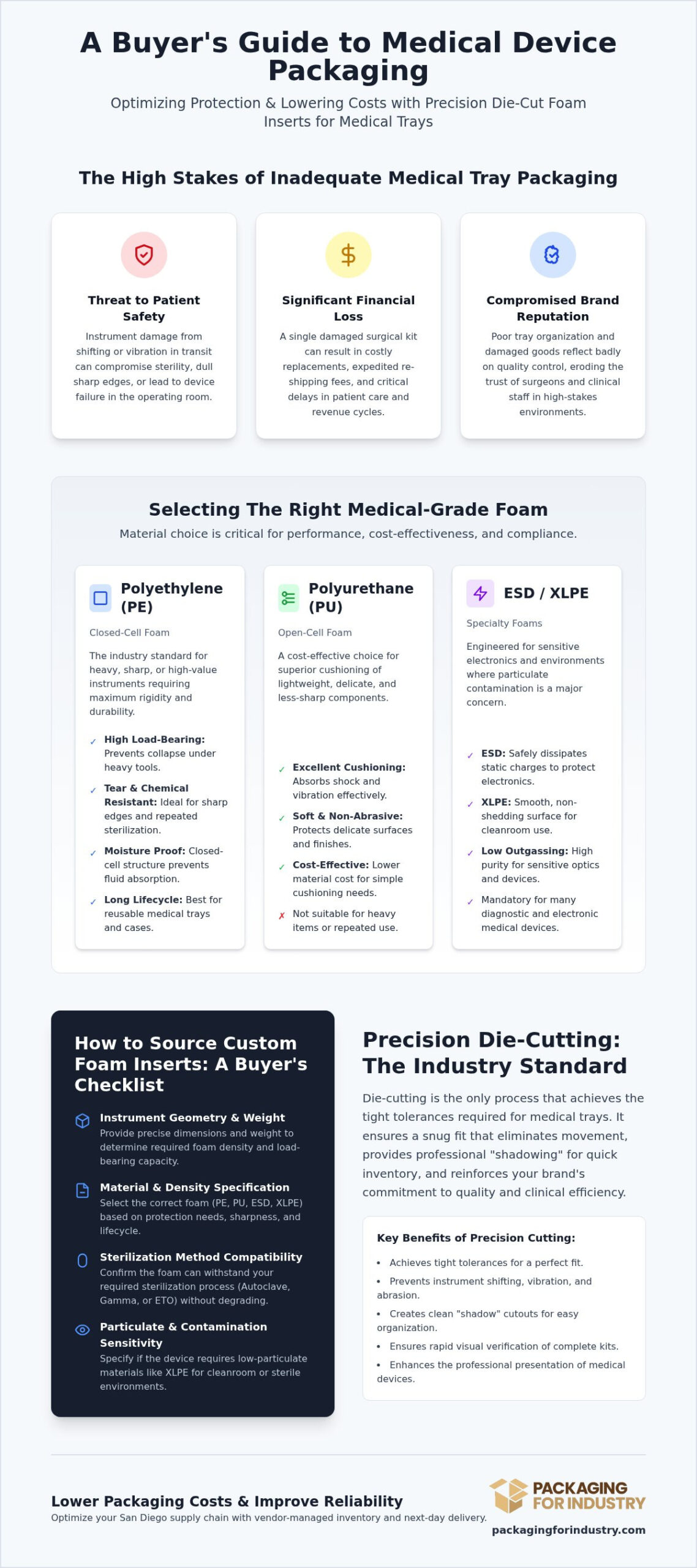
Choosing the right material for die cut foam inserts for medical trays San Diego is a technical decision with significant financial implications. Polyethylene (PE) is a closed-cell foam known for its rigidity and high load-bearing capacity. It’s the preferred choice for heavy surgical instruments or tools with sharp edges that would otherwise tear through softer materials. In contrast, Polyurethane (PU) is an open-cell foam that offers superior cushioning for lightweight, fragile components. While PU is often more cost-effective for simple cushioning, it lacks the long-term durability of PE for multi-use trays. For environments where particulate contamination is a risk, Cross-linked Polyethylene (XLPE) is mandatory. It offers a smooth surface, low outgassing, and high chemical resistance, making it compatible with most medical sterilization processes.
Material Performance Comparison
Manufacturers must weigh material characteristics against the rigorous requirements of FDA’s Quality System Regulation. PE foam provides excellent chemical resistance, which is vital for trays that undergo repeated cleaning. Its closed-cell structure prevents moisture absorption, unlike PU, which can trap fluids and contaminants. If your supply chain involves reusable medical cases, the higher upfront cost of PE often leads to lower packaging costs over the product’s lifecycle because it doesn’t degrade as quickly as open-cell alternatives. We recommend evaluating the following factors during selection:
- Instrument weight and sharp-edge potential
- Sterilization method (Autoclave, Gamma, or ETO)
- Expected lifecycle of the tray
- Particulate sensitivity of the device
ESD Protection for Medical Electronics
Standard foam can generate static charges that destroy sensitive diagnostic electronics before they even reach the hospital. Anti-static and Electrostatic Dissipative (ESD) foams are engineered with conductive additives to safely bleed off static. Identifying the correct resistivity level is critical; too much resistance fails to protect the device, while too little can cause shorts. You can review specific material technical data on our foam packaging page to ensure your selection meets industry standards. Using the wrong foam for electronics doesn’t just risk damage; it can lead to massive recall costs and regulatory scrutiny. If you’re unsure which density or material type fits your specific instrument geometry, you can request a packaging quote to consult with our engineering team for a precise recommendation.
Precision Die Cutting for Complex Medical Trays
High-volume medical device production demands a manufacturing process that balances extreme precision with logistical speed. While CNC routing is often used for low-volume prototypes, die cutting remains the industry standard for large-scale medical tray production. This method utilizes custom steel-rule dies to stamp out complex geometries in seconds, providing a level of repeatability that automated routing cannot match at scale. For companies sourcing die cut foam inserts for medical trays San Diego, this efficiency translates directly to lower packaging costs and more reliable lead times. Die cutting allows for the rapid production of thousands of identical units, ensuring that every kit in a shipment meets the exact same quality standards.
Complex surgical kits often require multi-layer foam assemblies to accommodate instruments of varying depths and shapes. By laminating different densities or thicknesses of foam together, engineers can create a three-dimensional nest that secures every component regardless of its profile. This integrated approach ensures that even the most delicate instruments remain immovable during the high-vibration environments of air freight or truck transport. It also allows for color-coding or “shadowing,” where a different colored bottom layer makes it immediately obvious if a tool is missing from the tray.
Engineering for Precision Fit
The design process begins with CAD/CAM integration, where your device’s exact specifications are used to create the cutting die. This digital-to-physical workflow ensures that tolerances remain within the strict requirements of the ISO 11607-1 standard for sterile medical device packaging. Beyond protection, clinical ergonomics play a major role in the design phase. Finger wells and easy-access cutouts are strategically placed to ensure surgical staff can retrieve instruments quickly and safely during a procedure. A precision-engineered fit eliminates the need for secondary void fill, reducing material waste and streamlining the kitting process.
Scaling from Prototype to Production
Transitioning from a design concept to a full production run requires a partner who understands the economics of scale. PFI provides free prototyping and samples to ensure a perfect product fit before you commit to full-scale tooling. While there is an initial investment in die tooling, the per-unit cost drops significantly as volume increases; this makes it the most fiscally responsible choice for recurring medical tray orders. Our manufacturing solutions are designed to support the San Diego biotech sector with both technical expertise and local logistical support. By combining precision engineering with high-speed production, we help manufacturers maintain consistent quality without the lead time inconsistencies common with large catalog suppliers.
How to Source Custom Foam Inserts: A Buyer’s Checklist
Procuring die cut foam inserts for medical trays San Diego requires a methodical approach to balance technical performance with budgetary constraints. The first step involves a deep dive into your instrument’s geometry and weight. Without precise measurements, the resulting insert won’t provide the “snug fit” necessary to pass vibration testing. Buyers must also decide on secondary requirements early in the process. Do you need adhesive backing for permanent tray mounting? Is color-coding required for kit completeness checks? By defining these parameters upfront, you avoid costly design revisions later in the production cycle. Finally, always evaluate supplier capabilities based on their proximity to your facility, as local logistics significantly impact your total landed cost.
Lowering Packaging Costs through Smart Specification
A common mistake in medical packaging is over-engineering. While high-density cross-linked foam is impressive, it’s often unnecessary for lightweight plastic components. Choosing the right material density for the specific application is one of the most effective ways to lower packaging costs. Additionally, consider standardizing your tray dimensions. If you design your foam inserts to fit into stock sizes of corrugated boxes, you eliminate the need for expensive custom-sized outer cartons. This holistic view of the packaging suite ensures that each component works together without redundant materials or wasted space.
Evaluating Lead Times and Stocking Programs
In the fast-paced San Diego biotech sector, a two-week delay in packaging can halt an entire production line. National catalog suppliers often struggle with consistent lead times for custom-engineered products. Partnering with a local supplier allows you to utilize Vendor Managed Inventory (VMI) to eliminate the risk of stockouts. These programs ensure that your die cut foam inserts for medical trays San Diego are always available for just-in-time delivery. By maintaining a buffer of finished goods locally, you can pivot to meet sudden increases in demand without the stress of managing bulk inventory in your own limited warehouse space. This logistical reliability is just as critical as the engineering of the foam itself.
San Diego’s medical device ecosystem, particularly in Sorrento Valley and Carlsbad, operates on tight schedules and even tighter tolerances. For these manufacturers, a generic supplier based in a distant hub simply cannot provide the responsiveness required for high-stakes product launches. Packaging For Industry (PFI) serves as a strategic local partner, offering specialized expertise in die cut foam inserts for medical trays San Diego. Our proximity allows us to go beyond just delivering a product; we provide a comprehensive logistical system designed to protect your instruments and your bottom line.
We provide integrated solutions that combine precision foam inserts with custom-sized, heavy-duty corrugated boxes. This single-source approach ensures a perfect fit between the protective foam and the outer shipping container, which is essential for passing rigorous drop and vibration tests. By sourcing both components from PFI, you can significantly lower packaging costs by reducing freight expenses and administrative overhead.
The PFI Local Advantage in Southern California
Our local presence provides tangible benefits that national catalog suppliers cannot match. We offer local next-day delivery across San Diego, Carlsbad, and the Inland Empire, ensuring your production line never stalls due to a packaging shortage. Because we are nearby, our team can perform on-site packaging reviews to identify specific damage reduction opportunities in your current workflow. This hands-on approach helps you request a packaging quote that’s tailored to your actual operational needs rather than a best-guess estimate from a distant sales rep.
Streamlining Procurement with VMI
Managing bulk inventory is a major challenge for San Diego manufacturers with limited warehouse space. Every square foot dedicated to storing empty boxes or foam is space that isn’t being used for high-value production. Our Vendor Managed Inventory (VMI) programs solve this problem by shifting the inventory burden to us. PFI monitors your stock levels and manages the replenishment of your die cut foam inserts for medical trays San Diego automatically.
This “just-in-time” model ensures you always have the packaging you need without the clutter of excess stock. It’s a pragmatic solution for businesses that want to focus on engineering life-saving devices rather than tracking pallet counts of packaging material. By partnering with a Southern California specialist, you gain the peace of mind that comes from a steady, reliable supply chain and a partner who understands the local industrial landscape.
Optimize Your Medical Supply Chain with Precision Protection
Securing high-value surgical instruments requires a strategic balance of engineering and logistics. By selecting the right material density and utilizing precision die cutting, you can eliminate transit damage while you work to lower packaging costs. Customized die cut foam inserts for medical trays San Diego provide the professional presentation surgeons expect and the durability clinical environments demand. Moving from generic catalog options to a specialized local partner ensures your supply chain remains resilient. It’s about reliability. We simplify your logistics.
Packaging For Industry (PFI) brings deep expertise in medical device and aerospace packaging standards to every project. We offer free prototyping to ensure a guaranteed product fit before you commit to a full production run. Our local next-day delivery in San Diego and across Southern California means you don’t have to wait for national carriers to catch up with your schedule. We’re here to help you streamline your procurement and protect your most critical assets.
We look forward to helping you build a more efficient and reliable packaging system for your business.
Frequently Asked Questions
What is the minimum order quantity (MOQ) for custom die cut foam inserts?
PFI specializes in bulk orders and custom sizes for industrial manufacturers. While MOQs depend on the material and tool complexity, we typically focus on production-level volumes where die cutting is most efficient. Custom tooling makes higher quantities more cost-effective per unit. We help you find the right balance between order frequency and pricing to lower packaging costs. Contact us for a specific quote based on your project’s technical requirements.
How do I choose between Polyethylene and Polyurethane foam for medical trays?
Base your choice on instrument weight and sensitivity. Polyethylene (PE) is a rigid, closed-cell material ideal for heavy tools or sharp edges. It’s durable and resists moisture. Polyurethane (PU) is a softer, open-cell foam best for lightweight cushioning. For medical environments, PE is often the standard because it’s easier to clean and maintains its shape. We can help you evaluate the technical trade-offs during the prototyping phase.
Can PFI design foam inserts that are ESD-safe for medical electronics?
We provide anti-static and Electrostatic Dissipative (ESD) foam specifically for sensitive diagnostic electronics. These materials safely bleed off static charges that can destroy electronic components during transit. When you source die cut foam inserts for medical trays San Diego from PFI, we ensure the material meets your exact resistivity standards. This protection is critical for high-value medical devices. It prevents the high cost of damage-related returns and maintains your brand’s reputation.
How long does the prototyping process take for a custom medical tray?
Prototyping is an efficient process once we receive your instrument’s CAD files or physical samples. We provide free prototyping to ensure a perfect fit before you commit to a full production run. This stage allows you to verify the tray organization and material performance. By working with a local partner, you avoid the long lead times common with catalog suppliers. Most prototypes are completed quickly to keep your product launch on schedule.
Do you offer local delivery for medical device manufacturers in San Diego?
We offer local next-day delivery for medical device manufacturers throughout San Diego County. This includes Sorrento Valley, Carlsbad, and the surrounding Southern California areas. Our local logistics network is built for speed and reliability. By using a local supplier, you reduce freight costs and eliminate the transit risks associated with long-distance shipping. This proximity allows our team to provide on-site support and immediate replenishment for your high-volume production lines.
Can custom foam inserts be integrated with medical-grade corrugated boxes?
Combining custom foam with heavy-duty corrugated boxes is a standard part of our service. We design the foam and the outer box together to ensure a seamless fit. This integrated approach is essential for passing vibration and drop tests. It also simplifies your supply chain by allowing you to source everything from a single partner. You can request a packaging quote for a complete kit solution that includes both protective foam and custom cartons.
What information is needed to request a packaging quote for custom foam?
We need your instrument’s dimensions, weight, and any specific material requirements like ESD safety or chemical resistance. Providing CAD files or physical samples allows us to achieve the tightest tolerances for your tray. We also require your estimated order volume to help you compare packaging pricing accurately. This information helps our engineering team recommend the most cost-effective design. Clear specifications upfront prevent design delays and help you lower packaging costs.
How does a VMI program help reduce my packaging costs?
A VMI program lowers costs by shifting the inventory management and storage burden to us. PFI monitors your stock levels and delivers your die cut foam inserts for medical trays San Diego just-in-time for production. This frees up valuable warehouse space for your manufacturing operations. You benefit from bulk pricing without the need for large on-site storage. It’s a pragmatic solution that improves your cash flow and eliminates the risk of expensive production shutdowns.