
Surface protection is a precision engineering challenge, not just a simple choice of wrapping material. For manufacturers in high-stakes sectors like aerospace and medical device production, a single hairline scratch on a polished component doesn’t just mean a cosmetic flaw; it represents a costly rejection and an immediate hit to your operational efficiency. You’ve likely found that off-the-shelf catalog supplies offer inconsistent results, leading to expensive rework and frustrated quality control teams.
We understand that your goal is a zero-defect delivery every time a shipment leaves your dock. This article demonstrates how specialized packaging design to prevent surface scratching on polished metals utilizes custom-engineered foam and integrated kitting to eliminate the friction that causes transit damage. You’ll learn how to leverage CAD/CAM design and free prototyping to create a secure, movement-free environment for your most sensitive parts. We’ll also explore how these tailored solutions actually lower your total packaging costs by reducing waste and streamlining your assembly line flow.
Key Takeaways
- Understand how transit vibration converts standard packaging into an abrasive and why specific foam densities are required to maintain surface integrity.
- Learn how an integrated packaging design to prevent surface scratching on polished metals utilizes a “zero-movement” philosophy to secure high-value components.
- Identify the material differences between PE and PU foams to determine the most cost-effective protection for your specific metal finishes.
- Discover how custom-engineered kitting and Vendor Managed Inventory (VMI) programs can lower your total packaging costs by reducing rework and shipping damage.
- Explore industry-specific solutions for aerospace and medical sectors, ensuring compliance with strict quality standards and cleanroom requirements.
The Mechanics of Surface Damage: Why Polished Metals Scratch
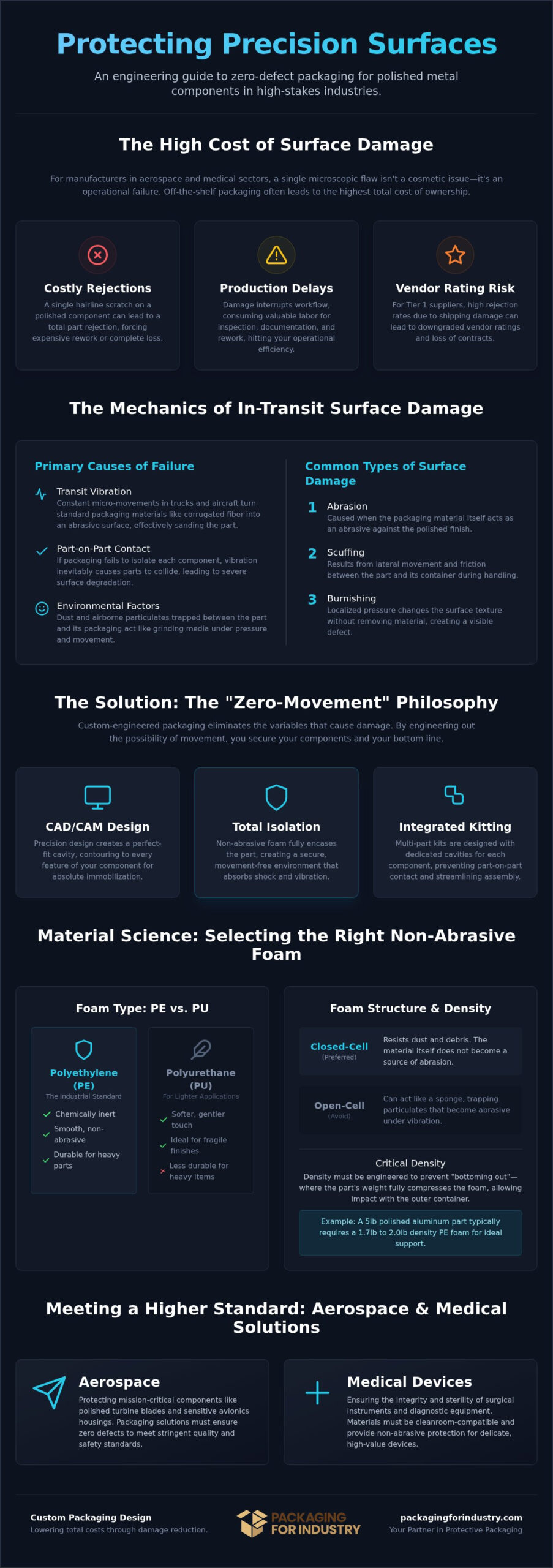
Polished metal surfaces are incredibly sensitive. Even microscopic imperfections can lead to a failed inspection in high-precision industries. Effective packaging design to prevent surface scratching on polished metals requires a technical understanding of how damage occurs during the logistical cycle. Surface damage typically falls into three categories. Abrasion happens when the packaging material itself acts as an abrasive. Scuffing is caused by lateral movement during handling. Burnishing occurs when localized pressure changes the surface texture of the metal without removing material. Each of these defects can trigger a total part rejection.
Environmental factors also play a critical role. Dust and airborne particulates can become trapped between the product and the packaging. When these particles are pressed against a polished surface, they act like grinding media. Part-on-part contact remains the primary cause of rejection in high-volume manufacturing environments. If your packaging doesn’t physically isolate each component, vibration will inevitably lead to surface degradation.
Understanding Vibration and Friction in Logistics
Transit is an inherently violent environment for finished goods. While a pallet might look stationary, it’s subjected to constant high-frequency vibrations in LTL trailers and different harmonic stresses in air freight. These micro-movements turn standard corrugated fibers into sandpaper. If the packaging allows any movement, the part effectively sands itself against the box. This is why standard bubble wrap often fails for heavy polished components. The air cells collapse under weight, allowing the metal to contact the outer container. The 2025 update to the ASTM F1886 standard, specifically Part 2 for Material Surface Inspection, highlights the industry’s shift toward verifying that protective foam packaging is free from defects that could trigger these abrasive reactions.
The Financial Impact of Surface Rejections
Rejections in sectors like aerospace and medical manufacturing aren’t just minor setbacks. They’re operational disasters. When a polished turbine blade or surgical instrument is rejected for surface scuffing, the cost of rework often exceeds the initial production margin. For Tier 1 suppliers, high rejection rates can lead to downgraded vendor ratings and the loss of long-term contracts. Choosing “cheap” catalog supplies often leads to the highest total cost of ownership once you factor in scrap rates and the labor required for inefficient kitting. Investing in custom design packaging eliminates these variables. By engineering out the possibility of movement, you secure your bottom line and ensure a zero-defect delivery. This proactive approach is the most effective way to achieve long-term packaging cost savings through damage reduction.
Comparing Materials for Non-Abrasive Packaging Design
Selecting the right material is the foundation of any packaging design to prevent surface scratching on polished metals. While standard corrugated provides structural integrity, it’s the interface between the metal and the container that determines whether a part arrives in “A-surface” condition. You need materials that offer high friction resistance without leaving residue or causing micro-abrasions.
Polyethylene (PE) foam serves as the industrial standard for non-abrasive cushioning. It’s chemically inert and offers a smooth surface that won’t react with sensitive metal finishes. For exceptionally fragile or lightweight finishes, polyurethane (PU) foam provides a softer touch, though it’s less durable for heavy industrial applications. If your polished metal components are electronic housings, utilizing anti-static or ESD-grade foam is essential to prevent both physical scuffing and electrostatic discharge.
Foam Density and Cell Structure
Cell structure significantly impacts how a material interacts with a polished surface. Closed-cell foams, like most PE options, are preferred because they don’t trap dust or debris within their structure. Open-cell foams can act like a sponge for particulates, which then become abrasive under transit vibration. You must ensure the material itself doesn’t become the cause of the damage you’re trying to prevent.
Selecting the correct density is vital to prevent “bottoming out,” a failure where the part’s weight compresses the foam entirely, allowing it to strike the outer box. For a 5lb polished aluminum part, a 1.7lb to 2.0lb density polyethylene foam typically provides the ideal balance of cushioning and surface contact resistance. Using a density that’s too high can be too rigid and cause scuffing, while a density that’s too low fails to support the weight during transit shocks.
Specialized Protective Liners
Sometimes foam isn’t enough on its own. Spun-bond polypropylene liners offer a non-woven, soft barrier that’s specifically designed for high-value surfaces. These liners are often used as a first wrap before the part is placed into a foam insert. Another option is using coated corrugated boards. These boards feature a wax or polyethylene coating that covers the abrasive wood fibers of the box, creating a smoother interior surface that reduces the risk of scuffing.
In high-volume assembly lines, using custom poly bags as a primary barrier is often the most efficient way to protect parts from dust and moisture. These bags provide a clean interface that remains with the part until the moment of installation. If you’re unsure which material combination best suits your specific finish, you can request a packaging quote to have our engineering team evaluate your requirements and provide a custom-tailored solution.
Engineering the Integrated Packaging System
Protecting high-value finishes requires more than just a soft wrap; it necessitates an integrated system where every component works in unison. A successful packaging design to prevent surface scratching on polished metals relies on a “Zero-Movement” philosophy. By eliminating the space where a part can shift, you neutralize the vibration-induced friction that leads to scuffing or burnishing. This approach moves beyond standalone materials to create a custom-engineered environment for each specific component.
The synergy between custom corrugated boxes and precision-cut foam ensures that exterior structural strength complements the internal cushioning. Integrated systems allow for faster pack-out times on production lines through packaging kitting, where all necessary components arrive as a single unit ready for assembly. We provide free prototyping to verify these designs. This allows you to test the fit and finish of the integrated system before committing to a full production rollout.
Custom Foam Inserts and End Caps
Engineering custom foam inserts for complex geometries requires CAD/CAM support to achieve the precision tolerances necessary for polished parts. For long or heavy components, end cap designs are often the most efficient solution. These caps suspend the part in the center of the shipping container, ensuring that the critical “A-surfaces” never come into contact with the outer walls. This suspension method provides a buffer zone that absorbs impacts and prevents the part from bottoming out during rough handling.
Heavy-Duty Outer Protection
While internal cushioning prevents scratches, the outer container must withstand the rigors of the global supply chain. For heavy industrial components, we utilize double-wall or triple-wall corrugated to prevent box deformation under load. When shipments involve international transit or extreme weights, we often recommend upgrading to custom shipping crates. These wood structures provide the ultimate rigid shell for your integrated foam systems. Additionally, the strategic use of corner and edge protection prevents box compression when pallets are stacked. This maintains the internal “Zero-Movement” environment throughout the entire logistical journey.
Industry-Specific Solutions for Polished Metals
Every industry defines a “defect” differently based on the final application of the part. For a Tier 1 automotive supplier, a scuffed trim piece is a cosmetic failure that stops an assembly line. In aerospace or medical fields, a surface defect can represent a functional risk or a safety violation. Effective packaging design to prevent surface scratching on polished metals must account for these specific regulatory and operational environments. A one-size-fits-all approach often fails because it doesn’t consider the chemical sensitivities or cleanliness requirements of specialized sectors.
Aerospace and Defense Standards
As of July 2026, MIL-STD-2073-1 remains the core standard governing military preservation and protection methods. Aerospace components, such as turbine blades or polished aluminum skins, require packaging that survives long-term storage and global deployment without surface degradation. We design solutions that meet these rigorous mil-spec packaging requirements. These designs often utilize suspension kitting to ensure high-value, low-volume parts never touch the outer container walls. This level of engineering is essential for components that may sit in a warehouse for years before being called into service.
Medical Device and Semiconductor Protection
Medical manufacturing demands materials that are particulate-free and often cleanroom-compatible. Polished surgical instruments and semiconductor equipment can’t tolerate the “shedding” or chemical outgassing found in standard industrial foams. We utilize specialized closed-cell polyethylene foams that meet low-outgassing requirements while maintaining sterile barrier integrity. The 2025 update to the ASTM F1886 standard emphasizes the importance of material surface inspection, ensuring that the packaging itself doesn’t introduce microscopic defects that could compromise a medical device’s performance or biocompatibility.
For the electronics sector, we integrate surface protection with ESD safety. Polished electronic housings are vulnerable to both physical scuffing and electrostatic discharge. Our custom-engineered solutions use dissipative materials that provide a soft-touch interface, preventing micro-abrasions while safely grounding the component. In automotive applications, we focus on high-density kitting for decorative trim. By isolating each polished component in a dedicated foam cavity, we eliminate the part-on-part contact that is the primary cause of rejection in high-volume production cycles. This methodical approach ensures your components arrive in factory-perfect condition, regardless of the industry standards you must meet.
Optimizing Procurement: Custom Design and VMI Programs
Procurement professionals often view packaging as a secondary expense, yet for high-value components, it’s a critical factor in the total cost of ownership. Even the most advanced packaging design to prevent surface scratching on polished metals loses its value if your production line stops due to a stockout. We view packaging as a logistical system that must be as reliable as your manufacturing process. By integrating custom design packaging with advanced inventory management, we help you eliminate the hidden costs of shipping damage and operational delays.
Our Vendor Managed Inventory (VMI) program is designed for high-stakes environments like aerospace and medical manufacturing. We take full responsibility for monitoring your stock levels and triggering replenishments before you hit a critical low. This proactive approach ensures that your team always has the exact die-cut inserts and heavy-duty corrugated boxes needed for the day’s production. You can request a packaging quote to see how a managed inventory system can stabilize your supply chain.
Streamlining the Supply Chain
Efficiency in the warehouse is just as important as protection in transit. Stocking bulk quantities of custom packaging can consume valuable floor space that’s better used for production. Our VMI and just-in-time delivery models allow you to reduce your warehouse footprint significantly. Instead of managing a massive inventory of oversized catalog boxes, you receive exactly what you need for your current kitting requirements. This model offers several financial benefits:
- Elimination of emergency rush orders and the associated high shipping fees.
- Reduction in capital tied up in unused packaging materials.
- Protection against 2026 shipping carrier rate increases through optimized, right-sized packaging that avoids dimensional weight surcharges.
- Consistent quality control through scheduled replenishment cycles.
Local Support and Nationwide Shipping
For manufacturers in Anaheim and Irvine, partnering with a local Southern California supplier provides a distinct competitive advantage. We offer next-day delivery capabilities throughout Orange County and Los Angeles, providing the agility needed to respond to sudden production spikes. You don’t have to wait for a cross-country shipment to resolve a packaging shortage.
While our local presence is a strength, we also maintain nationwide shipping capabilities through strategic distribution partners. This ensures that your satellite facilities receive the same high-quality packaging design to prevent surface scratching on polished metals as your primary hub. You gain direct access to our engineering teams for rapid prototyping and CAD/CAM support, ensuring that your packaging evolves as quickly as your product designs. This end-to-end accountability is what separates a true logistics partner from a simple box supplier.
Secure Your High-Value Components with Engineered Protection
Effective protection for polished finishes requires moving beyond standard catalog supplies. By implementing a specialized packaging design to prevent surface scratching on polished metals, you eliminate the micro-movements that lead to scuffing and costly rejections. We’ve explored how the synergy of precision foam inserts and heavy-duty outer containers creates a zero-movement environment. This integrated system doesn’t just protect your parts; it secures your bottom line by reducing rework and stabilizing your supply chain.
Our engineering team brings deep experience in the aerospace and medical sectors to every custom project. We provide free prototyping for all designs, allowing you to verify fit and finish before a full production rollout. For manufacturers across Southern California, our local next-day delivery and Vendor Managed Inventory (VMI) programs offer the agility your operations require. We’re committed to helping you achieve zero-defect delivery while lowering your total packaging costs through smarter design and reliable logistics.
We look forward to partnering with you to solve your most complex surface protection challenges and streamline your kitting process for maximum efficiency.
Frequently Asked Questions
What is the best foam for protecting polished stainless steel?
High-density polyethylene (PE) foam is the superior choice for polished stainless steel. Its closed-cell structure prevents the entrapment of abrasive particulates that cause hairline scratches. Unlike standard packaging, PE foam is chemically inert and won’t react with the metal’s surface over time. For heavy stainless components, we recommend a 1.7lb to 2.2lb density to ensure the part doesn’t bottom out and strike the outer corrugated box during transit.
How can I prevent scuffing on polished aluminum during long-distance shipping?
Preventing scuffing requires a zero-movement environment created through custom-engineered inserts. Polished aluminum is exceptionally soft and prone to scuffing from high-frequency transit vibrations. By utilizing die-cut foam end caps, you suspend the part in the center of the container, away from abrasive box fibers. This specialized packaging design to prevent surface scratching on polished metals ensures that the only contact point is a non-abrasive material, effectively neutralizing the sandpaper effect of standard logistics.
Does custom-engineered packaging really lower my overall costs?
Yes, custom packaging reduces your total cost of ownership by eliminating rework and scrap expenses. While the initial material cost might be higher than off-the-shelf supplies, the reduction in customer rejections and assembly line downtime provides a significant return on investment. Additionally, right-sized custom boxes help you lower packaging costs by avoiding 2026 shipping carrier dimensional weight surcharges and additional handling fees for oversized packages that exceed 50 lbs.
Can PFI provide prototypes for my specific metal part?
We offer free prototyping and samples for all custom packaging designs to ensure a perfect fit before bulk production. Our engineering team uses CAD/CAM technology to create precision-cut foam inserts that match your part’s exact geometry. This phase is critical for high-value polished metals, as it allows you to verify the surface interface and structural integrity. We can often deliver these prototypes quickly to our Southern California partners in Anaheim and Irvine.
What industries benefit most from custom non-abrasive packaging?
The aerospace, medical device, and semiconductor industries benefit most due to their stringent quality standards. In these sectors, a single surface defect can lead to total part failure or regulatory non-compliance. Automotive Tier 1 suppliers also rely on custom solutions to protect decorative trim and polished engine components. Any manufacturer shipping high-value items with an A-surface finish needs a methodical approach to prevent transit-related abrasion, burnishing, and scuffing.
Is anti-static foam necessary for all polished metal components?
Anti-static foam is necessary only if the metal part is part of an electronic housing or sensitive to electrostatic discharge. However, many manufacturers prefer ESD foam for polished parts because it’s specifically engineered to be low-sloughing and particulate-free. This cleanliness is beneficial for any polished surface, even if ESD protection isn’t a functional requirement. We evaluate your specific application to determine if standard or anti-static foam is the most cost-effective choice.
How do I request a packaging quote for custom foam inserts?
You can request a packaging quote directly through our online portal or by contacting our Southern California hub. To provide an accurate estimate, we typically require your part’s dimensions, weight, and the specific finish requirements. Our team can also perform a comprehensive packaging review to identify areas where custom kitting or Vendor Managed Inventory (VMI) could further streamline your operations and lower your total logistical expenses.
What is the difference between PE and PU foam for surface protection?
Polyethylene (PE) is a rigid, closed-cell foam ideal for heavy parts, while Polyurethane (PU) is a soft, open-cell foam used for lightweight items. PE foam provides better structural support and won’t absorb moisture or trap dust. PU foam offers a soft touch but can bottom out under heavy loads. For a packaging design to prevent surface scratching on polished metals, PE is usually the industrial standard due to its durability and non-abrasive surface properties.