
A standard wooden box isn’t a shipping strategy; it’s a liability when your cargo is a multi-million dollar lithography system or wafer processing unit. In the high-stakes world of microchip manufacturing, the traditional approach to crating for semiconductor equipment transport often falls short of the precision required for modern logistics. You’re likely already aware that a single microscopic particle, a stray electrostatic discharge, or unmitigated vibration can lead to months of production downtime and staggering financial losses. Generic catalog solutions can’t account for these variables, often leaving your most sensitive assets vulnerable during global transit.
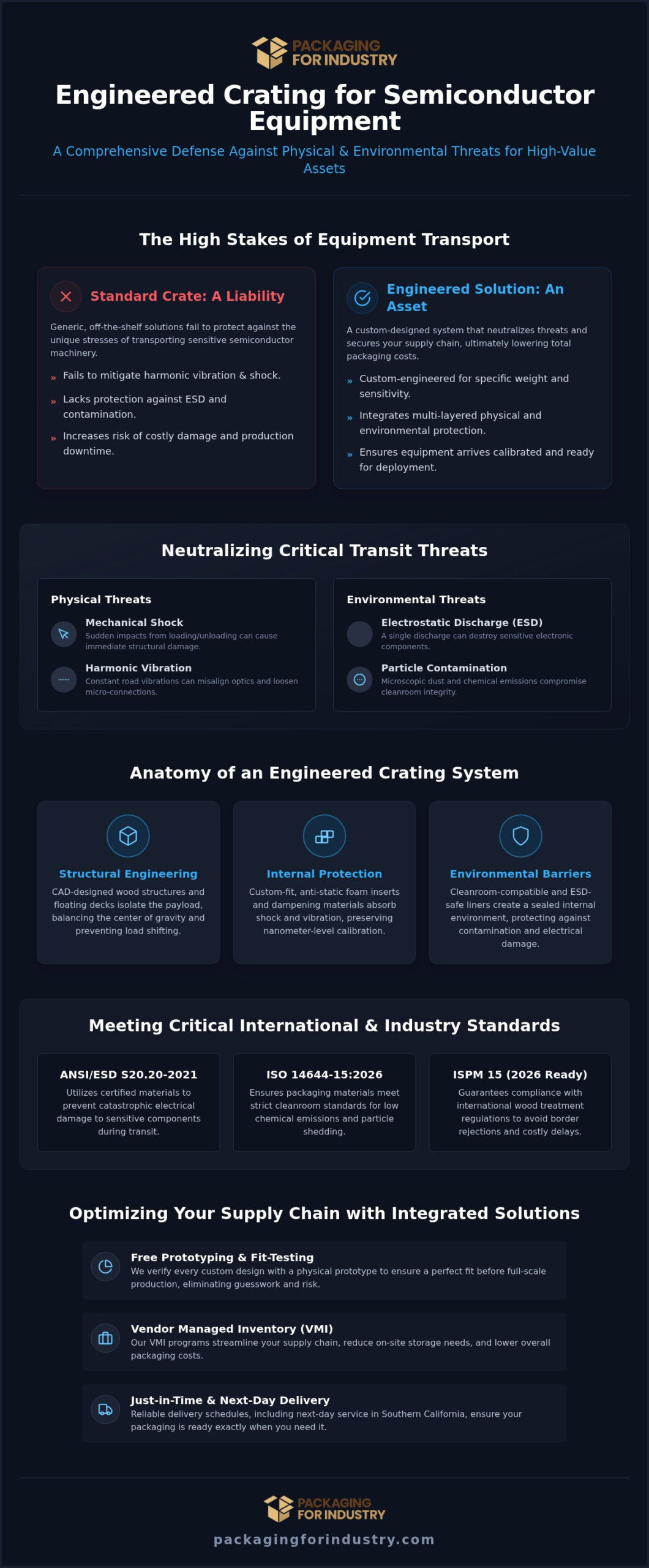
This article outlines how engineered crating solutions provide a comprehensive defense against environmental and physical threats. You’ll learn how to manage the strict January 2026 ISPM 15 hyphen marking requirements and maintain compliance with the latest ISO 14644-15:2026 cleanroom standards for chemical emissions. We’ll also examine the role of ANSI/ESD S20.20-2021 certified materials in preventing electrical damage. By the end of this guide, you’ll understand how an integrated approach, combining custom-engineered wood structures with specialized foam and environmental barriers, secures your supply chain and protects your bottom line.
Key Takeaways
- Learn why custom engineering is necessary to prevent harmonic vibration and structural fatigue that standard catalog crates cannot mitigate.
- Understand the critical role of ANSI/ESD S20.20-2021 standards and cleanroom-compatible liners in maintaining the integrity of sensitive electronic components.
- Discover how to navigate the 2026 ISPM 15 hyphen marking enforcement to ensure your international shipments avoid border rejections and costly delays.
- Explore how specialized crating for semiconductor equipment transport combines CAD-designed wood structures with integrated foam inserts for a single, reliable protection system.
- Find out how Vendor Managed Inventory (VMI) and local next-day delivery in Southern California can lower packaging costs and streamline your operations.
The High Stakes of Crating for Semiconductor Equipment Transport
In the semiconductor industry, your equipment is your most valuable asset. Moving a multi-million dollar lithography or metrology tool requires more than just a sturdy container. Professional crating for semiconductor equipment transport is an engineered isolation system designed to neutralize physical and environmental threats. Standard wood crates often fail because they lack the specific engineering to handle harmonic vibration and structural fatigue encountered during long-haul transit. When a crate lacks internal dampening, it transfers energy directly to the payload, risking catastrophic failure.
The economic impact of a shipping error is severe. If a single tool arrives out of calibration or with microscopic structural damage, the consequences ripple through the entire fabrication facility. It isn’t just the cost of the repair that matters; it’s the cost of a halted production line and missed delivery windows. PFI integrates rigorous engineering with industrial reliability to ensure your machinery arrives ready for immediate deployment. By choosing a partner that understands these stakes, you can lower packaging costs by eliminating the hidden expenses of transit damage.
Vulnerability to Mechanical Shock and Vibration
Transporting sensitive equipment involves two distinct mechanical threats: constant road vibrations and sudden impact shocks during loading or unloading. While a heavy-duty crate provides structural integrity, it must also act as a shock absorber. Harmonic vibration occurs when the frequency of transit movement matches the natural frequency of a machine’s internal components, potentially loosening micro-connections or misaligning delicate optics. To prevent this, we utilize specialized dampening materials and custom design packaging strategies that preserve nanometer-level calibration, even during cross-country or international transit.
The Cost of Failure in Semiconductor Logistics
The “true cost” of shipping damage extends far beyond the replacement value of the machinery. You must account for lost throughput, technician labor hours for recalibration, and the potential for long-term reliability issues. Off-the-shelf crates are a liability for high-value capital equipment because they offer generic protection that doesn’t account for specific weight distributions or center-of-gravity requirements. Investing in custom engineering is a pragmatic business decision that reduces long-term shipping insurance premiums. When you request a packaging quote for an engineered solution, you’re investing in the stability of your entire supply chain.
Structural Engineering: Custom Crate Designs for Sensitive Machinery
Effective protection starts with precise data. We use CAD/CAM technology to model every crate around the exact dimensions and weight distribution of your machine. This ensures the center of gravity is perfectly balanced, which is vital for stable crating for semiconductor equipment transport. Without this level of precision, a heavy tool can shift during transit, causing the crate to tip or the internal supports to buckle under uneven pressure.
We don’t just use wood to build a shell. For internal partitioning and component separation, we often integrate heavy-duty double-wall and triple-wall corrugated boxes and custom inserts. These materials provide a lightweight yet rigid barrier that prevents sensitive parts from contacting the outer wooden shell. One area where generic suppliers fail is fit-testing. At PFI, we offer free prototyping to ensure the design works in the real world before full-scale production begins. Testing the crate’s fit and function early prevents costly mid-transit adjustments and ensures your equipment is truly secure.
If you’re planning a move for high-value machinery, you can request a packaging quote to see how our engineered designs fit your specific requirements.
Floating Decks and Shockmount Bases
For the most delicate machinery, a standard base isn’t enough. Floating decks isolate the equipment from the crate floor using specialized shock mounts. We select the specific durometer of these mounts based on the equipment’s weight and its sensitivity to G-forces. By integrating heavy-duty skids into the base, we ensure the unit remains accessible for standard forklift and crane handling without compromising the isolation system. This setup is essential for maintaining the integrity of crating for semiconductor equipment transport when moving through busy regional hubs in Los Angeles or Orange County.
Internal Bracing and Support Structures
Internal movement is the primary cause of damage during sudden stops or rough handling. We eliminate this risk using custom-engineered wood bracing and protective foam packaging tailored to the machine’s geometry. Precision kitting ensures all components stay secure within their designated compartments throughout the journey. Our designs also prioritize the destination experience. We create cleanroom-ready structures that allow your technicians to unpack equipment quickly without introducing wood dust or other contaminants to your facility.
ESD, Cleanroom, and Environmental Protection Layers
Physical structural integrity is only the first layer of a professional logistics strategy. High-value electronics face invisible threats that can be just as damaging as a drop or a collision. Electrostatic Discharge (ESD) can fry sensitive circuitry without leaving any visible evidence of failure. When we design crating for semiconductor equipment transport, we prioritize materials that neutralize these electrical risks. We also address contamination control. Standard wood crates naturally produce particulates and dust. To maintain the integrity of your Class 1 or Class 10 cleanroom environment, we utilize cleanroom-compatible liners that act as a barrier between the raw wood and your machinery.
Managing environmental variables is essential for maintaining equipment calibration and reliability. We look at the entire journey, from the manufacturing floor in Orange County to a global destination. By integrating anti-static barriers and specialized shielding bags directly into the crate design, we eliminate the need for secondary handling at the destination. This integrated approach helps you lower packaging costs by reducing the labor and materials required for multi-stage packing.
Advanced Foam Cushioning Systems
Selecting the right cushioning involves more than just measuring thickness. We compare polyethylene and polyurethane foams based on the fragility and weight of your components. Polyethylene is often preferred for its high load-bearing capacity and moisture resistance. However, the most critical factor is electrical conductivity. We utilize pink anti-static and black conductive foam packaging to ensure compliance with ANSI/ESD S20.20-2021 standards. Custom die-cut inserts allow us to kit specialized tools and spare parts alongside the main unit, keeping everything secure and electrically grounded throughout the transit process.
Vapor Barriers and Desiccants
Moisture and humidity are constant threats during international ocean freight and long-term storage. Salt air and fluctuating temperatures can cause condensation to form inside a crate, leading to rapid corrosion of copper and aluminum traces. We solve this by using heavy-duty moisture barrier bags and vacuum sealing techniques. This process removes the air and replaces it with a controlled environment. We also include specific desiccants to absorb any residual moisture. This level of precision ensures that your equipment remains in factory condition, regardless of the climate it passes through. You can request a packaging quote to see how these environmental layers can be customized for your next shipment.
International Compliance and Southern California Logistics
Shipping semiconductor equipment across borders introduces regulatory hurdles that can stall your supply chain if not managed correctly. Compliance is mandatory. Specialized crating for semiconductor equipment transport must meet international standards to avoid rejection at the border. We focus on logistical efficiency by optimizing crate dimensions. This helps you avoid common carrier surcharges and maximizes freight space. You aren’t paying for unnecessary volume; instead, you’re getting a lean, protective system that supports your packaging cost savings goals. This level of optimization is particularly beneficial for high-volume exporters operating out of the Inland Empire and Los Angeles hubs. By ensuring your crates fit standard aircraft or ocean container footprints, we help you secure more competitive freight rates.
Export Crating and Global Standards
ISPM 15 certification is the baseline for global foundries. It ensures that wood packaging doesn’t introduce invasive species into foreign ecosystems, which could lead to immediate shipment quarantine. Effective January 1, 2026, the USDA’s APHIS has resumed full enforcement of the ISPM 15 hyphen requirement. This means the mark separating the country code and facility code must contain a hyphen. Shipments with non-compliant marks will be considered non-compliant with no soft enforcement period. We use only certified heat-treated wood to ensure your high-tech goods clear customs without delay. Documentation and labeling are integrated into our process to facilitate smooth customs clearance.
Local Support for the SoCal Tech Corridor
Our proximity to the Southern California tech corridor provides a distinct advantage for manufacturers in Anaheim, Irvine, and Santa Fe Springs. We also serve the Inland Empire, providing the same high-speed response to the expanding industrial parks in that region. Being local allows us to offer next-day delivery for urgent equipment shipments. It also reduces lead times for custom crate modifications. If a machine design changes last minute, our engineering team can adapt the packaging quickly to keep your project on schedule. Our drivers are familiar with the specific loading dock requirements of major tech campuses throughout the region. This regional expertise ensures that crating for semiconductor equipment transport remains a seamless part of your operations.
Optimizing the Supply Chain with PFI Custom Solutions
Effective crating for semiconductor equipment transport is more than a one-time purchase. It’s a recurring operational requirement that impacts your bottom line. By integrating engineering with supply chain logistics, PFI helps you lower packaging costs through significant damage reduction. When you eliminate transit failures, you remove the most expensive variable in your logistics budget. Our approach focuses on long-term reliability and fiscal responsibility, ensuring your high-volume production lines never stall due to packaging shortages or shipping delays. We don’t just sell crates; we provide a managed system that supports your entire manufacturing flow.
Vendor Managed Inventory for High-Volume Needs
Maintaining an adequate supply of custom crates and protective foam can consume valuable floor space in your warehouse. Our Vendor Managed Inventory (VMI) program solves this by monitoring your usage patterns and stocking crates only when you need them. This reduces warehouse clutter and improves your cash flow by ensuring you aren’t sitting on excess inventory. Combined with Just-In-Time (JIT) delivery, we synchronize our production with your manufacturing schedule. This provides a seamless flow of materials directly to your loading docks in Anaheim, Irvine, or across Southern California, allowing you to focus on production rather than procurement logistics.
Custom Prototyping and Performance Reviews
Every project begins with a consultative design phase. Our engineers use CAD modeling to develop a solution tailored to your machine’s specific G-force tolerances and dimensions. We then provide free prototyping to ensure a perfect fit before we move to full-scale production. This step is critical for verifying that the custom design packaging performs as expected under real-world transit conditions. We also conduct regular performance reviews to identify new cost-saving opportunities as your equipment evolves. If your tool designs change, our packaging adapts with them to maintain optimal protection levels. To start your next project, you can Request a quote for semiconductor crating and see how our integrated solutions protect your machinery and your budget.
By partnering with PFI, you gain access to an engineering-minded team that understands the intersection of logistics and economics. We provide the stability and reliability required for the semiconductor industry’s complex supply chains. Whether you’re shipping across the street in Orange County or to a global foundry, our engineered solutions ensure your equipment arrives ready for immediate deployment. You can request a packaging quote today to compare packaging pricing and explore custom sizes available for your sensitive assets.
Securing Your High-Value Semiconductor Supply Chain
Protecting sensitive semiconductor machinery requires an integrated engineering approach that goes beyond standard crating. We’ve explored how custom-designed isolation systems, ESD-safe materials, and strict adherence to international standards prevent catastrophic transit damage. By choosing a partner that offers free prototyping for all custom crate designs, you ensure a perfect fit before equipment ever leaves the production floor. This proactive testing phase eliminates the guesswork and protects your most valuable capital assets.
PFI provides the specialized expertise in ESD and mil-spec packaging needed to navigate today’s complex logistics environment. Our local next-day delivery in Southern California ensures that your operations in Anaheim, Irvine, or the Inland Empire remain on schedule. Implementing engineered crating for semiconductor equipment transport isn’t just about protection; it’s a strategic move to lower packaging costs and eliminate the risk of production downtime. Rely on a partner that understands the intersection of engineering and economics to move your most critical assets with confidence.
We look forward to helping you optimize your logistics and secure your sensitive machinery for global or local transit.
Frequently Asked Questions
What is the difference between standard crating and semiconductor crating?
Standard crating focuses primarily on structural containment, while semiconductor crating is an engineered isolation system. It incorporates advanced vibration dampening, ESD protection, and cleanroom-compatible materials that standard crates lack. We design these specialized solutions to neutralize harmonic vibrations that could loosen internal micro-components or ruin nanometer-level calibration. Standard crates don’t account for these microscopic risks, making them a liability for high-value capital equipment during transit.
How do you prevent ESD damage inside a shipping crate?
We prevent ESD damage by integrating specialized materials like pink anti-static foam, conductive black foam, and static shielding bags into the design. These materials ensure compliance with ANSI/ESD S20.20-2021 standards. By kitting components with these protective layers, we eliminate static buildup and discharge during handling. This integrated approach is a core part of our crating for semiconductor equipment transport, protecting sensitive circuitry from invisible but catastrophic electrical threats.
Why is ISPM 15 certification necessary for international semiconductor transport?
ISPM 15 certification is mandatory for international shipping to prevent the spread of invasive pests through wood packaging. Effective January 1, 2026, the USDA’s APHIS has resumed full enforcement of the hyphen requirement in the certification mark. Without this heat-treatment and proper labeling, your high-value machinery could be quarantined or rejected at the border. We use only certified heat-treated wood to ensure your shipments clear global customs without delay.
Can custom crates be designed for cleanroom environments?
Yes, we design cleanroom-ready crates using specialized liners and low-particulate materials. Standard wood crates naturally produce dust, which is unacceptable in Class 1 or Class 10 environments. Our designs act as a barrier to keep contaminants away from your machinery. We also follow ISO 14644-15:2026 standards for airborne chemical contamination. This ensures the packaging doesn’t compromise your facility’s air quality during the unpacking and deployment process.
How much lead time is required for a custom-engineered semiconductor crate?
Lead times vary based on design complexity, but our local proximity in Southern California allows for rapid response. We start with a CAD design and offer free prototyping to ensure a perfect fit before production begins. For recurring needs, our VMI programs ensure that your crating for semiconductor equipment transport is always in stock. You can request a packaging quote to receive a specific timeline based on your equipment’s unique dimensions.
What materials are used for shock absorption in high-value machinery crates?
We utilize a combination of floating decks, shockmount bases, and custom foam inserts for superior shock absorption. High-density polyethylene foam is often selected for its load-bearing capacity, while softer polyurethane foam provides cushioning for lighter components. We select the specific durometer of shock mounts based on the G-force tolerances of your machinery. These materials work together to isolate the payload from constant road vibrations and sudden impact shocks during loading.
Do you offer local delivery for semiconductor companies in Southern California?
We provide local next-day delivery for semiconductor companies throughout Southern California, including Anaheim, Irvine, and Santa Fe Springs. Our service area also extends to the Inland Empire and Los Angeles. Because our drivers understand the specific dock requirements of regional tech campuses, we ensure a seamless delivery process. This local support reduces lead times and allows for immediate adjustments if your equipment specifications change during the final manufacturing stages.
How does a VMI program help reduce my packaging costs?
A Vendor Managed Inventory (VMI) program helps you lower packaging costs by optimizing inventory levels and reducing warehouse waste. We monitor your usage patterns to ensure you never run out of critical supplies without dedicating valuable floor space to excess stock. This improves your cash flow and operational efficiency. You only pay for the crates you need, when you need them, eliminating the overhead of managing complex packaging logistics internally.