
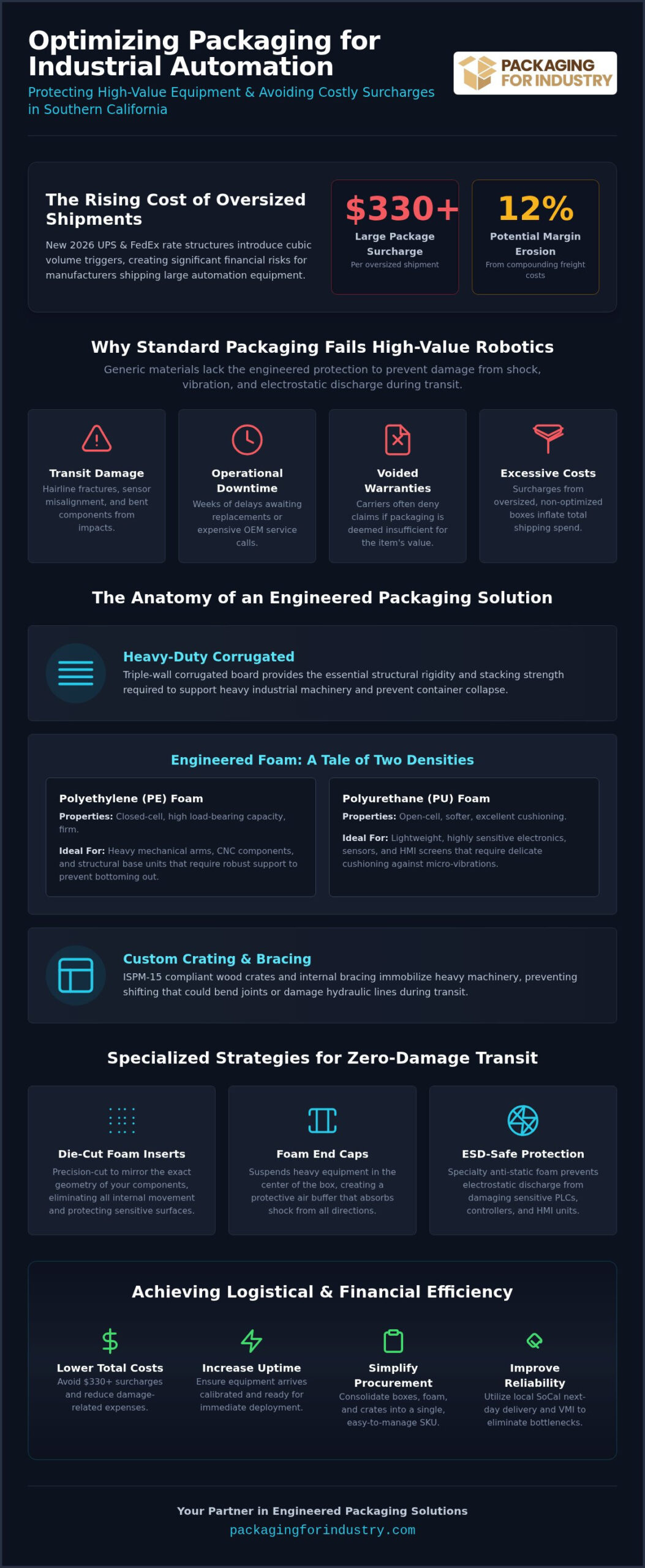
With UPS and FedEx implementing cubic volume triggers for surcharges in 2026, a single oversized shipment of robotics can now trigger a Large Package Surcharge exceeding $330. For manufacturers in Southern California, securing custom packaging for industrial automation equipment SoCal isn’t just about physical protection; it’s about avoiding these compounding freight costs that can erode your margins by up to 12% this year. You likely already know that even a minor hairline fracture on a sensitive sensor or a bent robotic arm leads to weeks of downtime and significant replacement costs. We understand that reliability and fiscal responsibility are your primary operational drivers.
This guide will show you how to secure your high-value automation machinery using engineered packaging designed to eliminate transit damage while staying under the new 2026 surcharge thresholds. We’ll preview engineered foam inserts, heavy-duty corrugated solutions, and ISPM-15 compliant crating designed specifically for the SoCal industrial landscape. By the end of this article, you’ll have a clear roadmap for achieving zero-damage transit and reducing your total shipping spend through optimized, local packaging partnerships that prioritize precision and logistical flow.
Key Takeaways
- Understand why standard shipping materials fail sensitive robotics and how to mitigate the high financial risks of transit damage through engineered protection.
- Identify the specific material grades, such as triple-wall corrugated and polyethylene foam, required for custom packaging for industrial automation equipment SoCal to ensure zero-damage transit.
- Master the technical framework for specifying weight capacities and fragility ratings to align packaging durability with the precise G-force limits of your machinery.
- Discover how local Southern California logistical advantages like next-day delivery and Vendor Managed Inventory (VMI) eliminate production delays and warehouse bottlenecks.
- Streamline your procurement by integrating boxes, foam, and crates into a single SKU to lower packaging costs and simplify inventory management.
Protecting High-Value Automation: Why Custom Packaging is Non-Negotiable
Industrial automation equipment is only as reliable as its last calibration. When you ship a robotic cell or a high-precision CNC component, the risk isn’t just a visible dent; it’s the internal misalignment caused by micro-vibrations during long-haul transit. Standard pallets and generic bubble wrap fail sensitive robotics because they lack the structural rigidity to dampen resonance. For manufacturers, investing in custom packaging for industrial automation equipment SoCal ensures that gear arrives ready for immediate deployment rather than requiring an expensive service call from the OEM.
Every impact during freight handling threatens your equipment warranty. Carriers often deny claims if they determine the packaging was insufficient for the machine’s mass or fragility. Custom-engineered solutions provide the documented protection levels required to maintain coverage. By accounting for cushioning design factors like peak acceleration and static load, we move beyond guesswork into verifiable protection. This proactive approach eliminates the professional stress of transit damage and the logistical nightmare of returning uncalibrated gear to the factory floor.
The Financial Impact of Improper Packaging
The ROI of engineered protection is measured in avoided downtime and reduced logistical fees. While generic boxes might seem cheaper upfront, they often lead to massive freight surcharges under the 2026 rate structures. With UPS and FedEx triggering surcharges for cubic volumes over 10,368 inches, dimensionally optimized custom design packaging is a direct cost-saving tool. Optimized sizing reduces the footprint of your shipment, potentially saving over $330 per package by avoiding Large Package Surcharges. Additionally, custom-fit kitting simplifies the unboxing process, allowing your technicians to move straight to installation without the delay of sorting through loose-fill peanuts or generic wrap.
Automation-Specific Protection Requirements
Sensitive electronics like PLC units and HMI touchscreens require protection that goes beyond shock absorption. We utilize ESD-safe materials to prevent electrostatic discharge from frying internal circuits during handling. For heavy mechanical arms, custom wood bracing is integrated into the crate design to prevent shifting that could bend joints or snap hydraulic lines. Precision-engineered foam densities are required because they must be specifically calculated to match the static load of the machinery to prevent the equipment from bottoming out during a drop. This multi-layered strategy ensures that every component, from the heaviest motor to the smallest sensor, remains secure and functional upon arrival.
Essential Materials for Automation Equipment Transit
Selecting the correct materials for custom packaging for industrial automation equipment SoCal requires a balance between structural engineering and cost management. High-value robotics don’t just need a box; they require a layered defense system that accounts for weight distribution, surface sensitivity, and the specific vibration frequencies of long-haul freight. For manufacturers in Los Angeles and Orange County, using the wrong material grade can lead to catastrophic equipment failure or excessive shipping surcharges.
Engineered Foam Packaging Solutions
The choice between Polyethylene (PE) and Polyurethane (PU) foam depends entirely on the machine’s fragility and mass. Polyethylene is a closed-cell foam that provides excellent load-bearing capacity, making it the preferred choice for heavy mechanical arms and base units. In contrast, Polyurethane is a softer, open-cell material better suited for lightweight, highly sensitive sensors that require delicate cushioning. We utilize several specialized foam configurations to ensure zero-damage transit:
- Die-cut foam inserts: These are precision-engineered to mirror the complex geometry of robotic components, preventing any internal movement within the carton.
- Foam end caps: By suspending heavy machinery in the center of the package, end caps create a protective air buffer that absorbs shock before it reaches the equipment.
- ESD-safe foam: Essential for PLC units and electronic controllers, these materials prevent electrostatic discharge that can fry internal circuits.
You can find detailed specifications on densities and compression sets on our PFI Foam Packaging page to help determine the best fit for your specific gear.
Industrial Strength Corrugated Options
When dealing with heavy-duty corrugated materials, wall thickness is the primary factor in puncture resistance and stacking strength. Most industrial automation components require at least double-wall corrugated, which consists of two layers of fluting. For exceptionally heavy sub-assemblies or international shipping, triple-wall corrugated provides a rigid, wood-like alternative that is significantly lighter than timber. While a standard Regular Slotted Carton (RSC) works for uniform parts, custom die-cut designs are often necessary to accommodate irregular shapes without wasting space.
For bulk kitting or shipping multiple automation parts to a single site, Gaylord boxes offer a high-volume solution that simplifies warehouse logistics. These large-scale containers can be reinforced with corner boards to increase stacking strength, allowing you to maximize vertical space in the trailer. If you need to compare packaging pricing for your next shipment from the Inland Empire or San Diego, our team can help you select the most cost-effective material grade for your machine’s weight profile. Custom sizes available for all corrugated and foam configurations ensure you don’t pay for empty space or unnecessary dimensional weight surcharges.
Specifying Your Requirements: A Buyer’s Framework
Successful procurement of custom packaging for industrial automation equipment SoCal begins with a rigorous technical assessment of the machine’s physical properties. You shouldn’t rely on generic estimations; instead, you must align your packaging specifications with the exact mass and fragility of your equipment. This data-driven approach ensures you don’t over-engineer the solution, which inflates material costs, or under-protect the gear, which leads to transit damage. For Southern California manufacturers, this framework serves as a checklist to bridge the gap between engineering requirements and warehouse logistics.
Determining the fragility rating, or G-force limit, is the most critical step in this framework. This rating tells us how much shock a calibrated sensor or PLC can withstand before failing. When we combine this with weight capacity analysis, we can determine the exact thickness of corrugated board or density of foam required. Additionally, your transit method dictates the level of secondary protection needed. LTL freight within the Inland Empire requires different vibration dampening than ocean export shipments destined for international markets, where humidity and multi-modal handling become significant factors.
Material Selection Matrix
Choosing between corrugated grades requires a balance of bursting strength and stacking capability. While standard 200# test boxes suffice for small components, heavy-duty automation gear typically demands 350# double-wall construction to prevent wall compression. For defense-contract automation, we also provide MIL-SPEC packaging that meets strict federal durability and environmental standards.
| Corrugated Grade | Bursting Strength | Max Load Capacity | Typical Application |
|---|---|---|---|
| 200# Single Wall | 200 lbs/sq in | 65 lbs | Light sensor kits, HMIs |
| 275# Double Wall | 275 lbs/sq in | 100 lbs | Small robotic sub-assemblies |
| 350# Double Wall | 350 lbs/sq in | 120 lbs | Heavy motors, control panels |
If your project involves complex geometries, we recommend utilizing our custom design packaging services for professional prototyping before placing a bulk order.
The Prototyping Process
CAD/CAM support is vital for ensuring your custom sizes available are optimized for the 2026 carrier surcharge thresholds. By designing your packaging around the 10,368 cubic inch trigger for additional handling fees, we can help you lower packaging costs significantly. Local engineering support at our Anaheim facility allows us to produce physical prototypes quickly. This “fit testing” phase ensures that every foam insert and corrugated fold aligns perfectly with your machine’s mounting points, reducing lead times and eliminating the risk of a costly misfire during high-volume production runs.
Maximizing Efficiency in Southern California’s Automation Sector
Southern California’s industrial sector operates on razor-thin lead times. Whether you’re based in the Inland Empire or San Diego, your production schedule depends on the reliability of your supply chain. For OEMs, sourcing custom packaging for industrial automation equipment SoCal from a local partner provides a significant logistical edge. Localized support means you aren’t waiting for a shipment to clear a cross-country rail hub. Instead, you benefit from next-day delivery and immediate response times that keep your assembly lines moving. We understand that in a high-stakes manufacturing environment, a delay in packaging is a delay in revenue.
Vendor Managed Inventory (VMI) for Manufacturers
High real estate costs in Los Angeles and Orange County make warehouse space a premium asset. You shouldn’t waste valuable floor space on bulk quantities of empty corrugated boxes or crates. Our VMI Services allow you to eliminate warehouse clutter by stocking packaging only when your production schedule demands it. We monitor your usage patterns and replenish your stock automatically, which prevents production stops due to inventory gaps. This system is particularly effective for managing recurring orders of standard automation components, ensuring you have the right materials for just-in-time assembly without the overhead of excess storage.
Local Support for Orange County and Beyond
Our Anaheim-based facility serves as a central hub for the entire region. This proximity allows for rapid on-site consultations and prototyping sessions that distant catalog suppliers can’t provide. We offer dedicated local service to industrial centers in Irvine and Santa Fe Springs, providing a level of accountability that builds long-term partnerships. Being local means we can visit your facility to measure equipment personally, ensuring that custom sizes available are accurate to the millimeter.
Navigating the specific logistics of the Inland Empire and San Diego requires a partner who understands regional freight lanes. We leverage local partners for custom wood crate assembly to reduce transit times for oversized machinery. While our primary focus is the SoCal market, we maintain nationwide shipping capabilities for SoCal-based OEMs with customers across the country. You get the benefit of local engineering expertise combined with the logistical reach of a national distributor. This holistic approach ensures your equipment is protected from the moment it leaves your dock until it reaches its final destination.
Partnering with PFI for Custom Engineered Solutions
Choosing the right materials is only half the battle; the real value lies in how those materials are integrated into a cohesive protective system. PFI’s approach to custom packaging for industrial automation equipment SoCal focuses on total accountability. Unlike catalog suppliers who ship generic components, we design integrated solutions where the heavy-duty corrugated, precision foam inserts, and custom crates work in unison. This holistic engineering ensures that the load path of your machinery is properly supported, preventing the internal shear that often leads to uncalibrated equipment upon delivery.
Efficiency is further maximized through SKU simplification. We can combine your boxes, foam, and specialized bracing into a single SKU, which streamlines your procurement process and reduces administrative costs. Instead of managing three different vendors and three separate lead times, your operations team handles one line item. This reduces warehouse errors and ensures that every component needed for a secure shipment is always on hand at the same time. Our cost-reduction analysis focuses on finding the precise balance between material strength and price, ensuring you don’t overpay for protection you don’t need.
The PFI Difference: Engineering + Economics
We position ourselves as a cost-saving alternative to large catalog suppliers that rely on high markups and rigid sizing. With PFI, you have access to custom sizes available with no minimum order barriers, allowing you to scale your packaging needs alongside your production volume. PFI provides free prototyping for new automation designs to ensure a precision fit before full-scale production begins. This engineering-first mindset allows us to optimize your packaging dimensions for the 2026 freight environment, protecting your bottom line from unnecessary dimensional weight fees.
Next Steps for Operations Managers
If your current damage rates are impacting your margins, it’s time to initiate a comprehensive packaging review. Start by documenting the specific points of failure in your current transit cycle and gather the weight and dimension specs for your 2026 automation projects. Preparing these details allows our engineering team to provide a more accurate and effective custom quote. We’re ready to serve as your steady, dependable partner in Southern California, moving your high-value gear with quiet confidence and logistical precision.
Optimizing Your Industrial Automation Supply Chain
Securing high-value robotics for transit requires a shift from generic supplies to engineered systems. We’ve explored how identifying the correct G-force limits and utilizing 2026-compliant dimensional sizing can eliminate transit damage while lowering your total freight spend. By prioritizing custom packaging for industrial automation equipment SoCal, your facility gains the peace of mind that comes with precision-fit protection and reliable local oversight.
PFI is committed to supporting Southern California’s manufacturers with tangible logistical solutions. Our Anaheim-based team provides the technical expertise needed to navigate the complexities of carrier surcharges and regional logistics. With access to free prototyping, CAD design, and local next-day delivery, your operations remain efficient and resilient. Our cost-saving VMI programs ensure that you never face production stops due to inventory gaps.
We’re ready to help you streamline your shipping process and protect your most sensitive investments. Let’s work together to build a more secure and cost-effective future for your automation projects.
Frequently Asked Questions
How do I determine the right foam density for my automation sensors?
Determining the correct foam density requires calculating the static load, which is the weight of the sensor divided by the surface area touching the foam. For lightweight, highly sensitive automation sensors, a lower-density open-cell polyurethane is often ideal for maximum shock absorption. Heavier components require high-density closed-cell polyethylene to prevent the equipment from bottoming out. We use these engineering metrics to ensure your custom packaging for industrial automation equipment SoCal provides optimal protection during transit.
What is the lead time for custom corrugated boxes in Southern California?
Lead times for custom corrugated boxes typically range from 5 to 10 business days depending on the complexity of the die-cuts and current production volume. Because we operate locally in Anaheim, we eliminate the transit delays associated with out-of-state suppliers. For recurring needs, our Vendor Managed Inventory programs can reduce this lead time to next-day availability by stocking your specific custom sizes available in advance at our regional warehouse facility.
Do you provide ESD (anti-static) foam for electronic controllers?
Yes, we provide a full range of ESD-safe foam packaging specifically designed for sensitive electronic controllers and PLCs. These materials are treated with anti-static agents to prevent the buildup of triboelectric charges during handling and transit. Protecting your internal circuitry from electrostatic discharge is a standard part of our engineering process. We offer these specialized materials in various thicknesses to accommodate both small control modules and larger automated assemblies without risking electrical failure.
Can PFI design custom crates for international export of machinery?
PFI designs and builds custom wood crates that are fully compliant with ISPM-15 international heat-treatment standards. This ensures your automation machinery clears customs without delays or rejection in over 180 countries. Our crates feature custom internal bracing and foam lining to secure heavy loads against the multi-modal stresses of ocean and air freight. We handle the entire process from engineering the structural base to applying the required IPPC certification marks for global compliance.
How does a Vendor Managed Inventory (VMI) program save my company money?
A VMI program helps lower packaging costs by shifting the burden of inventory management and storage to us. You save money by reclaiming valuable warehouse floor space for production rather than storing bulky corrugated boxes. Additionally, VMI eliminates the administrative costs of frequent small-batch ordering and protects you against production stops caused by unexpected stockouts. It allows for more predictable cash flow through consolidated billing and optimized, just-in-time delivery schedules tailored to your production.
Is it possible to get a prototype of a custom foam insert before ordering bulk?
We offer free prototyping for new automation designs to ensure a precision fit before you commit to a high-volume order. Our engineering team uses CAD/CAM technology to create a sample that mirrors your equipment’s exact geometry. This allows your team to perform physical fit tests and verify the protection level in a real-world setting. Prototyping reduces buyer friction and prevents the costly mistake of producing units that don’t meet your machine’s specific mounting points.
What is the difference between double-wall and triple-wall corrugated for heavy gear?
The primary difference lies in the number of fluted layers and the resulting stacking strength. Double-wall corrugated consists of two layers of fluting and is the industry standard for most industrial automation components up to 120 pounds. Triple-wall corrugated adds a third layer, providing extreme puncture resistance and structural rigidity comparable to wood. Triple-wall is typically reserved for exceptionally heavy machinery or shipments where the carton must serve as a lightweight, cost-effective alternative to a wood crate.
Do you offer local next-day delivery for stock packaging supplies in Anaheim?
We provide local next-day delivery for a wide range of stock packaging supplies throughout Anaheim and the surrounding Orange County area. This service covers essential items like stretch film, corner boards, and standard RSC boxes that keep your warehouse running smoothly. By maintaining a robust local fleet, we help you avoid the shipping delays and high freight costs of national catalog suppliers. It’s an efficient way to manage your daily consumables while you focus on high-value custom packaging for industrial automation equipment SoCal.