
Industrial equipment is only as reliable as the protection it travels in, yet many operations still rely on generic foam that degrades after a few months of use. When you search for foam inserts for hard cases near me, you aren’t just looking for cushioning. You’re looking for an engineering partner who understands that shifting gear leads to calibration errors and expensive downtime. You likely agree that high-value medical or aerospace components require more than a basic fit. They need specific material densities and precision cuts that match a tool’s exact geometry to prevent vibration damage during transit.
This guide will show you how to move from low-quality catalog foam to custom-engineered solutions that lower your total cost of ownership. We’ll explore why materials like polyethylene and ESD-safe polyurethane are the standards for industrial durability, especially when meeting strict military specifications. You’ll learn how to secure a reliable local supplier in Orange County or Los Angeles for recurring orders, ensuring your fleet remains protected without the shipping delays of national distributors. From prototyping to vendor-managed inventory, we’re covering everything you need to eliminate shipping damage and streamline your logistics.
Key Takeaways
- Learn the critical differences between polyethylene and polyurethane foam to select the correct density and material for your specific industrial equipment.
- Discover why custom CNC-routed inserts outperform “pick-and-pluck” alternatives by eliminating foam dusting and providing a precision fit that prevents shifting.
- Understand how sourcing foam inserts for hard cases near me from a local Southern California supplier reduces lead times and lowers shipping costs.
- Identify specialized requirements for aerospace and medical applications, including ESD-safe materials and MIL-spec compliance for defense contracts.
- Explore how professional CAD/CAM design support and free prototyping help your operation lower packaging costs while significantly reducing equipment damage rates.
Why Standard Hard Case Foam Fails Industrial Users
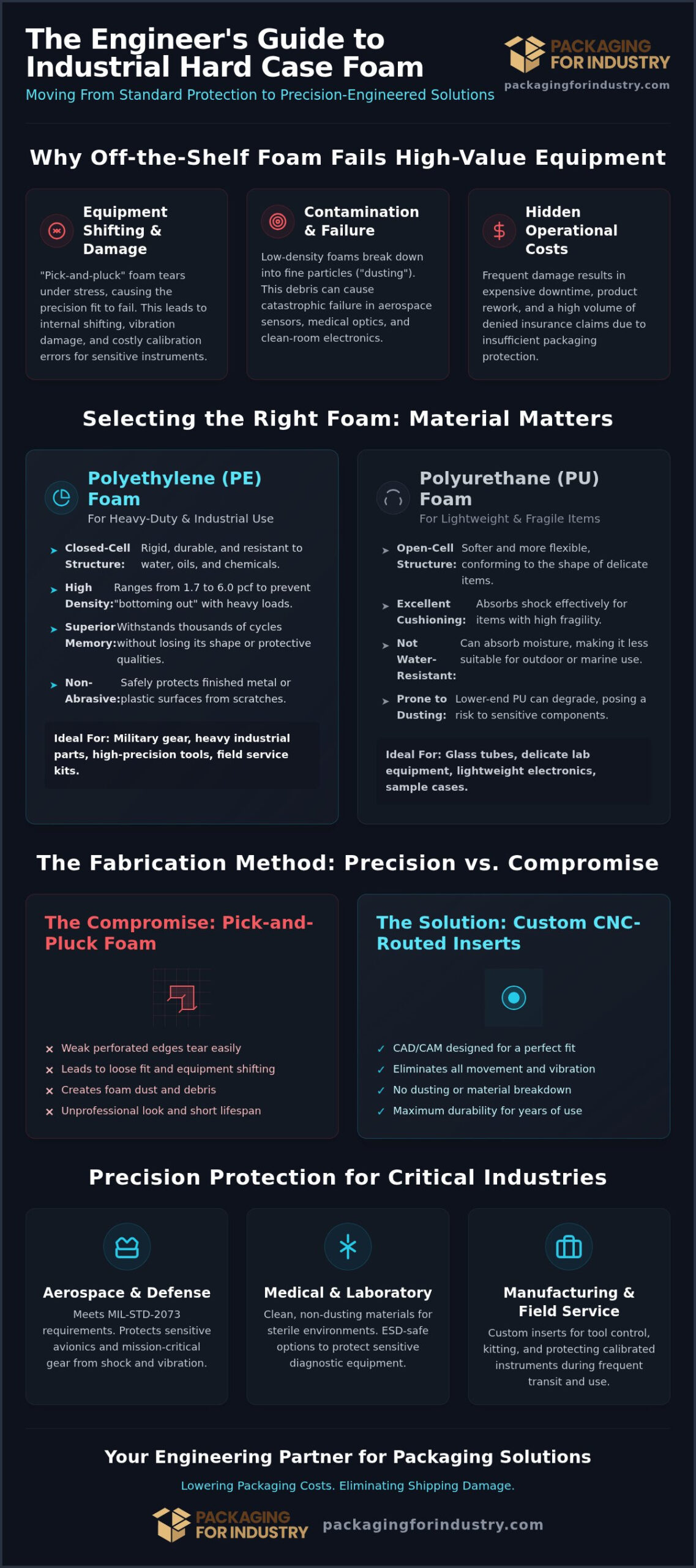
Searching for foam inserts for hard cases near me often leads professionals to retail outlets or hobbyist shops. These suppliers typically offer “pick-and-pluck” foam, which is designed for convenience rather than durability. While these pre-scored cubes allow for a quick DIY fit, they lack the structural integrity required for heavy industrial use. Under the stress of recurring transit, the perforated edges of pick-and-pluck foam begin to tear, causing high-value equipment to shift. Once a part loses its precision fit, it’s susceptible to impact damage that standard retail foam simply isn’t engineered to prevent.
Material quality is the primary differentiator between consumer grade and industrial solutions. Many off-the-shelf cases use low-density polyurethane foam that is prone to “dusting.” This occurs when the foam cells break down into microscopic particles. For aerospace sensors, medical optics, or clean-room electronics, this debris can cause catastrophic failure. Industrial-grade foam packaging uses closed-cell polyethylene or high-resiliency polyurethane to eliminate shedding and provide superior structural memory. This memory ensures the foam returns to its original shape after every shipment, maintaining a secure grip on your equipment over years of service.
The Hidden Costs of Low-Quality Foam
The cost of a custom-engineered insert is small compared to the price of a single damaged component. When foam fails to secure a part, the resulting “loose fit” can knock sensitive equipment out of calibration, leading to expensive downtime or rework. Relying on inferior materials also increases your administrative burden. Frequent shipping damage leads to a higher volume of insurance claims with carriers like UPS or FedEx, which often result in long delays and denied payouts if the packaging is deemed insufficient. Investing in precision-cut inserts allows you to lower packaging costs by reducing these secondary expenses and eliminating the need for frequent foam replacements.
Industrial Standards for Case Protection
For defense and aerospace contractors, protection isn’t just a preference; it’s a contractual requirement. Many industrial projects must adhere to MIL-STD-2073, the standard governing preservation and cushioning methods for the Department of Defense. We also look to ASTM standards to measure impact resistance and vibration dampening across various transit environments. Professional engineering avoids guesswork by utilizing the “cushioning curve,” which is the mathematical basis for foam selection that plots peak deceleration against static stress to ensure equipment never bottoms out during a drop.
Selecting the Right Foam Material: Polyethylene vs. Polyurethane
Choosing between foam types depends on the weight, fragility, and environmental exposure of your equipment. For those searching for foam inserts for hard cases near me, it’s vital to look past the color of the material and focus on technical specifications like density. Measured in pounds per cubic foot (pcf), foam density determines how much weight a material can support before it compresses completely. High-value industrial items often require higher density to prevent “bottoming out” during a drop. Standard densities for polyethylene often range from 1.7 to 2.2 pcf, but heavier applications can require 4.0 or 6.0 pcf for maximum shock absorption.
Polyethylene (PE) Foam for Heavy-Duty Use
Polyethylene is a closed-cell foam, meaning its cells are sealed off from each other. This creates a rigid, durable structure that doesn’t absorb water or chemicals. It’s the industry standard for securing heavy industrial parts, military gear, and high-precision tools.
- Non-abrasive surface protects finished metal or plastic parts from scratches during transit.
- Water-resistant properties make it ideal for field cases used in marine or outdoor environments.
- High structural memory allows it to withstand thousands of shipping cycles without losing its shape or protective capabilities.
Polyurethane (PU) and Convoluted Foam
Polyurethane is an open-cell material that is much softer and more flexible than PE. It’s best suited for protecting lightweight, highly fragile items like glass tubes or delicate lab equipment. Because it’s breathable, it provides a gentle “cradle” effect that absorbs minor vibrations. Convoluted foam, often called egg-crate foam, is frequently used in case lids to apply consistent top-down pressure. This keeps items from bouncing inside their custom base inserts. However, PU foam has limitations; it can absorb moisture in high-humidity settings, which may lead to material degradation or mildew if the cases aren’t properly maintained.
Specialized sectors like semiconductor manufacturing require more than just impact protection. Anti-Static (ESD) foam is essential for preventing electrostatic discharge from damaging sensitive circuit boards or electronic components. Similarly, field service tools exposed to oils, fuels, or solvents need foam with specific chemical resistance to prevent the insert from dissolving over time. When sourcing foam inserts for hard cases near me, confirm that your supplier can provide these specific technical grades rather than just generic cushioning. If you’re unsure which material meets your operational requirements, you can request a packaging quote to consult with an engineering specialist who can match foam density to your product’s fragility.
Custom Engineering vs. Pick-and-Pluck Foam Inserts
DIY methods like using kitchen knives or “pick-and-pluck” foam might suffice for hobbyists, but they fail the standards of professional manufacturing and logistics. When searching for foam inserts for hard cases near me, businesses need repeatable precision that manual methods cannot provide. Custom CAD/CAM design support allows for the exact mapping of complex part geometries, ensuring every component is held in a neutral, stress-free position. Unlike the square-grid limitation of perforated foam, CNC routing and water-jet cutting create smooth, contoured cavities that follow the unique lines of your equipment. This level of detail prevents the small lateral movements that eventually lead to surface abrasion or internal component fatigue.
This precision isn’t just about protection; it’s about logistical efficiency. Custom engineering allows us to design multi-layer foam assemblies, creating tiered organization within a single case. By stacking components vertically with high-density dividers, we significantly reduce “void space.” This optimization often allows you to utilize a smaller case size, which directly minimizes freight costs and storage requirements across your entire supply chain. When you’re managing a fleet of cases, these incremental space savings result in substantial long-term packaging cost reductions.
The Prototyping Advantage
PFI offers free prototyping to eliminate the guesswork from your packaging rollout. We use CAD drawings to create digital blueprints that ensure every insert in a fleet of hundreds is identical. Testing a physical sample allows your team to verify the “finger wells” for easy part removal and check the compression fit before committing to a full production run. This proactive step prevents the costly errors often associated with “near me” retail solutions that lack formal engineering oversight.
Die-Cutting for High-Volume Production
While CNC routing is ideal for low-to-medium volumes and deep cavities, die-cutting becomes the more cost-effective choice for high-volume production. It offers unmatched speed and consistency for manufacturing lines that require thousands of identical units. For a comprehensive shipping solution, we can integrate these die-cut inserts into custom corrugated boxes. This provides a seamless transition from the protective hard case to the final shipping container, ensuring your products arrive at their destination in factory-perfect condition.
Industrial Applications for Custom Case Inserts in Southern California
Southern California serves as a primary hub for global aerospace and medical innovation. While many local suppliers focus on consumer applications like photography or firearms, industrial manufacturers in Orange County and Los Angeles require a higher tier of protection. When you search for foam inserts for hard cases near me, you’re likely looking for a partner who understands the high stakes of transporting flight-critical hardware or sensitive diagnostic tools. Generic retail foam cannot meet the rigorous vibration dampening and material purity standards required by these high-tech sectors.
Aerospace and Defense Logistics
The regional aerospace corridor relies on a complex network of subcontractors. Transit between these facilities exposes delicate sensors and machined parts to recurring vibration and handling risks. Custom foam solutions must adhere to strict Mil-Spec packaging standards, such as MIL-STD-2073, to ensure compliance with defense contracts. Design plays a critical role in FOD (Foreign Object Debris) prevention. We utilize high-performance closed-cell materials that don’t shed or flake, keeping turbine components and avionics free from contamination during every stage of the supply chain.
Medical and Diagnostic Equipment
In the medical sector, the protective case is often the first thing a potential client sees. Professional presentation cases for high-stakes sales demos must be both protective and aesthetically organized to reflect the quality of the device inside. Beyond sales, surgical tool sets require cleanroom-compatible foam that resists moisture and microbial growth. Delicate laboratory sensors used in field diagnostics need specific cushioning curves to prevent calibration drift. Our engineering team ensures that every medical insert provides a secure, non-abrasive fit that maintains the integrity of sterile or sensitive equipment.
Electronics manufacturers in the Inland Empire and San Diego face the constant threat of electrostatic discharge. ESD-safe foam inserts are non-negotiable for protecting semiconductor components and circuit boards from latent damage. For industrial machinery providers, custom hard cases serve as mobile tool kits for field service technicians. Organized, tiered inserts ensure that expensive specialized tools are never misplaced or left behind at a job site. This level of organization protects both the physical equipment and your operational bottom line.
Request a custom foam insert quote
Precision Foam Inserts from Packaging For Industry
Choosing a local manufacturer in Anaheim provides a distinct logistical advantage over national catalog suppliers. When you search for foam inserts for hard cases near me, you’re looking for more than just a product; you’re seeking a partner who can respond to design changes in real-time. Packaging For Industry (PFI) offers an integrated solution by providing both the ruggedized hard case and the custom-engineered insert as a single unit. This eliminates the coordination headaches of managing multiple vendors and ensures the exterior shell and interior cushioning work in perfect synchronization to protect your assets.
Our approach centers on fiscal responsibility and operational flow. We help companies lower packaging costs by optimizing every square inch of foam, reducing the overall case footprint without sacrificing safety. For operations with recurring needs, our Vendor Managed Inventory (VMI) program ensures you never face a stockout. We monitor your usage levels and maintain a buffer of precision-cut inserts, delivering them exactly when your production line or field service team needs them. This “just-in-time” reliability allows you to reclaim warehouse space and focus on your core business goals.
Local Service, Nationwide Reach
Proximity matters for quality control and speed. We provide local next-day delivery for businesses in Irvine, Huntington Beach, and Santa Ana, allowing your team to move from design to deployment in record time. While our roots are in Orange County, we support nationwide shipping for clients with multi-state distribution networks. We act as a consultative partner rather than a simple supplier. We don’t just take orders; we analyze your logistics chain to identify where custom foam can reduce damage rates and improve technician efficiency in the field.
Request a Custom Foam Quote Today
Transitioning from generic, failing foam to a professional-grade solution is a straightforward process. It begins when you request a packaging quote with your specific case dimensions and equipment weight. Our engineering team moves quickly from initial design to a physical prototype, ensuring the fit is perfect before we begin full-scale production. Don’t let high-value equipment remain at risk in low-quality “pluck” foam. Contact PFI today to secure your fleet with precision-engineered protection designed for the demands of modern industry.
Secure Your Industrial Assets with Precision Engineering
Protecting high-value assets requires moving beyond the limitations of retail-grade foam. By selecting the correct material density and utilizing custom CAD-based routing, you eliminate the risks of equipment shifting and material “dusting” that lead to calibration errors. Finding foam inserts for hard cases near me is the first step toward building a more resilient and cost-effective supply chain. Our engineering team in Anaheim specializes in the rigorous demands of aerospace and medical packaging, providing the technical expertise needed to meet complex Mil-Spec and cleanroom standards.
We provide a complete end-to-end service that includes free industrial prototyping to ensure a perfect fit before production begins. For businesses in Southern California, our local next-day delivery and Vendor Managed Inventory programs offer a level of reliability that national catalog suppliers can’t match. This consultative approach turns your protective cases into a strategic asset that reduces shipping damage and streamlines field operations.
Investing in custom-engineered protection is a pragmatic choice for any operation focused on fiscal responsibility and equipment longevity. We’re ready to help you design a solution that meets your exact logistical requirements.
Frequently Asked Questions
What is the best foam for hard case inserts?
The best foam depends on your equipment’s weight and fragility. Closed-cell polyethylene (PE) is the industrial standard for heavy-duty protection because it resists moisture and maintains its shape under stress. For lightweight or highly delicate items, open-cell polyurethane (PU) provides a softer cradle that absorbs minor vibrations. We often recommend high-density PE for aerospace components to ensure long-term durability and structural memory during recurring transit cycles.
Is custom foam more expensive than pluck-and-pull foam?
While pluck-and-pull foam has a lower initial price point, custom-engineered inserts are more cost-effective over the product’s lifecycle. Generic foam often tears and sheds particles, leading to equipment damage and frequent replacements. Custom CNC-routed inserts provide a precision fit that eliminates shifting. This helps manufacturers lower packaging costs by reducing shipping damage and administrative time spent on insurance claims. It’s a strategic investment in logistical reliability.
Can you make foam inserts for any hard case brand like Pelican or SKB?
We design custom inserts for all major hard case brands, including Pelican, SKB, and Nanuk. Our engineering team uses CAD/CAM software to map the internal dimensions of any protective shell, ensuring a perfect friction fit. Whether you’re using a standard protector case or a specialized military-spec container, we can create multi-layer assemblies that optimize the interior space. This allows you to secure more equipment in a single case without compromising safety.
How do I get a custom foam insert made near me in Southern California?
If you’re searching for foam inserts for hard cases near me, you can work directly with our facility in Anaheim. Being local to Orange County and Los Angeles allows us to offer free prototyping and face-to-face design consultations. This proximity ensures faster turnaround times and eliminates the communication delays common with national catalog suppliers. We provide local next-day delivery across the Inland Empire, San Diego, and the greater Los Angeles area.
What is the difference between open-cell and closed-cell foam for cases?
The primary difference lies in cell structure and density. Closed-cell foam, like polyethylene, is rigid and water-resistant, making it ideal for heavy industrial tools and field equipment. Open-cell foam, such as polyurethane, is softer and more breathable, which is better for lightweight, fragile items. We analyze your equipment’s fragility factor to determine which material prevents bottoming out during a drop while providing sufficient vibration dampening for sensitive sensors.
Do you provide anti-static foam for electronic components?
We provide specialized anti-static (ESD) foam designed for the semiconductor and electronics industries. This material prevents electrostatic discharge from damaging sensitive circuit boards or microchips during transit. Unlike standard cushioning, ESD-safe foam has specific surface resistivity properties that protect components from latent failures. This is a critical requirement for medical diagnostic gear and aerospace avionics where even a minor static shock can lead to catastrophic hardware failure.
How long does it take to get a prototype for a custom foam insert?
We prioritize speed to keep your supply chain moving. After receiving your equipment dimensions or CAD files, we provide rapid turnaround for fit-testing samples. This free prototyping service allows you to verify the insert’s organization and part accessibility before we begin full-scale production. It’s an essential step for complex aerospace or medical kits where precision is non-negotiable and errors in the final rollout are costly.
Can PFI handle bulk orders for large equipment fleets?
PFI is equipped to handle high-volume orders for large equipment fleets through our die-cutting and CNC routing capabilities. We support recurring needs through our Vendor Managed Inventory (VMI) program, where we maintain stock levels of your custom inserts for just-in-time delivery. This service is ideal for manufacturers who need to scale their operations quickly while maintaining a reliable local supplier for foam inserts for hard cases near me and nationwide.