
For heavy machinery, a pallet isn’t just a platform; it’s the structural foundation that determines whether your equipment arrives in one piece or becomes a high-stakes insurance claim. Relying on generic, off-the-shelf solutions for multi-ton loads often leads to structural failure, load shifting, and expensive transit damage. When you invest in custom pallets for heavy machinery transport, you’re not just buying wood; you’re securing a specialized engineering solution designed to handle specific weight distributions and irregular dimensions.
We understand that managing industrial logistics means balancing safety with strict budget requirements. You need to eliminate the risk of unstable loads and avoid the unnecessary surcharges that come with poorly optimized freight. This guide will show you how to specify and procure engineered pallets that ensure zero-damage shipping and maintain full compliance with international ISPM-15 standards. We’ll examine how CAD/CAM design support and custom-tailored skids can reduce your total landed cost while streamlining your entire supply chain from the warehouse floor to the final destination.
Key Takeaways
- Identify why standard 48×40 pallets fail under industrial loads and how to avoid catastrophic “point loading” failures during transit.
- Learn how to specify custom pallets for heavy machinery transport using CAD/CAM design and integrated bolt-down patterns for total load securement.
- Evaluate the structural differences between heavy-duty wood pallets and industrial skids to optimize weight distribution for oversized equipment.
- Leverage Vendor Managed Inventory (VMI) and local next-day delivery in Southern California to reduce warehouse footprints and lower packaging costs.
- Ensure global shipping compliance with ISPM-15 export standards while utilizing free prototyping to confirm product fit before production.
The Risks of Using Standard Pallets for Heavy Machinery Transport
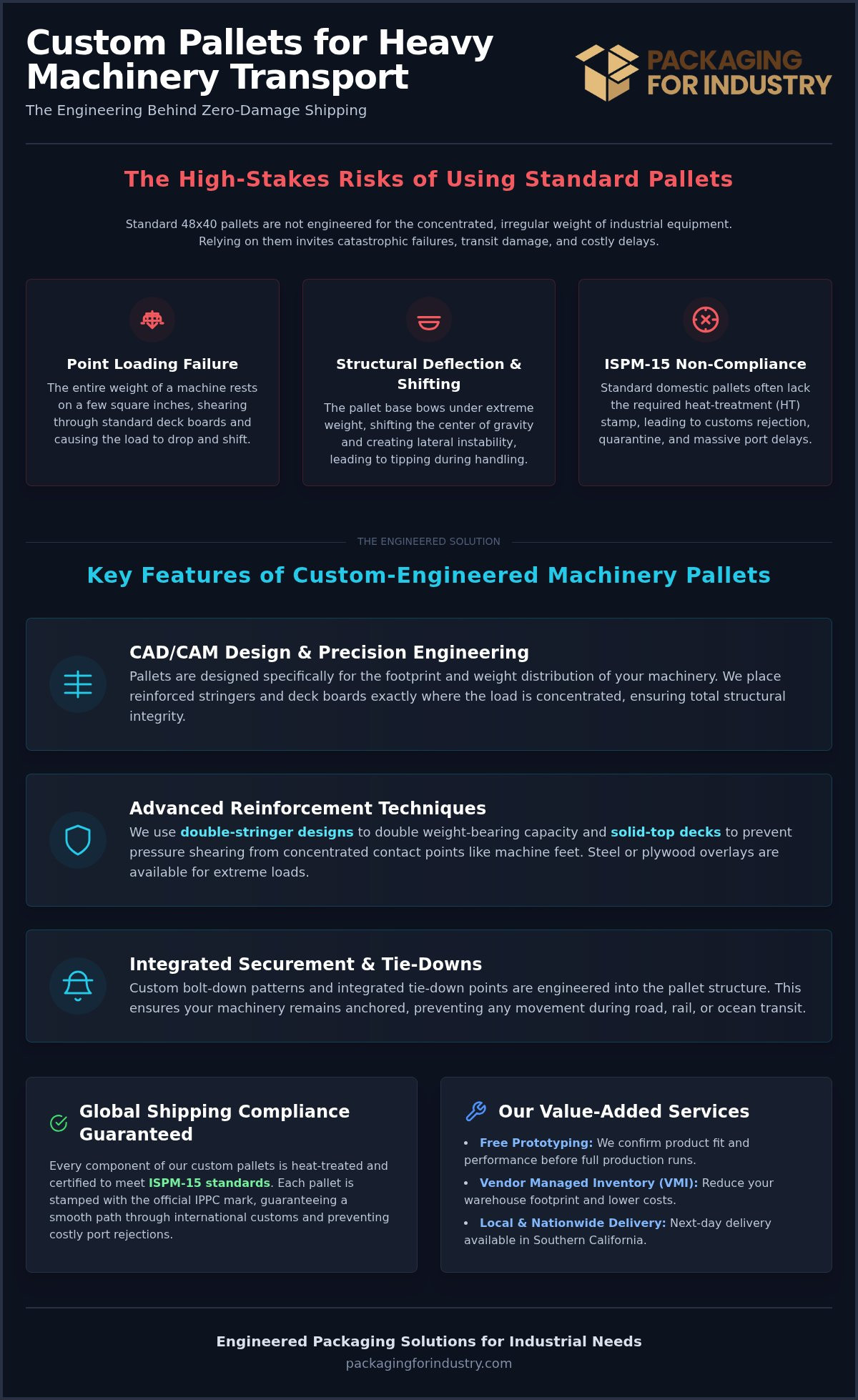
Standard 48×40 GMA pallets are designed for evenly distributed loads, such as stacked corrugated boxes. They aren’t built for the concentrated, irregular weight of industrial equipment. Using these off-the-shelf options for heavy machinery creates immediate structural vulnerabilities. The most common failure is “point loading,” where the entire weight of a machine rests on a few square inches of deck board. Standard half-inch or 5/8-inch boards often shear under this pressure, causing the equipment to drop and shift before it even leaves the loading dock.
The financial consequences of these failures extend far beyond the cost of a broken pallet. A single incident of transit damage can lead to months of production downtime and complex insurance disputes. Opting for “cheap” shipping solutions often results in higher total landed costs due to repair expenses and lost customer trust. Manufacturers can find more sustainable packaging cost savings by investing in a foundation that actually protects the asset.
Identifying Load Shifting and Structural Failure Points
Structural failure often begins with deflection, or the bowing of the pallet base under extreme weight. When a base bows, the machine’s center of gravity shifts. This creates lateral instability that makes the load prone to tipping during forklift maneuvers or sharp turns in transit. High-value machinery also exerts significant shear stress on standard fasteners. If the nails or staples can’t withstand the vibration of ocean or rail transport, the pallet can pull apart. Specifying custom pallets for heavy machinery transport ensures that stringer thickness and fastener types are engineered specifically for the equipment’s weight profile.
Regulatory Risks: ISPM-15 and International Compliance
Global logistics require more than just physical durability. If you’re shipping equipment across borders, your packaging must meet ISPM-15 standards to prevent the spread of timber pests. Standard domestic pallets often lack the necessary heat-treatment (HT) certification. Customs officials can, and frequently do, quarantine or reject entire shipments if the wood packaging lacks the proper IPPC stamp. This leads to massive delays and additional storage fees at the port. Utilizing professionally engineered custom pallets for heavy machinery transport guarantees that every piece of lumber is heat-treated and documented, providing a clear path through international customs.
Engineering the Foundation: Key Features of Custom Machinery Pallets
Custom pallets for heavy machinery transport are engineered foundations rather than simple shipping platforms. They’re designed specifically for the weight distribution and footprint of a single asset. While standard pallets rely on uniform board spacing, custom solutions use reinforced stringers and deck boards placed exactly where the machine’s weight is concentrated. This engineering-first approach prevents the structural failures that lead to costly delays and equipment damage.
Handling irregular footprints requires an understanding of the machine’s center of gravity. If a pallet is too small or the weight is off-center, the load becomes a safety hazard during forklift maneuvers. We build pallets with custom dimensions that extend the base of support, ensuring stability even for top-heavy equipment. This precision also helps optimize logistics; by matching the pallet size to the load, you avoid oversized freight surcharges and maximize trailer space. If you’re managing complex shipments, you can request a packaging quote to see how tailored dimensions impact your total landed cost.
Reinforcement Techniques for High-Weight Assets
Standard stringers often buckle under multi-ton industrial loads. To prevent this, we utilize double-stringer designs that place two or more support beams side-by-side. This effectively doubles the weight-bearing capacity without significantly increasing the pallet’s height. For machinery with small contact points, such as cast-iron feet, we provide solid-top deck options. These solid surfaces prevent concentrated pressure from shearing through individual boards. In extreme cases, incorporating steel or plywood overlays adds a final layer of durability for long-haul transit or heavy-duty storage environments.
Securement and Tie-Down Integration
A pallet is only effective if the machinery stays securely attached to it. Our custom design packaging process integrates securement features directly into the build. We provide pre-drilled holes for lag bolts, allowing your team to anchor equipment directly to the structural stringers. Beyond bolting, we use custom cleating and blocking to create a “nest” for the machinery base. These features provide several critical benefits:
- Lateral Stability: Cleats prevent the machine from sliding during sudden stops or sharp turns.
- Vibration Dampening: Proper blocking reduces the resonance that can loosen sensitive internal components.
- Direct Securement: Anchoring points ensure the machine and pallet move as a single, stable unit.
This integrated approach eliminates the need for improvised on-site securement and ensures every shipment meets professional safety standards. By engineering the securement into the pallet itself, you reduce labor time and improve the reliability of your outbound logistics.
Material Selection: Wood vs. Hybrid Solutions for Heavy Loads
Selecting the right material is a balance of structural rigidity and cost-efficiency. While some catalog suppliers push plastic alternatives, these often lack the necessary stiffness to support 5,000-pound point loads without permanent deformation. Wood remains the industry standard because it’s easily customized and offers high strength-to-weight ratios. For custom pallets for heavy machinery transport, we typically utilize a mix of kiln-dried hardwoods and structural plywood to match the specific density requirements of your equipment.
When weight exceeds the capacity of a standard pallet structure, we transition to heavy-duty skids. Skids eliminate the bottom deck boards, allowing for thicker, solid-wood runners that can support massive industrial assets. This design is particularly effective for machinery that requires a low center of gravity. We also develop hybrid solutions that combine wood bases with steel plates or reinforced fasteners to ensure the pallet doesn’t shear under the stress of long-haul vibration. These choices help you lower packaging costs by using high-performance materials only where they’re structurally required.
When to Choose Custom Wood Crates Over Pallets
A pallet provides a solid foundation, but it doesn’t protect against vertical impacts or environmental hazards. If your equipment features sensitive electronic components or polished surfaces, you should consider engineering custom crates for international transit. Crates offer a full enclosure that shields machinery from debris and stacking accidents in cargo holds. For ocean freight, we integrate vapor barrier bags and desiccants into the crate design to prevent corrosion caused by salt air and humidity. This comprehensive approach ensures your asset arrives in factory-fresh condition regardless of the shipping duration.
Protective Foam Integration for Vibration Damping
High-value machinery often contains precision gears or calibrated sensors that can’t withstand the constant “road buzz” of trucking. Simply bolting a machine to a hard wood base isn’t always enough. We integrate custom foam packaging, specifically high-density polyethylene, into the pallet’s structure. This foam acts as a shock absorber, isolating the equipment from transit vibrations. It’s a pragmatic way to reduce the risk of internal mechanical failure while keeping your total packaging footprint lean and cost-effective. By combining the rigidity of custom pallets for heavy machinery transport with the damping properties of foam, you create a complete protection system.
The Design Process: From Load Requirements to Prototyping
Designing custom pallets for heavy machinery transport requires a shift from commodity buying to structural engineering. We begin the process with a comprehensive packaging review, analyzing your current damage rates and transit history to identify exactly where standard solutions have failed. This data-driven approach ensures the new design isn’t just a replacement; it’s a logistical optimization. By utilizing CAD/CAM design support, we visualize the entire pallet structure and its interaction with the machine’s weight distribution before production begins. This methodology allows us to identify potential failure points in the virtual environment, saving you time and preventing expensive material waste on the production floor.
Step 1: Analyzing the Machinery Footprint
We don’t just measure length and width. Our team maps the machinery footprint to identify sensitive components like sensors, hydraulic lines, or thin metal housings that must never contact the pallet surface. Mapping the center of gravity is equally critical. An off-center load is a major liability that can cause a forklift to tip during sharp turns or sudden stops in the warehouse. We also determine whether your facility or the end customer requires 2-way or 4-way entry. This ensures the equipment remains accessible for both heavy-duty forklifts and standard pallet jacks in any environment, which is vital for smooth loading and unloading at various transit hubs.
Step 2: Prototyping and Testing
While a digital model provides the blueprint, a physical prototype is essential for high-value industrial assets. We provide free prototyping to ensure a perfect fit before you move into a full production run or commit to a long-term supply contract. This phase allows your operations team to perform a dry run of the securement process, testing bolt-down patterns and cleat placements under actual load conditions. Testing the prototype under stress helps us refine the design to eliminate unnecessary lumber. This level of precision lowers your total landed cost and prevents the bulky over-packaging that often inflates freight expenses and leads to oversized shipping surcharges.
Why PFI is the Southern California Leader in Machinery Pallets
PFI has established itself as the primary partner for heavy-duty logistics across Southern California’s manufacturing hubs. We provide custom pallets for heavy machinery transport to businesses in Anaheim, Irvine, and Santa Fe Springs. Because we operate locally, we offer advantages that national catalog suppliers cannot match, including local next-day delivery and on-site engineering consultations. This proximity allows us to respond immediately to changing production schedules, ensuring your equipment never sits idle due to a lack of proper shipping foundations.
Our approach treats packaging as a single, integrated system. Instead of sourcing pallets from one vendor and protective foam or heavy-duty corrugated boxes from another, you can consolidate your supply chain with PFI. This single-source model improves reliability and simplifies quality control for your operations team. Whether you’re shipping aerospace components from Orange County or medical devices from the Inland Empire, our expertise in regional and international standards ensures your assets are protected from the moment they leave your dock.
Streamlining Procurement with VMI and JIT
Managing a warehouse full of oversized pallets is inefficient and takes up valuable floor space. Our Vendor Managed Inventory (VMI) program solves this by shifting the burden of stock management to our team. We monitor your usage patterns and maintain a buffer of your custom-designed pallets in our facility. This allows for just-in-time delivery that aligns perfectly with your production cycles. By utilizing VMI, operations managers can reduce warehouse clutter and eliminate the risk of shipping delays caused by stockouts. It’s a pragmatic solution that prioritizes fiscal responsibility by lowering your inventory carrying costs.
Next Steps: Request a Custom Packaging Quote
Transitioning to engineered custom pallets for heavy machinery transport begins with a technical consultation. Our engineers need specific data to provide an accurate quote, including the machine’s total weight, overall dimensions, and the location of critical contact points. We’ll also ask about your shipping method to determine if you need ISPM-15 heat-treated lumber for export or specialized vibration damping for sensitive electronics.
Once we have these load requirements, we can begin the CAD/CAM design and free prototyping phase. This consultative process ensures that every dollar spent on packaging directly contributes to the safety and efficiency of your logistics. If you’re ready to lower packaging costs and eliminate transit damage, you can request a quote today to speak with a PFI packaging specialist about your next machinery shipment.
Securing Your Industrial Logistics for the Long Haul
Moving from standard shipping platforms to engineered foundations is a critical step in protecting high-value industrial assets. By prioritizing weight distribution and structural integrity, you eliminate the common risks of point loading and catastrophic transit failure. PFI provides the technical expertise needed to optimize your logistics, offering CAD/CAM design support and free prototyping to ensure every pallet meets your exact machinery specifications before production begins.
Our specialized knowledge in aerospace and industrial manufacturing allows us to deliver high-performance custom pallets for heavy machinery transport that lower your total landed costs. With local next-day delivery available throughout Southern California, your team can maintain a lean inventory without risking production delays or stockouts. We’re ready to partner with you as a steady, dependable resource for all your heavy-duty packaging requirements.
We look forward to helping you stabilize your shipping operations and secure your high-value equipment for safe, damage-free delivery.
Frequently Asked Questions
What is the weight capacity of a custom heavy machinery pallet?
Weight capacity depends entirely on the engineering of the structural stringers and deck boards. Custom pallets are frequently designed to support loads exceeding 10,000 lbs by utilizing reinforced double-stringer configurations. We calculate the specific weight distribution of your equipment to ensure the lumber density and fastener types can handle the asset without deflection. Unlike standard units, these solutions are built to withstand concentrated point loads that would otherwise cause structural failure.
How do I know if I need a custom pallet or a standard heavy-duty pallet?
You generally require a custom solution if your equipment has an irregular footprint, a high center of gravity, or concentrated weight points exceeding 4,000 lbs. Standard heavy-duty pallets are engineered for uniform loads like stacked boxes. If your machinery requires specific bolt-down patterns or integrated cleating to remain stable during transit, a custom-engineered base is the only reliable way to ensure safety and eliminate the risk of expensive damage.
Are PFI custom pallets compliant for international shipping (ISPM-15)?
Yes, all custom pallets for heavy machinery transport intended for export are fully ISPM-15 compliant. We use heat-treated lumber that meets international phytosanitary standards, ensuring your shipment passes through customs without quarantine or rejection. Every pallet is marked with the official IPPC stamp. We also provide the necessary documentation to support your global logistics and prevent costly delays at international ports of entry.
Can you design pallets for machinery with irregular shapes or high centers of gravity?
We specialize in engineering foundations for complex machinery with irregular footprints or top-heavy weight distributions. Our design process uses CAD/CAM support to map the center of gravity and extend the base of support for maximum stability. By identifying these challenges during the prototyping phase, we integrate custom blocking and bracing that prevents tipping during forklift maneuvers or sharp turns throughout the supply chain.
Do you offer local delivery for custom pallets in Southern California?
We provide local next-day delivery throughout Southern California, including Orange County, Los Angeles, San Diego, and the Inland Empire. Our dedicated fleet is equipped to handle oversized and custom-sized pallets, ensuring they arrive at your facility exactly when your production line needs them. This local proximity allows us to support just-in-time manufacturing schedules and reduces the amount of warehouse space you must dedicate to packaging storage.
What information do I need to provide to get a custom pallet quote?
To provide an accurate quote, we require the machinery’s total weight, overall dimensions, and a description of the base footprint. It’s helpful to identify any sensitive components that require clearance and specify if you need pre-drilled bolt-down holes. Providing details about the shipping destination and method, such as ocean freight or flatbed trucking, helps our engineers select the right materials and securement features for your specific journey.
Can I integrate foam cushioning into my custom machinery pallet?
Integrating high-density foam cushioning is a standard option for machinery sensitive to vibration or shock. We often utilize polyethylene foam pads between the pallet deck and the machine base to dampen transit resonance. This hybrid approach protects internal sensors and precision gears from the constant road buzz encountered during long-haul transport. It provides a more comprehensive protection system than using wood alone for custom pallets for heavy machinery transport.
How does a Vendor Managed Inventory (VMI) program work for pallets?
Our VMI program allows us to manage your pallet stock levels so your team can focus on production. We monitor your usage patterns and maintain a consistent supply of your custom designs in our facility, delivering them to your dock as needed. This system reduces your on-site storage requirements and eliminates the risk of running out of packaging during peak periods. It’s a proven way to lower packaging costs and improve overall operational reliability.