
Choosing a pallet based solely on the lowest unit price might be the most expensive mistake your logistics department makes this year. While wood remains the traditional standard, the hidden costs of weight, compliance, and disposal are shifting the math for modern manufacturers. You’re likely already feeling the pressure of high air freight surcharges and the administrative burden of ISPM 15 heat-treatment regulations for international exports. It’s a logistical bottleneck that eats into your margins and slows down your warehouse operations.
This corrugated vs wood pallets cost-benefit analysis provides a clear framework to evaluate the total cost of ownership for your shipping materials. We’ll show you how switching to lightweight, exempt corrugated options can lower your total shipping costs and ensure faster customs clearance. We’ll also examine the durability and reuse benefits of wood for closed-loop systems. By comparing these two options across 2026 industry standards, you’ll gain the insights needed to improve warehouse safety, eliminate disposal fees, and streamline your entire industrial supply chain.
Key Takeaways
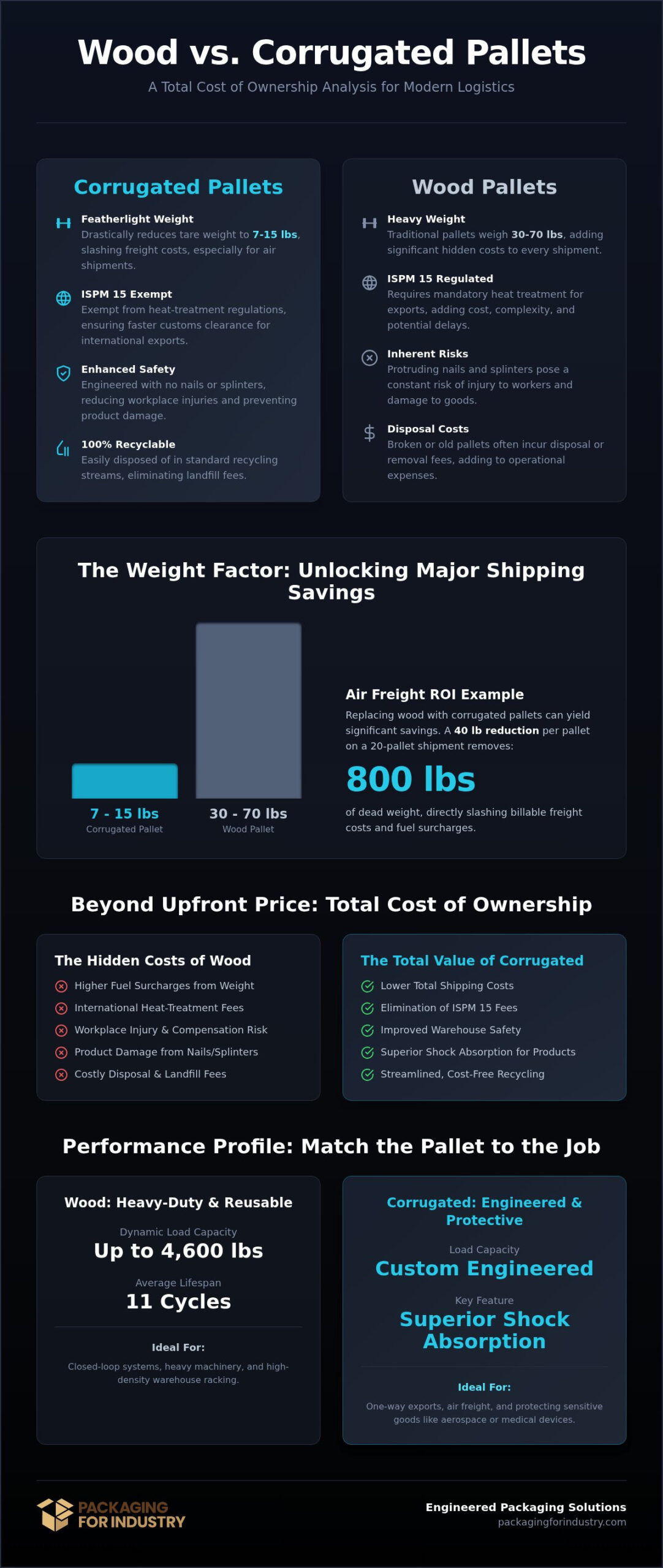
- Reduce shipping expenses by leveraging the significant tare weight reduction of corrugated pallets, which typically weigh between 7 and 15 pounds compared to the 30 to 70 pounds of traditional wood.
- Use this corrugated vs wood pallets cost-benefit analysis to determine how the ISPM 15 exemption for paper-based materials can accelerate international customs clearance and eliminate heat-treatment fees.
- Evaluate the total cost of ownership by accounting for hidden operational factors like pallet disposal fees, fuel surcharges, and workplace injury risks from nails or splinters.
- Optimize your warehouse efficiency through custom-engineered pallet designs and vendor-managed inventory (VMI) programs that maintain supply reliability without wasting valuable floor space.
Corrugated vs. Wood Pallets: Understanding the Material Fundamentals
The pallet serves as the essential platform for nearly every industrial transaction. It’s the baseline for warehouse efficiency. In 2026, supply chain managers are looking beyond the surface-level price tag to find deeper operational savings. This shift is driving a more rigorous corrugated vs wood pallets cost-benefit analysis across manufacturing sectors. While wood remains the dominant choice with roughly 90% market share, engineered paperboard alternatives are no longer just for lightweight e-commerce. They’re now foundational units of industrial logistics designed for high-stakes shipping.
The Anatomy of a Heavy-Duty Wood Pallet
Traditional pallets rely on hardwood or softwood timber to provide structural integrity. Hardwood offers superior load-bearing limits for heavy machinery, while softwood is a more economical choice for lighter freight. Most domestic shipping in the United States utilizes the 40” x 48” GMA standard. This ubiquity makes wood easy to source and exchange within existing pools. Durability is the primary selling point; a standard wood pallet offers an 11-cycle average lifespan before requiring significant repair. This makes them a reliable choice for closed-loop systems where the pallet returns to the manufacturer, though they bring significant weight—ranging from 30 to 70 pounds—to every shipment.
The Rise of Engineered Corrugated Pallets
Modern corrugated pallets aren’t simply reinforced cardboard. They’re engineered structures designed to withstand intense vertical pressure. Through custom design packaging, PFI develops pallets with high crush-test ratings that rival wood in specific weight categories. These units are typically categorized into single-way use cases for one-way exports or multi-way use for controlled distribution. Modern designs often incorporate moisture-resistant coatings and reinforced deck strength to prevent sagging in humid environments. Because they lack nails and splinters, they also reduce workplace injury risks and product damage during handling.
The 2026 logistical trend is moving toward “lightweighting” to offset rising transportation costs. Reducing tare weight directly impacts fuel surcharges and air freight rates. Corrugated pallets weigh between 7 and 15 pounds, offering a drastic reduction compared to timber. Deciding which material fits your operation requires a thorough corrugated vs wood pallets cost-benefit analysis that weighs the upfront unit cost against long-term shipping efficiencies and disposal logistics. For many, the choice isn’t about durability alone, but about the total cost of moving a product from the factory floor to the end user.
Performance Comparison: Weight, Durability, and Load Capacity
Performance in a warehouse isn’t just about how much a pallet can hold; it’s about how that weight interacts with your entire logistics network. A comprehensive corrugated vs wood pallets cost-benefit analysis must begin with tare weight. Traditional wood pallets typically weigh between 30 and 70 pounds. In contrast, engineered corrugated pallets weigh only 7 to 15 pounds. This weight differential impacts everything from manual handling safety to the fuel consumption of your delivery fleet. While wood remains the standard for extremely heavy loads, corrugated options have evolved to meet the needs of most industrial applications.
Load capacity is divided into static and dynamic ratings. Wood pallets are the established leaders for high-density storage, often supporting dynamic loads up to 4,600 pounds. However, most industrial freight doesn’t reach these limits. Modern corrugated pallets are engineered with specific deck reinforcements to handle significant dynamic loads while offering superior vibration dampening. Unlike rigid wood, which transfers road shock directly to the cargo, the cellular structure of corrugated material acts as a natural shock absorber. This protects sensitive components in sectors like aerospace and medical devices from micro-fractures during transit.
Weight Savings and Air Freight ROI
For international aerospace shipments, every ounce of tare weight translates into a direct freight penalty. A 40lb weight reduction per pallet on a 20-pallet shipment removes 800 lbs of dead weight from the aircraft, directly slashing billable freight costs. PFI has helped clients in Southern California realize these savings by replacing heavy timber with custom-engineered corrugated solutions for their export lines. These weight reductions don’t just lower costs; they also reduce the risk of forklift strain and pallet-related workplace injuries. If you’re unsure which material fits your specific load profile, you can request a packaging quote to get a tailored engineering assessment.
Durability and Environmental Resilience
Durability is often where wood is perceived to have the upper hand, but this depends on the environment. In high-humidity settings, untreated wood can warp or host mold, creating a hygiene risk for sensitive electronics or pharmaceutical goods. Corrugated pallets used by PFI are often treated for moisture resistance, providing a clean, dust-free platform that meets strict medical-grade standards. Furthermore, the absence of nails and splinters eliminates a common cause of product puncture and stretch film tearing. While wood is ideal for multi-cycle, closed-loop systems, corrugated is the superior choice for one-way hygiene-critical exports where the pallet won’t be returning to your facility.
Regulatory Compliance and Export Cost-Benefit Analysis
Navigating international borders requires more than just logistical coordination; it demands strict adherence to phytosanitary standards. For global exporters, a corrugated vs wood pallets cost-benefit analysis must prioritize regulatory speed. Solid wood packaging material is subject to International Standards for Phytosanitary Measures No. 15 (ISPM 15). This mandate requires all timber pallets to undergo heat treatment (HT) or fumigation to eliminate pests. While effective, this process adds significant time and administrative burden to your procurement cycle.
Navigating International Shipping Regulations
Heat treatment is a mandatory expense for wood pallets used in international trade. This process adds a per-unit surcharge to every pallet that scales based on your order volume. Beyond the direct cost, the risk of non-compliance remains a significant threat to your delivery timelines. If a certification stamp is missing, faded, or illegible, customs authorities can quarantine or reject the entire shipment at the shipper’s expense. Corrugated pallets are inherently exempt from ISPM 15 because they’re manufactured using high heat and pressure, which naturally destroys timber pests. This exemption allows your cargo to move through customs without the certification bottleneck, which is critical for time-sensitive aerospace components and medical supplies.
Sustainability and Corporate ESG Goals
Modern supply chains are increasingly measured by their environmental impact and corporate ESG (Environmental, Social, and Governance) targets. Corrugated pallets align with these goals by offering a simpler “cradle-to-grave” lifecycle. Once a corrugated pallet reaches its destination, it can be broken down and placed in standard curbside recycling. This eliminates the need for specialized pallet removal services or landfill disposal fees often associated with broken wood units. When you lower packaging costs by removing disposal logistics, you also improve your facility’s hygiene by eliminating wood dust and debris.
- 100% Recyclability: Corrugated materials feed directly back into the paper production loop, supporting a circular economy.
- Carbon Reduction: The lighter tare weight reduces the fuel required for transport, lowering the overall carbon footprint of your distribution network.
- Waste Elimination: Avoid the disposal logistics of damaged timber, which often requires dedicated hauling and tipping fees at the end of its life.
By choosing inherently compliant materials, you simplify your documentation and reduce the likelihood of costly customs delays. This operational efficiency is a core component of a thorough corrugated vs wood pallets cost-benefit analysis. When your goal is to maintain global compliance without the administrative headache of heat-treatment logs, the simplicity of corrugated becomes a clear competitive advantage for your export operations.
Total Cost of Ownership: Upfront Price vs. Hidden Expenses
Procurement teams often fall into the trap of comparing unit prices without accounting for downstream friction. While a used wood pallet might appear cheaper on a purchase order, a rigorous corrugated vs wood pallets cost-benefit analysis reveals that upfront savings are frequently erased by hidden operational burdens. High-density plastic pallets offer the lowest cost-per-trip in closed-loop systems, but they require a massive initial investment. For most industrial shippers, the real financial battle takes place between the maintenance-heavy wood standard and the high-efficiency corrugated alternative.
Workplace safety is a primary driver of hidden costs. Wood pallets are notorious for protruding nails, splinters, and cracked stringers that cause hand injuries and tear expensive stretch film. These incidents don’t just slow down production; they increase your liability and workers’ comp risks. Corrugated pallets feature smooth, die-cut edges and no metallic fasteners. This cleaner design eliminates the need for heavy gloves during manual handling and prevents product punctures that lead to costly returns and insurance claims.
The Hidden Costs of Wood Pallet Maintenance
Wood pallets require constant oversight. Warehouse staff must spend billable hours inspecting every incoming unit for rot, pests, or structural failure. If a pallet fails while stored in a high-rack system, the resulting damage to inventory and equipment can be catastrophic. Furthermore, wood pallets are bulky and non-nestable. They consume significant floor space even when empty. In contrast, many corrugated designs are nestable or can be shipped in “knocked down” kits, allowing you to store a larger inventory of pallets in a fraction of the space. This efficiency is a core component of a vendor-managed inventory (VMI) strategy, ensuring you have the supplies you need without wasting warehouse real estate.
Maximizing ROI with Custom Engineered Solutions
Standard pallets often lead to “dead space” inside shipping containers or trucks. Custom-engineered solutions allow you to match the pallet dimensions exactly to your product footprint. This precision helps you avoid UPS/FedEx surcharges related to dimensional weight (DIM). Financial benefits also increase when you utilize kitting services. By combining pallets with custom foam inserts, PFI creates a unified protection system that reduces labor time on the packing line. When your shipments are one-way and international, the cost of corrugated is almost always lower than the combined price of wood plus the return logistics required for a reusable system.
Implementing the Right Pallet Strategy with PFI
Executing a successful corrugated vs wood pallets cost-benefit analysis is only the first step toward supply chain optimization. The second step is partnering with a supplier that moves beyond catalog sales to provide engineered solutions. At PFI, we take a consultative approach to your logistics. We analyze your specific load requirements, transit routes, and storage environments to recommend the most cost-effective platform. Whether you’re a manufacturer in Orange County or a distributor in Los Angeles, our team provides the local support and technical expertise needed to keep your operations running smoothly.
Our capabilities extend across Southern California, with dedicated service areas in San Diego and the Inland Empire. We offer local next-day delivery for stock items to ensure your production lines never stall. For multi-location manufacturers, our nationwide shipping infrastructure provides consistent quality and pricing across all your facilities. This comprehensive oversight allows you to centralize your procurement while maintaining the speed of local logistics.
Custom Prototyping and Engineering
A “one-size-fits-all” pallet often results in wasted freight spend and inadequate product protection. PFI eliminates this inefficiency through custom design packaging services. Our process begins with CAD design, followed by free prototyping to verify performance under real-world conditions. We don’t just look at the pallet in isolation. We analyze how it integrates with your corrugated boxes and internal cushioning to create a total protection system. This holistic engineering ensures that your high-value aerospace or medical components arrive without damage, regardless of the transit method.
Streamlining Procurement with VMI
Managing pallet inventory can be a logistical headache, especially in the high-rent warehouse markets of Southern California. Our Vendor Managed Inventory (VMI) programs solve this by shifting the burden of stock management to PFI. We monitor your usage levels and replenish your supplies just-in-time, which frees up valuable floor space in your facility. This proactive approach prevents stockouts and allows your team to focus on production rather than procurement logistics.
If your current corrugated vs wood pallets cost-benefit analysis suggests a need for change, PFI is ready to facilitate the transition. We provide the data and engineering support required to justify the shift to decision-makers. You can request a packaging quote for bulk pallet programs or custom-sized shipping supplies to start lowering your total cost of ownership today. Our goal is to serve as your dependable partner, delivering the fiscal responsibility and operational peace of mind your business demands.
Optimizing Your Industrial Distribution Network
The decision to modernize your pallet strategy is a critical step toward fiscal responsibility and operational efficiency. As this corrugated vs wood pallets cost-benefit analysis demonstrates, moving beyond the traditional timber standard can yield significant dividends in tare weight reduction and customs speed. By eliminating the administrative burden of ISPM 15 compliance, you ensure that your international shipments move through the supply chain without the risk of costly pest-related rejections.
PFI supports this transition with technical expertise and local reliability. We specialize in aerospace and mil-spec compliance, providing the precision required for high-stakes manufacturing. Our team offers free prototyping for custom engineered designs to guarantee performance before you commit to a bulk order. For our partners in Southern California, we provide local next-day delivery to keep your warehouse moving at peak capacity.
We’re ready to help you lower packaging costs and build a more resilient logistical framework for the years ahead.
Frequently Asked Questions
How much weight can a corrugated pallet actually hold?
Modern corrugated pallets support significant weight, often handling dynamic loads up to 2,000 lbs depending on the internal engineering. While they don’t match the 4,600 lb capacity of heavy hardwood, they’re sufficient for the majority of industrial shipping needs. The specific capacity depends on the flute thickness and deck reinforcement. PFI provides custom engineering and free prototyping to ensure your specific load profile is fully supported during transit.
Do corrugated pallets require ISPM 15 heat treatment for export?
No, corrugated pallets are inherently exempt from ISPM 15 regulations. Because they’re manufactured using high heat and pressure, they aren’t considered solid wood packaging material. This “Exemption Advantage” allows you to skip the certification bottleneck and avoid the heat-treatment surcharges associated with timber. This leads to faster customs clearance for international exports, particularly in time-sensitive sectors like aerospace and medical device manufacturing.
Are corrugated pallets moisture resistant for long-term shipping?
Yes, modern corrugated pallets can be manufactured with moisture-resistant coatings or specialized glues to withstand humid transit environments. While they aren’t designed for prolonged outdoor storage, they maintain structural integrity during standard sea freight and warehouse storage. This resilience makes them a viable part of a corrugated vs wood pallets cost-benefit analysis for global supply chains where hygiene and dust-free environments are prioritized over extreme weather exposure.
What are the main cost savings when switching from wood to corrugated?
The primary savings come from reduced tare weight, which lowers air freight costs and fuel surcharges. You also eliminate ISPM 15 heat-treatment fees and pallet disposal costs, as corrugated is 100% recyclable. Additionally, the lack of nails and splinters reduces product damage and workplace injury claims. When you lower packaging costs through these hidden efficiencies, the corrugated vs wood pallets cost-benefit analysis clearly favors the engineered paper alternative for most one-way export applications.
Can I get custom-sized pallets for specialized aerospace components?
Yes, PFI specializes in custom sizes available for specialized aerospace and medical components. We provide free prototyping for custom engineered designs to ensure a perfect fit for your product footprint. Matching the pallet size to your cargo helps you avoid dimensional weight surcharges. You can compare packaging pricing for these custom solutions by contacting our engineering team for a CAD assessment to ensure maximum protection and efficiency.
How do I dispose of corrugated pallets compared to wood pallets?
Disposal of corrugated pallets is much simpler and more cost-effective than wood. Corrugated units can be broken down and placed in standard curbside recycling bins, feeding directly back into the paper production loop. Wood pallets often require specialized removal services or landfill tipping fees once they’re damaged beyond repair. Switching to paper-based platforms eliminates these end-of-life logistics and helps your facility meet corporate ESG and sustainability targets.
Are corrugated pallets safe for use in cleanroom environments?
Corrugated pallets are ideal for cleanrooms because they’re dust-free and lack the organic contaminants found in timber. They don’t harbor pests, mold, or bacteria, which is a critical requirement for the medical and electronics industries. Unlike wood, which can shed splinters and debris, corrugated provides a sterile, smooth platform. This hygiene advantage reduces the risk of product contamination and ensures compliance with strict pharmaceutical and laboratory handling standards.
Does PFI offer local delivery for pallets in Southern California?
Yes, PFI provides local next-day delivery across Southern California, including Orange County, Los Angeles, and San Diego. Our regional logistics network ensures your production lines stay moving without the need for excessive on-site inventory. We also offer vendor-managed inventory (VMI) to optimize your warehouse floor space. For multi-location manufacturers, we maintain nationwide shipping capabilities to ensure consistent supply reliability and price stability across all your domestic facilities.