
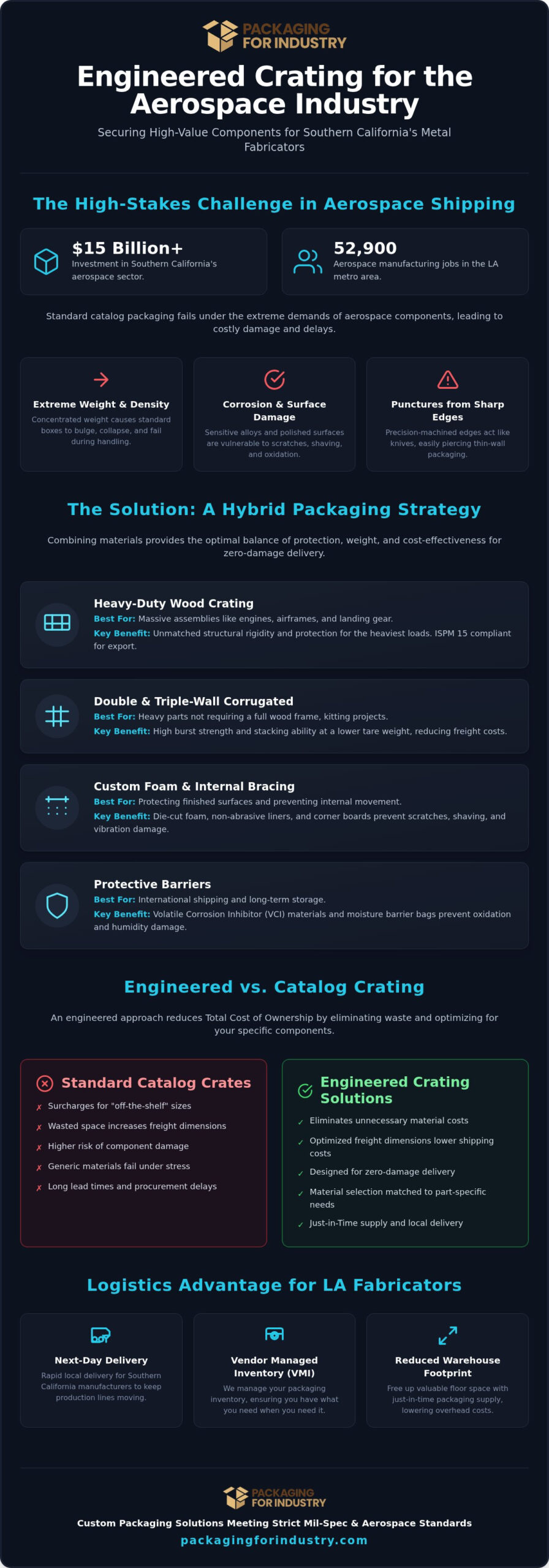
With over $15 billion in investment flowing into Southern California’s aerospace sector in 2026, the pressure on local metal fabricators to deliver flawless, high-value assemblies is at an all-time high. Finding reliable aerospace crating solutions Los Angeles manufacturers can depend on is no longer just a logistical box to check; it’s a critical financial imperative for your bottom line.
You likely know the frustration of seeing a precision-engineered part, weeks in the making, arrive at a client site with freight damage because a standard catalog crate couldn’t handle the weight or sharp edges. It’s a costly cycle of long lead times and excessive shipping risks that eats into your margins and creates unnecessary operational stress. We understand that your reputation depends on the physical integrity of every component you ship.
This guide will show you how to secure your most sensitive components using engineered crating and localized logistics that slash both damage rates and procurement costs. We will examine how to bypass overpriced suppliers, leverage just-in-time supply to clear warehouse floor space, and ensure every shipment meets the newest ISPM 15 export standards for zero-tolerance bark and branded heat-stamping.
Key Takeaways
- Engineered crating prevents high-density metal parts from puncturing or shaving packaging, ensuring zero-damage delivery for sensitive assemblies.
- Custom-sized crating reduces total cost of ownership by eliminating “off-the-shelf” catalog surcharges and optimizing freight dimensions.
- Utilizing local aerospace crating solutions Los Angeles fabricators can access next-day delivery and Vendor Managed Inventory to reduce their warehouse footprint.
- A hybrid packaging approach combines custom wood crates, triple-wall corrugated, and die-cut foam to meet strict Mil-Spec and aerospace standards.
Challenges of Aerospace Metal Shipping in the Los Angeles Industrial Hub
The Southern California aerospace renaissance has transformed the Long Beach and Carson industrial corridors into high-stakes environments for metal fabricators. With approximately 52,900 aerospace manufacturing jobs in the Los Angeles-Long Beach metropolitan area as of 2024, the volume of high-value components moving through local ports and highways is staggering. Fabricators often struggle with the unique physical demands of shipping aerospace-grade metals. These parts aren’t just expensive; they’re incredibly dense and often feature sharp, precision-machined edges that can easily compromise standard packaging. Securing effective aerospace crating solutions Los Angeles providers offer is the only way to mitigate these risks and avoid rejected shipments.
Weight and Density: The Failure of Standard Boxes
Standard Regular Slotted Containers (RSC) rarely survive the transit of heavy metal assemblies. When weight is concentrated in a small footprint, the bottom flaps of a single-wall box often fail during forklift handling or transit vibrations. You need to calculate the exact burst strength and edge crush test (ECT) requirements before selecting a material. For most heavy-duty aerospace applications, we recommend a shift from standard corrugated to heavy-duty double and triple-wall corrugated boxes. These materials provide the structural rigidity needed to prevent box bulge and stacking collapse. When you compare packaging pricing, the long-term savings from reduced damage far outweigh the initial cost of high-strength materials. For the heaviest engines or airframe components, proper wooden crate construction remains the gold standard, providing a rigid frame that corrugated alone cannot match.
Corrosion and Surface Integrity in Transit
Aerospace alloys are sensitive to environmental shifts, especially during long-haul transport or port-side storage. Polished or powder-coated surfaces require more than just a box; they need a comprehensive surface protection strategy. We integrate Volatile Corrosion Inhibitor (VCI) materials to prevent oxidation on sensitive alloys without requiring messy greases. To maintain surface integrity, your packaging should include:
- Non-abrasive polyethylene foam liners to prevent scratching on finished surfaces.
- Moisture barrier bags for international export to block salt air and humidity.
- Custom-fitted foam blocking to stop “shaving” caused by metal parts vibrating against the crate walls.
Sharp metal edges act like knives during transit. If a fabricator uses thin-wall packaging, these edges can puncture the exterior, exposing the part to the elements. Our aerospace crating solutions Los Angeles services focus on internal bracing and reinforced corner boards to ensure that even the sharpest fabricated parts remain contained and protected from the moment they leave your facility in Los Angeles or Santa Fe Springs.
Essential Aerospace Crating Materials: From Triple-Wall to Custom Wood
Selecting the right materials is a balance between technical protection and economics. While many suppliers suggest wood for every load, the most efficient aerospace crating solutions Los Angeles fabricators use often involve a hybrid material strategy. This approach balances the extreme durability of wood with the weight-saving benefits of heavy-duty corrugated and protective foam inserts. By matching the material to the specific weight and fragility of the part, you can lower packaging costs while maintaining a zero-damage shipping standard.
Triple-wall corrugated is often overlooked but provides a significant advantage for parts that are heavy but don’t require a full wooden frame. It’s a lightweight, high-strength alternative that significantly reduces the tare weight of your shipment. This leads to lower freight costs while still providing a burst strength capable of containing dense metal components. It’s an ideal solution for kitting projects where multiple smaller machined parts are shipped together in a single unit.
Heavy-Duty Wood Crating and Pallets
For massive assemblies like engines or landing gear components, solid wood is non-negotiable. As of August 2026, international export standards remain strict. ISPM 15 regulations now enforce a zero-tolerance policy for any visible bark on Wood Packaging Material (WPM). Compliance also requires that the treatment mark be branded or heat-stamped directly into the wood, as ink stamps are no longer accepted for new packaging. We offer Custom Crates and custom skids designed to meet these global requirements, preventing costly port delays or shipment rejections at the port of San Pedro.
Engineered Foam and Hybrid Protection
Internal protection is just as critical as the outer crate. Foam Packaging provides the necessary shock absorption to prevent vibration damage during transit. Polyethylene foam is our primary recommendation for heavy metal parts due to its high load-bearing capacity and non-abrasive surface. For metal parts with integrated electronics, we provide anti-static and ESD foam to prevent electrostatic discharge. Using die-cut foam end caps is a pragmatic way to shield threaded ends, ensuring your precision machining stays intact during transit across Torrance or Orange County. This level of internal engineering is what separates standard boxes from professional aerospace crating solutions Los Angeles manufacturers trust.
Integrating corner boards and edge protection further reinforces the load against strap tension during flatbed transport. This holistic view of material selection ensures that your high-value fabrication arrives in the same condition it left your facility. If you’re ready to optimize your shipping workflow and reduce damage-related costs, you can request a packaging quote for a custom-engineered solution today.
Engineering vs. Catalog: Reducing Your Total Cost of Ownership
Buying from a standard catalog might seem like a shortcut for procurement, but for aerospace fabricators, it’s often a trap. Catalog packaging is built for a one-size-fits-all market, which means you’re frequently paying for air you don’t need or materials that aren’t rated for heavy-duty metal. When you use oversized catalog boxes, you trigger significant dimensional weight surcharges from carriers like UPS and FedEx. By switching to engineered aerospace crating solutions Los Angeles fabricators can eliminate these surcharges through precision-fit designs that minimize the shipping footprint.
Reducing your total cost of ownership goes beyond the price per unit. It involves calculating the cost of Return Material Authorizations (RMAs) and the production delays caused by shipping damage. Every time a part is rejected due to a surface scratch or a dented flange, you lose the labor hours and material costs invested in that piece. Engineered protection ensures that your high-value assemblies arrive ready for installation, protecting your margins and your professional reputation.
Prototyping and Custom Design
High-value metal components shouldn’t be subjected to guesswork. We provide free prototyping for our custom designs to ensure the fit is perfect before you commit to a full production run. This process allows us to test CAD/CAM designs against real-world stresses, ensuring that the internal foam blocking and external crating work in harmony. It’s a proactive approach that prevents the trial and error method often associated with generic supplies. Testing a prototype in your own facility helps confirm that the packaging integrates with your existing material handling equipment.
Cost-Reduction Analysis Framework
A true analysis of your packaging spend must account for material waste. If your team is spending hours cutting generic foam or stuffing void fill into oversized boxes, you’re losing money on labor and materials. Custom-cut foam end caps and precision crates eliminate this waste entirely. When you evaluate your workflow, consider these factors:
- Freight Optimization: Reducing box dimensions by just two inches can move a shipment out of an oversized tier.
- Labor Efficiency: Kitted packaging components allow warehouse teams to pack parts in seconds rather than minutes.
- Bulk Pricing: Leveraging wholesale rates for recurring aerospace runs provides a lower cost-per-unit than standard catalog rates.
Moving from a transactional catalog relationship to an engineered partnership turns packaging from a cost center into a competitive advantage. By focusing on precision and material efficiency, you can lower packaging costs while increasing the reliability of your supply chain.
Local Logistics: Next-Day Delivery and VMI for LA Fabricators
The geographic concentration of aerospace contractors in Southern California creates a unique logistical challenge. Relying on national catalog distributors often introduces unnecessary bottlenecks, such as multi-day shipping delays and increased risks of transit damage from cross-country freight. By utilizing local aerospace crating solutions Los Angeles fabricators can leverage next-day delivery across Los Angeles and Orange County. This proximity allows your operations to move at the speed of modern aerospace production, ensuring that packaging is never the reason for a missed shipping window.
Maintaining a lean manufacturing environment requires a Just-In-Time (JIT) approach to packaging supplies. Storing massive quantities of empty wooden crates or triple-wall boxes on your warehouse floor is an inefficient use of expensive industrial real estate. Localized logistics allow you to receive exactly what you need, when you need it, effectively turning your packaging supplier into an extension of your own facility. This model supports the high-velocity production schedules common in the South Bay and Inland Empire aerospace corridors.
Vendor Managed Inventory (VMI) for Aerospace
Stockouts are catastrophic during critical production runs. Our VMI programs remove the burden of inventory management from your procurement team. We establish regular review cycles, typically weekly or monthly, based on your specific fabrication volume. By monitoring your usage levels in real-time, we ensure that your custom foam inserts, crates, and heavy-duty corrugated supplies are replenished before they reach a critical low. This proactive oversight eliminates the stress of last-minute ordering and ensures your team stays focused on precision metal fabrication rather than tracking box counts.
Serving Los Angeles Industrial Hubs
Our fleet provides direct support to the major aerospace clusters that drive the regional economy. We offer rapid response times for contractors in Carson and Torrance, where space is at a premium and production deadlines are tight. For aerospace contractors in Santa Fe Springs, our local presence means we can provide rapid prototyping turnaround that national competitors simply can’t match. When a new part design requires a custom-engineered protection system, being only a few miles away allows for physical fit-tests and immediate design iterations. This local advantage is essential for securing the high-value, sensitive components that define the modern aerospace crating solutions Los Angeles market.
Custom Aerospace Solutions from Packaging For Industry (PFI)
At Packaging For Industry (PFI), we don’t just sell containers; we engineer comprehensive systems of protection. For Southern California fabricators, the challenge is often managing multiple vendors for different packaging components. We solve this by integrating heavy-duty corrugated, die-cut foam, and custom wood crates into a single, unified shipment. This integrated approach ensures that every piece of the protective assembly works in harmony, which is the hallmark of the most effective aerospace crating solutions Los Angeles businesses utilize to protect their bottom line.
Operations and warehouse managers face constant pressure to reduce overhead while maintaining reliability. We streamline the purchasing process by offering a single point of contact for all industrial supplies. Whether your project requires standard RSC boxes for smaller components or specialized aerospace crating solutions Los Angeles fabricators need for massive airframe sections, we provide the technical expertise to keep your production line moving. Our focus on fiscal responsibility means we prioritize material efficiency, helping you lower packaging costs without compromising the safety of your high-value metal assemblies.
Specialized Support for Aerospace and Defense
Defense-related projects demand a higher level of scrutiny and adherence to strict standards. We provide Aerospace Packaging Solutions that are fully compliant with Mil-Spec requirements, ensuring your metal fabrication projects meet every contractual obligation. Our expertise extends to high-value, fragile, and heavy industrial components that require more than just a standard pallet. We design heavy-duty skids and reusable packaging systems for recurring shipments, which helps reduce long-term material waste and improves the logistical flow between your facility and your end client.
Get Started with PFI in Southern California
Choosing a packaging partner is about more than just a simple transaction; it’s about establishing a reliable supply chain. We invite you to schedule a comprehensive packaging review with our engineering team to identify potential damage risks in your current workflow. By analyzing your part geometry and transit routes, we can develop a custom-tailored response that addresses your specific pain points. Our team functions as a proactive problem-solver, helping you transition from generic catalog supplies to a system built for your specific needs.
You can contact our Anaheim headquarters to speak with a local expert who understands the unique demands of the Southern California industrial corridor. We offer free prototyping for custom designs, allowing you to verify the fit and function of your protection system before moving to full-scale production. When you’re ready to optimize your logistics and secure your high-value components, you can request a packaging quote to see how our engineered solutions compare to standard catalog rates.
Optimize Your Aerospace Logistics Strategy
Transitioning from generic catalog packaging to the specialized aerospace crating solutions Los Angeles fabricators depend on is a critical step for protecting your bottom line. By prioritizing custom engineering and free prototyping, you eliminate the hidden costs of oversized freight surcharges and expensive shipping damage. Localizing your supply chain through PFI provides a distinct competitive advantage. Our local next-day delivery and VMI programs prevent production shortages while reclaiming valuable warehouse floor space for your core manufacturing activities.
We’re committed to helping you streamline operations through expert design and reliable logistics. Our team understands the precision required for aerospace metal fabrication and the economic necessity of a zero-damage delivery. We provide the technical expertise and fiscal oversight needed to turn your packaging from a simple expense into a robust protection system.
We look forward to partnering with you to secure your high-value assemblies and enhance your overall supply chain reliability.
Frequently Asked Questions
What is the best crating solution for heavy aerospace metal parts in Los Angeles?
Custom wood crates with internal blocking and bracing are the most reliable option for heavy fabricated assemblies. For international shipments leaving Los Angeles, these must meet ISPM 15 standards with branded heat-stamping. Our aerospace crating solutions Los Angeles are engineered to support the high density of metal components while preventing exterior puncture. You can request a packaging quote for a custom-sized crate that maximizes protection without adding unnecessary freight weight.
How can metal fabricators reduce shipping damage for aerospace components?
Reducing shipping damage starts with eliminating generic void fill in favor of engineered internal protection. Use die-cut polyethylene foam to block movement and VCI materials to prevent oxidation on sensitive alloys. When you compare packaging pricing, consider the total cost of ownership, including RMAs and production delays. Precision-fit aerospace crating solutions Los Angeles fabricators use ensure that sharp metal edges don’t compromise the box integrity during multi-stop transit through local hubs.
Does PFI offer local next-day delivery in Torrance and Carson?
Yes, we provide local next-day delivery to aerospace contractors located in Torrance, Carson, and the surrounding South Bay industrial clusters. Our proximity to these manufacturing hubs allows us to offer rapid response times that national catalog distributors can’t match. This local presence is essential for Just-In-Time production schedules, ensuring that your kitting and shipping operations never stall due to a lack of custom crates or heavy-duty corrugated supplies.
What are the benefits of VMI for an aerospace fabrication shop?
Vendor Managed Inventory (VMI) eliminates the risk of production shortages by automating your packaging replenishment. We conduct regular on-site reviews of your stock levels for custom foam, crates, and boxes. This program allows you to lower packaging costs by reducing administrative overhead and reclaiming warehouse floor space previously used for bulk storage. It’s a pragmatic solution for lean fabrication shops that need to focus on engineering rather than inventory tracking.
Can I get custom foam inserts designed for specialized metal assemblies?
We specialize in designing die-cut foam inserts specifically for complex metal assemblies and machined parts. Our engineering team uses polyethylene for heavy-duty impact absorption and anti-static foam for components with integrated electronics. We offer free prototyping for these custom designs, allowing you to fit-test the protection before committing to a production run. This ensures your custom sizes available are perfectly calibrated to shield threaded ends and polished surfaces from vibration damage.
How do I avoid UPS and FedEx oversized surcharges for aerospace shipments?
You can avoid oversized surcharges by switching from standard catalog boxes to custom-engineered dimensions. Most fabricators pay for “shipped air” when using off-the-shelf supplies, which triggers dimensional weight penalties from carriers like UPS and FedEx. By utilizing custom sizes available, we minimize the exterior footprint of your shipment. This precision engineering helps you lower packaging costs while ensuring your high-value parts remain securely braced within the smallest possible volume.
What is the difference between double-wall and triple-wall corrugated boxes?
Double-wall corrugated consists of two layers of fluting and provides high burst strength for standard industrial parts. Triple-wall corrugated adds a third layer, offering extreme structural rigidity and puncture resistance that can often replace heavy wood crates for smaller aerospace components. Choosing triple-wall can significantly reduce the tare weight of your shipment. We recommend you compare packaging pricing between these materials to find the most cost-effective balance of strength and freight savings.
Does PFI provide Mil-Spec packaging for defense and aerospace contractors?
Yes, PFI provides comprehensive Mil-Spec packaging that meets the rigorous standards required by defense and aerospace contractors. We understand the specific requirements for barrier materials, specialized labeling, and reinforced crating used in military logistics. Our team ensures that every component of your protection system is documented and compliant. This expertise allows fabricators to fulfill government contracts with confidence, knowing their packaging meets all necessary regulatory and durability specifications for long-term storage or global deployment.