
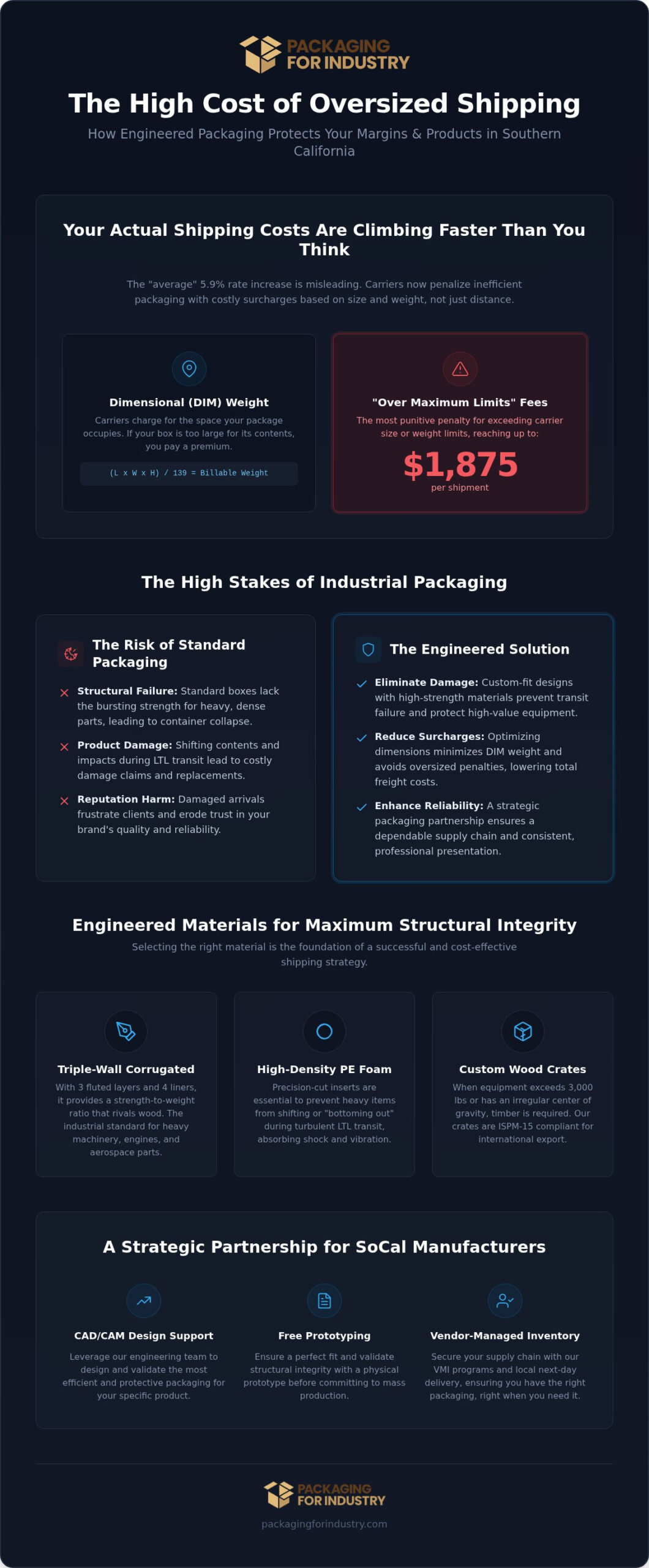
The average 5.9% rate increase announced by major carriers for 2026 is a mathematical fiction for industrial manufacturers shipping large equipment. Between new cubic volume triggers and weight surcharges for packages over 50 pounds, your actual costs are likely climbing much faster. When you’re sourcing packaging for heavy and oversized items Southern California operations require more than just a bigger box. You need an engineered solution that balances structural integrity with dimensional precision to avoid the “Over Maximum Limits” fees that now reach $1,875 per shipment.
We understand the frustration of paying premium rates only to have your products arrive damaged or held up at the port due to minor ISPM 15 marking errors. It’s time to move away from expensive, one-size-fits-all catalog suppliers and adopt a more strategic approach. This guide will teach you how to engineer high-strength packaging that eliminates transit damage and reduces shipping surcharges for heavy industrial goods. We’ll explore how custom triple-wall corrugated, precision foam, and compliant wood crating work together to optimize your logistics and protect your margins.
Key Takeaways
- Mitigate compounding carrier surcharges by optimizing dimensional weight through custom-engineered designs that right-size your shipments.
- Compare the structural performance of triple-wall corrugated and heavy-duty bulk bins to ensure maximum protection for high-value industrial equipment.
- Learn why high-density polyethylene foam is necessary to prevent heavy components from bottoming out during turbulent LTL or international transit.
- Secure reliable packaging for heavy and oversized items Southern California manufacturers need with local next-day delivery and vendor-managed inventory programs.
- Leverage CAD/CAM support and free prototyping to validate your packaging design and ensure a precise product fit before mass production.
The Logistics Landscape for Oversized Shipments in Southern California
SoCal manufacturers face a volatile logistics environment. Proximity to the Ports of Los Angeles and Long Beach brings both opportunity and complexity. With port congestion expected to rise due to Panama Canal diversions in late 2026, local freight capacity is tightening. For businesses sourcing packaging for heavy and oversized items Southern California, this means every inch of truck space and every pound of weight is under scrutiny by carriers. Identifying danger zones in your supply chain, such as high-vibration LTL transit or frequent forklift handling at regional hubs, is the first step toward reducing total landed costs.
Understanding Regional Carrier Surcharges and DIM Weight
Carriers prioritize space efficiency. They use Dimensional (DIM) weight to charge for the volume a package occupies, not just its mass. You calculate this by multiplying the length, width, and height, then dividing by 139. If the result is higher than the actual weight, you pay the DIM rate. In 2026, UPS and FedEx introduced stricter triggers. UPS now applies a “Large Package Surcharge” if the volume exceeds 17,280 cubic inches. Even more critical is the “Over Maximum Limits Fee,” which reached $1,875 per shipment in late 2025 for packages exceeding 150 pounds or 108 inches in length. Southern California manufacturers must engineer their corrugated boxes to be as compact as possible without sacrificing the structural integrity needed for heavy loads.
The Risks of Standard Packaging for Heavy Industrial Loads
Relying on off-the-shelf boxes from large catalog suppliers is a gamble for industrial equipment. These generic containers often lack the bursting strength required for dense, heavy parts. When a standard double-wall box fails during LTL transit, the costs extend far beyond the box itself. You’re looking at replacement part manufacturing, expedited shipping to appease a frustrated client, and long-term damage to your brand reputation. Effective Package cushioning materials and high-strength materials like triple-wall corrugated are essential. Engineered foam packaging prevents heavy items from shifting, which is the primary cause of transit failure. By moving away from generic solutions, you can lower packaging costs by reducing both damage claims and carrier penalties. This is why specialized packaging for heavy and oversized items Southern California is a business-critical investment for local warehouses and distributors.
Engineered Materials for Maximum Structural Integrity
Material selection is the foundation of a successful logistical strategy. Selecting the wrong grade leads to crushed containers or excessive freight costs. While standard single-wall RSC boxes (Regular Slotted Containers) are effective for lightweight goods, they lack the stacking strength required for heavy industrial components. High-performance packaging for heavy and oversized items Southern California manufacturers rely on typically starts with triple-wall corrugated or custom timber. These materials provide the rigidity needed to survive the vertical compression of stacked freight during long-haul transit.
Triple-Wall Corrugated and Heavy-Duty Bulk Bins
Triple-wall corrugated consists of three fluted layers and four liners, providing a strength-to-weight ratio that rivals wood. It’s the industrial standard for shipping heavy machinery, engines, and aerospace parts. Adhering to the U.S. Code of Federal Regulations for Large Packagings ensures your structural designs meet safety benchmarks for dense loads. For businesses shipping through the Ports of Los Angeles or Long Beach, we offer weather-resistant adhesives that prevent delamination in high-humidity coastal environments. Gaylord boxes or bulk bins serve as effective consolidation points for smaller heavy parts. They allow you to lower packaging costs by palletizing multiple units into one high-strength unit.
Custom Wood Crates and Export-Ready Pallets
Corrugated has limits. When your equipment exceeds 3,000 pounds or features an irregular center of gravity, you must transition to timber. For international transit, compliance is non-negotiable. Our wood packaging meets ISPM-15 standards, including the 2026 formatting updates requiring a hyphen in the IPPC mark and zero-tolerance for bark. For equipment with extreme dimensions, custom shipping crates provide the highest level of stability. We often design hybrid solutions that use wood bases for forklift access and triple-wall sleeves for impact protection. This approach balances durability with weight reduction. You can request a packaging quote to compare material performance for your next project.
Protective Interior Systems: Beyond Standard Cushioning
Standard bubble wrap and loose fill are designed for small parcel shipments, not industrial machinery. When shipping heavy items, the primary risk is “bottoming out.” This occurs when the item’s weight completely compresses the cushioning, transferring the impact of every bump and vibration directly to the product. To prevent this, your strategy for packaging for heavy and oversized items Southern California must include high-density, closed-cell materials. These systems don’t just fill space; they manage the physics of heavy-mass transit.
High-Density Polyethylene (PE) Foam Inserts
Polyethylene (PE) foam is the industrial standard for heavy-duty protection. Unlike soft polyurethane (PU) foam, which is better suited for lightweight items, PE is rigid and resilient. It maintains its structural integrity under significant pressure and resists moisture, which is critical for shipments moving through the coastal humidity of Orange County or Los Angeles. We engineer custom protective foam packaging using die-cut inserts or foam end caps that suspend the item in the center of the crate. For defense contractors and aerospace firms, we provide mil-spec packaging solutions that meet rigorous cushioning and ESD requirements. This suspension design ensures that even if the outer container is dropped, the foam absorbs the kinetic energy before it reaches the product.
Corner Protection and Edge Guards for Palletized Loads
Heavy items often require high-tension strapping to stay secured to a pallet. However, this tension can crush the edges of corrugated sleeves or damage the product’s finish. Heavy-duty cardboard edge protectors distribute this pressure across a larger surface area, preventing strap damage and stabilizing the load. These structural corner boards also improve vertical stacking strength, allowing you to maximize warehouse space in high-rent areas like the Inland Empire. When sourcing packaging for heavy and oversized items Southern California firms must consider how these components work together to prevent load shifting.
Once the corners are protected, we recommend using high-performance stretch film to unitize the entire load. This prevents shifting during the sudden stops common in LTL trucking. To ensure these systems hold up under real-world conditions, our designs are developed according to International Safe Transit Association (ISTA) testing standards. This data-driven approach allows you to lower packaging costs by eliminating over-packaging while maintaining total product safety. You can compare packaging pricing for these integrated interior systems to see how engineering reduces long-term damage costs.
The Engineering Process: Prototyping and Load Testing
Industrial packaging isn’t a guessing game. When you’re dealing with equipment worth hundreds of thousands of dollars, “good enough” doesn’t exist. Our engineering process starts with precise measurements of your product’s geometry and weight distribution. By utilizing CAD/CAM support, we create a 3D model that accounts for every protrusion and fragile component. This digital foundation allows us to run right-sizing analysis. It’s the only way to secure the packaging for heavy and oversized items Southern California businesses need to stay competitive.
CAD Design and Prototyping for Industrial Parts
The journey from a blueprint to a finished crate involves technical precision. We translate your product dimensions into a 3D packaging model, identifying exactly where high-density foam or wood bracing is required. PFI provides free prototyping because we believe in physical verification. A digital model is vital, but a physical sample allows your team to test the fit in your own facility before mass production begins.
Real-world testing often reveals hidden vulnerabilities. For example, in our aerospace packaging solutions for turbine components, prototyping revealed that a hybrid foam and wood cradle was necessary. It prevented rotational shifting that a standard box couldn’t handle. This level of detail is why specialized packaging for heavy and oversized items Southern California industries rely on can’t be found in a catalog.
Optimizing for LTL and International Freight
Carriers charge for the “cube.” If your crate has six inches of unnecessary air on every side, you’re paying for empty space at premium rates. Our engineering team analyzes your load to maximize pallet density. This is especially critical for Less-Than-Truckload (LTL) shipments. In these scenarios, your cargo shares space with other freight. Unlike a dedicated truck, LTL involves multiple transfers at regional hubs. Each transfer introduces new risks of vibration and shock.
By engineering for the specific rigors of long-haul industrial logistics, we help you lower packaging costs. We maintain zero-damage targets through rigorous validation. Whether you’re shipping across the Inland Empire or to a global port, a validated design is your best defense against professional stress and financial loss. We identify potential failure points before your product ever leaves the warehouse.
Partnering with a Southern California Packaging Manufacturer
Proximity is a strategic asset when managing heavy industrial logistics. For manufacturers in the region, sourcing packaging for heavy and oversized items Southern California suppliers provide can drastically reduce lead times and freight volatility. PFI operates from its Anaheim headquarters, offering a level of responsiveness that massive national catalog suppliers can’t match. While big-box distributors focus on stock sizes and high-volume retail needs, we specialize in the custom engineering required to protect high-value industrial assets. This local presence allows us to act as a seasoned consultant, helping you optimize your supply chain from the ground up.
Next-Day Delivery and VMI Programs in SoCal
Real estate in Southern California is expensive. Storing massive triple-wall boxes or custom wood crates on your own warehouse floor consumes capital and space. Our Vendor Managed Inventory (VMI) program solves this by keeping your specific packaging components in our facility until you need them. We provide local next-day delivery across Orange County, Los Angeles, San Diego, and the Inland Empire. Specifically, we serve industrial hubs such as Anaheim, Irvine, and Santa Fe Springs.
By utilizing Just-in-Time (JIT) delivery, you can free up floor space for production while ensuring you never face a stockout. This reliability is vital for maintaining a consistent supply chain, especially when dealing with the irregular production schedules of aerospace or medical manufacturing. For companies with multiple US locations, we also provide nationwide shipping capabilities. This ensures that your validated packaging designs for heavy and oversized items Southern California engineering teams have approved are used consistently across all your operations, regardless of the destination.
Custom Kitting and Assembly for Heavy Equipment
Procurement for heavy items is often fragmented. You might source boxes from one vendor, foam from another, and pallets from a third. This creates administrative overhead and increases the risk of a missing component stopping your line. We streamline this through kitting and assembly. We combine your triple-wall sleeves, high-density foam inserts, and labels into a single SKU. This methodical approach reinforces the image of a thorough operation and eliminates the stress of managing multiple vendors.
When your team receives a kit, it’s pre-assembled and ready for the equipment to be loaded. This reduces labor costs on the packing line and ensures every item is protected according to the engineered design. It’s a pragmatic approach to logistics that prioritizes fiscal responsibility and operational flow. If you’re ready to lower packaging costs and improve your shipping reliability, it’s time to move beyond generic catalog options and partner with a local expert.
Optimize Your Heavy Industrial Shipping Strategy
Shipping large-scale equipment through Southern California’s complex logistics hubs requires more than just high-strength materials. It demands a precise intersection of engineering and economic strategy. By transitioning to custom-engineered triple-wall corrugated or ISPM-15 compliant wood crates, you protect your assets and your bottom line from compounding carrier surcharges. Our expertise in packaging for heavy and oversized items Southern California ensures that your most sensitive aerospace and industrial components arrive without damage or logistical delays.
We provide the technical oversight needed for high-stakes manufacturing. Our team offers free prototyping and CAD design to validate every solution before it hits your production line. With our Anaheim headquarters, we offer local next-day delivery across the region, helping you maintain lean inventory through VMI programs. It’s time to replace generic catalog options with a dependable industrial partnership that prioritizes your operational efficiency and fiscal responsibility.
We’re ready to help you eliminate professional stress and streamline your warehouse operations for the long term.
Frequently Asked Questions
What is the best material for shipping items over 100 pounds?
Triple-wall corrugated and custom wood crates are the most reliable materials for loads exceeding 100 pounds. While standard double-wall boxes often fail under vertical pressure, triple-wall provides the structural rigidity of wood with a lower tare weight. This helps you lower packaging costs by reducing freight charges. For items with extreme mass or irregular centers of gravity, heat-treated wood crates offer the maximum protection required for safe industrial transit and handling.
How can I avoid oversized package surcharges from UPS and FedEx?
You can avoid carrier surcharges by optimizing your package dimensions to stay below specific volume and weight triggers. UPS and FedEx apply Large Package fees if a shipment exceeds 17,280 cubic inches or weighs over 110 pounds as of 2026. By engineering custom sizes available for your specific equipment, we eliminate the excess air that inflates your DIM weight. This right-sizing strategy is the most effective way to mitigate compounding freight penalties.
What is the difference between double-wall and triple-wall corrugated boxes?
The difference lies in the number of fluted layers and their corresponding stacking strength. Double-wall corrugated uses two fluted mediums and three liners, suitable for standard industrial parts. Triple-wall adds a third fluted layer and a fourth liner, significantly increasing its bursting strength. This makes triple-wall the preferred choice for packaging for heavy and oversized items Southern California manufacturers use to protect high-value machinery during long-haul LTL or international transit.
Do you provide custom crates for international aerospace shipping?
We design and manufacture custom crates specifically for the aerospace sector, ensuring full compliance with international ISPM-15 standards. These crates often feature hybrid designs, combining heavy-duty wood bases for forklift stability with triple-wall sleeves for impact protection. Our team understands the zero-tolerance requirements for bark and correct IPPC marking. This ensures your high-value turbines and aviation components pass through global customs without delays or costly rejections at the port.
How does the free prototyping process work for custom industrial packaging?
Our free prototyping process begins with an engineering analysis of your product’s dimensions and weight distribution. We use CAD/CAM software to develop a precise 3D model of the packaging system. Once the digital design is validated, we produce a physical sample for you to test in your facility. This step is critical for ensuring a perfect product fit and identifying potential failure points before you commit to a full production run.
Can PFI manage my packaging inventory for recurring heavy-duty orders?
PFI provides comprehensive Vendor Managed Inventory (VMI) programs to ensure you never face stockouts of critical packaging materials. We store your custom crates and corrugated supplies in our Anaheim facility and monitor your usage levels. By delivering items only when you need them, we help you free up valuable warehouse floor space and improve your cash flow. This Just-in-Time approach is ideal for recurring orders of heavy-duty industrial packaging.
What Southern California cities do you offer next-day delivery to?
We offer local next-day delivery to industrial hubs across Orange County, Los Angeles, and the Inland Empire. This includes cities such as Anaheim, Brea, Irvine, Costa Mesa, and Santa Fe Springs. Our regional fleet is equipped to handle the specialized packaging for heavy and oversized items Southern California businesses require for daily operations. This proximity allows us to respond quickly to urgent shipping needs while keeping your logistics costs as low as possible.
How do custom foam inserts protect heavy machinery better than bubble wrap?
High-density foam inserts provide superior protection by preventing heavy items from bottoming out during transit. Standard bubble wrap is too thin and lacks the load-bearing capacity to support heavy machinery. Closed-cell polyethylene foam absorbs kinetic energy and maintains its structural integrity under significant pressure. This ensures that the product remains suspended and protected from vibration, whereas bubble wrap would simply deflate and fail under the same industrial-scale mass.