
Did you know that for heavy or oversized shipments in 2026, the base freight rate is often just a fraction of the total bill once carrier surcharges are applied? With UPS and FedEx Large Package fees reaching as high as $331 per parcel this year, the hidden costs of logistics can quickly erode your margins. You’ve likely felt the frustration of paying these steep penalties only to have a heavy industrial component arrive at its destination with transit damage. Finding the right packaging for heavy and oversized items Southern California requires more than just a thicker box. It requires an engineering-first approach that balances structural integrity with dimensional efficiency.
It’s time to stop overpaying for catalog supplies that don’t fit your specific industrial requirements. You’ll learn how to engineer high-strength packaging solutions that eliminate transit damage and reduce shipping surcharges for heavy industrial goods. We’ll preview how specialized materials like triple-wall corrugated and custom wood crates, combined with vendor-managed inventory (VMI) programs, can streamline your operations from San Diego to Los Angeles. By right-sizing your protection, you can lower packaging costs and ensure your high-value cargo survives the rigors of LTL or international transit.
Key Takeaways
- Identify how 2026 carrier surcharges impact your bottom line and why engineered right-sizing is the most effective way to avoid these steep penalties.
- Learn how to select the right materials, such as triple-wall corrugated and high-density foam, when sourcing packaging for heavy and oversized items Southern California.
- Use CAD/CAM support and free prototyping to ensure a precise product fit that eliminates movement and “bottoming out” during transit.
- Compare the long-term value of custom industrial solutions against standard catalog suppliers to lower your total packaging spend.
- Leverage local advantages like next-day delivery and vendor-managed inventory (VMI) to streamline your supply chain across Orange County and the Inland Empire.
The Logistics Landscape for Oversized Shipments in Southern California
Shipping industrial equipment from the Inland Empire or Orange County requires a deep understanding of the current logistics environment. The Ports of Los Angeles and Long Beach are experiencing increased traffic due to Panama Canal diversions, which tightens local trucking capacity and increases the demand for precise warehouse operations. For manufacturers, this means that any inefficiency in how products are prepared for transit is magnified by regional congestion. Effective coordinated system of preparing goods for transport is no longer just about containment; it’s a critical financial strategy. When sourcing packaging for heavy and oversized items Southern California businesses must account for both physical protection and the aggressive surcharge structures implemented by major carriers in 2026.
Understanding Regional Carrier Surcharges and DIM Weight
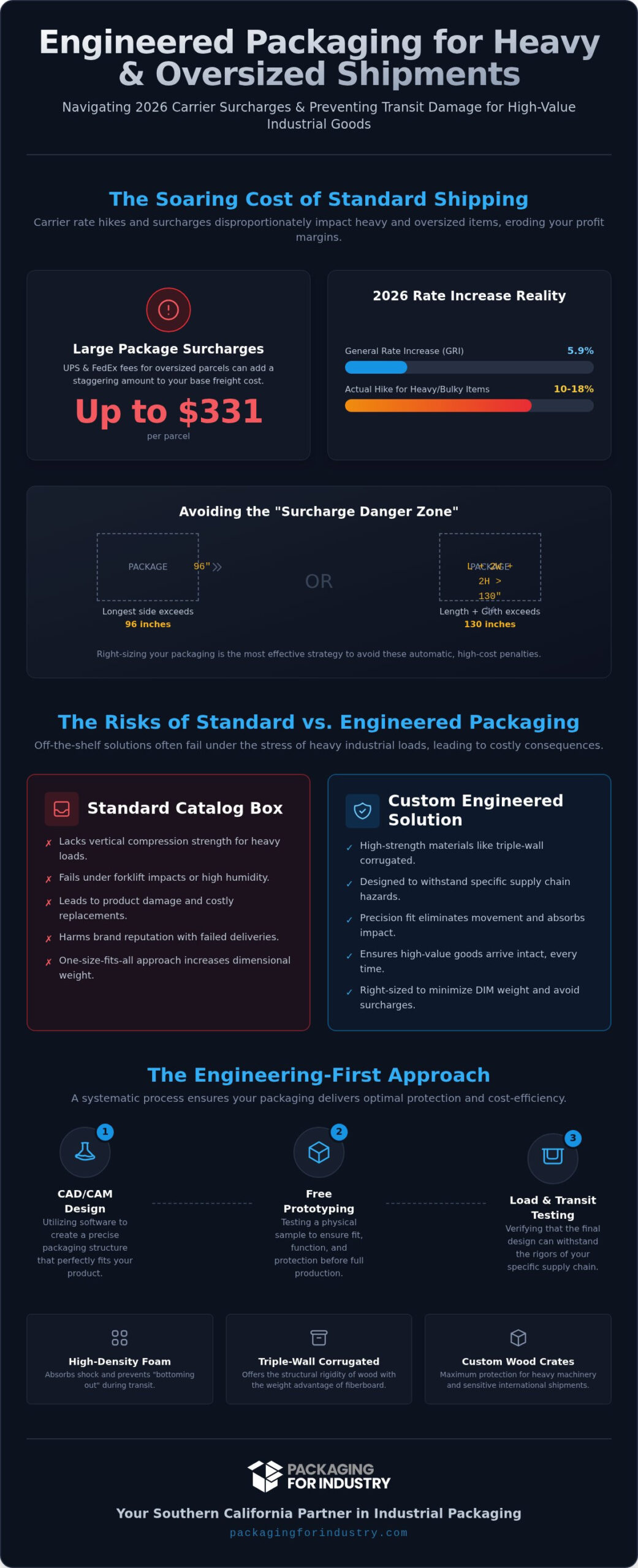
In 2026, UPS and FedEx announced an average General Rate Increase (GRI) of 5.9%. However, for those shipping heavy or bulky items, the actual cost hike often ranges between 10% and 18% due to escalating surcharges. Carriers use Dimensional (DIM) weight to ensure they’re paid for the space a package occupies, not just its mass. To calculate this, multiply the package dimensions and divide by the current industry standard divisor of 139. If the DIM weight exceeds the actual weight, you’re billed at the higher rate.
Beyond DIM weight, specific triggers for “Large Package” or “Oversize” fees now result in base surcharges between $219.50 and $331.00 per piece. These fees apply if the longest side exceeds 96 inches or if the length plus girth tops 130 inches. Local manufacturers can lower packaging costs by engineering boxes that sit just below these thresholds, avoiding the “danger zones” where shipping costs can suddenly double or triple.
The Risks of Standard Packaging for Heavy Industrial Loads
Relying on off the shelf boxes from large catalog suppliers is a common mistake for industrial shippers. Standard double wall corrugated often lacks the vertical compression strength required for heavy machinery or aerospace components. When a generic box fails under the weight of a 110 pound load, the financial impact extends far beyond the cost of the packaging. You face the expense of replacement parts, expedited shipping to fix the error, and significant damage to your brand reputation.
At Packaging For Industry (PFI), we advocate for custom design packaging that uses heavy duty materials like triple wall corrugated. Engineered solutions are designed to withstand the specific “danger zones” of the supply chain, such as forklift impacts during LTL cross docking or high humidity environments near the coast. By moving away from generic large boxes and toward precision engineered protection, you ensure your high value goods arrive intact while keeping your freight spend predictable.
Engineered Materials for Maximum Structural Integrity
Selecting the correct substrate is a fundamental application of packaging science. While single-wall and double-wall corrugated boxes serve standard distribution needs, they often fail under the vertical compression of heavy industrial components. For these applications, triple-wall corrugated is the professional standard. It offers the structural rigidity of wood with the weight advantages of fiberboard. When you’re sourcing packaging for heavy and oversized items Southern California’s coastal environment adds another layer of complexity. High humidity near the ports can soften standard corrugated, making weather-resistant adhesives and moisture barriers essential for maintaining stacking strength during long transit durations.
Triple-Wall Corrugated and Heavy-Duty Bulk Bins
Triple-wall construction utilizes three layers of fluting and four liners to create a high-strength barrier. This material is frequently used for Gaylord boxes and large bulk bins that consolidate smaller heavy parts into a single, manageable unit. These bins are designed for high-volume industrial shipping where maximum crush resistance is required. For Southern California businesses shipping through the Ports of Los Angeles or Long Beach, choosing the right grade of corrugated boxes prevents the collapse of bottom-tier units in a shipping container. If you’re unsure which grade your load requires, you can request a packaging quote to compare material performance and cost-effectiveness.
Custom Wood Crates and Export-Ready Pallets
When a load exceeds the weight limits of even triple-wall corrugated, the transition to custom wood crates is necessary. These solutions provide the ultimate protection for sensitive aerospace or medical equipment. For international shipments, all wood packaging must comply with ISPM-15 regulations. As of January 1, 2026, customs officials are strictly enforcing the hyphen requirement in the IPPC mark. We provide heat-treated wood that ensures your cargo isn’t delayed at the border.
Engineering reliable packaging for heavy and oversized items Southern California manufacturers rely on requires a focus on both material grade and handling efficiency. Many industrial clients benefit from hybrid solutions, such as a heavy-duty wood skid paired with a triple-wall corrugated sleeve. This combination facilitates easier forklift handling while providing 360-degree protection. You can learn more about our engineering process for custom shipping crates to see how we balance durability with export compliance.
Protective Interior Systems: Beyond Standard Cushioning
External strength is only half the battle. Heavy industrial goods generate significant kinetic energy during transit. Without proper interior engineering, a product can “bottom out,” which occurs when the weight of the item completely compresses the cushioning and impacts the outer container. When moving these loads through the region, logistics managers must also consider Caltrans oversized vehicle regulations, which govern the physical transport of exceptionally large gear on state highways. Effective packaging for heavy and oversized items Southern California manufacturers use must integrate high-density materials that maintain their structural integrity under extreme pressure.
High-Density Polyethylene (PE) Foam Inserts
Polyethylene (PE) foam is the preferred choice for heavy loads because of its closed-cell structure and high load-bearing capacity. Unlike softer Polyurethane (PU) foam, which is better suited for lightweight electronics, PE foam doesn’t collapse under the weight of industrial machinery. We design custom die-cut inserts and foam end caps to suspend heavy items, ensuring they don’t touch the carton walls. For irregular shapes, foam-in-place solutions provide a molded fit that locks the item in place. If your hardware is sensitive to static, we offer anti-static and ESD foam grades to protect aerospace and electronic components during transit. You can explore our protective foam packaging options to find a density that matches your specific product weight.
Corner Protection and Edge Guards for Palletized Loads
Stabilizing a heavy load on a pallet is essential for preventing shifting during LTL transit. Heavy-duty cardboard edge protectors prevent steel or plastic strapping from cutting into your corrugated boxes. These structural corner boards also improve vertical stacking strength, allowing you to maximize warehouse space safely. To unitize these loads effectively, we recommend using high-performance stretch film with a high gauge rating. This ensures the entire assembly moves as a single unit, reducing the risk of individual components breaking loose. Proper interior bracing and exterior stabilization work together to lower packaging costs by reducing the damage rates that plague non-engineered shipments.
The Engineering Process: Prototyping and Load Testing
Engineering reliable packaging for heavy and oversized items Southern California manufacturers need starts with precision data. We don’t guess at structural requirements. Instead, we use CAD/CAM support to create digital models of your specific industrial parts. This allows us to visualize the interaction between the product’s center of gravity and the internal cushioning systems discussed earlier. By simulating the “cube” before a single sheet of triple-wall corrugated is cut, we identify potential failure points in a virtual environment. This proactive approach prevents the costly “bottoming out” mentioned in the previous section by ensuring the foam density and box grade are mathematically matched to the load.
CAD Design and Prototyping for Industrial Parts
The transition from digital model to physical sample is where PFI provides distinct value. We offer free prototyping to ensure a perfect fit before mass production begins. This isn’t a generic box; it’s a custom-engineered system. For example, in our aerospace packaging solutions, we’ve designed integrated crates for high-value turbines that combine wood skids with precision-cut foam inserts. Having a physical prototype allows your operations team to test the loading process in your own facility. It ensures that the packaging doesn’t just protect the item but also improves warehouse efficiency by simplifying the kitting process.
Optimizing for LTL and International Freight
Right-sizing is the primary tool for reducing shipping surcharges. Our engineering team performs a right-sizing analysis to eliminate excess void fill, which directly reduces the dimensional (DIM) weight of the shipment. In the world of LTL (Less-Than-Truckload) freight, space is at a premium. We design for maximum pallet density to lower packaging costs and freight spend. Carriers often handle LTL shipments multiple times at various hubs. This requires packaging that can withstand frequent forklift movements and potential impacts.
If your item is moving via dedicated truck, the focus shifts toward mitigating the constant vibration and shock of long-haul travel. By simulating these transit conditions during the design phase, we ensure that your heavy oversized loads remain stable and secure from the Inland Empire to their final destination. This level of oversight is why PFI is a preferred alternative to large catalog suppliers who only offer one-size-fits-all options. We build for the specific rigors of your supply chain, not a generic standard. To complement your specialized packaging, you can discover Parcel International and their global logistics platform that simplifies shipping to over 220 countries.
Aligning with a regional manufacturer provides a level of operational flexibility that national catalog distributors simply cannot match. While large commodity suppliers focus on high-volume stock items, they often lack the engineering depth required for high-value industrial assets. Packaging For Industry (PFI) serves as a direct, cost-saving alternative by designing for your specific application rather than selling generic solutions out of a catalog. For businesses managing relocations that require specialized surface protection or high-quality moving supplies, Phoenix Supplies UK offers a comprehensive range of products to ensure every aspect of your transition is handled with care. Our Anaheim headquarters is positioned to provide rapid responses to the evolving needs of the region’s manufacturing sector, ensuring that your protective systems are as precise as the equipment they contain.
Next-Day Delivery and VMI Programs in SoCal
Space management is frequently the hidden cost of industrial logistics. Storing bulky triple-wall boxes or pre-assembled custom wood crates can quickly clutter a production floor and impede workflow. Our Vendor Managed Inventory (VMI) program addresses this by acting as your off-site warehouse, housing your custom stock until it is needed. We provide local next-day delivery to major industrial centers like Anaheim, Irvine, and Santa Fe Springs. This Just-in-Time (JIT) model ensures you have the necessary packaging for heavy and oversized items Southern California operations require without sacrificing valuable square footage for long-term storage.
Custom Kitting and Assembly for Heavy Equipment
Beyond delivery, we optimize how your team interacts with packaging materials on the line. Our custom kitting and assembly services consolidate multiple protective components, such as heavy-duty corrugated sleeves, PE foam inserts, and edge protection, into a single SKU. This prevents the inefficiency of warehouse staff searching for individual pieces during the packing phase, which accelerates your throughput. While our local presence is a major benefit for businesses in the Inland Empire and Orange County, we also support clients with nationwide shipping capabilities for their satellite locations across the country. By integrating design, storage, and assembly into one streamlined workflow, we offer a comprehensive system that protects your bottom line as much as your equipment. You can request a packaging quote to see how a localized partnership can improve your supply reliability and reduce total procurement costs.
Optimize Your Industrial Shipping Strategy
Success in moving industrial equipment requires balancing material science with logistical efficiency. You’ve seen how engineered solutions like triple-wall corrugated and high-density foam inserts eliminate transit damage while helping you bypass unnecessary carrier surcharges. Implementing precision-engineered packaging for heavy and oversized items Southern California manufacturers need is the most effective way to stabilize your logistics budget and protect your brand reputation.
As a specialized partner for the aerospace and industrial sectors, we provide the technical expertise that catalog suppliers simply can’t match. Our team offers free prototyping and CAD design to verify your solution before mass production begins. With our Anaheim headquarters providing local next-day delivery across Orange County and the Inland Empire, you can maintain a lean inventory without risking stockouts. It’s time to replace generic supplies with a coordinated system of protection and optimization.
We look forward to helping you streamline your operations and secure your most critical cargo for the road ahead.
Frequently Asked Questions
What is the best material for shipping items over 100 pounds?
Triple-wall corrugated and custom wood crates are the most reliable materials for loads exceeding 100 pounds. Triple-wall corrugated offers exceptional vertical compression strength while remaining lighter than wood, which helps lower freight costs. For extremely heavy or sensitive industrial equipment, custom wood crates provide the necessary structural rigidity. We often combine these materials with high-density foam inserts to create a hybrid solution that ensures your cargo remains secure during the rigors of LTL transit.
How can I avoid oversized package surcharges from UPS and FedEx?
The most effective way to avoid steep penalties is through engineered right-sizing of your containers. In 2026, carriers apply “Large Package” surcharges if the longest side exceeds 96 inches or the length plus girth tops 130 inches. By using CAD design to minimize excess void fill, we help you stay below these specific thresholds. Precision packaging for heavy and oversized items Southern California businesses use can significantly reduce total shipping spend by eliminating these avoidable fees.
What is the difference between double-wall and triple-wall corrugated boxes?
The primary difference lies in the number of fluting layers and liners used in construction. Double-wall boxes consist of two layers of fluting and three liners, which is suitable for standard industrial needs. Triple-wall corrugated adds a third fluting layer and a fourth liner, drastically increasing its stacking strength and puncture resistance. This makes triple-wall the professional standard for heavy industrial loads or items that require the durability of a crate with the flexibility of a box.
Do you provide custom crates for international aerospace shipping?
Yes, PFI specializes in ISPM-15 compliant wood crates designed for the aerospace and aviation sectors. All wood packaging intended for export must undergo heat treatment to eliminate pests. As of early 2026, international regulations strictly require a legible IPPC mark with a hyphen. We ensure all custom crates meet these specific compliance standards to prevent your high-value turbines or components from being delayed or rejected at international borders during transit.
How does the free prototyping process work for custom industrial packaging?
Our prototyping process begins with a detailed analysis of your product’s dimensions and center of gravity. We use CAD/CAM support to develop a 3D model of the protective system. Once the digital design is finalized, we produce a physical sample at no cost to you. This allows your team to perform load testing and verify the product fit in your own facility. This step is critical for ensuring structural integrity before moving into mass production.
Can PFI manage my packaging inventory for recurring heavy-duty orders?
We offer a comprehensive Vendor Managed Inventory (VMI) program to streamline your operations. Managing large stocks of triple-wall boxes or custom crates can consume valuable warehouse floor space. Through our VMI service, we house your custom packaging at our facility and deliver it to you on a Just-in-Time (JIT) basis. This approach prevents stockouts of recurring items while allowing you to use your warehouse square footage for more profitable production activities.
What Southern California cities do you offer next-day delivery to?
We provide local next-day delivery to industrial hubs throughout Orange County, Los Angeles, and the Inland Empire. This includes cities such as Anaheim, Irvine, Santa Fe Springs, Carson, and Ontario. Our proximity to the Ports of Los Angeles and Long Beach allows us to support manufacturers who face tight shipping windows. Whether you’re in San Diego or the High Desert, our regional fleet ensures your packaging supplies arrive exactly when your production schedule demands.
How do custom foam inserts protect heavy machinery better than bubble wrap?
Bubble wrap is designed for lightweight items and typically pops or flattens under the weight of industrial machinery. In contrast, custom packaging for heavy and oversized items Southern California manufacturers rely on uses high-density polyethylene (PE) foam. PE foam features a closed-cell structure that doesn’t collapse under pressure. It provides structural suspension that prevents “bottoming out,” ensuring your heavy equipment remains centered and protected from impacts during every stage of the shipping process.