
The cheapest box on your procurement invoice is often the most expensive item on your annual balance sheet. While stock corrugated boxes seem like a safe, low-cost choice, they frequently hide escalating costs in the form of UPS and FedEx DIM weight surcharges and excessive labor. Conducting a thorough cost analysis of custom vs stock packaging is no longer just a warehouse exercise; it’s a financial necessity for industrial operations. You’re likely feeling the squeeze of rising freight rates and the frustration of LTL transit damage that eats into your margins.
We understand that justifying the higher unit price of custom-engineered solutions is difficult when budgets are tight. However, focusing solely on the price per box ignores the total logistical flow. This guide will help you master the Total Landed Cost (TLC) formula so you can determine exactly when custom packaging delivers a superior ROI. We’ll provide a data-backed framework to help you reduce your total shipping spend, minimize your warehouse footprint, and eliminate the kitting inefficiencies that slow down your production line. By the end of this guide, you’ll have the technical insight needed to transform your packaging from a cost center into a competitive advantage.
Key Takeaways
- Learn how to move beyond the unit price of a box and apply the Total Landed Cost (TLC) formula to reveal hidden logistical expenses.
- Understand how oversized stock boxes lead to “shipping air” and trigger expensive DIM weight surcharges from major carriers.
- Perform a comprehensive cost analysis of custom vs stock packaging to identify the exact volume thresholds where engineered solutions become more profitable.
- Discover how precision die-cut foam inserts reduce transit damage and eliminate the need for excessive secondary cushioning materials.
- Evaluate the ROI of custom designs that streamline warehouse kitting and assembly, significantly reducing labor hours per shipment.
The Unit Price Myth: Why Total Landed Cost (TLC) Matters
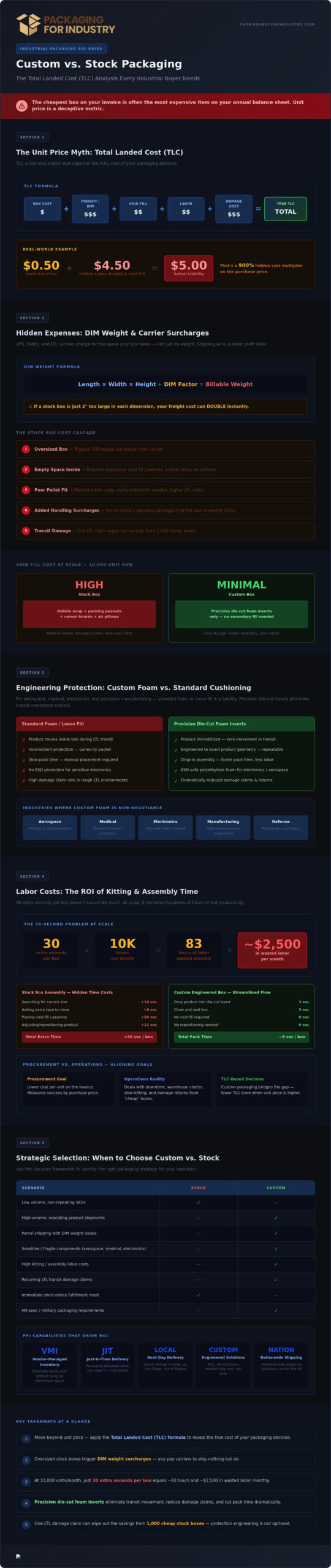
Procurement teams often focus on the unit price per box. It’s a visible, easily tracked number on a spreadsheet. But for an industrial buyer, this metric is deceptive. A thorough cost analysis of custom vs stock packaging reveals that the purchase price represents only a small fraction of the total expense. Total Landed Cost (TLC) is the only metric that accounts for the full journey of your product. If a $0.50 stock box requires $4.50 in additional labor, oversized shipping fees, and excessive void fill, it’s actually a $5.00 liability to your bottom line. Procurement tunnel vision often ignores these hidden logistics fees, leading to operational budgets that balloon despite “savings” in the purchasing phase.
Breaking Down the TLC Formula
TLC isn’t just about the invoice; it’s a calculation of materials, freight, and labor. If you use a standard RSC box that’s too large for your component, you’re paying the carrier to ship air. Carriers use DIM weight factors to charge for volume, which means an oversized box can double your freight costs instantly. Additionally, stock boxes often require more cushioning materials like bubble wrap or corner boards to fill gaps. This increases material waste and expands your warehouse storage needs. We help clients move beyond these inefficiencies with a packaging cost-reduction analysis that identifies where material savings are being lost to freight surcharges. You must also factor in the cost of “un-protection.” One damaged shipment in a rough LTL transit environment can wipe out the savings of a thousand cheap boxes through returns and replacements.
Procurement vs. Operations: Aligning the Goals
Friction often exists between the purchasing department and the warehouse floor. Procurement managers are tasked with lowering the cost per unit, while operations teams deal with the logistical fallout of poor packaging. A “cheap” stock box might take 30 seconds longer to assemble or require three extra strips of tape to secure. In a high-volume facility, those seconds turn into hundreds of hours of lost productivity. When you perform a cost analysis of custom vs stock packaging, you see that custom engineering simplifies kitting and assembly. It bridges the gap between buying cheap and shipping efficiently. Data-driven packaging reviews ensure that the box on the dock doesn’t become a bottleneck. Operations shouldn’t have to pay for procurement’s tunnel vision with increased downtime or warehouse clutter.
Hidden Expenses of Stock Packaging: DIM Weight and Surcharges
Shipping air is a silent profit killer in industrial logistics. Most carriers, including UPS, FedEx, and major LTL providers, calculate freight costs based on Dimensional (DIM) Weight rather than actual weight. This formula, which involves multiplying length, width, and height and dividing by a specific DIM factor, means you’re billed for the space your box occupies in the truck. When you perform a cost analysis of custom vs stock packaging, the freight savings often dwarf the material costs. Stock boxes are designed for general use, which inevitably leaves empty space. If you’re using a standard RSC box that’s even two inches too large in each dimension, you aren’t just wasting corrugated; you’re paying a premium to ship nothing but air.
Freight optimization is particularly critical for manufacturers moving products via Parcel or LTL. Parcel carriers are increasingly aggressive with “Additional Handling” surcharges for packages that don’t meet strict size and weight ratios. By switching to custom-engineered dimensions, you can often drop into a lower freight class or avoid these surcharges entirely. For those shipping in bulk, optimizing the box size allows for better pallet patterns. When boxes fit perfectly on a standard pallet without overhang or wasted gaps, you maximize trailer cube utilization. This often allows you to move more product in fewer shipments, providing a direct boost to your operational margins. If you want to see how these adjustments affect your bottom line, it’s helpful to compare packaging pricing based on your specific shipping volumes.
Calculating the Cost of Excess Void Fill
The expense of a stock box doesn’t end with the freight bill. Because stock sizes rarely fit industrial components perfectly, they require significant amounts of void fill like bubble wrap, packing peanuts, or air pillows. Over a run of 10,000 units, the cost of these secondary materials adds up to a substantial sum. Beyond the purchase price, you must account for the labor required to manage, store, and dispense these materials. Custom foam inserts or precisely sized corrugated internal structures eliminate the need for secondary void fill. This doesn’t just lower packaging costs; it also reduces the environmental footprint and disposal headaches for your end-user, which is a growing concern in sectors like medical and aerospace packaging.
Surcharge Avoidance in Industrial Logistics
Box deformation is another hidden cost of using inadequate stock solutions. Standard single-wall boxes often fail under the weight of heavy industrial parts during LTL transit. When a box deforms, it loses its structural integrity and can no longer be stacked safely, leading to “non-conveyable” surcharges or damage claims. Utilizing heavy-duty double-wall or triple-wall corrugated in a custom size ensures the box maintains its shape under pressure. This protection is a profit center because it prevents the cascading costs of product damage, return freight, and administrative time spent on carrier claims. Precision sizing ensures that the product is the primary support for the box, creating a more stable and stackable unit for the warehouse floor. With custom sizes available, you can design for the exact footprint of a standard 48×40 pallet to maximize every inch of trailer space.
Engineering Protection: Custom Foam vs. Standard Solutions
Standard foam planks are often the go-to for “good enough” protection. However, a detailed cost analysis of custom vs stock packaging proves that “good enough” is a financial risk for high-value components. Standard planks require manual cutting or stacking, leading to inconsistent protection and wasted material. Precision die-cut foam inserts provide a repeatable, engineered fit that cradles the product. This eliminates the movement that causes surface abrasion or internal mechanical failure during transit. It’s a shift from reactive cushioning to proactive engineering. Custom sizes available for these inserts ensure your protection is as efficient as it is secure.
Material density is a critical factor in your ROI. Polyethylene (PE) is a closed-cell foam, ideal for heavier industrial parts that need high shock absorption without bottoming out. Polyurethane (PU) is an open-cell foam, better suited for lighter, more delicate items. Selecting the wrong material density results in either over-packaging or product damage. In high-value industries like aerospace and medical, you can’t afford the trial-and-error approach of stock solutions. Every design choice must be backed by the technical requirements of the part being shipped. Using the correct material density ensures you aren’t paying for excess foam that serves no functional purpose.
Damage Reduction as a Profit Center
Every damaged shipment carries a significant “RMA tax.” This includes the cost of return freight, the administrative hours spent on processing returns, and the potential loss of a long-term contract. If your current damage rate is even slightly above industry benchmarks, your packaging is a leak in your revenue. We provide free prototyping to ensure a perfect fit before you commit to a full production run. This precision prevents the hidden costs of replacement logistics from eroding your operational margins. Damage reduction isn’t just a safety measure. It’s a direct contributor to your bottom line. Lowering your total damage rate can often pay for the entire packaging design process.
Specialized Protection: ESD and Mil-Spec
For sensitive electronics, standard packaging can actually destroy the product through static discharge. Anti-static (ESD) foam is a requirement for these applications. Stock packaging often fails these compliance tests, leading to rejected shipments and failed audits. Similarly, military packaging must adhere to strict Mil-Spec standards. The cost of non-compliance can include heavy contract penalties or even the loss of your supplier status. Custom-engineered foam ensures you meet every regulatory hurdle while maintaining the most efficient material usage possible. You don’t just get a box. You get a system of protection that meets the highest industrial standards. Request a packaging quote to see how specialized materials can secure your most sensitive shipments.
Labor Costs: The ROI of Kitting and Assembly Time
In high-volume warehouse operations, seconds determine your daily throughput. When you conduct a cost analysis of custom vs stock packaging, the time spent on the assembly line is often the most overlooked variable. Stock boxes usually arrive as flat sheets that require significant manual intervention. Workers must fold, tape, and then manage secondary cushioning materials to secure the product. This creates multiple “touch points” that slow down the shipping process. Custom-engineered boxes are often designed with self-locking features or integrated inserts that snap into place. This reduces the number of steps required to get a product out the door, directly lowering your labor cost per unit.
Outsourcing these repetitive tasks through packaging kitting services allows your team to focus on core manufacturing rather than box assembly. We provide pre-assembled kits where the box, foam, and labels are ready for immediate use. This approach eliminates the bottleneck of searching for the right box and ensures that every shipment is packed with the same level of precision and speed. It’s a pragmatic solution for operations looking to scale without proportionally increasing their headcount.
Analyzing Labor-Hours in the Warehouse
The math of warehouse labor is simple but impactful. If a custom design allows a worker to pack 50 units per hour compared to 30 units with a stock box and loose-fill peanuts, the labor savings quickly offset the higher material cost. You also save on consumables. A box that fits perfectly doesn’t need three strips of heavy-duty tape to maintain its shape. Common secondary costs reduced by custom designs include:
- Excessive packaging tape and dispenser maintenance
- Staples and heavy-duty adhesives
- Storage and handling of bulky void fill materials
Ergonomics also play a role; custom designs reduce the repetitive, awkward motions associated with wrestling oversized stock boxes. This keeps your workforce more productive throughout an eight-hour shift and reduces the risk of fatigue-related errors.
Just-In-Time (JIT) and Production Flow
Integrating packaging into your manufacturing workflow is essential for lean operations. Custom packaging simplifies the assembly line by serving as a dedicated component of the production flow. Instead of a warehouse cluttered with various sizes of stock boxes, a JIT system delivers exactly what you need when you need it. This eliminates the searching bottleneck and maximizes your floor space. When the packaging is designed for the product, it flows through the facility with the same efficiency as the product itself. This level of logistical optimization is what separates a vendor from a true cost-reduction partner.
Strategic Selection: When to Choose Custom vs. Stock
Choosing between stock and custom isn’t a binary choice. It’s a strategic decision based on your specific operational data. A comprehensive cost analysis of custom vs stock packaging often shows that the volume threshold for custom is lower than most procurement managers realize. While stock boxes work for low-risk, low-volume prototypes, any recurring industrial shipment requires a closer look at the sensitivity of the product. Heavy aerospace components or delicate medical instruments simply cannot risk the lack of precision found in standard sizes. You must also consider your primary shipping method. Parcel shipments via FedEx or UPS are far more sensitive to DIM weight than LTL freight, making custom sizing even more valuable for e-commerce and manufacturing sectors.
Lead times and storage requirements are common deterrent for custom solutions. However, leveraging Vendor Managed Inventory (VMI) allows you to offset these logistical hurdles. We manage your stock levels and deliver custom materials on a JIT basis. This ensures you never run out of specialized materials while simultaneously freeing up square footage in your facility. It’s a pragmatic way to make custom engineering viable even for businesses with limited warehouse space. By shifting the storage burden to your supplier, you convert fixed warehouse costs into variable operational expenses.
The Hybrid Packaging Strategy
You don’t have to go 100% custom across every SKU to see a return. A hybrid strategy often provides the best balance of protection and price. This might involve using stock RSC boxes for outer protection but integrating custom foam inserts for internal stability. Focus your customization efforts on high-velocity SKUs where small savings in labor or freight will aggregate into significant annual gains. Standardizing your product dimensions where possible also helps lower MOQs for custom orders. This approach allows you to maintain the flexibility of stock materials while securing your most sensitive or frequently shipped items with engineered precision.
PFI’s Southern California Advantage
For businesses operating in Southern California, the proximity of our facilities in Orange County, Los Angeles, and the Inland Empire offers a unique logistical edge. We provide local next-day delivery, which is essential for maintaining a lean production flow. This local presence allows us to perform on-site packaging audits to find your specific “break-even” point. By performing a cost analysis of custom vs stock packaging tailored to your local shipping lanes, we can identify exactly where you’re overpaying for freight or labor. Reducing your warehouse footprint through JIT stocking programs frees up valuable capital for other areas of your manufacturing process. If you’re ready to find those hidden efficiencies, you can request a packaging quote to begin your audit.
Optimizing Your 2026 Logistical Efficiency
The choice between standard and engineered solutions shouldn’t be based on a single procurement line item. As freight factors and labor costs rise, a detailed cost analysis of custom vs stock packaging becomes an essential tool for protecting your profit margins. You now understand how precision sizing eliminates “shipping air” and how custom kitting reduces the touch points that slow down your warehouse team. We’ve demonstrated that the cheapest box on the invoice is often the most expensive on the balance sheet.
PFI specializes in helping aerospace and medical manufacturers navigate these complexities with technical precision. We offer free CAD/CAM prototyping to ensure your designs are perfect before production begins. For our partners in Orange County, Los Angeles, and across Southern California, our local next-day delivery and VMI programs keep your production lines moving without the burden of excess inventory. We’re ready to help you transition from simply buying boxes to implementing a high-performance protection system.
We look forward to helping you streamline your operations and lower your total shipping spend.
Frequently Asked Questions
Is custom packaging always more expensive than stock boxes?
No. While the per-unit material cost might be higher, a full cost analysis of custom vs stock packaging reveals significant savings in other areas. Custom boxes eliminate excess void fill and reduce labor hours during assembly. Most importantly, they prevent the dimensional weight surcharges that carriers apply to oversized stock boxes. When you calculate the total landed cost, custom solutions are often the more economical choice for recurring industrial shipments.
What is the typical ROI period for custom packaging tooling costs?
The return on investment for custom tooling typically occurs within the first few production runs. This period depends on your shipping volume and the reduction in freight costs achieved through optimized sizing. Businesses often see a rapid payback by avoiding “shipping air” surcharges and reducing the labor required for kitting. We recommend performing a packaging audit to compare packaging pricing and determine the exact break-even point for your specific product lines.
How does custom packaging reduce my freight surcharges?
Custom packaging reduces surcharges by aligning the box dimensions perfectly with the product, which minimizes the Dimensional (DIM) Weight. Carriers like UPS and FedEx use DIM weight to bill for the space a package occupies. By eliminating unnecessary volume, you lower the billable weight and avoid “Additional Handling” fees. This precision ensures your shipments stay within the most cost-effective freight classes, providing a direct path to lower packaging costs.
Can custom packaging help reduce product damage in aerospace shipping?
Yes, custom engineering is critical for aerospace components that require high-precision protection. Unlike stock boxes that leave gaps, custom designs utilize die-cut foam inserts to secure sensitive parts against vibration and impact. This level of protection is vital for maintaining compliance with strict industry standards. Reducing damage doesn’t just save on replacement costs; it protects your reputation and prevents the administrative burden of processing complex carrier insurance claims.
What is the minimum order quantity (MOQ) for custom corrugated boxes?
MOQs for custom corrugated boxes vary based on the complexity of the design and the material specifications. While custom runs generally require higher volumes than off-the-shelf stock boxes, we work with manufacturers to find a balance that justifies the setup costs. For high-value or recurring needs, the savings in freight and labor often make even smaller custom runs viable. We offer custom sizes available to meet the specific requirements of your production schedule.
How does a Vendor Managed Inventory (VMI) program work for custom boxes?
In a VMI program, PFI takes over the responsibility of monitoring and replenishing your packaging stock levels. We store your custom-engineered materials in our local Southern California facilities and deliver them to your warehouse on a just-in-time basis. This eliminates the need for you to dedicate large areas of floor space to bulky packaging inventory. It also ensures you have the right materials ready for your assembly line without managing complex lead times.
Does PFI offer free prototypes for custom packaging designs?
Yes, we provide free CAD/CAM prototyping to ensure your custom design performs exactly as intended before you commit to a full production run. This process allows our engineers to test the fit and structural integrity of the corrugated and foam components. By validating the design early, you avoid the cost of mid-production adjustments and ensure that the final solution delivers the expected ROI in both protection and logistical efficiency.
What industries benefit most from custom foam inserts?
Industries shipping high-value, fragile, or technically sensitive items see the greatest benefit from custom foam inserts. This includes the medical device, aerospace, and electronics sectors where precision is non-negotiable. These sectors often require anti-static (ESD) properties or specific polyethylene densities to meet safety standards. Custom foam provides a repeatable, professional presentation while ensuring that components arrive in perfect condition, regardless of the transit environment or handling conditions.