
A packaging prototype isn’t just a design sample. It’s a financial tool that dictates your total landed costs for years to come. If you’re tired of paying for the air inside oversized boxes or dealing with the recurring costs of shipping damage, you need a solution built on engineering rather than guesswork. Learning how to request a packaging prototype is the most effective way to secure your supply chain and protect your bottom line.
We understand the pressure of managing high-value inventory where slow lead times and poor fitment aren’t options. This guide outlines the exact technical steps to request a custom packaging prototype that reduces damage and lowers freight expenses. We’ll show you how to provide the right product data, validate materials like custom foam or corrugated, and move efficiently from a physical sample to full-scale production. By the end, you’ll have a clear path to optimizing your logistics through precision design and reliable inventory management.
Key Takeaways
- Mitigate risk for high-value components by using functional prototypes to validate protection standards before full-scale production.
- Provide accurate technical data like dimensions and center of gravity to ensure your custom foam or corrugated solution fits perfectly.
- Use physical samples instead of just digital mockups to verify structural integrity and drop protection for sensitive equipment.
- Learn exactly how to request a packaging prototype using CAD/CAM engineering to streamline your design phase and reduce lead times.
- Transition approved designs into bulk production with vendor-managed inventory to maintain supply reliability and lower total landed costs.
The Strategic Role of Prototyping in Industrial Packaging
An industrial packaging prototype is a precision-engineered functional unit designed to validate protection and performance. Unlike retail samples that focus primarily on branding, an industrial prototype tests the physical limits of materials like heavy-duty corrugated and custom-cut foam. For manufacturers of aerospace components, medical devices, or specialized electronics, this is a mandatory step to ensure high-value goods survive the vibration and impact of long-haul logistics. It’s the first tangible evidence that your engineering requirements translate to the real world.
Understanding how to request a packaging prototype correctly allows you to target your “Total Landed Cost” rather than just the price per unit. Standard catalog boxes often lead to excessive dimensional weight (DIM) surcharges from carriers because they include wasted space. A custom-engineered prototype proves that a box designed specifically around your product’s dimensions will yield long-term savings by optimizing freight density. It moves the conversation from “what is the cheapest box” to “what is the most efficient shipping system.”
Risk Mitigation and Damage Prevention
Prototypes simulate the harsh realities of the industrial supply chain before you risk your inventory. We use these samples to validate whether a double-wall corrugated structure provides enough puncture resistance or if a triple-wall solution is required for heavy equipment. For sensitive electronics, a physical sample allows us to test foam packaging density and ESD properties. This “fail-safe” approach prevents the catastrophic costs of field failures and returns, providing peace of mind for operations managers handling mission-critical shipments.
Cost Reduction Through Precision Engineering
Precision engineering eliminates the need for expensive, manual void fill like bubble wrap or paper dunnage. When you request a custom design, the prototype demonstrates how the packaging can double as an assembly jig, speeding up warehouse throughput. It provides a tangible ROI comparison against stock catalog items, showing exactly how much space and labor you save per shipment. By designing out the “fluff,” you reduce material waste and streamline the entire kitting process. This data-driven approach transforms packaging from a commodity expense into a strategic operational advantage that supports your bottom line.
Essential Technical Data for Your Prototype Request
Precision in the design phase is the only way to ensure the final product performs as expected. When you begin the process of learning how to request a packaging prototype, your focus must shift from general descriptions to exact technical specifications. A successful prototype requires a comprehensive data set that accounts for the physical properties of your product and the specific stresses of your distribution cycle. Providing this data upfront prevents the “guess-and-check” method that often leads to shipping delays.
At a minimum, your request should include the following details:
- Exact dimensions and weight: Provide the length, width, and height to the nearest millimeter. For heavy industrial equipment, identifying the center of gravity is critical for designing proper support structures and pallet bases.
- Fragility assessment: Pinpoint the most sensitive areas of the component, such as glass screens, protruding sensors, or delicate calibration points that require specialized cushioning.
- Shipping environment: Specify if the product will face international transit, high humidity in sea freight, or extreme temperature fluctuations.
- Material requirements: Indicate if you need heavy-duty corrugated, custom foam inserts, or edge protection for high-density loads.
Product Specifications and CAD Support
Providing CAD files is the most effective way to accelerate the design cycle. When our engineering team receives your 3D models, we use CAD/CAM support to design custom foam inserts that account for every contour of your product. This ensures a “snug fit” that prevents internal movement, which is the leading cause of transit damage. For electronic components, it’s vital to specify anti-static (ESD) requirements so we can select the appropriate polyethylene or polyurethane foam grades during the prototyping stage. If you’re unsure which material fits your application, you can speak with our engineering team for a technical assessment.
Compliance and Industry Standards
Industrial sectors often require more than just physical protection; they require documented compliance. For government contracts, we incorporate the specific data needed for military packaging (Mil-Spec) to ensure your prototype meets rigorous durability and labeling standards. Aerospace and medical device manufacturers must also account for cleanliness levels and specialized part protection. By providing these regulatory requirements early, you ensure the prototype is a valid representation of the final, compliant production run. This proactive data gathering prevents costly redesigns and ensures your supply chain remains uninterrupted.
Comparing CAD Mockups vs. Physical Packaging Samples
Understanding the distinction between digital mockups and physical samples is a critical step in learning how to request a packaging prototype that actually performs in the field. While both formats serve a purpose in the design cycle, they address different levels of risk. Digital models are ideal for the conceptual phase, but industrial applications often require the tangible validation that only a physical sample can provide. Choosing the right format at the right time ensures you don’t overspend on design iterations or underspend on protection.
For procurement managers, the decision framework is simple: use digital mockups to confirm dimensions and use physical prototypes to confirm survival. Our CAD/CAM engineering process bridges this gap by turning virtual designs into precision-cut components that mirror the exact specifications of your final production run. This transition from screen to warehouse floor is where your packaging strategy moves from theory to operational reality.
The Benefits of Digital 3D Prototyping
Digital 3D mockups offer a high-speed entry point for initial design validation. They allow your engineering and procurement teams to verify basic dimensions and spatial orientation without the lead time associated with physical material production. This phase is perfect for rapid iteration. If a component’s center of gravity shifts during its own design phase, we can adjust the virtual packaging model instantly. This collaborative review process is particularly valuable for remote engineering teams who need to sign off on a design before we commit to cutting expensive foam or heavy-duty corrugated materials.
The Necessity of Physical Samples for Industrial Use
A digital model cannot simulate the physical “crush” of a box or the shock-absorption limits of custom foam. Physical prototypes are essential for conducting drop tests and verifying structural integrity, especially for high-value aerospace or medical equipment. Beyond protection, a physical sample allows your operations team to test the efficiency of kitting and assembly. They can physically handle the inserts to ensure the packing process is intuitive and fast, which directly impacts your labor costs.
Furthermore, a physical sample is the only way to validate load stabilization. If you’re using stretch film to secure palletized goods, the prototype proves how the primary packaging interacts with secondary containment. It provides tangible proof that your heavy-duty triple-wall corrugated boxes can withstand the stacking pressures of a crowded warehouse. This physical validation is the final “green light” needed before moving into bulk production and inventory rollout.
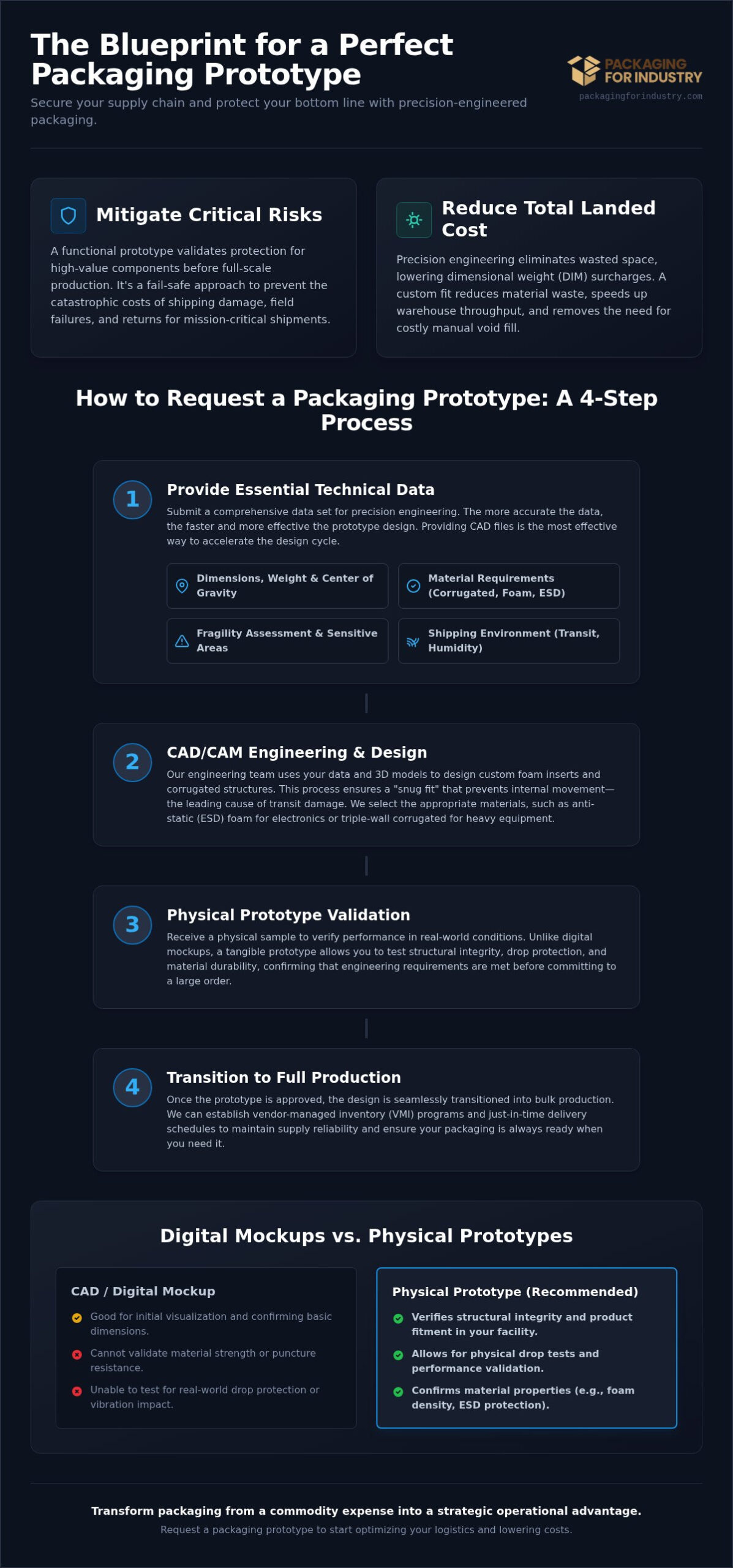
Step-by-Step: How to Request a Packaging Prototype from PFI
Requesting a prototype shouldn’t be a generic transaction. When you understand how to request a packaging prototype through an engineering-first supplier, it becomes a strategic consultative project. The process begins with an initial consultation where we analyze your specific shipping challenges. We examine your damage history, current transit routes, and any recurring failures in your existing packaging. This data allows us to move into the design phase, where our team uses CAD/CAM support to engineer a solution that addresses these specific vulnerabilities.
Once the digital design is finalized, we move to sample production. We manufacture the physical prototype at our Southern California facility to ensure tight quality control and material integrity. This is followed by a testing and feedback stage. You’ll receive the physical sample to test the real-world product fit within your warehouse environment. If adjustments are needed for better kitting speed or tighter tolerances, we refine the design before moving to bulk production. This iterative approach ensures the final rollout meets every operational requirement.
Local Support for Southern California Manufacturers
Manufacturers in Southern California benefit from our local presence in Orange County. Being Anaheim-based allows us to offer on-site reviews for companies throughout Los Angeles and the Inland Empire. Proximity significantly reduces lead times for physical samples. In many cases, we provide local next-day delivery of prototypes to industrial hubs, allowing your team to maintain momentum on new product launches or logistics overhauls without waiting weeks for a design from out-of-state catalog suppliers.
Preparing for Your Request
To get the most value from your request, gather your current packaging costs first. This establishes a baseline for identifying potential savings in material use or freight density. When you use our Request a Quote form, include your estimated recurring volume. PFI offers free prototyping for custom designs when they’re tied to recurring bulk orders. This eliminates upfront engineering costs and allows you to focus on the long-term ROI of an optimized and secure supply chain.
Transitioning from Prototype Approval to Full Production Rollout
Approval of the physical sample marks the transition from engineering to execution. Once you’ve validated the fit and protection, we finalize the material specifications for bulk production. This process includes locking in the exact corrugated fluting, foam density, and any specialized labeling requirements. We then establish recurring order schedules that align with your manufacturing cycles. This ensures your production line never stops due to a packaging shortage. For companies with multi-location operations, our nationwide shipping capabilities ensure that the exact design approved when you first learned how to request a packaging prototype is replicated across all your facilities.
Integrating a new design into your existing warehouse logistics requires a partner who understands the flow of industrial operations. We coordinate with your team to ensure that the bulk delivery of custom boxes and inserts fits your rack space and kitting stations. This methodical approach to the rollout phase minimizes disruption and allows you to realize the benefits of damage reduction and freight optimization immediately.
Optimizing Inventory with VMI and JIT
Integrating your custom design into a Vendor Managed Inventory (VMI) program is the most efficient way to maintain supply reliability. Instead of manually tracking stock levels, we monitor your usage and replenish approved designs automatically. This approach is especially beneficial for complex, multi-component kits that were validated during the prototyping phase. By utilizing Just-In-Time (JIT) delivery, you reduce your warehouse footprint and free up valuable floor space for production. It eliminates the need to store bulk quantities of oversized custom boxes, shifting the inventory burden to us while ensuring you have exactly what you need for daily operations.
Continuous Improvement and Cost Analysis
A successful rollout isn’t the end of the partnership. We conduct ongoing packaging cost-savings reviews to identify further opportunities as your shipping volumes grow or carrier rates change. If your product undergoes a design revision, we revisit the prototyping process to ensure the packaging evolves alongside it. This proactive management prevents the use of outdated packaging that could lead to increased damage or wasted space. Whether you are scaling a local operation or coordinating a nationwide distribution network, our focus remains on the intersection of engineering precision and fiscal responsibility. This ensures that the process of knowing how to request a packaging prototype continues to deliver value throughout the entire product lifecycle.
Secure Your Supply Chain with Engineered Packaging
Prototyping is the most effective way to eliminate shipping damage and optimize your freight density before committing to bulk production. By validating material performance and fit through physical samples, you transform your packaging from a simple container into a strategic financial asset. Our CAD/CAM engineering services provide the precision required for high-value aerospace and medical device protection; this ensures every component arrives without compromise.
Understanding how to request a packaging prototype is the first step toward a more efficient warehouse operation. Whether you need local support in Southern California or nationwide shipping for multi-location manufacturing, PFI provides the technical expertise to streamline your logistics. This methodical approach moves beyond the guesswork of stock catalog boxes. It allows you to integrate your custom designs into VMI and JIT programs that secure your long-term supply chain while lowering total landed costs.
Our team is ready to help you solve your most complex logistics challenges with custom-tailored solutions. We look forward to partnering with you to improve your supply reliability and professional peace of mind.
Frequently Asked Questions
Is there a cost for a custom packaging prototype?
PFI offers free prototyping for custom designs when they are tied to recurring bulk orders or established production schedules. This allows you to validate the engineering without upfront design fees. If you are looking to lower packaging costs over the long term, this service ensures the solution is fiscally sound before you place a full purchase order. We focus on high-volume industrial partnerships rather than one-off retail samples.
How long does it take to receive a physical packaging sample?
Lead times for a physical prototype vary depending on the complexity of the design and material availability. For manufacturers in Southern California, we often provide local next-day delivery once the CAD design is finalized and approved. Nationwide shipping typically takes a few additional days for transit. Our Anaheim facility is optimized for rapid turnaround to ensure your product development cycle stays on schedule without unnecessary delays.
What file formats do I need to provide for a prototype request?
Providing 3D CAD files such as STEP, IGES, or SolidWorks formats is the most efficient way to initiate your request. These files allow our engineering team to use CAD/CAM support to design custom foam inserts with exact tolerances. If digital models aren’t available, we can work from physical product samples or detailed technical drawings that include dimensions, weight, and the center of gravity for heavy equipment.
Can I get a prototype for both corrugated boxes and custom foam inserts?
Yes, we specialize in creating integrated prototypes that combine heavy-duty corrugated boxes with custom foam packaging inserts. This holistic approach is essential for high-value electronics and medical devices that require both structural outer protection and internal cushioning. Testing how these materials interact in a single prototype is the best way to ensure your product survives the vibration and impact of industrial shipping environments.
Do you provide prototyping for Mil-Spec or aerospace packaging?
We provide specialized prototyping for both military-spec and aerospace packaging requirements. These sectors often require documented compliance with strict durability and cleanliness standards. Our team understands how to request a packaging prototype that meets Mil-Spec labeling and material constraints; this ensures your shipment is protected and fully compliant with government regulations. This precision engineering mitigates risk for mission-critical components during long-haul transit.
What is the minimum order quantity for a custom prototype to be produced?
Our prototyping services are designed for industrial clients intending to transition into recurring bulk production. While we don’t have a rigid minimum for the prototype itself, we prioritize projects that will move into full-scale rollout or vendor-managed inventory (VMI) programs. This focus ensures that the engineering resources we invest in your design result in a scalable, cost-effective solution for your manufacturing or distribution operations.
Can you help with a prototype if my product is still in the design phase?
We frequently assist clients who are still finalizing their product designs. By involving our packaging engineers early, you can design the product and the protection simultaneously. This proactive approach helps you avoid oversized boxes and reduces total landed costs by ensuring the final product dimensions fit into the most efficient shipping configuration possible. We use CAD mockups to iterate quickly as your component evolves.
Will the prototype be made of the exact same material as the final production run?
The prototype will be manufactured using the exact material specifications intended for your final production run. Whether your design requires triple-wall corrugated, polyethylene foam, or anti-static (ESD) materials, the sample serves as a functional test unit. This allows you to validate protection standards and structural integrity with total confidence. Using identical materials ensures that the performance you see in the prototype phase is replicated in every bulk shipment.