
The most expensive fabrication method isn’t always the one that provides the best protection for your sensitive electronics or aerospace components. When evaluating die cut foam vs waterjet cut foam for inserts, many manufacturers assume that higher precision always requires a higher price tag. You’ve likely felt the sting of high upfront tooling costs for short runs or dealt with the fallout of poor foam tolerances that leave parts rattling in transit. These delays and damages don’t just hurt your bottom line; they disrupt your entire supply chain reliability.
The right choice for your operation hinges on the intersection of engineering requirements and economic scale. We’ll show you how to lower per-unit packaging costs by matching your order volume to the right technology. This guide examines the technical differences in tolerances, from the ±0.010″ precision of steel rule dies to the ±0.005″ accuracy of waterjet systems. You’ll learn how to secure a reliable local supply in Orange County or Los Angeles while ensuring your custom foam inserts provide a perfect, damage-free fit every time. By the end of this comparison, you’ll have a clear roadmap for selecting a fabrication method that balances fiscal responsibility with uncompromising part protection.
Key Takeaways
- Identify the most cost-effective fabrication method by balancing upfront tooling expenses against production volume and machine time.
- Learn how die cutting maximizes efficiency for high-volume industrial packaging through rapid, repeatable mechanical pressure.
- Discover the engineering advantages of waterjet cutting for complex components that require tight tolerances and no-heat material preservation.
- Compare the specific performance metrics of die cut foam vs waterjet cut foam for inserts to ensure a precision fit for sensitive aerospace or medical parts.
- See how local supply chain solutions and free prototyping in Southern California can reduce lead times and transit damage.
Understanding Foam Fabrication: Die Cutting vs. Waterjet Technology
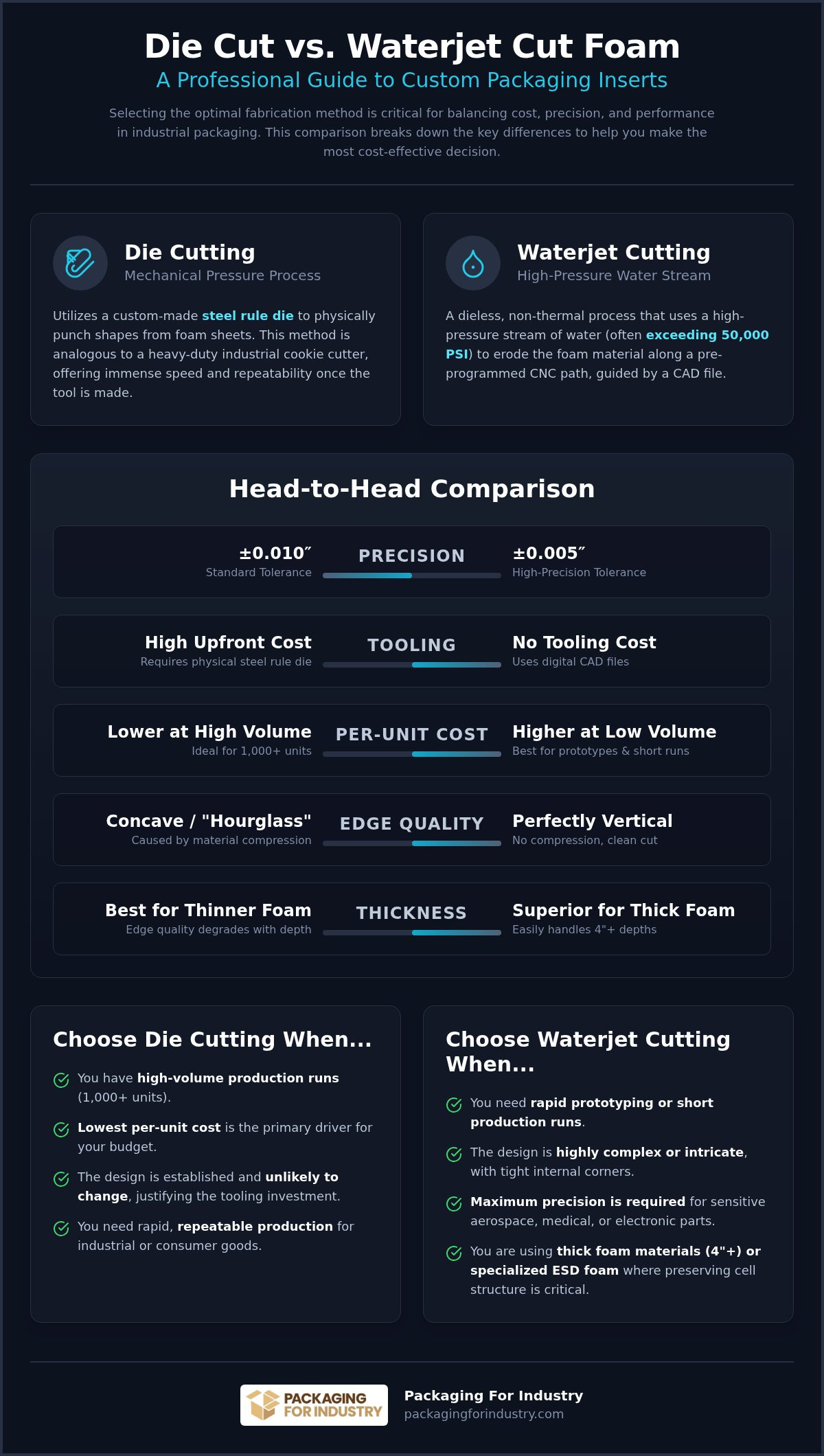
Choosing between die cut foam vs waterjet cut foam for inserts requires a clear understanding of how each process manipulates material. Die cutting is a mechanical pressure process. It utilizes a custom-made steel rule die to punch shapes out of foam sheets, similar to a heavy-duty industrial cookie cutter. In contrast, waterjet cutting is a non-thermal, dieless process. It uses a high-pressure stream of water, often exceeding 50,000 PSI, to erode the material along a pre-programmed path. The fundamental difference lies in the reliance on physical tooling versus CNC programming. Your primary goal is to achieve tight tolerances that protect sensitive parts while managing total packaging costs effectively.
The Role of Tooling in Foam Inserts
A steel rule die consists of sharpened metal blades bent into a specific shape and mounted into a wooden or composite base. This setup requires an upfront investment in both time and capital to manufacture the physical tool. Once the die is built, production is extremely fast; however, any design change requires a completely new tool. Waterjet cutting eliminates physical tools entirely. It relies on CAD files to guide the cutting head. This makes waterjet the preferred method for rapid prototyping or short production runs where the cost of a die would be prohibitive. Because no physical tool is required, waterjet cutting can often start immediately after the design is finalized. Die cutting, conversely, adds days or weeks to the initial project lead time for tool fabrication.
Material Compatibility: PE, PU, and ESD Foams
The physics of each method impacts material choice and final product quality. Die cutting relies on compression. When the die strikes the foam, it can slightly compress the edges. This often creates a “concave” or “hourglass” effect on the sides of the cut. While this is negligible on thinner protective foam packaging, it becomes a factor as depth increases. Waterjet cutting avoids this compression issue entirely. It’s the superior choice for thick foam planks, easily handling depths of 4 inches or more with perfectly vertical edges.
This precision is vital for specialized materials like anti-static or ESD foam. High-value electronics require a snug fit to prevent static discharge or physical impact during transit. Waterjet technology ensures these custom foam solutions maintain the exact cell structure and dimensions needed for optimal protection. Whether you’re working with Polyethylene (PE) or Polyurethane (PU), the fabrication method must align with the material’s density and the part’s sensitivity.
Die Cut Foam Inserts: High-Volume Efficiency for Industrial Packaging
Die cutting is the workhorse of high-volume industrial packaging. When evaluating die cut foam vs waterjet cut foam for inserts, the primary advantage is the sheer speed of production. Once a steel rule die is mounted in the press, finished inserts are produced in a matter of seconds. This repeatability is critical for consumer goods and electronics manufacturers who need thousands of identical units delivered on a reliable schedule. It provides a level of mechanical consistency that’s essential for maintaining supply chain stability.
Efficiency in die cutting isn’t just about speed; it’s about material optimization. Using a process called nesting, engineers can arrange multiple parts on a single sheet of foam to minimize scrap. For specialized materials like ESD (electrostatic discharge) foam used in high-volume electronics packaging, reducing waste is a direct way to lower packaging costs. This method ensures every square inch of high-performance foam is utilized effectively, which is a significant factor in large-scale manufacturing budgets.
When the Tooling Investment Pays Off
The upfront cost of a custom steel rule die is a one-time expense that pays dividends during long production runs. For orders exceeding 1,000 units, the amortization of the tool makes the per-unit cost significantly lower than methods that rely on higher machine-time rates. It provides a level of consistency that’s hard to match. Every piece of custom foam packaging is an exact clone of the master design. This ensures a seamless fit for your products across multiple batches, whether you’re shipping from a local warehouse or distributing nationwide.
Limitations of the Die Cutting Process
Despite its efficiency, die cutting has mechanical limits. The physical pressure required to punch through foam can cause a slight concavity or “hourglass” effect on the edges, particularly in materials thicker than two inches. If your application demands perfectly vertical walls in thick foam planks, this distortion might be unacceptable for sensitive part protection. Die cutting is also rigid. Any design change requires a new physical die, which can delay lead times and increase costs during the prototyping phase. It’s less ideal for rapid iterations where CAD files are still being refined.
Die cutting remains the standard for high-volume stability. If you’re ready to compare packaging pricing for a large-scale project, this method typically offers the best balance of speed and fiscal responsibility.
Waterjet Cut Foam: Precision Engineering for Complex Components
Waterjet cutting represents the pinnacle of precision in the packaging industry. It’s a non-thermal process that uses a high-velocity stream of water to erode material along a computer-guided path. This is a critical distinction because heat-based or pressure-based methods can compromise the physical properties of the material. In the debate of die cut foam vs waterjet cut foam for inserts, waterjet technology wins on complexity. It easily handles sharp internal corners and deep, narrow slots that a physical steel rule die simply cannot reach. This capability is essential for securing high-value, irregularly shaped components that require more than a generic rectangular cutout.
Aerospace and Medical Grade Precision
The aerospace and medical device sectors demand a level of accuracy that standard fabrication methods often can’t provide. Sensitive instrumentation doesn’t just need generic cushioning; it requires a zero-tolerance fit to prevent internal calibration shifts. Waterjet systems can achieve tolerances as tight as ±0.005″, ensuring that even the most delicate sensors or surgical tools remain completely stationary during transit. This precision is especially vital when working with thick PE foam planks. While die cutting often produces concave edges in materials over two inches thick, waterjet cutting maintains perfectly vertical walls through foam up to 4 inches or more. This makes it the superior choice for heavy-duty aerospace packaging solutions and custom military-spec crates where structural integrity is non-negotiable.
Rapid Prototyping and Design Flexibility
One of the most significant advantages of waterjet cutting is the elimination of physical tooling. At PFI, we leverage this CAD-driven flexibility to offer free prototyping for product fit. If a design needs an adjustment after the first sample, we simply update the digital file and re-cut the part. There’s no expensive die to discard and no second tooling charge to pay. This agility is a massive benefit for manufacturers in Orange County and Los Angeles who face tight production deadlines. It allows for a much faster transition from the engineering phase to the final packaging solution. By removing the lead time required for tool fabrication, we can fulfill emergency industrial orders and specialized short runs with a speed that traditional die-cutting houses can’t match. This process ensures you get a custom-tailored response that addresses your specific transit damage risks without the financial burden of upfront tooling costs.
The Professional Comparison: Cost, Tolerances, and Lead Times
Selecting the right fabrication method is a strategic decision that balances upfront capital against long-term operational efficiency. When evaluating die cut foam vs waterjet cut foam for inserts, the primary financial trade-off involves tooling fees versus machine-time rates. Die cutting requires a one-time investment in a steel rule die, which can be amortized over thousands of units to achieve the lowest possible per-part cost. Waterjet cutting eliminates the tooling fee entirely, but it carries a higher per-unit price because the machine operates at a slower, more deliberate pace. For manufacturers, the choice often depends on whether you’re prioritizing immediate cash flow or long-term packaging cost-savings.
Precision requirements also dictate the process. Die cutting typically delivers tolerances of ±0.010″, which is the industry standard for most protective packaging and industrial kitting. If your application involves sensitive instrumentation or medical devices, waterjet cutting provides a tighter tolerance of ±0.005″. This level of accuracy ensures a surgical fit, preventing even the slightest movement during transit. While die cutting is faster during the production phase, producing a part in seconds, waterjet cutting wins on initial setup speed. Since it’s CAD-driven, we can begin production almost as soon as the design is finalized, whereas die cutting adds days to the initial lead time for tool fabrication.
Volume Break-Even Points for Buyers
For most industrial projects, the break-even point between these two methods occurs around the 1,000-unit mark. Below this volume, the cost of a physical die often outweighs the savings in labor. Above this volume, the speed of the die press makes it the most fiscally responsible choice. To help manage these logistics, PFI offers Vendor Managed Inventory (VMI) programs. We can engineer your solution using the most efficient method and then store the stock, providing local next-day delivery in Orange County and Los Angeles to keep your supply chain moving without interruption.
Total Integrated Solutions
A precision foam insert is only as effective as the outer container that holds it. We specialize in creating total integrated solutions by combining custom foam with custom corrugated boxes. This approach ensures that every millimeter of space is optimized. By refining the fit between the foam and the box, we can often reduce the overall shipping dimensions. This is a critical factor in avoiding expensive UPS or FedEx dimensional weight surcharges, ensuring your high-value parts are protected without inflating your freight budget. Whether you need heavy-duty double-wall boxes or specialized military-spec packaging, our engineering team focuses on reducing damage while optimizing your bottom line.
Custom Foam Solutions in Southern California: Why Choose PFI?
Deciding on the right fabrication method is only half the battle. The reliability of your supply chain determines whether those precision inserts actually arrive when your production line needs them. As a dedicated Anaheim packaging supplier, PFI bridges the gap between complex engineering and local logistical reality. We understand that a delay in your foam supply is a delay in your revenue. That’s why we prioritize local next-day delivery for our partners in Orange County and Los Angeles, ensuring your operations never stall due to packaging shortages.
Our consultative approach sets us apart from large catalog distributors. We don’t just take an order for die cut foam vs waterjet cut foam for inserts; we analyze your entire packaging flow to identify hidden inefficiencies. With custom sizes available for every grade of PE and ESD foam, we ensure your specific components receive a tailored fit that generic solutions can’t match. If you’re experiencing damage in transit or struggling with high freight costs, our engineers act as fixers to redesign your internal protection. We evaluate your requirements to lower packaging costs through better material yield and optimized shipping dimensions.
Local Expertise and Nationwide Support
Service areas like Irvine, Huntington Beach, and Santa Fe Springs form the core of our daily operations. Being local means we can be on-site at your facility to troubleshoot packaging failures in person. While our local footprint ensures rapid response times and reduced shipping lead times, PFI also maintains the infrastructure for nationwide shipping through strategic distribution partners. This dual capability allows us to support your primary manufacturing facility in Southern California while ensuring consistent packaging quality for your distribution centers across the country. It’s a comprehensive system designed for total accountability.
Request Your Custom Packaging Quote
We invite you to leverage our engineering expertise through a comprehensive packaging review. PFI offers free prototyping to ensure your product fit is perfect before you commit to a full production run. This process eliminates the risk of ordering thousands of inserts that don’t meet your exact tolerances or material requirements. For recurring industrial needs, our Vendor Managed Inventory (VMI) program is designed to reduce your warehouse footprint and free up capital. We manage the stock levels and deliver just-in-time, allowing you to focus on your core manufacturing operations. You can compare packaging pricing for your specific volume and see the fiscal impact of our engineering-first mindset. Request a packaging quote today to stabilize your supply chain and protect your bottom line.
Optimize Your Industrial Packaging Strategy
Selecting the most effective method between die cut foam vs waterjet cut foam for inserts depends on your specific balance of volume and precision. Die cutting offers unmatched speed for high-volume industrial orders, whereas waterjet technology provides the ±0.005″ tolerances required for sensitive aerospace and medical instrumentation. Both methods serve as critical tools in reducing total packaging costs and improving part protection during the logistical cycle.
PFI serves as your steady partner in Southern California, offering the engineering expertise needed to solve complex damage issues. We provide free prototyping and CAD support to guarantee your custom inserts meet exact specifications. For businesses in Anaheim, Irvine, or Los Angeles, our local next-day delivery ensures your supply chain remains uninterrupted. Whether you require mil-spec packaging or high-volume electronics inserts, our team focuses on fiscal responsibility and logistical flow.
We’re here to help you secure your inventory with precision engineering and reliable local service.
Frequently Asked Questions
What is the typical lead time for custom die-cut foam inserts?
Initial lead times for die-cut inserts generally range from 7 to 10 business days to account for the fabrication of the custom steel rule die. Once the tool is ready, production speed is extremely high, with parts produced in seconds. This makes die cutting the most efficient option for recurring high-volume orders. For urgent prototypes or short runs, waterjet cutting offers a faster initial turnaround since it requires no physical tooling setup.
Can waterjet cutting handle high-density polyethylene foam for heavy industrial parts?
Waterjet cutting is highly effective for high-density polyethylene (PE) foam used in heavy industrial applications. Unlike mechanical presses, the high-pressure water stream easily penetrates dense materials without causing the material to compress or deform. This process preserves the structural integrity of the foam while maintaining perfectly vertical edges on thick planks. It’s the preferred method for securing heavy aerospace components or machinery parts that require a robust, exact fit.
How much does it cost to create a custom steel rule die for foam?
The cost of a custom steel rule die varies based on the complexity of the design and the number of cavities required. While it represents an upfront investment, this one-time fee is typically amortized over production runs of 1,000 units or more to achieve significant per-part savings. When you compare packaging pricing, you’ll find that the elimination of recurring machine-time costs makes die cutting the most fiscally responsible choice for long-term manufacturing needs.
Is waterjet cutting better than die cutting for ESD-sensitive electronics?
Waterjet cutting is often superior for sensitive electronics because it achieves tolerances as tight as ±0.005″. This precision ensures that ESD-sensitive parts remain stationary, preventing friction that could lead to static discharge. However, for massive production runs of standard electronic components, the choice between die cut foam vs waterjet cut foam for inserts becomes a question of volume. Die cutting can still provide adequate protection while significantly lowering packaging costs for simpler, high-quantity designs.
Does PFI offer free prototyping for custom foam inserts in Southern California?
PFI provides free prototyping for custom foam inserts to our partners throughout Southern California. We use waterjet technology to create these samples, allowing you to verify the product fit and protection levels before committing to a full production run. This consultative approach helps manufacturers in Anaheim and Irvine avoid costly design errors. It ensures that your final packaging solution is engineered correctly to eliminate transit damage and improve supply chain reliability.
Which method is better for thick foam inserts used in custom crates?
Waterjet cutting is the preferred method for thick foam inserts used in custom crates and heavy-duty shipping containers. Mechanical die cutting can struggle with foam planks over two inches thick, often resulting in concavity where the center of the cut is narrower than the top. Waterjet technology maintains a consistent, vertical cut through foam up to four inches or more. This ensures your heavy industrial parts are supported evenly across the entire surface area of the insert.
How do I choose between die cut and waterjet for a run of 500 units?
For a run of 500 units, the choice between die cut foam vs waterjet cut foam for inserts depends on the likelihood of future design changes. If the design is finalized and will be ordered repeatedly, the upfront tooling cost for die cutting will eventually pay for itself through lower per-unit pricing. If the project is a one-time order or the design is still evolving, waterjet cutting is more cost-effective because it avoids the initial tooling investment entirely.
Can I change my insert design after the die has already been made?
You cannot modify a physical steel rule die once it has been manufactured. Any change to the dimensions or layout of your insert will require the fabrication of a completely new tool. This is why waterjet cutting is so valuable during the engineering and prototyping phases. Since it is CAD-driven, our engineers can adjust the digital file and produce a new sample instantly. This flexibility reduces lead times and prevents wasted capital on obsolete tooling.