
In industrial logistics, the perceived stickiness of a tape is often secondary to its chemical compatibility with the specific surface energy of the substrate. You might find that standard products fail unexpectedly on your new recycled corrugated boxes or oily metal components, necessitating the use of specialized high-tack adhesive tapes for difficult surfaces. This isn’t just a minor inconvenience; it leads to frequent carton pop-open failures during transit and increased labor costs from constant re-taping. When your adhesive fails in high-heat environments or cold storage, your entire supply chain’s reliability and fiscal efficiency are at risk.
We understand that your primary goals are zero-failure shipping and a reduced total cost of ownership through reliable first-time bonding. This guide provides a deep dive into selecting high-performance tapes that bond permanently to low-surface energy plastics, oily metals, and recycled materials. We’ll examine the specific adhesive chemistries and engineering strategies that streamline procurement while eliminating the professional stress associated with unexpected bond failure.
Key Takeaways
- Identify the specific chemical and physical causes of “pop-open” failures on recycled corrugated to ensure reliable carton closure.
- Understand the science of Surface Energy to effectively bond adhesives to difficult materials like powder coatings and LSE plastics.
- Evaluate the performance differences between Hot Melt and Synthetic Rubber chemistries to match your specific manufacturing environment.
- Use a structured framework to select high-tack adhesive tapes for difficult surfaces based on environmental conditions and stress loads.
- Lower total packaging costs and improve logistical flow through custom tape engineering and Vendor Managed Inventory (VMI) programs.
Why Standard Tapes Fail on Difficult Industrial Surfaces
In industrial environments, the stickiness of a tape isn’t a single measurement. It’s a balance of tack, shear, and peel adhesion. High-tack refers specifically to the adhesive’s ability to form an immediate bond with minimal pressure. This is a fundamental property of a Pressure-sensitive adhesive, which must “wet out” the surface to create a secure connection. While a standard tape might work on clean, virgin kraft paper, it often fails when faced with the realities of a modern warehouse. Using high-tack adhesive tapes for difficult surfaces is a proactive damage-reduction strategy that ensures your products arrive intact.
The cost of selecting an inadequate tape extends far beyond the price per roll. When a carton “pops open” during transit, you face increased freight claims, damaged inventory, and the unnecessary labor cost of re-taping. Selecting a high-performance tape helps lower packaging costs by ensuring a reliable first-time bond, even on problematic substrates like oily metals, waxed cartons, or dusty manufacturing floors.
The Challenge of Recycled Corrugated
Many facilities have transitioned to corrugated boxes with high recycled content to meet sustainability goals. However, the recycling process breaks down paper fibers, resulting in shorter, more brittle strands that offer less surface area for bonding. Standard acrylic adhesives often struggle to grip these fibers, leading to flap failure. High-tack hot melt adhesives solve this by penetrating deeper into the recycled substrate. ‘Initial grab’ is the critical performance metric for high-speed automated packaging lines, ensuring the flap stays closed the moment it leaves the taper.
Contaminants and Environmental Stressors
Industrial environments are rarely clinical. Dust from manufacturing, moisture in cold storage, and microscopic oil films on metal parts all interfere with adhesive wetting. This is particularly evident on waxed cartons or surfaces with high ink coverage, where standard adhesives simply bead up rather than bonding. Standard tapes often fail to displace these contaminants, leading to a superficial bond that breaks under stress.
Temperature also plays a decisive role in performance. In the high-heat environments common in Southern California warehouses, standard adhesives can “bleed” or lose their internal strength. Conversely, in cold storage, the same tape might become brittle and “shatter” upon impact. Integrating specialized tapes into your manufacturing packaging solutions ensures that environmental variables don’t compromise your logistical flow or supply reliability.
The Science of Tack: Adhesion to Low Surface Energy (LSE) Materials
Surface energy is a physical property that determines how well an adhesive can “wet” a substrate. Think of it like water on a freshly waxed car; the liquid beads up because the surface energy is too low for the liquid to spread. Many modern industrial materials, such as Polyethylene (PE), Polypropylene (PP), and various powder coatings, possess low surface energy (LSE). Standard adhesives sit on top of these surfaces rather than bonding with them. To achieve a permanent hold, you must utilize high-tack adhesive tapes for difficult surfaces engineered with chemistries that overcome this molecular resistance.
The fundamental Science of Adhesion dictates that for a bond to be successful, the adhesive’s surface tension must be lower than the surface energy of the substrate. When these values are mismatched, the tape will eventually delaminate. This leads to the shipping failures and increased labor costs mentioned previously. High-tack adhesives are specifically formulated to have very low surface tension, allowing them to “grip” LSE plastics and composites that would otherwise repel standard packing tapes.
Wetting Out: The Key to Permanent Bonding
Wetting out is the process where an adhesive flows into the microscopic valleys and textures of a surface. While standard tapes might look flat, every substrate has a “topography” at the molecular level. High-tack adhesives are designed with a softer, more fluid consistency that allows them to spread quickly with minimal application pressure. It’s important to distinguish between immediate tack and ultimate bond strength. While high-tack tapes offer an aggressive initial grab, they continue to “flow” over the first 72 hours, maximizing surface contact to create a structural, permanent bond.
Substrate Specificity in Aerospace and Electronics
In specialized sectors, the choice of tape involves more than just stickiness. For aerospace packaging, materials must meet rigorous standards for durability and environmental resistance. Engineers often select high-tack adhesive tapes for difficult surfaces that can bond to advanced composites and specialized coatings without degrading. These materials must withstand extreme pressure changes and temperature fluctuations without losing their integrity.
In the electronics industry, the requirements are even more precise. You need adhesives that provide high initial tack while ensuring they don’t cause chemical outgassing, which can damage sensitive components. Additionally, cleanroom environments often require ESD-safe options to prevent static discharge during the unrolling and application process. If you’re dealing with these complex material requirements, you can request a packaging quote to find a custom-engineered solution for your specific application.
Comparing Adhesive Chemistries for Manufacturing Environments
Selecting the right adhesive chemistry is a critical step in optimizing your logistical flow and reducing shipping damage. While we’ve discussed the physics of surface energy, the chemical makeup of the tape determines its performance under specific operational stressors. Choosing high-tack adhesive tapes for difficult surfaces requires a pragmatic evaluation of your warehouse environment and the specific substrates you’re bonding. When Testing Tape Stickiness, industrial engineers prioritize different chemical properties based on whether they need an immediate bond or long-term environmental resistance.
Hot melt adhesives serve as the industry standard for high-volume manufacturing due to their aggressive initial grab on corrugated and dusty surfaces. For heavy-duty load stabilization, synthetic rubber tapes offer exceptional shear strength, ensuring that heavy boxes don’t shift during transit. If your inventory requires long-term storage, acrylic adhesives are the superior choice due to their UV and temperature resistance. For operations requiring permanent tamper-evidence, Water-Activated Tape (WAT) serves as the ‘difficult surface’ alternative by creating a fiber-deep bond that is impossible to remove without leaving visible evidence.
Hot Melt vs. Acrylic: The Industrial Showdown
In unconditioned warehouses, application temperature is a decisive factor. Hot melt adhesives perform best at room temperature and provide a nearly instantaneous seal, whereas acrylic adhesives can be applied in colder conditions but take longer to reach full bond strength. Over time, hot melt tapes can turn yellow and become brittle, especially when exposed to heat. Acrylics remain clear and flexible for years. Hot melt adhesives are specifically preferred for high-recycled RSC boxes because they provide the aggressive initial grab required to penetrate short, dense paper fibers.
Specialized Backings and Carriers
The carrier material is just as important as the adhesive itself. Reinforced filament tapes use fiberglass strands to provide immense tensile strength for securing corner boards and stabilizing heavy-duty pallets. In defense and government applications, selecting tapes that meet mil-spec packaging standards ensures compliance and durability for long-term deployments. In specialized kitting operations, double-sided high-tack adhesive tapes for difficult surfaces are essential for bonding components to foam packaging. The thickness of the film, measured in mils, directly impacts the tape’s ability to resist tearing and puncture during the rigors of nationwide shipping.
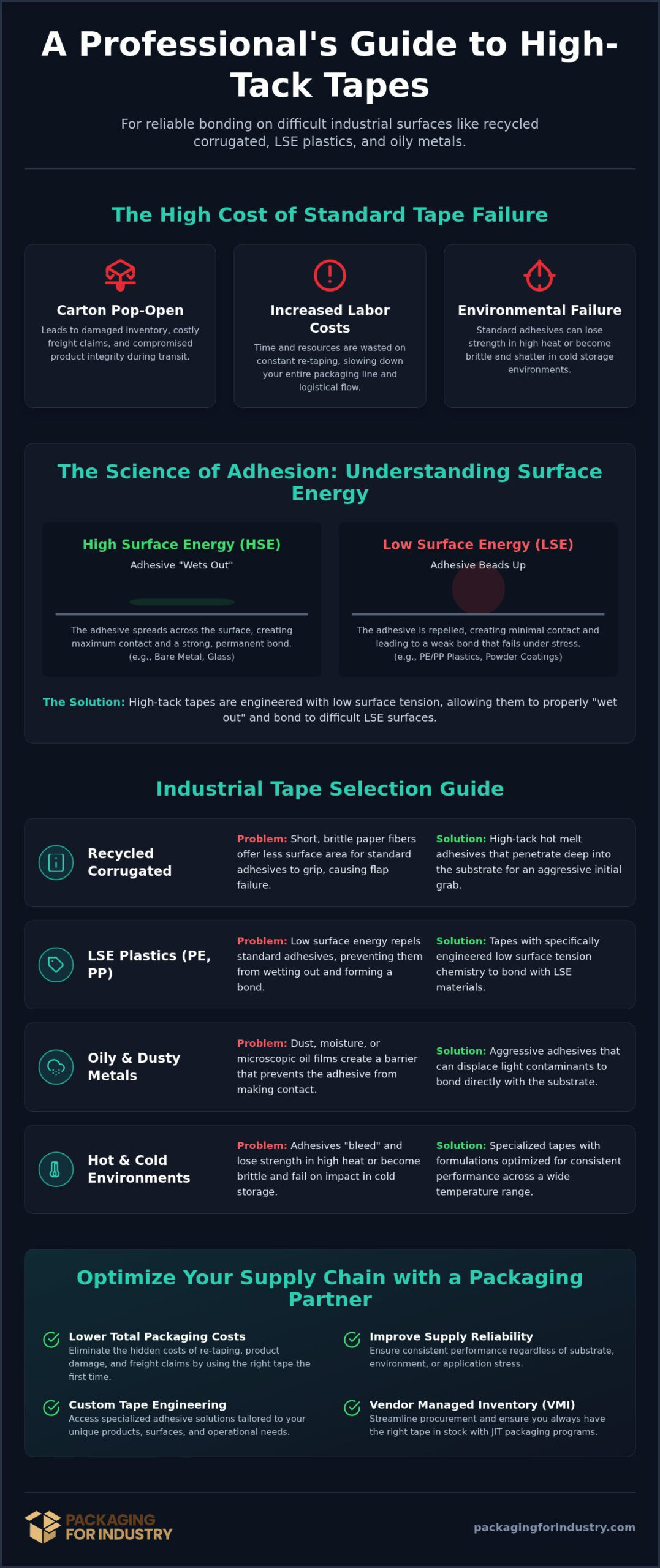
Industrial Selection Guide: Choosing Tape by Surface Type
Selecting the right tape requires a methodical evaluation of three primary variables: the surface type, the environmental conditions, and the anticipated stress load. While previous sections detailed the chemistry of high-tack adhesive tapes for difficult surfaces, the practical application depends on how these variables intersect on your warehouse floor. For instance, corrugated boxes with heavy ink coverage or aqueous coatings present a significantly different bonding challenge than virgin kraft paper. High ink density can create a barrier that prevents standard adhesives from reaching the paper fibers, making a high-tack solution essential for a secure seal.
Application methods also dictate performance. Manual hand dispensers allow for variable pressure, which can help “wet out” an adhesive on textured surfaces. However, automated case sealers require tape with consistent unwind tension and immediate grab to maintain line speed. If your tape fails to bond instantly in an automated system, the resulting downtime can quickly erode your operational margins. When dealing with high-value metal components or sensitive plastics, selecting an adhesive that leaves zero residue is as important as the bond strength itself. This ensures that your parts remain pristine upon arrival without requiring secondary cleaning processes.
The PFI Decision Matrix for Tape Selection
- Surface Texture: Rough surfaces require thicker adhesive layers to fill microscopic voids. Smooth surfaces typically benefit from thinner, high-flow adhesives that maximize contact area.
- Contamination Level: In environments with residual machine oils or industrial dust, you need a tape with high initial tack that can displace surface film to reach the substrate.
- Bond Duration: Permanent bonds require adhesives that continue to flow and build strength over 72 hours. Temporary masking or protection needs a high-tack initial grip with a clean-release chemistry.
Southern California Logistics Considerations
Regional climate factors in Southern California significantly impact adhesive behavior. In high-humidity coastal areas like Long Beach or San Pedro, standard adhesives can experience “ooze,” where the adhesive softens and migrates past the tape backing. This creates a sticky residue that can jam conveyor systems or damage adjacent cargo. Conversely, manufacturers in the Inland Empire must account for extreme heat and UV exposure during outdoor staging. These conditions can cause standard rubber-based adhesives to oxidize and fail prematurely.
Our team provides localized expertise to help Orange County manufacturers troubleshoot these specific tape failures. By analyzing the intersection of your substrate and your shipping environment, we ensure that your high-tack adhesive tapes for difficult surfaces perform reliably from the assembly line to the final destination. This consultative approach helps lower packaging costs by eliminating the need for excessive wrapping or redundant taping.
Optimizing Your Tape Supply with Packaging For Industry
Industrial procurement teams often struggle with the hidden costs associated with tape failure and redundant application. When you compare packaging pricing against standard catalog options, it’s essential to look beyond the cost per roll and evaluate the total cost of ownership. By utilizing high-tack adhesive tapes for difficult surfaces that are engineered specifically for your substrates, you can lower packaging costs through a significant reduction in tape consumption per carton. This shift from a commodity mindset to an engineering-focused approach ensures your supply chain remains lean and fiscally responsible.
Custom Engineering and Prototyping
We don’t just provide shipping supplies; we provide technical solutions based on rigorous compatibility testing. Our team analyzes your tape-to-substrate interaction to ensure the adhesive penetrates recycled fibers or grips LSE plastics effectively. This data-driven process is often integrated with custom design packaging to create a holistic protection strategy. We have custom sizes available for various tape widths and lengths, ensuring perfect compatibility with your specific production machinery or specialized manual dispensers. These tailored responses eliminate the guesswork and professional stress associated with off-the-shelf tape failures.
VMI and JIT: The PFI Reliability Advantage
Operational downtime due to supply shortages is a significant hidden cost in modern manufacturing. Our Vendor Managed Inventory (VMI) programs ensure you never stop the line because of a packaging shortage. By proactively managing your stock levels, we eliminate the need for expensive emergency orders and the logistical complexity of tracking recurring supplies. This reliability is backed by our local next-day delivery capabilities for high-volume manufacturers in Anaheim, Los Angeles, and the Inland Empire. When you choose PFI, you gain a dependable partner that values long-term stability over flashy innovation.
It’s time to move beyond the catalog and implement a bonding strategy built for your unique operational needs. We’re here to solve your most persistent logistical challenges through pragmatic, business-focused solutions that improve your bottom line. Our team is ready to audit your current tape performance and identify specific areas where custom engineering can enhance your supply chain reliability.
Secure Your Supply Chain with Engineered Adhesion
Industrial reliability begins with selecting the right materials for your specific environment. Success on difficult substrates requires matching adhesive chemistry to surface energy to prevent costly shipping damage and operational delays. By implementing high-tack adhesive tapes for difficult surfaces, you ensure that even recycled corrugated and low-surface energy plastics maintain a permanent bond from the warehouse floor to the final destination.
Our team specializes in custom engineering for aerospace and defense packaging, where precision is non-negotiable. We offer local next-day delivery in Orange County and Los Angeles to keep your lines moving without interruption. With specialized Vendor Managed Inventory (VMI) programs, you can eliminate the stress of emergency shortages while lowering your total cost of ownership through optimized tape usage.
It’s time to move beyond off-the-shelf options and implement a bonding strategy built for your unique operational needs. We look forward to partnering with you to solve your most persistent logistical challenges through pragmatic, engineering-minded solutions.
Frequently Asked Questions
What makes a surface ‘difficult’ for standard adhesive tapes?
A surface is considered difficult if it possesses low surface energy (LSE), which causes standard adhesives to bead up rather than spread. Common industrial examples include polypropylene, polyethylene, and powder-coated metals. Environmental contaminants like machine oils, industrial dust, or moisture also prevent a secure bond. Additionally, the short, brittle fibers found in high-recycled content corrugated boxes offer less surface area for standard tapes to grip, often leading to carton pop-open failures.
How do I know if I need a high-tack or a low-tack adhesive?
High-tack adhesives are necessary when you require an aggressive, immediate bond on challenging substrates or in unconditioned warehouse environments. These are ideal for permanent closure on heavy-duty RSC boxes or LSE plastics. Conversely, low-tack adhesives are designed for temporary applications, such as surface protection or masking. If your goal is a permanent, zero-failure seal on recycled materials or oily parts, you should specify high-tack adhesive tapes for difficult surfaces to avoid transit damage.
Does high-tack tape work better on recycled corrugated boxes?
Yes, high-tack tapes are specifically engineered to penetrate the short, dense fibers of recycled corrugated material. Standard acrylic tapes often sit on the surface of recycled boxes, which can lead to delamination during shipping. High-tack hot melt adhesives provide the “initial grab” needed to secure the flaps instantly on automated lines. This ensures that the carton remains closed even when subjected to the mechanical stresses of nationwide freight or local Southern California distribution.
Can high-tack tapes be used in cold storage or high-heat environments?
Yes, but the specific chemistry must match the temperature profile. Acrylic high-tack adhesives are generally superior for cold storage because they don’t become brittle or shatter. For high-heat environments, such as Inland Empire warehouses during summer, specialized formulations prevent the adhesive from “bleeding” or losing shear strength. We conduct packaging reviews to ensure your tape choice maintains its integrity across your entire supply chain, regardless of temperature fluctuations or humidity levels.
Will high-tack adhesive leave a residue on my products?
Most high-tack tapes designed for carton sealing or bundling are permanent and may leave a residue if removed. However, we offer specialized high-tack tapes for the electronics and aerospace sectors that provide aggressive initial adhesion but use clean-release chemistries. These are ideal for protecting high-value parts during manufacturing. If residue is a concern, we can prototype specific tape-to-substrate combinations to verify that your components remain pristine after the tape is removed.
What is the difference between hot melt and acrylic high-tack tape?
Hot melt tapes offer the strongest initial grab and are the preferred choice for high-recycled content boxes and dusty environments. They perform exceptionally well on high-speed automated case sealers. Acrylic tapes provide better long-term aging characteristics, UV resistance, and performance in extreme cold. While hot melt is often more cost-effective for immediate shipping needs, acrylic is the professional choice for inventory that requires long-term storage or exposure to sunlight before delivery.
How can I lower my total packaging costs using better tape?
You can lower packaging costs by reducing the total volume of tape used per carton. High-performance high-tack adhesive tapes for difficult surfaces often require only a single strip to secure a box, whereas cheaper alternatives may require multiple layers or frequent re-taping. Additionally, implementing a Vendor Managed Inventory (VMI) program eliminates emergency order premiums and prevents production downtime. Our analysis helps identify the most efficient tape for your specific application to minimize waste.
Does PFI offer local next-day delivery for adhesive tapes in Southern California?
PFI provides local next-day delivery for a wide range of adhesive tapes and shipping supplies throughout Southern California. Our service area includes Orange County, Los Angeles, San Diego, and the Inland Empire. Because we are headquartered in Anaheim, we can quickly support manufacturers and warehouses with just-in-time replenishment. This local presence allows us to offer on-site troubleshooting and specialized stocking programs that keep your production lines moving without the delays of nationwide shipping.