
If you’re still wrapping your odd-shaped pallets with the same film you use for standard RSC boxes, you’re likely paying for it twice: once in wasted material and again in carrier damage claims. Finding the right stretch film for securing irregular shaped loads isn’t just about choosing a thicker gauge. It’s about engineering a solution that survives the high-stress environment of LTL transit without succumbing to punctures or load shift. With carrier surcharges for oversized and improperly handled packages rising by nearly 10% in 2026, the financial stakes of a failed wrap have never been higher.
We understand the frustration of seeing a shipment arrive at a customer’s dock with film punctures from sharp corners or a pallet that’s lost its structural integrity. This guide will help you master the technical selection and application techniques required to stabilize complex, odd-shaped loads while reducing material waste. You’ll learn how to choose between blown and cast films based on puncture resistance, how to standardize your wrapping process, and how PFI’s custom packaging reviews can lower your cost-per-pallet. Whether you’re shipping across Southern California or nationwide, the goal is zero-damage shipments and predictable logistical flow.
Key Takeaways
- Understand why blown film is the technical standard for loads with sharp protrusions due to its superior puncture resistance and elastic memory.
- Master the engineering principles of using stretch film for securing irregular shaped loads to eliminate shifting during the rigors of transit.
- Identify how to integrate edge protection and pallet anchoring to stabilize non-uniform profiles and reduce the risk of carrier damage claims.
- Evaluate the transition from hand wrapping to machine automation to achieve standardized results and lower your overall cost-per-pallet.
- Learn how customized film selection and Vendor Managed Inventory (VMI) can streamline your warehouse operations and improve supply reliability.
The Engineering Challenge of Irregularly Shaped Loads
Securing a standard cube is a straightforward task for most warehouse teams. However, applying Stretch wrap to a pallet of custom machinery, aerospace components, or industrial equipment requires an understanding of physics, not just a stronger arm. The primary goal of using stretch film for securing irregular shaped loads is to achieve consistent containment force across a non-uniform surface. When loads are asymmetrical, standard wrapping patterns often leave critical gaps or apply uneven pressure. This imbalance leads to structural failure during the vibrations and G-forces of transit.
Anatomy of an Irregular Load
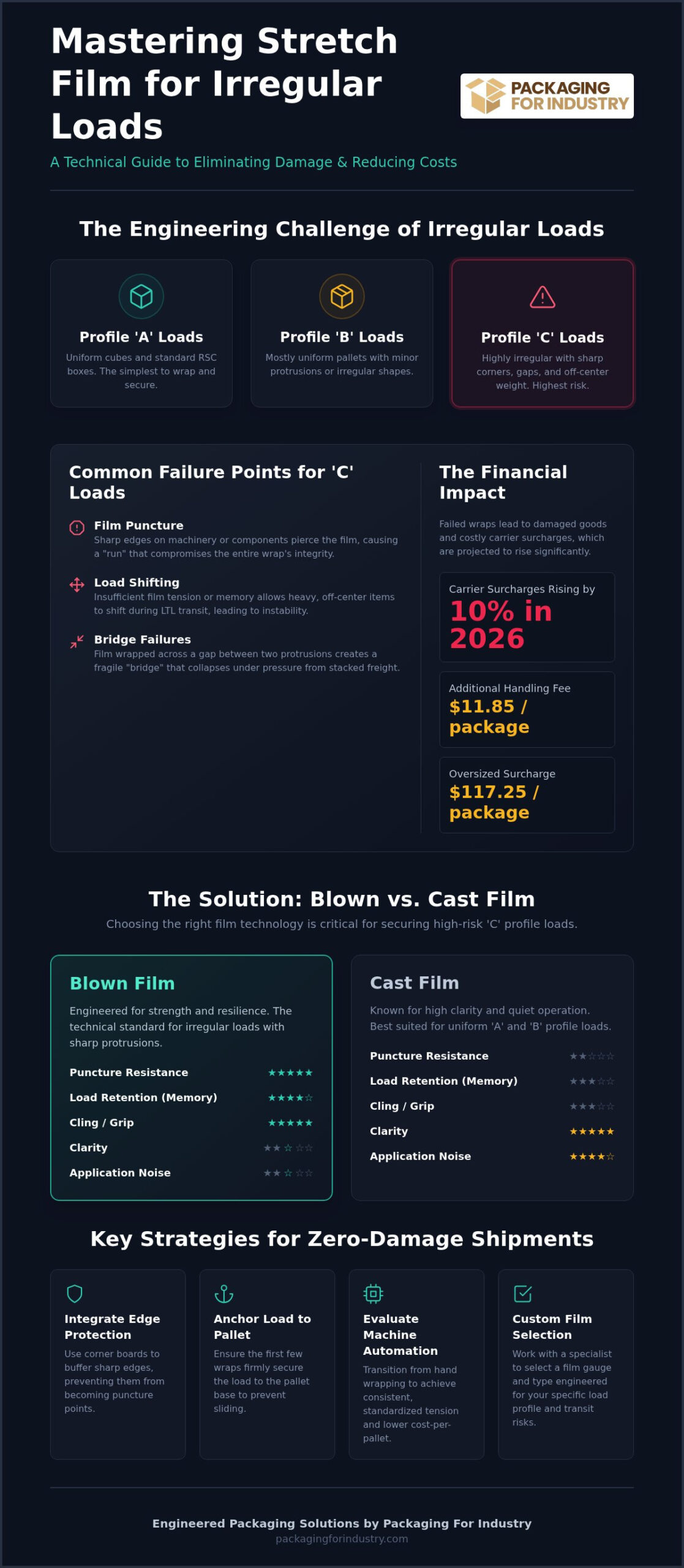
In industrial logistics, we categorize pallets into three distinct profiles. ‘A’ loads are uniform cubes. ‘B’ loads have minor protrusions. ‘C’ loads are the most challenging; they’re highly irregular, featuring sharp corners and off-center weight distributions. These ‘C’ profiles create stress concentrations. At these specific points, the film is stretched to its physical limit by a sharp edge, making it vulnerable to punctures. If the weight isn’t centered, centrifugal force during forklift maneuvers can cause the entire load to slide off the pallet base. This is especially dangerous when the film fails to anchor the product to the pallet itself.
Common Failures in Load Stabilization
Many operations attempt to solve puncture issues by simply increasing the film gauge. This is a costly mistake that often leads to excessive material waste. Over-wrapping with a thick, low-quality film doesn’t necessarily improve “memory,” which is the film’s ability to return to its original shape. Without high elastic recovery, the wrap will loosen as the load settles. Common failure points we see in the field include:
- Film Puncture: Sharp edges piercing the wrap, causing a “run” that compromises the entire pallet’s integrity.
- Load Shifting: This occurs when the film lacks the tension to hold heavy, off-center items in place during LTL transit.
- Bridge Failures: These happen when film is wrapped across a gap between two protruding parts, creating a fragile “bridge” that collapses under the weight of stacked freight.
The financial impact of these failures is compounding. Beyond the cost of damaged goods, carriers have become increasingly aggressive with surcharges. For the 2026 peak season, FedEx has set additional handling fees at $11.85 per package, while oversized surcharges can reach $117.25. Proper stabilization isn’t just about protection; it’s a necessary strategy to lower packaging costs and avoid these margin-eroding fees. If you’re struggling with frequent damage, it’s time to request a packaging quote for a film specifically engineered for high-puncture environments.
Selecting the Right Stretch Film: Blown vs. Cast for Odd Shapes
Selecting the correct material is the first step in optimizing your unitization process. For procurement teams, the choice usually comes down to blown versus cast film. While cast film is known for its high clarity and quiet operation, it often lacks the structural integrity required for “C” profile loads. Using the right stretch film for securing irregular shaped loads requires a material that can withstand constant stress without snapping or losing its grip during transit.
When to Choose Blown Film for Industrial Gear
Blown film is manufactured through a process where the resin is extruded and blown into a large bubble, then air-cooled. This technique creates a film with high multi-directional strength. It’s the preferred choice for heavy industrial equipment and aerospace components that feature sharp, protruding edges. Blown film also offers superior “cling,” which is essential in high-vibration transit environments. If your pallets frequently shift during LTL shipping, the one-sided or two-sided cling of a blown film provides the friction needed to keep items locked in place. While the initial cost-per-roll may be higher, the ROI is realized through a drastic reduction in damaged product and rejected shipments.
The Role of Film Gauge and Puncture Resistance
Puncture resistance is the film’s ability to withstand sharp protrusions without tearing. For procurement managers, understanding technical specifications like microns and gauge is critical for cost control. An 80-gauge film is the industrial standard for loads up to 2,500 lbs, but for irregular loads with extreme protrusions, a higher-performance 60-gauge film might actually outperform a standard 80-gauge cast wrap due to better resin technology.
When selecting stretch film for securing irregular shaped loads, you must account for “film memory.” This refers to the film’s elastic recovery, or its tendency to want to return to its original size after being stretched. High memory ensures the wrap stays tight even as the load settles or shifts during a long haul. Following Best practices for wrapping tall or irregular pallet loads often involves the use of pre-stretch film. This material is mechanically stretched before it’s applied, ensuring maximum containment force is reached with every wrap without causing operator fatigue. If you’re unsure which gauge matches your specific load profile, you can request a packaging quote to have our team conduct a technical film performance review.
Hand vs. Machine Wrapping for Complex Pallet Profiles
Determining whether to wrap by hand or invest in automation is a critical decision for operations managers in manufacturing and distribution. While manual application provides the agility required for one-off custom machinery, machine wrapping is often necessary to maintain the precise tension required for high-volume irregular production. The choice ultimately depends on your throughput and the stability of the load profile. For many specialized manufacturers, a hybrid approach works best: machines handle the recurring lines while hand wrapping is reserved for unique, oversized crates.
In Southern California locations like Irvine, Santa Fe Springs, and the Inland Empire, warehouse temperatures can significantly impact your film’s performance. High ambient heat increases film elasticity, which can lead to “necking,” where the film thins and loses its containment force. Automated wrappers allow for precise adjustments to carriage speed and tension, compensating for these environmental factors better than manual application. If your team is struggling with load shift during the warmer months, it’s often a sign that your current wrapping method isn’t maintaining the necessary memory to hold the load together.
Optimizing Hand Wrapping Techniques
For warehouses processing specialized equipment or lower volumes, using high-quality hand stretch film remains a pragmatic solution. However, ergonomics must be a priority to ensure both safety and effectiveness. Securing low-profile loads often requires operators to wrap near the floor, which increases the risk of back strain and often results in insufficient anchoring to the pallet. We recommend using dispensers with integrated tension control. These tools allow the operator to apply a consistent wrap without having to physically pull the film to its breaking point, which is essential when using stretch film for securing irregular shaped loads with multiple protrusion points.
Automated Solutions for Irregular Production Lines
When volume exceeds 15 to 20 pallets per day, transitioning to machine wrapping is a proven way to lower packaging costs. For unstable or top-heavy irregular loads, a rotary arm wrapper is superior to a turntable model because the pallet remains stationary while the film carriage rotates around it. To further stabilize tall or narrow items, we often suggest adding a top platen. This pneumatic or electric press holds the load in place during the wrap cycle, ensuring that the stretch film for securing irregular shaped loads is applied with maximum efficiency and zero shifting. This level of consistency is impossible to replicate with manual labor and significantly reduces the risk of transit damage.
How to Secure Irregular Loads: A Step-by-Step Guide
Securing a “C” profile load requires an integrated system rather than a standalone product. If you rely solely on film, you’re inviting punctures and structural failure. Effective stabilization begins with a methodical approach that addresses the unique geometry of the shipment. By following these steps, you’ll ensure that your stretch film for securing irregular shaped loads performs at its technical limit.
- Step 1: Base Stabilization and Pallet Anchoring. Start by securing the film to the pallet base. You must wrap the pallet itself at least three times to create a solid anchor point. This prevents the load from sliding off the wood during sudden stops.
- Step 2: Integrating Edge Protection. Apply corner and edge protection to any sharp protrusions. This creates a buffer that prevents the film from tearing at stress concentrations.
- Step 3: The ‘Rope’ Technique. Bunch the film into a tight cord as you wrap high-stress areas. This “rope” provides the structural strength of a strap while maintaining the flexibility of the film.
- Step 4: Managing Overlap. Maintain a 50% overlap on every pass. For highly irregular areas, increase this to 75% to ensure there are no gaps where the film might catch or pull.
- Step 5: Final Inspection. Conduct a physical check of the containment force. The wrap should feel like a single, rigid skin rather than individual layers.
Advanced Stabilizing Techniques
Standard wrapping often fails on tall or top-heavy industrial equipment. In these cases, we recommend an X-pattern wrap. This involves crossing the film diagonally from the top corner to the opposite bottom corner, creating a lateral brace that resists swaying. If the load has deep recesses, integrate custom foam inserts to level out the surface. This creates a more uniform profile, allowing the film to apply even pressure across the entire unit. Using foam kitting in this way reduces the amount of film needed and lowers your total cost per pallet.
Compliance and Safety Checks
Before a pallet leaves your dock, it must pass a rigorous safety check. Load shift is the leading cause of transit damage; if the item moves more than an inch when pushed, it isn’t secure. You also need to ensure that shipping labels and barcodes remain legible through the wrap. To perform a ‘tug test,’ attempt to pull the film away from the load at its narrowest point to ensure there is no significant slack or separation. If the film pulls away easily, the containment force is insufficient for LTL transit. Achieving this level of precision is why many Southern California warehouses rely on PFI for technical packaging reviews.
Optimizing Your Supply Chain with PFI Stretch Film Solutions
Securing complex loads is a precision task that requires the right materials and a reliable supply chain. At Packaging For Industry (PFI), we don’t treat stretch film as a commodity. We view it as an engineered component of your logistical success. Selecting the specific stretch film for securing irregular shaped loads is only half the battle; the other half is ensuring that film is available exactly when your production line needs it. Our team conducts custom packaging reviews to identify the optimal film gauge for your specific load profiles, ensuring you aren’t over-spending on material or under-protecting high-value assets.
Operational efficiency often hinges on inventory management. Many manufacturers struggle with stockouts or excessive capital tied up in packaging supplies. We solve this through our Vendor Managed Inventory (VMI) programs. By allowing PFI to manage your film levels, you lower your total cost of ownership and eliminate the administrative burden of frequent reordering. This proactive approach ensures your warehouse in Santa Fe Springs or Anaheim always has the high-performance blown or pre-stretch film required to maintain throughput.
The PFI Advantage for Southern California Manufacturers
Our local presence in Orange County and the Inland Empire provides a distinct logistical edge. We offer next-day delivery to warehouses across Los Angeles County, helping you implement a just-in-time (JIT) packaging strategy. This frees up valuable warehouse floor space that would otherwise be occupied by bulk pallets of wrap. For aerospace and medical sectors, we also provide specialized packaging kitting services. We can bundle your stretch film for securing irregular shaped loads with custom foam inserts and corner boards, providing a complete stabilization kit for your most challenging shipments. This holistic approach ensures that every component of your packaging system works in unison to prevent transit damage.
Next Steps: Request a Packaging Quote
Improving your unitization process starts with a data-driven audit of your current methods. We invite you to schedule a site visit for a comprehensive load stabilization audit. Our experts will evaluate your containment force, film memory, and puncture resistance requirements to provide a tailored recommendation. Whether you need bulk quantities of stock film or custom sizes for specialized equipment, we provide transparent pricing to help you lower packaging costs without compromising safety. It’s time to move beyond guesswork and implement a standardized wrapping process that survives the rigors of the modern supply chain. You can contact PFI experts today to begin your technical review and request a custom quote.
Stabilize Your Operations with High-Performance Load Containment
Implementing a technical approach to stretch film for securing irregular shaped loads is more than a safety measure; it’s a pragmatic financial strategy. By moving away from generic wrapping and utilizing high-memory blown films alongside integrated corner protection, you protect your margins from rising carrier surcharges and costly product returns. Standardizing these processes allows your warehouse team to work with greater efficiency while ensuring every pallet meets rigorous containment standards even during the most demanding transit conditions.
PFI provides the engineering expertise and logistical support needed to stabilize your supply chain. As specialists in aerospace and industrial packaging, we understand that “one-size-fits-all” solutions don’t work for complex equipment or non-uniform profiles. Our VMI programs are designed to eliminate the stress of inventory management, and our fleet provides local next-day delivery throughout Southern California to support your just-in-time operations. We’re ready to help you transform your packaging from a cost center into a reliable system of protection.
We look forward to partnering with you to solve your most challenging packaging obstacles and improve your delivery reliability.
Frequently Asked Questions
What is the best stretch film gauge for heavy industrial machinery?
For heavy industrial machinery, an 80-gauge film is the baseline, but loads exceeding 2,500 lbs often require 100-gauge or 120-gauge material. High-performance blown film is recommended because it provides the necessary containment force without snapping. Selecting the right stretch film for securing irregular shaped loads depends on matching the film’s tensile strength to the weight and center of gravity of the equipment. We often conduct audits to determine if a thinner, high-performance film can replace a thicker, standard gauge.
How do I prevent stretch film from puncturing on sharp metal corners?
Preventing punctures on sharp metal corners requires a combination of high-puncture-resistance blown film and integrated corner and edge protection. Corner boards distribute the film’s tension across a wider surface area, preventing the material from reaching its breaking point at a single stress concentration. This integrated approach is far more effective than simply adding more layers of wrap. Using the correct protective materials reduces damage claims and avoids the need for expensive re-wrapping at the shipping dock.
Is blown stretch film or cast stretch film better for irregular loads?
Blown stretch film is typically the better choice for irregular loads due to its superior puncture resistance and one-sided cling. The manufacturing process creates a tougher material that handles sharp protrusions and high-vibration environments better than cast film. While cast film offers better clarity for barcode scanning, it’s more prone to tearing when stretched over odd profiles. For manufacturers in Orange County handling heavy industrial gear, blown film provides the reliability needed for long-distance LTL transit.
Can I use pre-stretched film for non-uniform pallet profiles?
You can use pre-stretched film for non-uniform pallet profiles to maintain consistent containment force while reducing physical strain on your warehouse team. Since the film is already stretched during manufacturing, it requires less force from the operator to reach its maximum tension. This is particularly useful for securing irregular shaped loads where manual wrapping can lead to inconsistent tension and load shift. It’s a cost-effective solution that improves wrap consistency across diverse product lines.
How many layers of stretch film are needed to secure an odd-shaped load?
Most odd-shaped loads require a minimum of three wraps at the pallet base to ensure proper anchoring, followed by two to three layers on the body with a 50% overlap. Highly irregular areas or top-heavy items may require additional “X-pattern” passes or roping to maintain structural integrity. The goal is to reach a specific containment force rather than a specific layer count. Our packaging reviews help standardize these requirements to prevent over-wrapping and lower packaging costs.
What is the ‘roping’ technique in stretch wrapping and when should I use it?
Roping is a technique where the stretch film is bunched into a high-strength cord as it’s applied to the pallet. This creates a structural brace similar to a strap, providing extra support for heavy or shifting components within an irregular load. You should use roping at the pallet base for anchoring or across the middle of tall, unstable items. It’s a pragmatic way to increase containment force at specific stress points without increasing overall film usage.
Does heat in Southern California warehouses affect stretch film performance?
High ambient temperatures in Southern California warehouses, from Anaheim to the Inland Empire, can significantly increase film elasticity. This often leads to “necking,” where the film narrows and loses its ability to hold the load tight. To combat this, we recommend using films with higher elastic memory or transitioning to automated wrappers that can maintain precise tension regardless of the temperature. Consistent inventory management through VMI ensures your film is stored in optimal conditions before use.
How can I reduce film waste when wrapping irregular items?
Reducing film waste starts with a technical audit to identify the correct film gauge and material for your specific load profiles. Many businesses over-wrap irregular items because they’re using a film with poor puncture resistance. By switching to a high-performance blown film and utilizing specialized techniques like roping, you can achieve better stability with fewer revolutions. This not only lowers your cost-per-pallet but also supports sustainability goals by minimizing the total volume of plastic sent to landfills.