
In a city that serves as the nation’s largest manufacturing hub with over 510,000 employees, the most expensive mistake an operations manager can make isn’t the cost of the material; it’s the cost of a generic box that fails. When you rely on one-size-fits-all foam from a catalog, you aren’t just risking product damage. You’re likely paying for excess air that triggers expensive UPS and FedEx dimensional weight surcharges. Specialized foam packaging engineering Los Angeles manufacturers need goes beyond simple cushioning. It’s about optimizing the intersection of material science and logistical economics.
You likely already know that high damage rates and bloated warehouse shelves are draining your bottom line, especially when dealing with the high-value aerospace and medical components central to Southern California’s economy. This guide will show you how precision foam engineering protects your industrial assets while significantly reducing your total cost of shipping. We’ll explore how custom die-cut inserts, rapid prototyping, and vendor-managed inventory can streamline your procurement and ensure zero-damage delivery for every shipment.
Key Takeaways
- Understand why professional foam packaging engineering Los Angeles services are essential for protecting high-value industrial assets from the rigors of transit.
- Learn to select the correct material for your specific application, whether you require heavy-duty polyethylene or specialized anti-static ESD foam for electronics.
- Discover how CAD-driven design and free prototyping ensure a precision fit that eliminates product movement while reducing overall package dimensions.
- Calculate the true ROI of custom engineering by accounting for lower damage rates and the avoidance of expensive carrier dimensional weight surcharges.
- Streamline your operations through local Southern California support, utilizing Vendor Managed Inventory (VMI) to solve warehouse space constraints.
Why Foam Packaging Engineering is Critical for Los Angeles Manufacturers
The Los Angeles-Long Beach-Anaheim area represents the nation’s most dense manufacturing landscape. Within this corridor, generic packaging often fails because it isn’t designed for the specific vibrations and impacts found in heavy industrial logistics. Professional foam packaging engineering Los Angeles manufacturers rely on provides a layer of security that catalog-bought void fill simply can’t match. Relying on generic suppliers often leads to high damage rates because these materials leave too much room for movement inside the box.
When sensitive equipment shifts during transit, the resulting impact can destroy internal components before the shipment even reaches its destination. Utilizing Package cushioning materials that are specifically engineered for a product’s unique fragility ensures that energy is absorbed by the foam rather than the asset. This precision is what separates a successful delivery from a costly insurance claim.
Protecting High-Value Assets in the SoCal Aerospace Hub
The “Aerospace Corridor” stretching through the South Bay and Orange County demands specialized protection. Manufacturers here handle sensitive avionics, satellite components, and defense systems that require more than just a standard container. We design custom foam packaging to meet rigorous mil-spec requirements, ensuring every insert provides the exact G-force protection needed for delicate electronics.
Local proximity to LAX and the Port of Long Beach means your products face unique handling stresses during export and domestic transit. Local foam packaging engineering Los Angeles services allow for rapid prototyping, which significantly speeds up product development cycles. It’s about getting to market faster while maintaining the confidence that your gear will arrive in perfect condition, regardless of how many hands it passes through.
Beyond Cushioning: The Strategic Value of Engineered Packaging
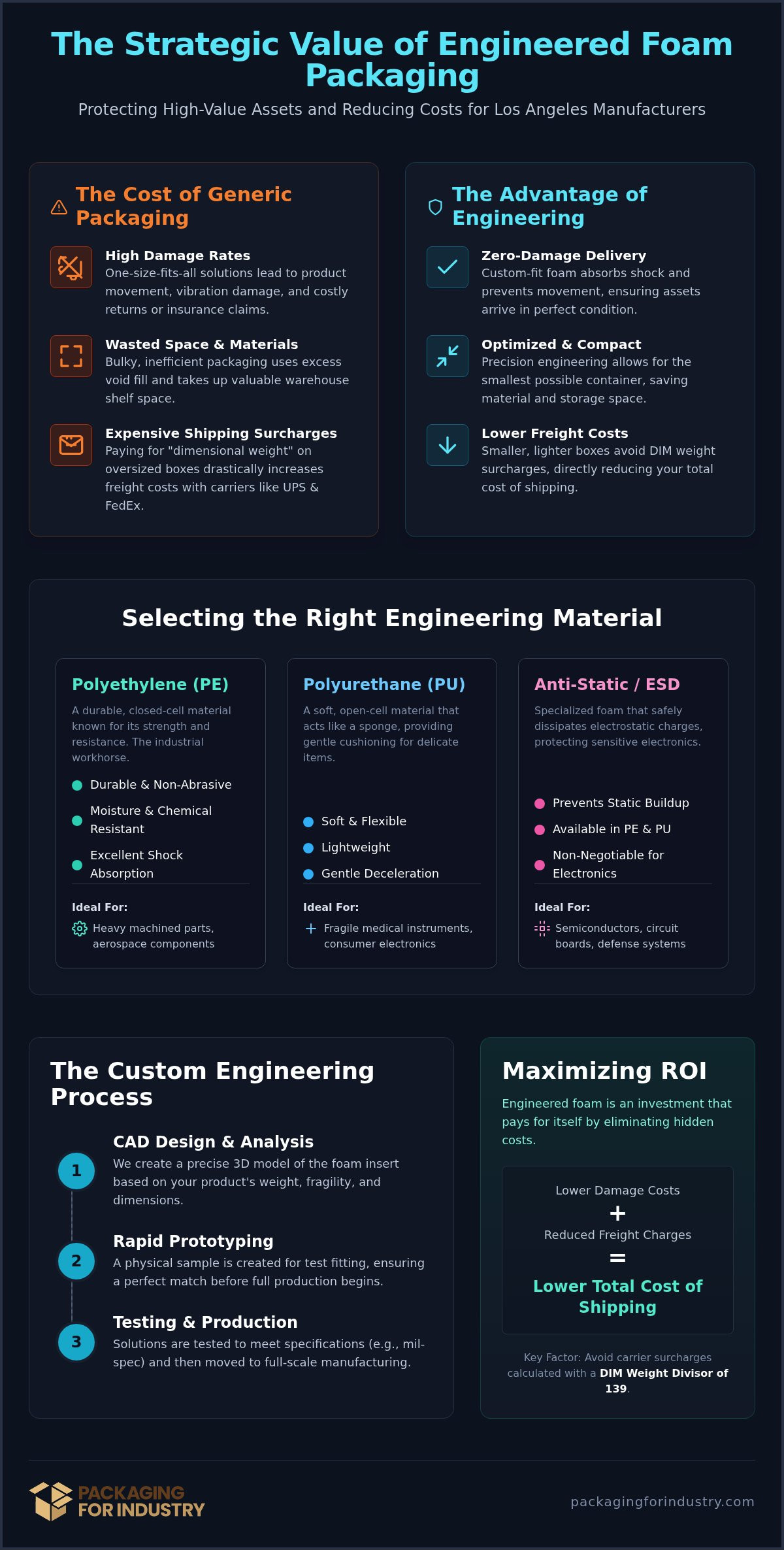
Engineering isn’t just about physical protection; it’s a tool for fiscal responsibility. In 2026, major carriers like UPS and FedEx use a DIM weight divisor of 139 to calculate shipping costs. If your packaging is unnecessarily bulky, you’re paying for empty space. Precision-cut foam allows you to use smaller boxes, which directly lowers your freight costs and helps you avoid cubic volume surcharges.
Standardizing these designs across your production lines also creates a professional brand image. When a client in the aerospace sector or medical field opens a shipment, a precision-engineered insert signals quality and attention to detail. It transforms a simple shipping container into a strategic asset that reflects the high standards of your own manufacturing processes.
Selecting the Right Engineering Materials: Polyethylene, Polyurethane, and ESD Foams
Success in foam packaging engineering Los Angeles projects depends entirely on matching the material’s physical properties to the product’s fragility. Industrial buyers shouldn’t view foam as a commodity. It’s a technical component. Selecting the wrong density or cell structure leads to “bottoming out,” where the foam compresses completely and transfers the full shock of an impact directly to your asset.
Polyethylene (PE) foam serves as the industrial workhorse. It’s a closed-cell material known for its durability and resistance to moisture and chemicals. It’s ideal for heavy-duty protection, such as securing machined parts or heavy aerospace components. In contrast, Polyurethane (PU) foam is an open-cell material. It’s much softer, making it the preferred choice for lightweight, highly fragile items like medical instruments or consumer electronics that require gentle deceleration during a drop.
For the Los Angeles electronics sector, anti-static and ESD (Electrostatic Discharge) foams are non-negotiable. These materials prevent the buildup of static electricity that can fry sensitive semiconductors during transit. When aesthetics or cleanroom compliance are priorities, Cross-linked polyethylene (XLPE) offers a smooth, non-abrasive surface that won’t shed particles, making it essential for high-end medical device packaging.
Material Density and Shock Absorption Science
Technical buyers must understand Indentation Load Deflection (ILD) to make informed procurement decisions. ILD measures the firmness of the foam. A higher ILD means the material is harder to compress. We specify density based on the “static loading” of your product, which is the weight of the item divided by the surface area touching the foam. Value-engineered packaging relies on these calculations to ensure the material provides maximum protection without adding unnecessary bulk.
Specialized Additives for Sensitive Environments
Industrial environments often require more than just physical cushioning. We offer foams with specialized additives to meet strict safety and operational standards. Flame retardant foams are essential for aerospace and automotive compliance, where fire safety is a critical design factor. Chemical-resistant foams are also available for parts that may still have residual oils or solvents from the manufacturing process. If you aren’t sure which material meets your specific compliance needs, you can compare packaging pricing and material options with our engineering team to find the most cost-effective solution.
The Custom Engineering Process: CAD Design, Prototyping, and Testing
Transitioning from material selection to a finished protective solution requires a rigorous, data-driven workflow. Professional foam packaging engineering Los Angeles firms don’t rely on guesswork; they treat every insert as a precision-machined part. The process begins with a technical assessment of your product’s “G-factor” and the specific shipping hazards it will face, such as vibration in long-haul freight or impact during last-mile delivery.
Once we establish the protection requirements, our engineers utilize CAD/CAM software to create a digital blueprint. This design phase ensures the foam insert is tailored to both the product’s geometry and the dimensions of the outer container. This integration is vital for reducing dimensional weight and avoiding the billing surcharges common with oversized packaging. After the design is finalized, the project moves through a structured validation phase:
- CAD/CAM Design: Digital modeling ensures every cutout and cavity provides a snug, secure fit.
- Performance Testing: Validation through drop tests and vibration analysis confirms the design meets your specific fragility requirements.
- Scalable Production: Once validated, the design moves to full-scale manufacturing using high-speed die-cutting or precision CNC routing.
Precision Prototyping: Reducing Risk Before Full Rollout
Physical samples are mandatory when you’re shipping high-value industrial gear. A digital model can’t always account for the tactile reality of how a part slides into its cavity or how much effort it takes to remove it. PFI provides free prototyping to guarantee a perfect product fit before you commit to a large production run. This iterative approach allows us to refine the insert for better packaging kitting efficiency, ensuring your warehouse team can pack orders quickly and accurately.
Fabrication Methods: Die-Cutting vs. CNC Routing
The choice between die-cutting and CNC routing depends on your volume and the complexity of the part. Die-cutting is the standard for high-volume orders. It utilizes a custom steel-rule die to punch out shapes with extreme speed, offering significant cost savings for repeat industrial orders. It’s the most efficient way to produce large quantities of PE or PU foam inserts.
CNC routing is the preferred method for complex, deep-cavity inserts or low-volume runs where tooling costs would be prohibitive. Because it’s a computer-controlled cutting process, it requires no physical die, allowing for rapid adjustments and intricate 3D shapes. This flexibility is essential for custom design packaging in the aerospace and medical sectors. Regardless of the method, we deliver ready-to-use solutions that integrate seamlessly into your existing logistics. If you’re ready to see how precision engineering can protect your assets, you can request a packaging quote today.
Maximizing ROI: How Engineered Packaging Lowers Freight and Damage Costs
Focusing on the unit cost of a foam insert is a trap for industrial buyers. Calculating the true return on investment for foam packaging engineering Los Angeles projects requires analyzing the total landed cost of your shipments. When you switch from generic void fill to custom inserts, you’re investing in a system that reduces expenses across your entire supply chain. High precision engineering allows you to downsize from oversized containers to standard RSC boxes, which is the most effective way to lower packaging costs.
Carriers heavily penalize volumetric inefficiency. Precision engineering ensures that your package dimensions stay exactly within the thresholds needed to avoid expensive surcharges. By integrating corner boards with custom foam, we add structural integrity to a shipment without the weight or bulk of a full wooden crate. Value-engineered packaging strategies focus on these technical adjustments to prevent “Additional Handling” fees and ensure you don’t pay to ship empty air.
The Hidden Costs of Improper Cushioning
A single damaged shipment costs significantly more than the price of the item itself. You lose labor hours processing the return, pay expedited shipping for a replacement, and risk damaging your reputation with the client. Precision foam engineering eliminates these variables by providing a repeatable, fail-safe level of protection. Beyond damage prevention, custom inserts simplify kitting by providing a standardized packing method. This eliminates the need for warehouse teams to guess how much bubble wrap to use, which speeds up throughput and reduces labor hours per order.
Sustainable Engineering: Material Efficiency and Reusability
Sustainability in an industrial context is synonymous with efficiency. By reducing the total volume of materials used per shipment, you lower your environmental footprint while cutting costs. We design many of our foam inserts for multi-trip industrial transit, allowing manufacturers to reuse the same packaging for internal transfers or closed-loop distribution cycles. This durability is a hallmark of our mil-spec packaging, where materials are engineered to withstand long term storage and repeated deployment without losing their shock-absorbing properties.
With California’s SB 54 regulations now in effect as of May 2026, producers face new mandates on single-use packaging. Transitioning to engineered polyethylene or polyurethane foams, which often incorporate recycled content, helps your business stay ahead of these regulatory shifts. Unlike expanded polystyrene which faces increasing bans, our engineered foams offer a compliant, high-performance alternative that supports both your fiscal and environmental goals.
Sourcing Local: Custom Foam Solutions and VMI Programs in Southern California
Partnering with a provider for foam packaging engineering Los Angeles manufacturers can trust translates to immediate operational agility. When your design team is local, you bypass the friction of long-distance communication and shipping delays for physical samples. With custom sizes available for any industrial application, our engineering team can adapt to your production shifts in real time. This responsiveness is vital for companies across Orange County, San Diego, and the Inland Empire that require immediate adjustments to their protective packaging inserts.
Warehouse space is a premium asset in Southern California. In Q2 2026, industrial lease rates in Los Angeles reached $1.37 per square foot, making it fiscally irresponsible to store bulk quantities of empty boxes or foam planks. Our Vendor Managed Inventory (VMI) program solves this by shifting the storage burden to us. We utilize just-in-time packaging to deliver exactly what you need for your daily production, freeing up your floor space for high-value manufacturing and assembly.
Servicing the Southern California Industrial Corridor
Our logistical footprint covers the entire region with next-day delivery capabilities in Los Angeles hubs like Carson, Torrance, and Santa Fe Springs. This localized support is a strategic advantage for aerospace and medical firms that operate under strict contract deadlines. By shortening the distance between production and packaging, we help you maintain a leaner, more responsive supply chain that can react to market demands faster than competitors relying on distant catalog suppliers.
Request a Packaging Quote: The Next Steps for Your Operations Team
A more efficient packaging strategy begins with a technical review of your current damage rates and freight spend. Our team conducts a detailed cost-reduction analysis to identify where professional foam packaging engineering Los Angeles services can optimize your protection and lower your landed costs. We’ll help you prepare for a seamless transition by establishing the stocking levels and delivery schedules that best support your production flow. Request a custom foam packaging quote today to secure your supply chain.
Optimize Your Industrial Logistics with Precision Engineering
Mastering the foam packaging engineering Los Angeles manufacturers require is the difference between a high-damage shipping cycle and a lean, protected operation. We’ve explored how technical material selection and CAD-driven design eliminate the guesswork from your supply chain. By aligning your packaging dimensions with carrier standards and your product’s specific fragility, you don’t just protect your assets; you reclaim your profit margins.
PFI stands as a steady partner for Southern California’s aerospace and medical sectors. Our local next-day delivery and expertise in mil-spec requirements ensure your gear arrives exactly as intended. With free prototyping and vendor-managed inventory, we solve the common frustrations of warehouse bloat and stock reliability. It’s time to transition from off-the-shelf catalog failures to a system built for industrial durability.
Our team is ready to analyze your current shipping data and engineer a solution that lowers your total costs while providing professional peace of mind. We look forward to helping you streamline your next product launch with precision-cut protection.
Frequently Asked Questions
What is the lead time for custom foam packaging engineering in Los Angeles?
Lead times for foam packaging engineering Los Angeles projects vary based on design complexity and material availability. Typically, initial CAD designs and prototypes are completed within a few business days. Because we are a local provider, we eliminate the transit delays common with out-of-state suppliers. For recurring production runs, we often utilize stocking programs to ensure next-day delivery for our Southern California clients.
Do I need to provide CAD files for a custom foam insert quote?
You don’t need to provide finished CAD files to receive a quote. While existing digital blueprints can speed up the process, our engineering team can work directly from your physical product or basic dimensions. We utilize internal CAD/CAM support to develop the precision cutouts required for your specific asset. This technical oversight ensures the final insert integrates perfectly with your corrugated boxes or wood crates.
Can you engineer foam packaging that meets military (mil-spec) standards?
Yes, we specialize in engineering foam solutions that comply with rigorous military and aerospace specifications. Our team understands the density and durability requirements necessary to meet mil-spec standards for protective cushioning. We provide the documentation and material certifications required for defense contracts. This expertise ensures your sensitive avionics or tactical gear remains protected against the extreme environmental stresses found in military logistics chains.
What is the difference between polyethylene and polyurethane foam for shipping?
Polyethylene is a closed-cell foam that offers high durability and moisture resistance, making it the workhorse for heavy industrial parts. Polyurethane is an open-cell, softer material designed to protect lightweight, fragile items like medical instruments. Choosing the right material for foam packaging engineering Los Angeles projects depends on your product’s weight and fragility. PE provides firm support for heavy loads, while PU offers gentle deceleration for delicate surfaces.
Does PFI offer free prototyping for custom foam designs?
We provide free prototyping and samples to ensure a precision fit before you commit to a full production rollout. Physical samples are a critical step in the engineering process because they allow your operations team to verify kitting efficiency and protection levels. This service eliminates the risk of design errors and ensures that the final custom foam inserts meet your exact performance requirements without additional upfront costs.
How does a VMI program work for custom foam packaging?
Our Vendor Managed Inventory (VMI) program involves scheduled reviews of your packaging stock to ensure you never face a shortage. We monitor your actual usage and replenish custom foam and boxes based on agreed-upon minimum and maximum levels. This system moves the storage burden to our facility, freeing up valuable floor space in your Los Angeles warehouse. It simplifies purchasing and ensures consistent supply for your production lines.
Can you combine custom foam with corrugated boxes and wood crates?
We specialize in creating integrated packaging solutions that combine custom foam inserts with heavy-duty corrugated boxes or wood crates. This holistic approach ensures that the inner cushioning and outer container work together to provide maximum protection. By sourcing a total solution from a single local partner, you reduce procurement complexity and ensure that all components are engineered to fit together perfectly for zero-damage delivery.
What is the minimum order quantity for engineered foam inserts?
Minimum order quantities are tailored to repeat industrial orders and high-volume production needs rather than one-time small purchases. MOQs vary depending on the fabrication method, such as die-cutting or CNC routing, and the specific material requirements. Our goal is to provide cost-effective solutions for manufacturers and warehouses with recurring packaging needs. Please contact our team to discuss your specific volume requirements and compare packaging pricing.