
The standard catalog box your team has used for years is likely costing your operation more in DIM weight surcharges and transit damage than the material itself is worth. Learning how to perform a packaging audit in your warehouse is the only way to expose these hidden fiscal drains before they further erode your 2026 margins. While many operations view packaging as a fixed expense, it’s actually a variable lever that directly impacts your bottom line and overall supply chain reliability.
You likely agree that rising freight rates and warehouse clutter are becoming unsustainable burdens for your logistics team. This guide promises a clear, step by step framework to identify inefficiencies and implement a more streamlined, reliable supply chain. Mastering how to perform a packaging audit in your warehouse ensures that every corrugated box and foam insert is engineered for protection rather than just convenience. We’ll cover everything from material testing to post audit execution, showing you exactly how to perform a packaging audit in your warehouse to achieve long term peace of mind and operational stability.
Key Takeaways
- Recognize that material costs represent only a small fraction of your total shipping expense; a thorough audit reveals hidden drains like labor inefficiency and DIM weight surcharges.
- Follow a structured, four-stage process to learn how to perform a packaging audit in your warehouse, focusing on objective material testing and real-time packing line observation.
- Prioritize data-driven decisions by reviewing 12 months of damage claims to identify where custom corrugated or foam packaging can provide better protection than stock catalog supplies.
- Transition from reactive purchasing to a sustainable Vendor Managed Inventory (VMI) system to maintain audit-optimized stock levels and eliminate warehouse clutter.
- Categorize your findings into immediate wins and long-term engineering improvements to ensure a clear path toward reduced per-package costs and a more reliable supply chain.
What is a Packaging Audit and Why Does Your Warehouse Need One?
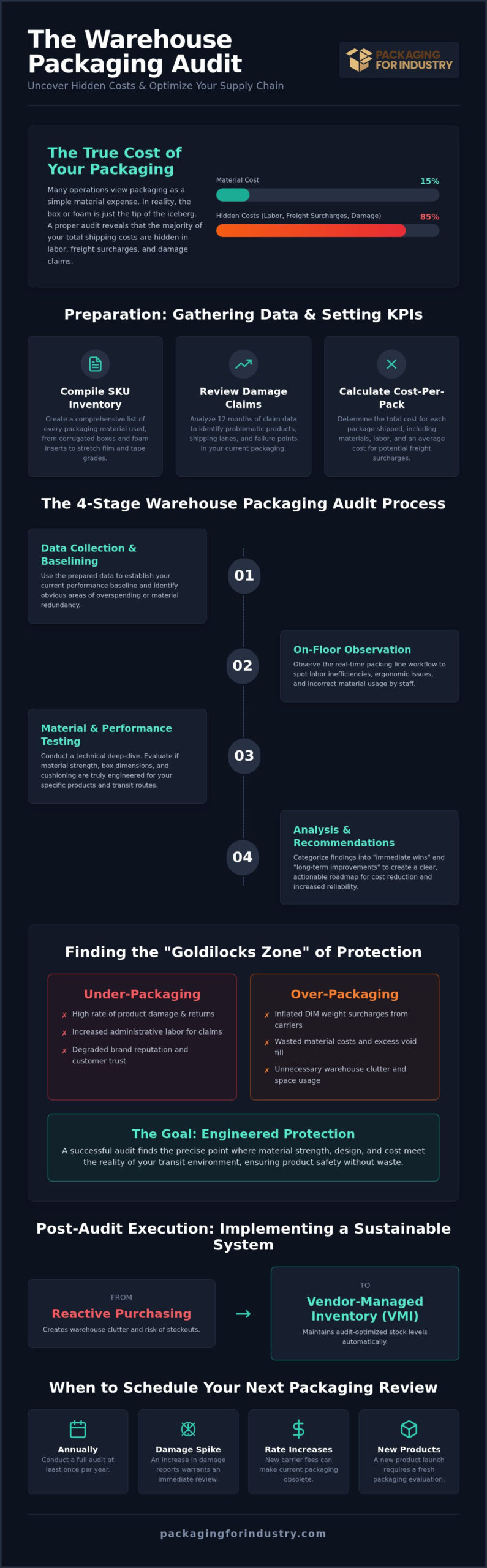
A packaging audit is a systematic evaluation of your current materials, shipping workflows, and transit performance. It isn’t just a simple inventory count; it’s a technical deep dive into how your products are protected and what that protection actually costs your business. For many industrial operations, the price of the physical corrugated box or foam insert only accounts for roughly 15% of the total shipping equation. The remaining 85% is hidden within labor hours, freight surcharges, and the financial fallout of transit damage. Integrating these reviews into your broader supply chain management strategy ensures that your logistics remain lean, predictable, and fiscally responsible.
Specialized sectors like aerospace and medical device manufacturing require even tighter audit cycles due to the high stakes of their shipments. These industries face zero-tolerance policies for contamination or structural compromise. A medical instrument shipped in a standard RSC box might arrive intact but fail calibration due to micro-vibrations that were not addressed by the internal cushioning. A professional audit identifies these engineering gaps before they become massive liabilities. The ultimate goal is to move beyond generic catalog solutions and implement custom design packaging that balances product safety with aggressive packaging cost savings.
The High Cost of Under-Packaging vs. Over-Packaging
Finding the “Goldilocks zone” of protection is the primary objective when you learn how to perform a packaging audit in your warehouse. Over-packaging often occurs when teams use oversized boxes filled with excessive void fill to avoid damage at any cost. This habit inflates UPS and FedEx DIM weight surcharges and wastes valuable warehouse square footage. Conversely, under-packaging is a silent profit killer. While it lowers initial material spend, it drives up costs through high return rates, administrative labor for damage claims, and a degraded brand reputation. A technical audit uses real-world data to find the precise point where material strength meets transit reality.
Frequency: When to Schedule Your Packaging Review
Most high-volume warehouses should conduct a comprehensive audit at least once per year. However, specific trigger events should prompt an immediate review. If you’ve noticed a spike in damage reports or a significant carrier rate increase, your current packaging specs are likely obsolete. New product rollouts also require a fresh look at material requirements to ensure you aren’t over-spending on protection for a lighter or more durable item. For companies utilizing vendor managed inventory (VMI), quarterly reviews are often built into the service. This proactive approach ensures your inventory levels match your actual production needs without creating unnecessary warehouse clutter.
Preparation: Gathering Data and Setting Audit KPIs
Before you begin the physical inspection, you must establish a data-driven baseline. You can’t optimize what you don’t measure. Start by compiling a comprehensive list of every packaging SKU currently on your warehouse floor. This inventory should include corrugated boxes, protective foam inserts, stretch film, and even the specific grade of tape used. When you learn how to perform a packaging audit in your warehouse, this baseline SKU data allows you to see exactly where your budget is allocated and which materials are redundant.
The second step involves reviewing 12 months of damage claim data to identify problematic shipping lanes. If you’re shipping from Southern California hubs like Orange County or Los Angeles, analyze the difference between local next-day delivery and long-haul national freight. Local deliveries often require less heavy-duty protection compared to cross-country transit where packages face multiple sorting facilities and increased handling. You can Increase efficiency with a packaging audit by aligning material strength with these specific transit risks rather than using a one-size-fits-all approach.
Calculating your “cost-per-pack” is equally vital for a successful preparation phase. This figure must include more than just the material price. You need to factor in the labor required for kitting and assembly, along with the average freight cost, including DIM weight surcharges. This holistic view is essential for anyone looking at how to perform a packaging audit in your warehouse because it exposes the true financial impact of every shipping decision, from the box size to the type of void fill used.
Tracking Material Usage and Waste
Inventory management often reveals significant waste that goes unnoticed during daily operations. Walk your racks and identify “dead stock.” Dead stock is defined as any packaging material that has not moved or been utilized in at least six months. These obsolete custom designs or over-ordered stock boxes consume valuable floor space and represent tied-up capital that could be better invested elsewhere. Auditing these levels helps you transition toward a more efficient inventory model and prepares your team for a more streamlined supply chain.
Establishing Performance Benchmarks
KPIs provide the roadmap for your operational success. Set a concrete target for damage reduction, such as aiming for a rate under 0.5% for high-value electronics or medical devices. You should also benchmark labor time for kitting and assembly operations. If a complex box design takes three minutes to fold and tape, it’s a labor drain that increases your per-package cost. Finding faster-to-assemble alternatives is a key driver for packaging cost savings. Once you have these benchmarks in place, you can request a packaging quote to compare your current spend against optimized, custom-tailored alternatives.
The 4-Stage Warehouse Packaging Audit Process
Executing a technical review requires a direct, boots-on-the-ground approach to identify where your current system is failing. To understand how to perform a packaging audit in your warehouse effectively, your team must move beyond the procurement office and spend time on the packing floor. This process is divided into four distinct stages that analyze everything from the structural integrity of your corrugated boxes to the ergonomics of your kitting line.
- Stage 1: Material Evaluation — This involves testing the physical properties of your inventory, comparing Edge Crush Test (ECT) ratings for stacking strength against Mullen ratings for puncture resistance.
- Stage 2: Process Observation — We watch your packing team in real-time to identify bottlenecks, excessive material usage, or repetitive motion delays that inflate labor costs.
- Stage 3: Load Stabilization — We inspect how pallets are secured for transit, evaluating stretch film tension and the necessity of corner and edge protection for heavy industrial loads.
- Stage 4: Storage and Inbound — We review how your packaging materials arrive and how they’re stored to prevent humidity damage or structural compromise before they reach the packing bench.
Material Deep-Dive: Corrugated and Foam
One of the most common findings in an industrial audit is the reliance on “close enough” stock sizes from large catalog suppliers. While these boxes are convenient, they often lead to excessive void-fill usage and increased DIM weight costs. We evaluate whether your heavy industrial components truly require triple-wall corrugated or if a custom engineered double-wall solution provides equal protection at a lower weight. For sensitive electronics or medical devices, we analyze custom foam inserts to ensure proper compression. A snug, engineered fit eliminates the internal movement that causes most transit damage.
The Process Audit: Taping, Labeling, and Kitting
Efficiency on the packing line is often compromised by poor material choices or inconsistent application. If your team is using six strips of tape to secure a single box, the box quality is likely insufficient or the tape grade is incorrect. We also evaluate the consistency of your palletizing; switching from hand-applied to machine-applied stretch film often results in better load containment with less film waste. For complex assemblies, we analyze the ROI of packaging kitting services. Pre-assembled kits delivered to your bench can significantly reduce labor hours and streamline your internal logistics.
Transit Testing and Prototyping
Data from the audit should lead directly to physical validation. We use standardized drop tests and vibration testing to simulate the rigors of national freight lanes. This ensures that any recommended changes actually perform under pressure. By utilizing custom design packaging, you can replace guesswork with engineering. PFI provides free prototyping for custom designs, allowing you to test fit and function before committing to a bulk order. This stage bridges the gap between identifying a problem and implementing a reliable, field-tested solution.
Analyzing Audit Results for ROI and Optimization
Once the data gathering and physical inspections are complete, you must translate those observations into a financial roadmap. This is the stage where you determine the return on investment for any proposed changes. When you learn how to perform a packaging audit in your warehouse, the analysis phase should categorize findings into three distinct tiers. Immediate wins involve low-effort changes like switching tape grades or optimizing pallet patterns. Process improvements focus on kitting or automation, such as introducing machine-applied stretch film. Engineering changes involve redesigning the actual structural protection of your product. With custom sizes available for almost any industrial application, PFI helps you move away from the limitations of off-the-shelf inventory to lower packaging costs.
The most significant ROI often stems from a technical DIM Weight analysis. Carriers like UPS and FedEx charge based on volume, not just physical weight. Reducing a box’s dimensions by even one inch can save thousands in annual surcharges across a high-volume operation. Catalog suppliers provide standard sizes that rarely fit industrial components perfectly, forcing you to pay for shipping air. In contrast, custom-engineered solutions ensure your packaging is precisely sized for your product. Understanding how to perform a packaging audit in your warehouse allows you to eliminate unnecessary void-fill and directly lower your freight costs while improving protection.
Reducing Surcharges and Freight Costs
Optimizing box dimensions is only one part of the freight equation. You must also maximize pallet density to reduce the total number of shipments. By utilizing corner boards, you can stack pallets higher and more securely without risking structural collapse. This allows you to fit more product into a single truckload, maximizing your freight spend. These engineering adjustments often yield more significant savings than simply searching for the lowest material price. We focus on these technical details to ensure your logistics remain as lean as possible.
Material Consolidation Strategies
A professional audit often reveals that a warehouse is stocking dozens of different box sizes when a handful of custom sizes would suffice. This inventory bloat complicates purchasing and wastes valuable floor space. By analyzing your inventory of warehouse packaging supplies, you can identify clear opportunities to consolidate. One custom-designed box can often replace multiple stock sizes, simplifying your supply chain and reducing administrative labor. Consolidating your supplier list to a single, reliable partner like PFI further reduces costs by streamlining the ordering and delivery process. This integrated approach ensures that your audit results lead to a lean, high-performing operation.
Post-Audit Execution: Implementing a Sustainable System
Identifying waste is only half the battle. The execution phase is where those savings actually reach your balance sheet. To ensure a smooth transition, you should develop a phased rollout for any new packaging materials. Replacing every box and foam insert overnight often leads to production delays or worker confusion. Instead, introduce changes to one product line at a time. This allows your team to adjust to new packing standards without compromising throughput. Learning how to perform a packaging audit in your warehouse provides the roadmap, but consistent implementation is what delivers the ROI.
Leveraging VMI for Long-Term Efficiency
The most common failure after an audit is returning to old, inefficient ordering habits. Setting up a Vendor Managed Inventory (VMI) program is the best way to maintain your newly optimized levels. VMI prevents the “panic ordering” that leads to high-cost emergency shipments and stockouts. By using the actual usage data from your audit, you can establish precise min/max levels for every SKU. PFI manages these levels for you, often stocking your inventory off-site to free up valuable warehouse floor space. For our clients in Southern California, this includes local next-day delivery to ensure your lines never stop.
Custom Engineering for High-Value Sectors
For specialized industries like aerospace and electronics manufacturing, the audit often reveals that generic catalog supplies are insufficient. These sectors require a transition to custom-engineered foam and crates that offer superior protection and compliance. If your operations involve government contracts, you must ensure your system supports mil-spec packaging standards. Moving from stock RSC boxes to custom-fit solutions reduces the risk of structural compromise during long-haul transit. This precision is what protects your high-value assets and your professional reputation.
Sustaining these results requires ongoing commitment. You should schedule a “mini-audit” every six months to verify that your team is following the new standards and that no new inefficiencies have crept into the workflow. Training your warehouse staff on the proper use of new materials, such as the correct tension for stretch film or the specific kitting order for custom inserts, ensures that the engineering works as intended. When your team understands the “why” behind the changes, the optimization sticks.
Ready to lower your costs? Request a packaging quote today.
Optimizing Your Logistics for 2026 and Beyond
Understanding how to perform a packaging audit in your warehouse is the first step toward reclaiming your margins from rising carrier rates and transit damages. By shifting from generic catalog supplies to custom engineered solutions, you address the technical gaps that lead to over-packaging and excessive surcharges. Whether you require mil-spec packaging for aerospace components or specialized foam for medical devices, a data-driven review ensures every material serves a fiscal and structural purpose.
Packaging For Industry (PFI) supports these transitions with technical expertise and free custom prototyping to validate every design before full production. Our local next-day delivery across Orange County, Los Angeles, San Diego, and the Inland Empire ensures your supply chain remains resilient and responsive. We’re ready to help you move beyond catalog limitations and implement a system built for durability and precision.
We’re ready to help you streamline your operations and achieve the peace of mind that comes with a truly optimized supply chain.
Frequently Asked Questions
How long does a typical warehouse packaging audit take?
A typical on-site audit takes between one and three days depending on your SKU count and facility size. This initial phase focuses on observing your packing lines and measuring current inventory. After the physical walkthrough, we spend additional time analyzing your 12 month damage history and shipping data. For businesses in Southern California, PFI can often coordinate these reviews around your production schedule to minimize operational downtime.
Can a packaging audit help reduce UPS and FedEx shipping surcharges?
Yes, a thorough review is the most effective way to eliminate UPS and FedEx DIM weight surcharges. By reducing box dimensions by even a single inch, you can often drop into a lower pricing tier. When you learn how to perform a packaging audit in your warehouse, you identify where standard catalog boxes are forcing you to pay for shipping air. Custom sized corrugated boxes ensure you only pay for the space your product occupies.
What are the most common signs that our warehouse needs a packaging audit?
Spiking damage rates and rising material costs from catalog suppliers are the most urgent warning signs. When evaluating how to perform a packaging audit in your warehouse, look for warehouse clutter caused by “dead stock” or obsolete packaging that hasn’t moved in six months. If your team is using excessive tape or void fill to compensate for poor box quality, your current system is failing. These inefficiencies indicate that your warehouse is overdue for a review.
Do we need special equipment to perform a packaging audit?
You don’t need heavy machinery to start the process, but basic tools like digital calipers, industrial scales, and tape measures are essential. More technical evaluations, such as Edge Crush Test (ECT) or Mullen puncture testing, are typically handled by your packaging partner. PFI provides the engineering expertise and testing equipment to validate material strength. This ensures your heavy duty double wall boxes meet the specific structural requirements of your shipping lanes.
How much can a company save by switching from stock to custom boxes?
While custom boxes may have a higher unit price than stock sizes, the total cost of ownership is often much lower. You save money by eliminating oversized shipping surcharges and reducing the labor hours spent on complex kitting or excessive taping. Custom engineered solutions also lower your damage rates, which removes the administrative cost of processing claims. We help you compare packaging pricing to find the most fiscally responsible balance for your operation.
What is the difference between ECT and Mullen testing in a packaging audit?
Edge Crush Test (ECT) measures the stacking strength of a box, which is critical for palletized freight. Mullen testing measures the bursting strength or puncture resistance of the corrugated wall. During an audit, we determine which metric is more important for your specific transit risks. For example, heavy industrial parts often require high Mullen ratings, while lightweight e-commerce goods might prioritize ECT to survive high stacking in carrier sortation facilities.
How does Vendor Managed Inventory (VMI) fit into a packaging audit?
Vendor Managed Inventory (VMI) is the long-term solution that sustains the results of your audit. Once we identify your ideal packaging specs and stocking levels, a VMI program ensures you never run out of critical supplies. We monitor your usage and provide local next-day delivery across Orange County and Los Angeles. This prevents the “panic ordering” and warehouse clutter that often occur when inventory is managed reactively without audit data.
Should we audit our protective foam packaging separately from our boxes?
You should never audit foam packaging in isolation because it works as an integrated system with your corrugated boxes. The density and compression of your foam inserts must be engineered to fit the exact dimensions and wall strength of the outer container. Auditing them together allows us to identify where a thinner box might work if the internal foam is properly designed. This holistic approach ensures maximum protection while helping you lower packaging costs effectively.