
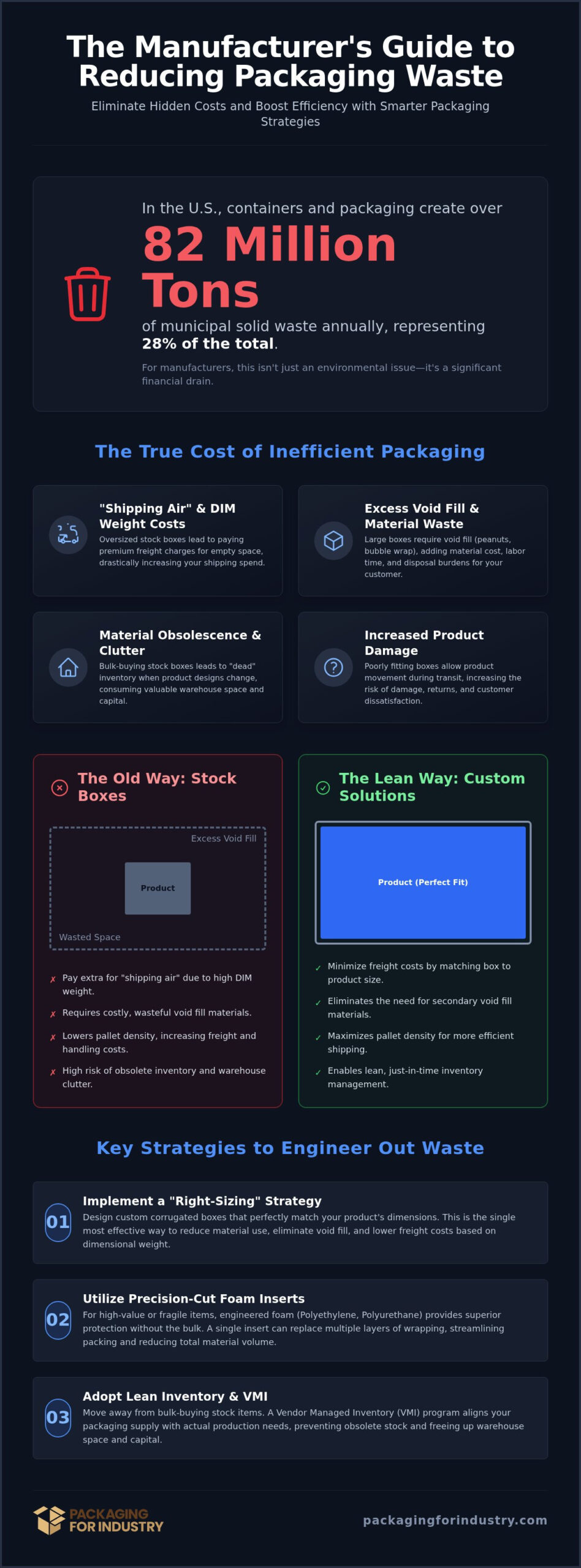
Did you know that containers and packaging account for more than 28% of municipal solid waste in the U.S., totaling over 82 million tons? For a high-volume manufacturer, that isn’t just an environmental concern. It’s a direct reflection of the capital you’re losing to material excess and rising disposal costs. You’ve likely seen your warehouse floor space consumed by bulky, obsolete inventory or dealt with the frustration of shipping damage caused by oversized stock boxes that require too much void fill.
We understand that the priority is operational efficiency. Learning how to reduce packaging waste in manufacturing is one of the most effective ways to lower your total packaging spend and simplify your procurement process. This guide will show you how to eliminate waste through custom engineering and lean inventory management. We’ll explore how right-sizing your corrugated boxes and using high-performance stretch film can protect your products while cutting out the fluff. You’ll learn how to move away from generic catalogs and toward a system that provides better protection with less material, ensuring your facility stays lean and your shipments arrive intact.
Key Takeaways
- Identify the hidden financial drain of “shipping air” and rising disposal fees that inflate your total operational overhead.
- Discover how to reduce packaging waste in manufacturing by implementing a right-sizing strategy for custom corrugated boxes and precision-cut foam inserts.
- Learn to evaluate the protection-to-waste ratio of your materials to ensure you use the most efficient cushioning and stretch film for your specific application.
- Streamline warehouse operations with Vendor Managed Inventory (VMI) to prevent the accumulation of obsolete stock and excess packaging inventory.
- Utilize free prototyping and local next-day delivery in Southern California to optimize your procurement process and lower packaging costs.
Identifying the True Cost of Packaging Waste in Manufacturing
Industrial packaging waste isn’t just the scraps left on the production floor. It’s the accumulation of excess material, damaged goods, and inefficient storage that quietly drains your operational budget. While many focus on the environmental footprint, the most immediate impact for a manufacturer is fiscal. The financial drain includes rising disposal fees, the labor costs associated with handling waste, and the high price of “shipping air” in non-optimized containers.
Stock solutions from large catalogs are designed for convenience, not efficiency. They often lead to the highest waste rates because they force you to use more material than necessary. Understanding Packaging waste in a B2B context means recognizing that every square inch of excess material is a missed opportunity for packaging cost savings. When you rely on generic sizes, you’re essentially paying for material that provides no functional benefit to your product protection.
The Hidden Costs of Oversized Packaging
Shipping carriers use dimensional weight (DIM) pricing to charge for the space a package occupies, rather than just its actual weight. When you use oversized boxes, you’re paying a premium for empty space. This also reduces your pallet density. Fewer units fit on a pallet, which increases your total freight costs and requires more labor hours to manage the extra shipments. It’s a compounding expense that starts with a poorly sized box. Additionally, oversized boxes require more void fill, which adds another layer of cost and disposal responsibility for your customer.
Material Obsolescence and Warehouse Clutter
Bulk ordering stock sizes might seem like a way to save money, but it frequently leads to “dead” inventory. When product designs change, those thousands of pre-purchased boxes become useless. We define packaging obsolescence as a primary driver of manufacturing waste, as it forces you to pay for storage space and eventually disposal fees for items that never shipped. This clutter reduces facility efficiency and ties up capital that could be used elsewhere. Learning how to reduce packaging waste in manufacturing starts by aligning your inventory with actual production needs rather than arbitrary bulk pricing tiers. By shifting toward custom solutions, you can eliminate the need to store “safety stock” of inefficient materials that may never be used.
Engineering Custom Solutions to Eliminate Excess Materials
True waste reduction begins at the design phase. While many companies focus on recycling programs, the most effective way to understand how to reduce packaging waste in manufacturing is to engineer the waste out of the system before it ever reaches the production line. When you request a corrugated box quote for custom-engineered designs, you move away from the “shipping air” inherent in stock sizes. Our Right-Sizing strategy involves designing custom corrugated boxes that mirror the exact dimensions of your product, which improves pallet density and lowers freight costs.
Utilizing precision-cut inserts allows you to completely eliminate the need for traditional void fill like packing peanuts or bubble wrap. These materials often create facility clutter and increase labor time at the packing station. Effective Strategies for Cutting Waste involve using CAD/CAM technology to create a perfect fit. Prototyping plays a critical role here, as it allows you to test protection levels before committing to a production run, preventing the waste associated with non-optimized designs.
Custom Foam Packaging for High-Value Protection
For high-value industries like aerospace, protective foam packaging often serves as the primary defense, reducing the need for secondary outer boxes. We compare materials like polyethylene for durability with polyurethane for delicate cushioning. In aerospace component shipping, using a single, well-engineered foam insert can replace multiple layers of individual wrapping. This creates a minimal-waste design that ensures mission-critical parts arrive without damage while keeping total material volume low.
Heavy-Duty Corrugated for Bulk Shipments
In heavy industrial applications, moving from wooden crates to double-wall or triple-wall corrugated boxes can drastically reduce material weight and disposal complexity. For high-volume manufacturing, Gaylord boxes are an efficient choice for consolidating shipments and reducing individual box waste. We also utilize custom partitions and dividers within these larger containers. These inserts keep parts secure, eliminating the need for individual plastic wrapping for every component. If you are struggling with excess material in your facility, you can request a packaging quote to see how an engineered design can streamline your process.
Optimizing Material Selection for Durability and Reusability
Selecting the right materials is a balancing act between durability and volume. We use a “Protection-to-Waste” ratio to determine the minimum amount of material required to guarantee safe delivery. If you use a material that’s too weak, you risk product damage; if it’s too heavy, you’re paying for excess mass and disposal. This engineering mindset is vital when considering how to reduce packaging waste in manufacturing. It’s about choosing the right gauge and strength to minimize mass without sacrificing the safety of the contents.
Pallet selection is a prime example of this trade-off. Reusable plastic pallets are excellent for closed-loop systems where you control the return logistics, as they can last for hundreds of trips. However, for one-way international shipping, recyclable wooden pallets remain the standard because they can be easily processed at the destination. We help you evaluate your supply chain to decide which pallet type minimizes your long-term waste footprint while keeping your bulk packaging pricing competitive.
Stretch Film Efficiency and Load Stabilization
Stretch film is often the most misused material in a warehouse. Switching from hand wrapping to machine stretch film allows you to use high-performance, thinner gauge films that provide better load containment with less plastic. Machine wrappers can pre-stretch the film by up to 300%, effectively tripling the yield of a single roll compared to manual application. When you request a stretch film quote, we can demonstrate how these high-yield films lower packaging costs while sending less plastic to the landfill.
To further reduce plastic usage, we recommend integrating corner and edge protection. These simple tools provide structural rigidity to the pallet, allowing you to achieve a stable load with fewer revolutions of film. This not only cuts down on waste but also helps reduce shipping damage. Standardizing your tape and closure methods also prevents the common issue of “over-taping,” where packers use far more adhesive than necessary to secure a box.
Sustainable Industrial Alternatives
In heavy industrial and aerospace sectors, sustainability must never compromise protection. For international transit, heavy-duty corrugated often serves as a lower-waste alternative to traditional wood crates because it’s easier for the end-user to recycle. When looking at cushioning, we weigh the benefits of biodegradable options against high-performance recyclable foams to ensure they meet the specific needs of packaging for manufacturers.
Military and aerospace applications often require military packaging that meets strict mil-spec compliance. Our goal is to meet these rigorous standards without “over-packaging.” By using high-performance materials that offer superior strength-to-weight ratios, you can satisfy compliance requirements while significantly reducing the total volume of material entering the waste stream. This focused approach ensures your facility stays lean and your shipments remain secure.
Implementing Lean Inventory and VMI to Reduce Facility Waste
Physical waste in a manufacturing facility often stems from poor inventory control. When you store months of packaging stock, you’re losing valuable floor space and increasing the risk of material damage or moisture exposure. Transitioning to a “Just-In-Time” (JIT) model is a critical step in understanding how to reduce packaging waste in manufacturing. By aligning your supply with actual production demand, you eliminate the clutter of obsolete inventory that often ends up in a landfill when product designs change. A professional packaging audit can identify these hotspots, allowing you to streamline your procurement and clear your warehouse floor.
Implementing a Vendor Managed Inventory (VMI) program allows Packaging For Industry (PFI) to take over the monitoring of your stock levels. We manage the replenishment based on actual usage, which simplifies the purchasing process and reduces administrative waste. This partnership ensures you have the right materials available without the financial drain of over-ordering. By managing your inventory levels proactively, we help you maintain a leaner operation that responds quickly to production shifts while keeping your bulk packaging pricing consistent and predictable.
The VMI Process for Southern California Manufacturers
Our VMI programs are designed for the high-volume needs of the Inland Empire and greater Los Angeles area. We begin with an assessment of your usage history and lead times to establish baseline stocking levels. From there, we set up scheduled replenishment cycles to keep your facility lean. Because we provide reliable local packaging delivery across Anaheim, Irvine, and San Diego, you don’t need to warehouse massive quantities to maintain supply reliability. This proximity allows us to offer next-day service throughout Orange County and Riverside, ensuring your packaging for manufacturers is always ready when production starts.
Packaging Kitting and Assembly
Line-side waste is a common bottleneck that creates unnecessary trash at assembly workstations. By utilizing packaging kitting services, you receive pre-assembled sets of boxes, foam, and labels ready for immediate use. This eliminates the need for individual component packaging that would otherwise be discarded at the station. Pre-assembled kits also reduce labor time and material handling errors, ensuring every product is packed with the correct engineered protection. It’s a pragmatic solution that removes the chaos of loose components and keeps your assembly line moving with minimal waste.
Partnering with PFI for Custom, Waste-Reducing Packaging Designs
At Packaging For Industry (PFI), our approach focuses on the intersection of engineering expertise and economic optimization. We don’t just sell containers; we design systems that lower your total operational spend. Understanding how to reduce packaging waste in manufacturing requires a shift from buying “stock” items to investing in custom-engineered solutions. We provide free prototyping and full CAD/CAM support to ensure every component of your packaging is a “Right-Sized” fit. This precision eliminates the material excess that catalog suppliers often ignore, giving you a leaner and more cost-effective supply chain.
When you request a packaging quote from PFI, you can compare custom pricing against the inflated costs of large catalog suppliers. While those catalogs offer convenience, they often hide the true cost in the form of dimensional weight surcharges and wasted warehouse space. We provide a reliable supply for high-stakes industries, including aerospace, medical, and electronics, where precision isn’t optional. Our goal is to ensure your high-value products arrive safely while using the absolute minimum amount of material required to guarantee protection.
Why Choose a Local Southern California Supplier?
Operating as a local partner gives us a distinct advantage in responsiveness and logistical efficiency. We offer next-day delivery across Orange County, Los Angeles, and the Inland Empire, including cities like Anaheim and Irvine. This proximity reduces transit-related waste and lowers your carbon footprint by eliminating long-haul freight requirements. We also conduct on-site packaging reviews to identify cost-saving opportunities that a remote supplier would miss. By seeing your production floor firsthand, we can pinpoint exactly where material is being wasted and recommend immediate engineering changes to your custom corrugated boxes or foam inserts.
Get Started with a Packaging Cost-Reduction Analysis
Our team identifies hidden surcharges and damage risks that are likely inflating your current budget. We look at your entire process, from the packing station to the final delivery, to ensure you aren’t paying for “shipping air” or using excessive void fill. This analysis provides a clear path to cleaner inventory control and more warehouse space. By eliminating obsolete stock and optimizing your material selection, you’ll gain a more predictable and efficient operation. You don’t have to settle for the waste inherent in generic packaging solutions. When you’re ready to move beyond generic catalogs, Request a Quote for custom industrial packaging to see how we can optimize your facility.
Optimize Your Industrial Packaging for Long-Term Efficiency
Achieving a lean facility requires moving beyond generic, one-size-fits-all solutions. You’ve learned that understanding how to reduce packaging waste in manufacturing involves a combination of custom engineering, precise material selection, and strategic inventory management. By right-sizing your corrugated boxes and utilizing high-performance stretch film, you can eliminate the material excess that drives up operational costs. Transitioning to a Vendor Managed Inventory (VMI) program further ensures your warehouse remains free of obsolete stock and facility clutter.
Packaging For Industry (PFI) provides the specialized expertise needed for high-value sectors like aerospace and medical device packaging. We offer free prototyping to ensure a perfect product fit before you commit to a production run. With fast nationwide shipping and local next-day delivery across Southern California, including Orange County, Los Angeles, and the Inland Empire, you can maintain a lean inventory without sacrificing reliability. We’re ready to help you lower your total packaging spend while providing superior protection for your shipments.
Taking control of your packaging waste is a direct path to improved profitability and operational stability. We look forward to partnering with you to build a more efficient, waste-free supply chain.
Frequently Asked Questions
How does custom packaging design actually reduce waste?
Custom design eliminates “shipping air” and the need for excessive void fill. By engineering a box to the exact dimensions of your product, you use less corrugated material and fewer secondary cushioning supplies like bubble wrap or peanuts. This “right-sizing” approach directly addresses how to reduce packaging waste in manufacturing at the design stage, ensuring that only the necessary amount of material is used for protection.
Is custom-sized packaging more expensive than stock boxes?
While the unit price of a custom box may be slightly higher than a generic stock size, the total cost of ownership is often lower. Custom sizes reduce dimensional weight surcharges from carriers and eliminate the expense of extra void fill. When you factor in reduced shipping damage and improved pallet density, custom-engineered solutions provide a significant cost-saving alternative to large, nationwide catalog suppliers.
What is the most common source of packaging waste in manufacturing?
The most common source of waste is “over-packaging” caused by using oversized stock boxes and excessive layers of wrap. Many facilities use generic containers that require massive amounts of tape and filler to secure the product. Another major source is obsolete inventory, where bulk-purchased boxes become unusable due to product design changes, eventually leading to disposal fees for materials that never shipped.
How can a VMI program help my facility reduce warehouse clutter?
A Vendor Managed Inventory (VMI) program clears warehouse floor space by delivering packaging materials based on your actual usage history rather than bulk forecasts. Instead of storing months of safety stock, you receive only what you need for current production cycles. This prevents the accumulation of obsolete inventory and ensures your facility stays organized, allowing you to use that space for core manufacturing operations instead.
Can I reduce packaging waste without compromising product protection?
Yes, you can improve protection while using less material through precision engineering. By using high-performance materials like double-wall corrugated or custom-cut foam inserts, you create a more secure environment for your product with a smaller physical footprint. Learning how to reduce packaging waste in manufacturing involves optimizing the “protection-to-waste” ratio, ensuring that every piece of material serves a functional purpose in stabilizing the load.
What Southern California cities does Packaging For Industry (PFI) serve for local delivery?
Packaging For Industry (PFI) provides local next-day delivery across Southern California to keep your production lines moving. Our primary service areas include Anaheim, Irvine, Huntington Beach, Santa Ana, and Long Beach. We also serve manufacturers and warehouses throughout Los Angeles County, Orange County, San Diego County, Riverside, and San Bernardino. This local proximity allows us to support JIT inventory models and reduce lead-time waste for regional businesses.
How do I start a packaging waste audit for my company?
You can start by requesting a professional packaging review from Packaging For Industry (PFI). We conduct on-site audits to identify waste hotspots, such as high shipping damage rates, excessive use of stretch film, or warehouse space consumed by obsolete boxes. Our team analyzes your current material usage and shipping surcharges to provide a clear cost-reduction strategy, helping you transition to a more efficient and reliable supply process.
Does Packaging For Industry (PFI) offer free prototypes for custom designs?
Yes, Packaging For Industry (PFI) offers free prototyping and CAD/CAM support for our custom packaging solutions. This allows you to test the fit and protection levels of a custom box or foam insert before committing to a full production run. Prototyping ensures that your final design is “right-sized” for your product, preventing the large-scale material waste that occurs when non-optimized packaging is rolled out across your entire supply chain.