
Designing the thickest possible box won’t guarantee your product survives the transit cycle; in fact, over-engineering often leads to brittle packaging that fails under the specific vibration frequencies of a long-haul truck. If you’re currently facing high damage rates or expensive retailer chargebacks, you already know that standard off-the-shelf containers aren’t sufficient for sensitive industrial equipment or aerospace components. You need a pragmatic solution that balances material density with structural integrity. This guide explains how to engineer custom packaging to pass ISTA testing Los Angeles manufacturers and distributors use to ensure their goods arrive intact every time.
We’ll walk through the technical process of combining heavy-duty corrugated boxes with precision-cut foam inserts to meet rigorous ISTA 3A or 6-Amazon standards. You’ll learn how a local Southern California partner can accelerate your development cycle with free prototyping and local next-day delivery. We’ll also cover how to request a custom packaging quote that prioritizes both protection and fiscal efficiency. By the end of this guide, you’ll have a clear roadmap to reduce shipping damage and secure the certifications your customers demand.
Key Takeaways
- Understand how ISTA performance standards protect high-value industrial goods by simulating real-world transit stresses such as shock, vibration, and compression.
- Learn how to engineer custom packaging to pass ISTA testing Los Angeles manufacturers use to eliminate shipping damage and avoid expensive retailer chargebacks.
- Discover how to select the correct combination of heavy-duty corrugated boxes and specialized protective foam based on your product’s specific fragility and weight class.
- Utilize CAD design and free prototyping to verify your packaging performance and fit before committing to a full production run.
- Leverage local next-day delivery and technical support in Southern California to streamline your supply chain and reduce lead times for compliant packaging.
What is ISTA Testing and Why Does Your Los Angeles Business Need It?
The International Safe Transit Association (ISTA) provides the definitive framework for validating how well a container protects its contents. For Los Angeles manufacturers, ISTA certification isn’t just a badge; it’s a rigorous engineering requirement. Standard shipping involves a high degree of risk, whereas engineered protection uses scientific data to predict how materials will react to real-world stress. Package testing protocols from ISTA simulate the exact conditions your shipment will face, from the vibration of a cargo ship in San Pedro to the rough handling of a local fulfillment center.
Major retailers like Amazon, Walmart, and Target now mandate specific certifications, such as ISTA 6-series or 3A, to minimize their own operational overhead. If your packaging fails to meet these standards, you face more than just product loss. You’ll likely deal with retailer chargebacks, rejected shipments, and the high cost of expedited replacements. Engineering custom packaging to pass ISTA testing Los Angeles standards ensures your high-value goods survive the transit cycle without draining your bottom line.
Common ISTA Test Procedures for Industrial Goods
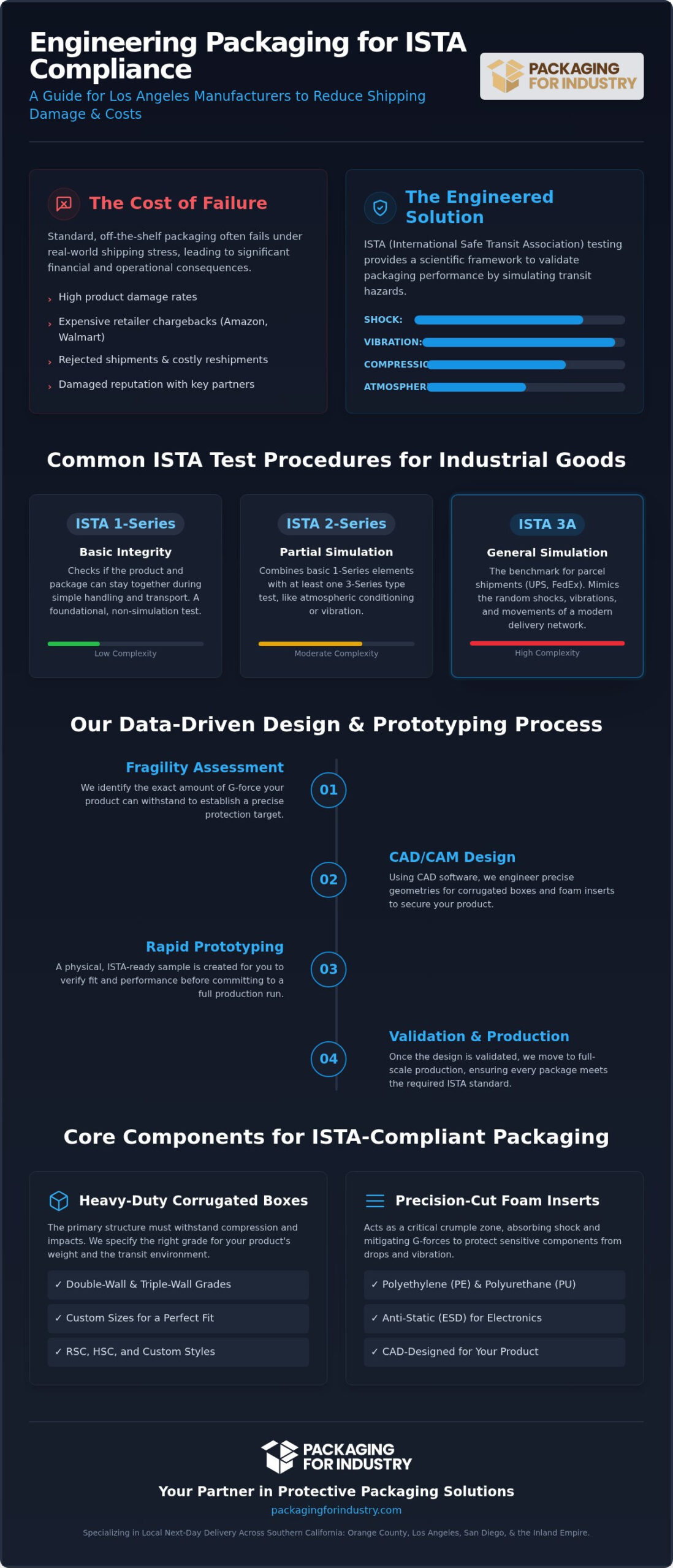
Most industrial shipments require one of three primary test categories. ISTA 1-Series (1A and 1B) focuses on basic integrity, checking if the product and package can stay together during simple handling. ISTA 2-Series (2A and 2B) adds atmospheric conditioning and vibration to simulate more complex transit environments. For most parcel shipments through UPS or FedEx, ISTA 3A is the benchmark. It uses general simulation to mimic the chaotic movement of a modern delivery network. Using the right corrugated boxes and specialized foam packaging is critical to passing these specific sequences.
The Cost of Non-Compliance in Southern California Logistics
Shipping damage creates a ripple effect across your entire operation. In the high-volume corridors of Long Beach and the Inland Empire, a single failed shipment can stall a distribution line and damage your reputation with key partners. Beyond the immediate loss of inventory, non-compliant packaging forces you to absorb hidden costs like administrative labor for claims, additional warehouse space for returns, and increased freight charges for reshipment. Many industrial firms also find that certified packaging helps lower insurance premiums for high-value components, as it demonstrates a proactive approach to risk management. To secure your supply chain, you can request a packaging quote for an ISTA-ready design today.
Engineering Custom Packaging to Survive Shock and Vibration
Transit physics are unforgiving. While retail-focused suppliers prioritize visual branding, industrial manufacturers must focus on how a package handles drops, impacts, and warehouse handling stresses. PFI utilizes CAD/CAM support to engineer precise geometries that secure your product within its container. This engineering process begins with a “Fragility Assessment,” which identifies the exact amount of G-force your equipment can withstand before sustaining internal damage. By designing for the “Worst Case Scenario” common in the national LTL (Less Than Truckload) environment, we ensure your goods remain secure even when pallets are shifted multiple times during long-haul transit.
Designing custom packaging to pass ISTA testing Los Angeles requires a deep understanding of how materials interact under pressure. We don’t guess at protection levels; we use data-driven design to create integrated systems. If you’re struggling with high replacement costs, you can request a packaging quote to see how an engineered approach can stabilize your shipping outcomes.
Shock Absorption and G-Force Mitigation
Standard protocols from the International Safe Transit Association (ISTA) often require parcel shipments to survive a 30-inch drop. For sensitive electronics or medical devices, custom foam inserts act as a vital crumple zone, decelerating the product over a controlled distance to prevent impact damage. A cushion curve is a technical graph that illustrates how much shock a specific foam material can absorb based on its thickness and the weight of the product it supports. Selecting the right foam density ensures that the material doesn’t “bottom out” during a drop, which would transfer the full force of the impact directly to your product.
Vibration Dampening for Long-Haul Freight
Vibration is a silent killer in the logistics chain. Continuous movement during long-haul freight can create resonance frequencies that shake internal components loose or cause surface abrasion. Multi-material solutions, such as combining heavy-duty corrugated boxes with polyethylene or polyurethane foam, outperform single-material designs by dampening these frequencies across a broader range. We also design for stackability and compression strength to prevent bottom-box collapse in a crowded warehouse. This holistic design approach ensures that your corrugated boxes and protective foam work in tandem to maintain structural integrity from the loading dock to the final destination.
Material Selection: Choosing the Right Components for ISTA Compliance
Selecting the correct materials is a technical decision that directly impacts your ability to pass certification. You can’t rely on generic cardboard for high-value industrial goods. Engineering custom packaging to pass ISTA testing Los Angeles requires a strategic combination of wall thickness, foam density, and structural reinforcements. With custom sizes available for every component we manufacture, we evaluate your product’s weight and fragility against specific ISTA Test Procedures to determine if you need the standard protection of a single-wall box or the extreme durability of triple-wall corrugated. When weights exceed the limits of paper-based materials, we integrate custom wood crates to ensure structural stability during heavy-lift operations.
Heavy-Duty Corrugated and Weather Resistance
Standard boxes often lose structural integrity in high-humidity environments, such as during international export or storage in damp warehouse conditions. To prevent bottom-box collapse, we utilize high-ECT (Edge Crush Test) ratings for palletized loads. Moving from a 32 ECT single-wall to a 44 or 51 ECT double-wall provides the vertical compression strength needed to survive the stacking requirements of ISTA 3E. For the most demanding environments, weather-resistant corrugated boxes maintain their rigidity even when exposed to moisture. This ensures your unitized load remains stable throughout the Southern California logistics corridor.
Protective Foam Inserts and ESD Considerations
The choice between Polyethylene (PE) and Polyurethane (PU) foam depends on your product’s weight class and fragility. PE is a high-density, closed-cell foam ideal for heavier industrial components that require repeatable shock absorption. PU is softer and open-cell, making it the better choice for lighter, highly sensitive items. For aerospace and semiconductor manufacturers, we provide anti-static and ESD foam packaging to protect internal circuitry from static discharge during handling. Custom die-cut foam inserts provide more consistent test results than foam-in-place methods because they offer repeatable, engineered tolerances that won’t vary between shipments.
Reinforcing Weak Points with Edge Protection
Even the strongest box has vulnerable points at the corners and edges. We use heavy-duty corner and edge protectors to distribute the pressure of stretch film and prevent the box from crushing under the weight of stacked pallets. These reinforcements act as internal pillars, significantly increasing the overall compression strength of the package. By identifying these “weak points” during the design phase, we help you lower packaging costs by reinforcing only where necessary rather than over-engineering the entire container. This pragmatic approach ensures your shipment passes ISTA protocols without unnecessary material waste.
The PFI Prototyping Process: From Design to ISTA-Ready Sample
Engineering custom packaging to pass ISTA testing Los Angeles manufacturers rely on is a multi-stage process that prioritizes technical accuracy over guesswork. We start with an initial packaging review to identify where your current designs are failing in the field. This cost-reduction analysis often reveals opportunities to swap expensive, bulky materials for more efficient, engineered alternatives. From there, our team uses CAD software to build a digital model based on your product’s exact dimensions and fragility rating. This ensures every foam insert and corrugated flap provides maximum structural support.
Once the digital design is finalized, we move to physical production. This iterative approach allows us to perform internal drop tests and vibration checks before you commit to formal lab submission. We don’t just hand off a design and walk away. We facilitate a full rollout, often utilizing Vendor Managed Inventory (VMI) to ensure your compliant packaging is always in stock and ready for the production line. This end-to-end oversight eliminates the stress of non-compliant shipments and stockouts.
The Value of Free Prototyping for LA Manufacturers
Effective testing starts on the design table, not in the certification lab. We provide free prototyping so you can verify the fit and protection of your container in person. A snug fit is essential; internal movement is a leading cause of ISTA failure during shock tests. Our Anaheim facility is equipped to support rapid prototyping for businesses across Los Angeles County, allowing you to move from a concept to a physical sample without the typical long lead times associated with custom manufacturing.
Refining Designs for Cost and Protection
Engineering for protection doesn’t have to mean shipping excess air. We optimize box dimensions to help you avoid expensive dimensional weight (DIM) surcharges from carriers like UPS and FedEx. By using custom design packaging, we reduce material waste while maintaining a high safety factor. This pragmatic approach ensures you aren’t paying for excess corrugated or foam that doesn’t add to the package’s survivability. It’s about finding the intersection of material science and economic efficiency.
Why Partner with a Los Angeles Packaging Supplier for ISTA Compliance?
National providers often focus on broad shipping averages, but Southern California has unique logistical demands that require localized expertise. As a dedicated Los Angeles packaging supplier, we understand the specific stresses of the Inland Empire to Port corridor, from the high-vibration environments of long-haul trucking to the heavy-lift requirements at the Port of Long Beach. Our proximity allows for face-to-face consultations where we can review your current damage rates and engineer custom boxes in Los Angeles that are built for the reality of the local supply chain. This proximity ensures that your custom packaging to pass ISTA testing Los Angeles is designed with total accountability.
A local partnership also means faster lead times for custom prototypes and recurring orders. We provide local next-day delivery across Orange County, Los Angeles, and San Diego to ensure your operations never stall. Having a “fixer” nearby means your operational challenges are addressed with pragmatic, engineering-minded solutions that prioritize both protection and fiscal responsibility. You get the benefit of technical depth without the communication gaps found with distant vendors.
Supporting the Southern California Industrial Hub
We provide specialized support for the region’s dense industrial clusters, where high-value components are the norm. Our team frequently works with aerospace and defense contractors in Carson, Torrance, and Santa Fe Springs. These sectors require more than just a standard box; they need mil-spec compliance and precision foam engineering that survives the rigors of global transit. Our local packaging delivery service ensures that manufacturing lines in Anaheim and Irvine maintain a steady flow of compliant materials without the risk of long-distance shipping delays. This responsiveness is critical for maintaining supply reliability in a fast-moving market.
Streamlining Your Supply Chain with VMI and JIT
Maintaining a lean warehouse is a priority for any Los Angeles business facing high square-footage costs. By utilizing vendor managed inventory (VMI), you can eliminate the risk of running out of compliant packaging. We stock your ISTA-ready materials locally and deliver them on a just-in-time basis. This strategy reduces your on-site warehouse footprint and frees up capital that would otherwise be tied up in bulk inventory. You get the benefit of bulk packaging pricing without the burden of storing months of supply on your own floor. It’s a system designed for maximum logistical flow and total accountability.
Secure Your Supply Chain with Engineered Protection
Achieving ISTA compliance is a technical necessity for any manufacturer shipping high-value goods from Southern California. By integrating heavy-duty corrugated boxes with precision-engineered foam inserts, you eliminate the guesswork that leads to shipping damage and retailer chargebacks. Our specialized expertise in aerospace and industrial equipment ensures that your most sensitive components are protected by designs validated through CAD software and physical prototyping.
Relying on a local partner allows you to move from the design phase to a certified sample with speed and precision. We provide free prototyping and CAD design to verify fit before production begins. Once your design is finalized, our local Southern California next-day delivery ensures your supply chain remains reliable and cost-effective. Engineering custom packaging to pass ISTA testing Los Angeles requires this level of localized oversight and technical accountability.
We’re ready to help you lower packaging costs and stabilize your logistics through better engineering. Let’s build a solution that protects your bottom line.
Frequently Asked Questions
What is the difference between ISTA 2A and ISTA 3A testing?
ISTA 2A is a partial simulation test for individual products, while ISTA 3A is a general simulation specifically for parcel delivery systems like UPS or FedEx. If you’re searching for a packaging supplier near me to handle small-parcel logistics, understanding these protocols is vital. We engineer internal cushioning to withstand the higher drop heights and random vibration frequencies defined in the 3A standard, ensuring your custom packaging to pass ISTA testing Los Angeles remains compliant throughout the transit cycle.
Does PFI provide the actual ISTA certification or just the packaging?
We specialize in the design and production of the protective materials rather than the testing laboratory services. However, we work closely with local labs to ensure your design is optimized before submission. When you request a corrugated box quote from PFI, we provide the technical specifications and CAD designs necessary for a lab to validate the performance of your unitized load according to ISTA standards. This collaborative approach ensures your packaging is engineered for success.
How much does custom packaging for ISTA testing cost in Los Angeles?
Pricing for ISTA-compliant designs varies based on material density and project scale. To lower packaging costs, we focus on right-sizing your containers and selecting the appropriate wall thickness for your specific load. Whether you need a corrugated box quote for triple-wall containers or a stretch film quote for high-performance pallet stabilization, we provide transparent bulk packaging pricing. Our goal’s to eliminate the financial burden of damaged goods through precise, data-driven engineering.
What industries in Southern California most commonly require ISTA testing?
Aerospace, medical device manufacturing, and industrial electronics are the primary sectors in Southern California requiring certified protection. If you need a packaging supplier near me that understands the strict compliance mandates of defense contractors in Carson or Torrance, PFI offers the necessary technical expertise. We provide the heavy-duty materials and specialized foam assemblies required to secure high-value components during global transit and long-term storage in custom boxes in Los Angeles.
Can PFI help reduce shipping damage for heavy machinery?
We engineer heavy-duty crates and skids specifically for industrial equipment that exceeds the capacity of standard shipping containers. By combining wood structures with high-density foam, we reduce shipping damage for oversized loads. If you require a corrugated box quote for heavy-duty double-wall boxes or custom wood packaging, we can design a hybrid solution that maintains structural integrity under the extreme compression forces found in the national LTL environment.
How long does it take to get a custom packaging prototype?
Our Anaheim facility supports rapid prototyping, typically delivering physical samples within a few business days. As a local packaging supplier near me, we understand that production schedules move quickly. We provide free prototyping to ensure your product fits perfectly within its custom foam inserts before you commit to a bulk order. This local presence allows for immediate refinements based on your internal fit-testing and quality control requirements, ensuring a faster path to market.
Do you offer ESD-safe packaging that can pass transit testing?
We provide a full range of anti-static and static shielding materials designed to pass rigorous transit testing. This includes ESD foam inserts and moisture barrier bags for the electronics and semiconductor industries. When you request a corrugated box quote or a stretch film quote for sensitive shipments, we ensure all components work together to prevent static discharge and mechanical damage. This holistic approach secures your components from the loading dock to the final destination.